Every day, millions of people ask ChatGPT questions about science, history, mathematics, programming, writing, travel, and countless other topics. Some use it to learn a new language. Others ask it to explain difficult concepts, write stories, summarize documents, or brainstorm ideas. It often feels surprisingly natural, almost like having a conversation with another person.
But what actually happens behind the scenes?
How can a computer understand a question written in ordinary language and respond with coherent, informative, and often helpful answers within seconds?
The answer lies in one of the most significant advances in modern artificial intelligence: Large Language Models, commonly known as LLMs.
Large Language Models are the core technology that enables systems like ChatGPT to understand and generate human language. They represent decades of research in computer science, mathematics, linguistics, and artificial intelligence. While they can appear almost magical, they operate according to well-understood scientific and engineering principles rather than human-like consciousness or independent thought.
Understanding how LLMs work not only helps explain ChatGPT but also provides insight into one of the fastest-growing technologies shaping the modern world.
What Is a Large Language Model?
A Large Language Model is an artificial intelligence system designed to process, understand, and generate human language.
The word “language” refers to written and spoken communication.
The word “model” refers to a mathematical system that has learned patterns from enormous amounts of text.
The word “large” has two meanings.
First, these models are trained using vast collections of text that may contain hundreds of billions or even trillions of words from many different sources.
Second, they contain an enormous number of adjustable mathematical values, called parameters, that help the model recognize patterns in language. Modern LLMs may contain billions or even hundreds of billions of these parameters, depending on the system.
Rather than storing fixed answers to every possible question, an LLM learns the statistical relationships between words, phrases, sentences, and ideas.
This allows it to generate new responses instead of simply retrieving memorized text.
Why Human Language Is So Difficult
Language seems effortless for people.
Children learn to speak naturally within just a few years.
Adults can understand jokes, metaphors, questions, emotions, and subtle meanings almost instantly.
For computers, however, language is extraordinarily complicated.
The same word can have multiple meanings.
Different sentences may express the same idea.
People often use incomplete sentences, slang, humor, or figurative expressions.
Even a simple sentence can depend heavily on context.
For example, the word “bank” could refer to a financial institution or the side of a river.
Humans usually understand the intended meaning without conscious effort because they combine language with experience and world knowledge.
Teaching computers to handle these complexities has challenged researchers for decades.
Large Language Models represent one of the most successful solutions developed so far.
Everything Begins with Text
Unlike humans, computers do not naturally understand words.
Inside a computer, everything is represented using numbers.
Before an LLM can process language, text must first be converted into numerical form.
This begins by dividing text into smaller units called tokens.
A token may represent a whole word, part of a word, punctuation, or even a short sequence of characters.
For example, a sentence is broken into tokens that the model can process mathematically.
Each token is then converted into numerical representations that capture relationships with other tokens.
This transformation allows the model to analyze language using mathematics rather than traditional grammar rules alone.
Learning from Enormous Collections of Text
Large Language Models learn by analyzing massive collections of written material.
During training, the model processes countless examples of language from books, articles, websites, educational materials, computer code, and many other publicly available or licensed sources, depending on how a particular model is developed.
The goal is not to memorize every document.
Instead, the model gradually discovers statistical patterns.
It learns which words commonly appear together.
It identifies grammatical structures.
It recognizes writing styles.
It observes relationships among concepts.
Over time, these repeated observations allow the model to develop an increasingly sophisticated representation of language.
The training process requires enormous computational resources and may involve thousands of specialized computer processors working together for weeks or months.
The Remarkably Simple Training Goal
One of the most surprising aspects of Large Language Models is that their core training objective is relatively simple.
During much of the training process, the model repeatedly tries to predict the next token in a sequence.
Imagine reading the sentence:
“The Earth revolves around the…”
Most people immediately expect the next word to be “Sun.”
An LLM learns by making millions upon millions of predictions like this.
At first, its guesses are mostly wrong.
The training system measures the errors and slightly adjusts the model’s parameters.
Then it tries again.
This process repeats billions of times.
Gradually, the model becomes increasingly accurate at predicting what comes next.
Although predicting the next token sounds simple, doing this across enormous amounts of diverse text allows the model to acquire surprisingly broad knowledge about language, facts, reasoning patterns, and writing styles.
What Are Parameters?
Parameters are one of the most important concepts in modern AI.
They are adjustable numerical values inside the model.
You can think of them as tiny pieces of mathematical knowledge distributed throughout the neural network.
No single parameter stores a complete fact.
Instead, information is spread across many billions of parameters.
Together, they capture patterns learned during training.
When people say an LLM has billions of parameters, they are describing the model’s complexity and capacity to represent relationships within language.
However, having more parameters alone does not automatically produce a better model.
Training methods, data quality, architecture, and evaluation all play essential roles.
Artificial Neural Networks
Large Language Models are built using artificial neural networks.
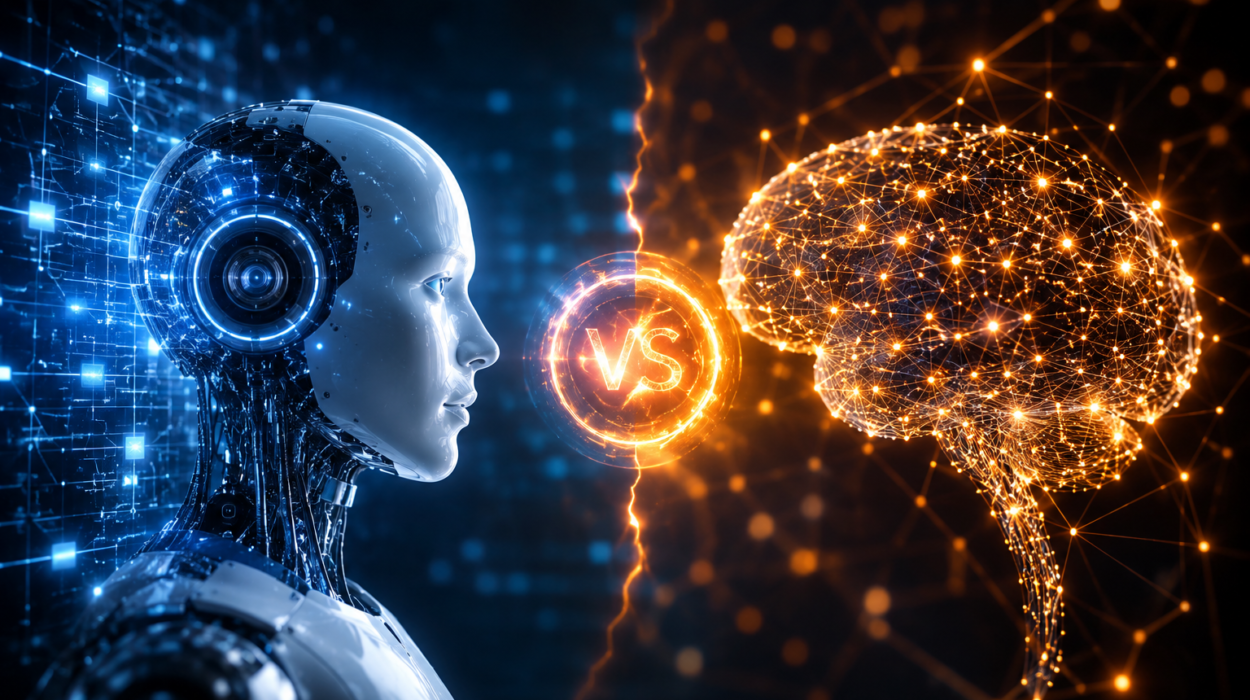
These mathematical systems were inspired loosely by biological neurons but operate very differently from the human brain.
Artificial neural networks consist of interconnected computational units arranged in multiple layers.
As information passes through these layers, mathematical operations transform it step by step.
During training, the network continuously adjusts its parameters to improve predictions.
This gradual optimization enables increasingly accurate language processing.
Although inspired by neuroscience, today’s neural networks remain far simpler than the extraordinary complexity of the human brain.
The Transformer Revolution
The breakthrough that made modern Large Language Models possible came from a neural network architecture called the Transformer.
Introduced by researchers in 2017, the Transformer dramatically improved how AI systems process language.
Earlier language models often struggled with long sentences because they processed words mainly one after another.
Transformers introduced a powerful mechanism called attention.
Attention allows the model to examine relationships among many different words simultaneously.
Instead of focusing only on nearby words, the model can identify important connections across an entire sentence or even much longer passages.
This greatly improved language understanding, translation, summarization, and text generation.
Nearly all modern LLMs, including ChatGPT, are built upon Transformer-based architectures.
What Is Attention?
Attention is one of the most important innovations in modern artificial intelligence.
When humans read, they naturally focus on words that matter most for understanding a sentence.
Similarly, attention mechanisms allow an LLM to determine which tokens are most relevant while processing language.
Suppose a paragraph mentions several people before using the word “she.”
Attention helps the model identify which earlier person “she” most likely refers to.
This ability enables more coherent writing, better reasoning across long passages, and improved conversational responses.
Attention does not give the model consciousness.
It is simply a mathematical method for assigning importance to different parts of the input.
From Training to Conversation
Training creates the underlying language model.
However, ChatGPT involves additional stages beyond basic language training.
After the initial training process, researchers refine the model using carefully designed examples of conversations.
Human trainers and evaluators help improve the model’s ability to follow instructions, answer questions clearly, avoid harmful outputs, and communicate more naturally.
The model also undergoes extensive testing to identify weaknesses, reduce errors, improve safety, and enhance overall usefulness.
This refinement transforms a general language model into a conversational AI assistant.
Generating Every Response
When you ask ChatGPT a question, it does not search its training data for an identical answer.
Instead, it generates a response one token at a time.
The model first analyzes your prompt.
It predicts the most appropriate next token.
Then it predicts another.
This process continues rapidly until a complete response is produced.
Each prediction depends on everything generated so far.
This sequential generation allows the model to create responses that have never existed before.
Although this process happens in fractions of a second, it involves billions of mathematical calculations.
Does ChatGPT Understand Meaning?
This question remains an active topic of scientific and philosophical discussion.
Current Large Language Models identify sophisticated statistical patterns within language.
They can often produce responses that appear highly intelligent.
However, researchers continue debating the extent to which these systems genuinely understand meaning in the same sense that humans do.
Unlike people, LLMs do not possess lived experience.
They do not perceive the physical world directly.
They do not experience emotions.
They do not form beliefs or intentions.
Their remarkable abilities emerge from mathematical pattern recognition rather than conscious understanding.
Why ChatGPT Sometimes Makes Mistakes
Despite their impressive capabilities, Large Language Models are not perfect.
They sometimes produce incorrect information.
They may misunderstand ambiguous questions.
They can generate convincing but inaccurate statements, a phenomenon commonly called a hallucination in AI research.
These errors occur because the model predicts likely language patterns rather than verifying every statement against reality.
Researchers continue improving factual accuracy through better training methods, stronger evaluation, retrieval systems, and user feedback.
Users should therefore treat AI-generated information thoughtfully, especially in fields such as medicine, law, finance, or scientific research where accuracy is especially important.
Why Context Matters
One reason ChatGPT feels conversational is that it processes context.
Instead of responding only to a single sentence, it considers the surrounding conversation.
If you ask a follow-up question using words like “it,” “they,” or “that,” the model often understands what you are referring to because it analyzes previous messages within the conversation.
However, every model has limits on how much information it can consider at one time.
This limit is called the context window.
Larger context windows allow models to process longer conversations and documents more effectively.
Reasoning and Problem Solving
Large Language Models can perform many reasoning tasks surprisingly well.
They solve mathematical problems.
They explain scientific concepts.
They write computer programs.
They summarize research papers.
They compare historical events.
They analyze arguments.
These abilities arise because reasoning patterns appear throughout the enormous collections of text used during training.
However, LLM reasoning is not identical to human reasoning.
Some complex logical problems remain difficult.
Researchers continue developing methods to improve reliability, planning, and multi-step reasoning.
Memory Is Different from Human Memory
People often imagine ChatGPT remembering everything it has ever seen.
In reality, its memory differs greatly from human memory.
Knowledge learned during training becomes distributed across billions of parameters rather than stored as separate memories.
During a conversation, the model uses the current context rather than recalling personal experiences.
Some AI systems can also incorporate separate memory features designed to remember user preferences across conversations, but these operate differently from the underlying language model itself.
Why LLMs Require Powerful Computers
Running a Large Language Model requires tremendous computational power.
Every response involves billions of mathematical operations.
Training is even more demanding.
Researchers use specialized processors called Graphics Processing Units (GPUs) and other AI accelerators because they can perform many calculations simultaneously.
Large data centers containing thousands of processors work together to train and operate modern LLMs.
Advances in computer hardware have played a major role in making today’s AI systems possible.
How LLMs Help Society
Large Language Models have rapidly found applications across many fields.
Students use them to understand difficult subjects.
Researchers summarize scientific literature.
Programmers write and debug software.
Businesses improve customer support.
Writers brainstorm ideas.
Doctors explore medical literature while relying on clinical expertise for patient care.
Scientists analyze research data.
Language translation becomes faster.
Accessibility tools assist people with disabilities.
These applications demonstrate how language models can enhance human productivity rather than simply automate tasks.
The Challenges of Large Language Models
Powerful technologies also bring important challenges.
LLMs can generate misinformation if used carelessly.
Biases present in training data may influence outputs.
Privacy, copyright, transparency, and fairness remain active areas of research and public discussion.
Researchers also seek methods for reducing hallucinations, improving factual accuracy, lowering computational costs, and making AI systems more energy efficient.
Responsible development requires collaboration among computer scientists, linguists, ethicists, educators, policymakers, and society as a whole.
Are Large Language Models Conscious?
One of the most common misconceptions about ChatGPT is that it is conscious.
Current scientific evidence does not support this idea.
Large Language Models do not possess awareness.
They do not experience happiness, sadness, fear, or curiosity.
They do not have personal desires or intentions.
Although they generate language that resembles human conversation, this ability emerges from statistical learning rather than conscious thought.
Researchers continue studying intelligence and cognition, but today’s LLMs remain sophisticated computational systems rather than sentient beings.
The Future of Large Language Models
Large Language Models continue evolving at an extraordinary pace.
Researchers are developing systems that reason more effectively, produce more reliable answers, understand multiple forms of information such as text, images, audio, and video, and collaborate more naturally with people.
Future models may become more efficient, requiring less computational power while delivering greater accuracy.
They may contribute to scientific discoveries, personalized education, medical research, environmental monitoring, engineering, and many other fields.
At the same time, careful governance, transparency, and ethical oversight will remain essential to ensure these powerful technologies benefit society responsibly.
Why Large Language Models Matter
Large Language Models represent one of the most important advances in artificial intelligence because they have fundamentally changed how computers interact with human language. Instead of relying on rigid rules or simple keyword matching, they learn complex statistical patterns from vast amounts of text, allowing them to generate coherent, context-aware responses across an extraordinary range of topics.
ChatGPT is a practical example of this technology in action. Behind every answer lies an intricate combination of mathematics, neural networks, Transformer architecture, attention mechanisms, large-scale training, and continuous refinement by researchers and human feedback. Yet despite their impressive capabilities, these models are tools rather than thinking minds. They do not possess consciousness or human understanding, but they can assist people by making information, communication, and creative work more accessible.
As research continues, Large Language Models are likely to become even more capable, reliable, and useful. Their greatest potential lies not in replacing human intelligence, but in expanding what people can accomplish. By combining human curiosity, judgment, and creativity with the remarkable pattern-recognition abilities of LLMs, society is entering a new era in which communication between humans and machines is becoming more natural than ever before.