Artificial intelligence is transforming the modern world at an astonishing pace. From voice assistants that understand natural language to self-driving cars that navigate busy streets, AI has become part of everyday life. Behind these remarkable capabilities lies an enormous amount of computation. Every image recognized, every sentence translated, and every recommendation generated requires billions—or even trillions—of mathematical calculations.
For decades, general-purpose processors such as CPUs handled most computing tasks. As AI models became larger and more complex, however, these processors alone were no longer fast or energy-efficient enough. Engineers needed a new kind of hardware specifically designed to handle the unique demands of artificial intelligence.
That need gave rise to one of the most important technologies of the modern computing era: the AI accelerator.
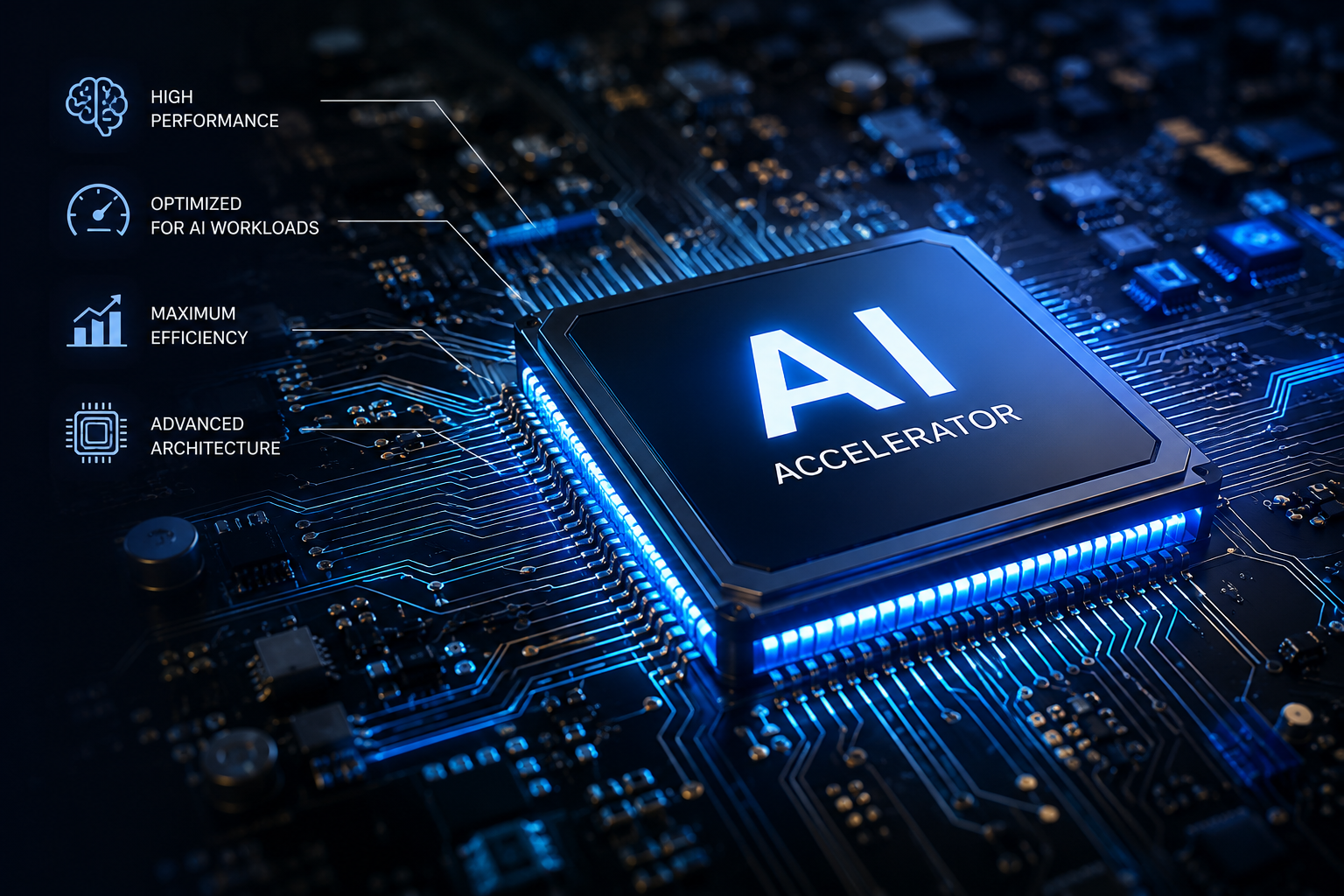
An AI accelerator is a specialized computer chip or hardware device built to perform artificial intelligence and machine learning calculations much faster and more efficiently than traditional processors. These powerful chips now power everything from smartphones and laptops to data centers, robots, autonomous vehicles, and advanced scientific research.
Understanding AI accelerators is key to understanding why modern AI has advanced so rapidly—and why the future of computing is increasingly centered around specialized hardware.
What Is an AI Accelerator?
An AI accelerator is a processor designed specifically to speed up artificial intelligence workloads, particularly machine learning and deep learning algorithms.
Unlike a traditional CPU, which is built to perform a wide variety of computing tasks, an AI accelerator focuses on executing the mathematical operations that AI models perform repeatedly. These operations often involve enormous numbers of matrix multiplications, vector calculations, and tensor operations.
Because AI accelerators are optimized for these specific tasks, they can process AI models much faster while using significantly less electrical power.
In simple terms, if a CPU is like a skilled worker capable of handling many different jobs, an AI accelerator is like a highly specialized expert that performs one particular task with extraordinary speed and efficiency.
Why Artificial Intelligence Needs Specialized Hardware
Modern AI systems process enormous amounts of information.
Imagine an AI model that recognizes faces in photographs. Every image contains millions of pixels. The AI examines patterns, compares features, performs mathematical calculations, and gradually determines whether it recognizes a particular person.
Large language models operate on an even greater scale. They process billions or even trillions of numerical parameters while generating human-like responses.
These calculations are repeated countless times.
Although a CPU can perform these operations, it was never designed specifically for this type of workload. As AI models grew larger, relying solely on CPUs became increasingly slow, expensive, and energy-intensive.
AI accelerators solve this challenge by performing many calculations simultaneously rather than one after another.
This massive parallel processing capability dramatically increases speed while reducing energy consumption.
How an AI Accelerator Works
At its core, artificial intelligence relies on mathematics.
Deep learning models represent information as enormous collections of numbers organized into vectors, matrices, and tensors.
Training or running an AI model requires continuous multiplication and addition of these numbers.
An AI accelerator contains specialized computing units optimized for exactly these operations.
Instead of executing general instructions one at a time, the chip processes thousands—or even millions—of mathematical operations simultaneously.
Many AI accelerators also include large amounts of high-speed memory and dedicated data pathways that allow information to move efficiently between different parts of the chip.
This architecture minimizes delays and keeps the computing units busy, maximizing performance.
The Difference Between CPUs and AI Accelerators
A CPU is designed for versatility.
It runs operating systems, opens applications, manages files, handles internet browsing, and performs countless everyday computing tasks.
Its strength lies in flexibility rather than specialization.
An AI accelerator is different.
Rather than trying to perform every kind of computation, it focuses almost entirely on accelerating machine learning operations.
This specialization allows it to perform certain AI tasks many times faster than a CPU while consuming much less energy for the same workload.
For ordinary computing tasks, the CPU remains essential.
For artificial intelligence, however, AI accelerators often provide dramatically better performance.
GPUs and the Rise of AI
Before dedicated AI accelerators became common, graphics processing units, or GPUs, became the primary hardware for training deep learning models.
GPUs were originally designed to render computer graphics by performing many calculations simultaneously.
Researchers soon realized that the same parallel computing capabilities made GPUs exceptionally effective for artificial intelligence.
Today, GPUs remain among the most widely used AI accelerators, especially for training large neural networks.
Many of the world’s most advanced AI models have been developed using massive clusters of GPUs working together.
Neural Processing Units
One of the fastest-growing types of AI accelerator is the Neural Processing Unit, often called an NPU.
An NPU is specifically designed to accelerate neural network computations.
Unlike general-purpose GPUs, NPUs focus almost entirely on AI inference—the process of running trained AI models.
Many modern smartphones, laptops, and tablets now include NPUs.
These chips enable features such as real-time language translation, photo enhancement, voice recognition, background removal during video calls, and image generation while consuming very little battery power.
Because AI processing happens directly on the device, NPUs also improve privacy by reducing the need to send personal data to cloud servers.
Tensor Processing Units
Another important type of AI accelerator is the Tensor Processing Unit, or TPU.
TPUs were designed specifically for machine learning workloads involving tensor calculations.
They are optimized for running large-scale AI models efficiently in data centers.
Tensor operations form the mathematical foundation of many deep learning algorithms, making TPUs exceptionally well suited for artificial intelligence.
Large cloud computing platforms use TPUs to train advanced AI systems and provide AI services to millions of users worldwide.
AI Accelerators in Smartphones
Many people already carry an AI accelerator in their pocket without realizing it.
Modern smartphones contain dedicated AI hardware that performs numerous intelligent tasks.
When your phone automatically improves a photograph, separates the subject from the background, recognizes speech, translates conversations instantly, or predicts the next word you want to type, an AI accelerator is often doing much of the work.
These operations happen almost instantly because the calculations occur directly inside the device rather than being sent to remote servers.
As smartphone AI becomes more advanced, these chips continue growing in importance.
AI Accelerators in Personal Computers
Artificial intelligence is becoming a standard feature of modern personal computers.
Many new laptops now include dedicated NPUs alongside traditional CPUs and GPUs.
These AI accelerators support intelligent productivity features, image editing, video enhancement, transcription, coding assistance, and local AI chatbots.
Running AI models locally offers several advantages.
Responses can be faster because data does not need to travel over the internet. Sensitive information can remain on the device, improving privacy. Local processing can also continue even when there is no internet connection.
This shift is helping transform personal computers into powerful AI-enabled machines.
AI Accelerators in Data Centers
The largest AI models require computing power far beyond what personal devices can provide.
Cloud data centers contain thousands of AI accelerators working together to train and run enormous neural networks.
These specialized processors perform trillions of mathematical operations every second.
Training a state-of-the-art AI model may require weeks or months of continuous computation across massive clusters of AI hardware.
Without specialized accelerators, many of today’s largest AI systems would simply be impractical to build.
AI Accelerators in Self-Driving Cars
Autonomous vehicles must make decisions within fractions of a second.
They continuously analyze camera images, radar signals, lidar measurements, maps, traffic conditions, pedestrians, road signs, and surrounding vehicles.
These enormous streams of information require extremely fast AI processing.
Dedicated AI accelerators allow vehicles to interpret their environment and respond rapidly while maintaining energy efficiency.
Reliability is especially important because delays could affect safety.
AI Accelerators in Healthcare
Artificial intelligence is becoming an increasingly valuable tool in medicine.
AI systems help analyze medical images, detect diseases, identify tumors, assist with drug discovery, and support clinical decision-making.
These applications require rapid processing of large datasets.
AI accelerators enable hospitals and research institutions to analyze medical information much more efficiently than would otherwise be possible.
Importantly, AI systems assist healthcare professionals rather than replacing their expertise. Medical decisions still depend on trained clinicians who evaluate AI results alongside clinical evidence.
AI Accelerators in Scientific Research
Scientists use AI accelerators to solve problems that would otherwise require enormous computing resources.
Researchers analyze climate models, simulate molecular interactions, study protein folding, search astronomical data for new discoveries, and process information from particle physics experiments.
These scientific applications often involve massive datasets and complex mathematical models.
Specialized AI hardware dramatically reduces computation time, enabling faster discoveries across many fields.
Energy Efficiency Matters
One of the greatest advantages of AI accelerators is their energy efficiency.
Artificial intelligence consumes significant electrical power.
Large AI data centers require substantial energy for both computation and cooling.
Specialized AI chips perform more calculations using less electricity than general-purpose processors.
This improved efficiency lowers operating costs while reducing environmental impact.
As AI continues expanding worldwide, designing more energy-efficient hardware has become a major research priority.
AI Training and AI Inference
AI accelerators support two major types of workloads.
Training involves teaching an AI model by exposing it to enormous amounts of data. During training, the model gradually adjusts billions of internal parameters to improve its performance. This process demands immense computational power and often relies on clusters of high-performance GPUs or other accelerators.
Inference occurs after training is complete. During inference, the AI model uses what it has learned to make predictions, answer questions, recognize images, or perform other tasks. Inference typically requires less computation than training, making it well suited to NPUs and other efficient accelerators found in everyday devices.
Both stages are essential, but they place different demands on hardware.
The Future of AI Accelerators
Artificial intelligence continues advancing rapidly.
Researchers are developing larger AI models, multimodal systems capable of processing text, images, audio, and video together, and intelligent agents that can perform increasingly complex tasks.
Meeting these growing computational demands will require even more powerful AI accelerators.
Future chips are expected to deliver higher performance while consuming less energy. Advances in semiconductor manufacturing, chip packaging, memory technologies, and interconnects will help accelerate AI even further.
Scientists are also exploring entirely new computing approaches, including neuromorphic computing, which draws inspiration from the structure of the human brain, and quantum computing, which could one day complement classical AI hardware for certain specialized problems. While these technologies remain areas of active research, they illustrate how AI hardware continues to evolve.
Challenges Facing AI Accelerators
Despite their remarkable capabilities, AI accelerators also present challenges.
Developing advanced chips requires years of research, sophisticated manufacturing processes, and substantial financial investment. The most advanced semiconductor fabrication technologies are available at only a small number of facilities worldwide.
Another challenge is balancing performance with power consumption. As AI models grow larger, keeping energy use under control becomes increasingly important.
Software also plays a critical role. AI applications must be carefully optimized to take full advantage of specialized hardware, requiring close collaboration between hardware engineers and software developers.
Why AI Accelerators Are Shaping the Future of Computing
Artificial intelligence is changing how people work, communicate, learn, create, and solve problems. Behind this transformation is a new generation of specialized hardware designed specifically for intelligent computation.
AI accelerators make it possible to process enormous amounts of data quickly and efficiently. They power everything from smartphone cameras and language translation to scientific research, medical imaging, autonomous vehicles, and the world’s largest AI models.
Rather than replacing traditional processors, AI accelerators work alongside CPUs and GPUs, each contributing its unique strengths. Together, they form the foundation of modern intelligent computing.
As artificial intelligence becomes increasingly integrated into everyday life, AI accelerators will continue driving innovation across science, technology, healthcare, education, transportation, and countless other fields. They represent not just faster computer chips, but a fundamental shift in how computers are designed to solve some of humanity’s most complex computational challenges.