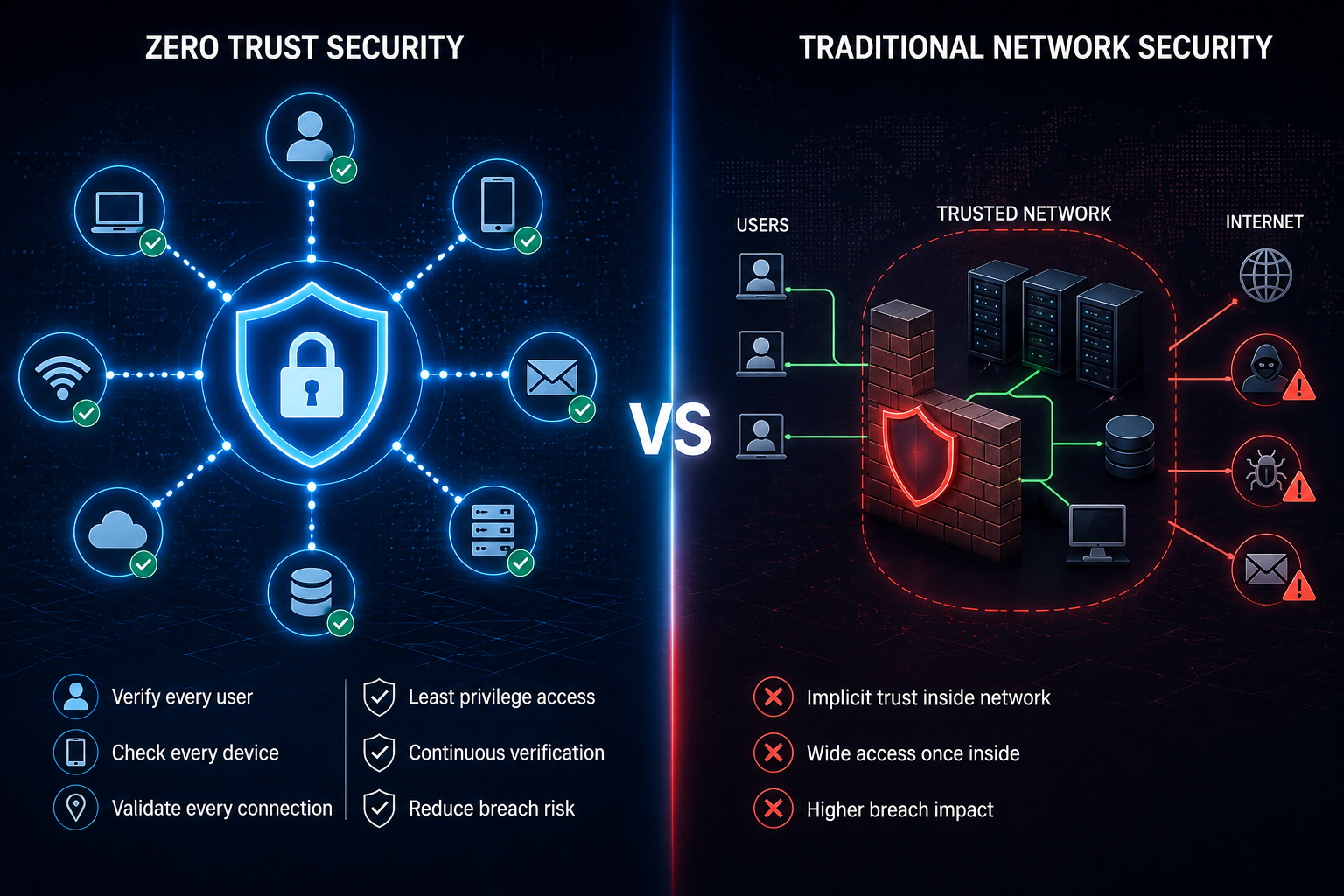
For decades, organizations protected their digital assets using a simple philosophy: build a strong wall around the network and trust everything inside it. This approach worked well when employees sat in offices, company data stayed in local servers, and most devices connected from a single location. The digital world was far less connected, and cyber threats were less sophisticated than they are today.
That world has changed dramatically.
Today, employees work from homes, airports, coffee shops, and shared workspaces. Businesses rely on cloud computing, software-as-a-service (SaaS) platforms, mobile devices, and Internet of Things (IoT) equipment. Sensitive data no longer lives inside one corporate building. Instead, it travels across the internet, cloud platforms, and countless connected devices.
At the same time, cybercriminals have become more organized, more patient, and more technologically advanced. Rather than attacking only network boundaries, they often steal passwords, compromise employee accounts, exploit software vulnerabilities, or trick users through phishing attacks. Once inside a network, attackers frequently move from one system to another, searching for valuable information.
These changes have challenged the effectiveness of traditional network security and encouraged organizations to adopt a fundamentally different approach known as Zero Trust.
Although both security models aim to protect digital systems and sensitive information, they are based on very different assumptions about trust, identity, and risk. Understanding these differences helps explain why Zero Trust has become one of the most important cybersecurity strategies of the modern era.
What Is Traditional Network Security?
Traditional network security is built around the concept of a trusted internal network protected by a secure perimeter.
Imagine a medieval castle surrounded by thick walls and guarded gates. Anyone outside the walls is considered untrusted, while everyone inside is generally assumed to be safe. This analogy closely reflects how traditional network security was designed.
Organizations deploy firewalls, intrusion detection systems, virtual private networks (VPNs), antivirus software, and network monitoring tools to protect the perimeter. These defenses are intended to prevent unauthorized users from entering the internal network.
Once authenticated and allowed inside, employees often receive broad access to company resources. Security checks become less frequent because the network itself is considered trustworthy.
For many years, this approach successfully protected organizations from external attacks.
The Origins of Traditional Security
Traditional security evolved during a time when computing environments were much simpler.
Most employees worked from a central office.
Business applications ran on local servers.
Sensitive data remained inside company buildings.
Personal devices rarely accessed corporate systems.
Internet-based cloud services were uncommon.
Because nearly everything existed inside a single physical location, protecting the network boundary made practical sense.
If attackers could be kept outside the firewall, internal systems were relatively secure.
However, digital transformation has significantly altered these assumptions.
What Is Zero Trust?
Zero Trust is a cybersecurity model based on one simple but powerful principle:
Never trust, always verify.
Rather than automatically trusting users or devices because they are inside the network, Zero Trust assumes that every access request could potentially represent a security risk.
Every user, device, application, and connection must continuously prove its identity before gaining access to resources.
Trust is not permanent.
It is earned through continuous verification.
This philosophy dramatically reduces opportunities for attackers to move freely within an organization’s systems.
Why Zero Trust Was Developed
Modern organizations face security challenges that traditional networks were never designed to handle.
Employees access company resources from around the world.
Cloud computing stores business data outside corporate offices.
Third-party vendors connect directly to internal systems.
Employees use smartphones, tablets, laptops, and home computers.
Applications operate across multiple cloud providers.
Cybercriminals increasingly steal legitimate user credentials instead of breaking through firewalls.
These realities make network boundaries much less meaningful.
A user working from home may legitimately access company databases.
A cloud application may reside entirely outside the organization’s physical network.
An attacker using stolen credentials may appear to be a legitimate employee.
Zero Trust addresses these modern realities by focusing on identity rather than location.
The Core Philosophy
The biggest difference between the two approaches lies in how they define trust.
Traditional security assumes that users inside the network are generally trustworthy.
Zero Trust assumes that no user or device should be trusted automatically, regardless of location.
Instead of asking,
“Is this user inside the network?”
Zero Trust asks,
“Can this user prove they should have access right now?”
This seemingly small change fundamentally transforms cybersecurity.
Identity Becomes the New Security Perimeter
In traditional security, the network itself acts as the primary defensive boundary.
In Zero Trust, identity becomes the new perimeter.
Every access request is evaluated using multiple factors.
The user’s identity.
The device being used.
Its security status.
The requested application.
The requested data.
The location.
The time of access.
The observed behavior.
Even if the same employee logs in successfully every day, Zero Trust continues verifying whether each request remains legitimate.
Authentication in Both Models
Authentication exists in both security approaches, but it functions differently.
Traditional networks often authenticate users once when they log in.
After authentication, users may continue accessing many internal resources without additional verification.
Zero Trust authenticates users continuously.
Logging in successfully does not automatically guarantee unrestricted access.
If risk conditions change, additional verification may be required.
This continuous evaluation greatly improves security.
Authorization Differences
Authorization determines what users are allowed to access.
Traditional networks frequently grant broad permissions after successful login.
Employees may have access to many systems simply because they belong to a particular department.
Zero Trust follows the principle of least privilege.
Users receive only the minimum access required to perform their specific tasks.
If someone only needs access to accounting software, they should not automatically gain access to engineering databases, human resources systems, or confidential research.
Limiting permissions reduces potential damage if an account becomes compromised.
Continuous Verification
One defining feature of Zero Trust is continuous verification.
Traditional systems often assume trust continues after login.
Zero Trust never makes this assumption.
Security systems continuously evaluate whether ongoing access remains appropriate.
If unusual behavior appears, additional authentication or access restrictions may be triggered automatically.
This dynamic approach allows organizations to respond quickly to changing risks.
Device Security
Modern cyberattacks often target devices rather than networks.
An infected laptop can become an entry point into corporate systems.
Zero Trust evaluates device health before granting access.
Security systems may verify whether devices have updated operating systems, current antivirus software, encrypted storage, and appropriate security configurations.
Devices that fail security requirements may receive limited access or be blocked entirely.
Traditional networks have historically placed less emphasis on continuous device evaluation.
Network Segmentation
Traditional networks often allow users to move relatively freely after entering the internal environment.
This creates opportunities for attackers to move laterally from one compromised system to another.
Zero Trust emphasizes microsegmentation.
Networks are divided into smaller protected sections.
Access between segments requires additional authorization.
Even if attackers compromise one system, moving deeper into the network becomes significantly more difficult.
Microsegmentation limits the spread of cyberattacks.
Protection Against Insider Threats
Not every cybersecurity risk comes from outside attackers.
Employees may accidentally expose sensitive information.
Disgruntled workers may intentionally misuse access privileges.
Compromised employee accounts can also become dangerous.
Traditional security often assumes internal users are trustworthy.
Zero Trust continuously evaluates all users equally.
Whether someone is a new employee, a senior executive, or an external contractor, every access request undergoes verification.
This consistent approach improves protection against insider threats.
Cloud Computing and Modern Workplaces
Cloud computing has transformed how organizations operate.
Applications now run across multiple cloud platforms.
Employees collaborate remotely.
Data moves between cloud services and personal devices.
Traditional network security struggles because many resources no longer reside inside a clearly defined corporate network.
Zero Trust adapts naturally to cloud environments.
Security follows users and data wherever they go rather than depending on physical network boundaries.
This flexibility makes Zero Trust especially valuable in modern organizations.
Multi-Factor Authentication
One of the most visible components of Zero Trust is multi-factor authentication, commonly called MFA.
Instead of relying solely on passwords, users provide multiple forms of verification.
These may include a password combined with a security key, authentication application, biometric scan, or temporary verification code.
Even if attackers steal passwords, additional authentication factors significantly reduce unauthorized access.
Although traditional security can also use MFA, Zero Trust treats strong authentication as a central requirement rather than an optional enhancement.
Monitoring User Behavior
Zero Trust continuously monitors user behavior.
Modern security systems analyze login patterns, access locations, device characteristics, and normal working habits.
Suppose an employee usually works in New York during business hours.
If the same account suddenly attempts to access sensitive systems from another country minutes later, automated security systems recognize this unusual behavior.
Additional verification may be required before access continues.
Behavioral analysis helps detect compromised accounts more quickly.
Data Protection
Traditional security focuses heavily on protecting networks.
Zero Trust places equal emphasis on protecting data itself.
Sensitive files may remain encrypted while stored and during transmission.
Access policies follow the data regardless of where it moves.
Whether information resides on local servers, cloud platforms, or employee devices, security policies remain consistent.
This data-centric approach better reflects today’s distributed computing environments.
Responding to Cyberattacks
No security system can guarantee perfect protection.
Organizations must prepare for the possibility that attackers will eventually gain some level of access.
Traditional security often assumes preventing intrusion is the primary objective.
Zero Trust assumes breaches may occur and focuses on minimizing their impact.
By limiting permissions, verifying identities continuously, and segmenting networks, Zero Trust reduces attackers’ ability to spread throughout an organization.
This philosophy is sometimes described as “assuming breach.”
Instead of asking whether an attack will happen, Zero Trust asks how to limit damage when one does.
Advantages of Traditional Network Security
Traditional network security still offers important benefits.
It remains effective for smaller organizations with centralized offices and limited cloud infrastructure.
Many existing security technologies, including firewalls, VPNs, antivirus software, and intrusion detection systems, continue to provide valuable protection.
Organizations that primarily operate from secure physical locations may find traditional approaches simpler to manage.
Traditional security also serves as an important foundation upon which modern security systems continue to build.
Advantages of Zero Trust
Zero Trust offers significant advantages for modern organizations.
Continuous verification strengthens identity protection.
Least-privilege access limits unnecessary exposure.
Microsegmentation reduces lateral movement.
Strong authentication decreases risks associated with stolen passwords.
Continuous monitoring detects suspicious activity earlier.
Cloud environments integrate naturally with Zero Trust principles.
Remote workers receive secure access regardless of location.
These advantages have made Zero Trust increasingly popular across governments, healthcare organizations, financial institutions, educational institutions, and multinational businesses.
Challenges of Zero Trust
Although Zero Trust improves security, implementing it is not always simple.
Organizations often need to redesign existing systems.
Older software may require modernization.
Identity management systems must become more sophisticated.
Security policies require careful planning.
Employees may need training to understand new authentication procedures.
Organizations also need ongoing monitoring and regular policy updates.
Successful Zero Trust implementation is usually an ongoing journey rather than a single technology installation.
Is Traditional Security Obsolete?
Despite the growing popularity of Zero Trust, traditional network security has not disappeared.
Firewalls remain essential.
Endpoint protection remains important.
Network monitoring continues to detect suspicious activity.
Secure network design still matters.
Rather than replacing traditional security entirely, Zero Trust builds upon existing protections while addressing modern cybersecurity challenges.
Many organizations use both approaches together.
Strong perimeter defenses continue protecting external boundaries, while Zero Trust secures identities, devices, applications, and data within those boundaries.
The Future of Cybersecurity
As digital technology continues evolving, cybersecurity strategies must evolve as well.
Artificial intelligence is helping security teams identify threats more quickly.
Cloud computing continues expanding.
Remote work remains common across many industries.
Internet-connected devices continue multiplying.
Cybercriminals constantly develop new attack techniques.
These trends reinforce the importance of flexible, identity-focused security models.
Zero Trust aligns closely with this future because it adapts to changing environments instead of relying on fixed network boundaries.
Choosing the Right Security Approach
The choice between Zero Trust and traditional network security is not simply about selecting one over the other.
Traditional security reflects the needs of an earlier era, when organizations operated primarily within clearly defined physical networks. It remains valuable and continues to provide essential defensive capabilities.
Zero Trust reflects today’s interconnected digital landscape, where users, devices, applications, and data exist far beyond traditional network boundaries. By replacing implicit trust with continuous verification, it provides stronger protection against modern cyber threats, including credential theft, insider risks, ransomware, and cloud-based attacks.
As organizations become increasingly dependent on cloud services, remote work, mobile devices, and digital collaboration, cybersecurity must focus less on where a connection originates and more on who is requesting access, what they need, whether their device is secure, and whether their behavior matches legitimate activity.
In this evolving environment, Zero Trust represents more than a new cybersecurity framework. It reflects a shift in thinking—from assuming safety to continuously verifying it. That change is helping organizations build more resilient defenses, protect sensitive information, and navigate an increasingly complex digital world with greater confidence.