Artificial intelligence can recognize faces in photos, translate languages in seconds, recommend movies you might enjoy, detect diseases from medical images, and even help scientists discover new medicines. Behind these remarkable abilities lies an invisible engine working at incredible speed: the AI chip.
Although AI software often receives most of the attention, it is the specialized hardware underneath that makes modern artificial intelligence practical. Every time you ask a chatbot a question, use a voice assistant, generate an image, or receive personalized recommendations, billions—or even trillions—of mathematical calculations are taking place inside advanced computer chips specifically designed for AI.
Understanding how AI chips process machine learning tasks reveals one of the most fascinating intersections of computer science, mathematics, and engineering. These chips are not simply faster versions of ordinary processors. They are built from the ground up to handle the unique computational demands of artificial intelligence, allowing machines to learn from data and make decisions with astonishing speed and efficiency.
What Is an AI Chip?
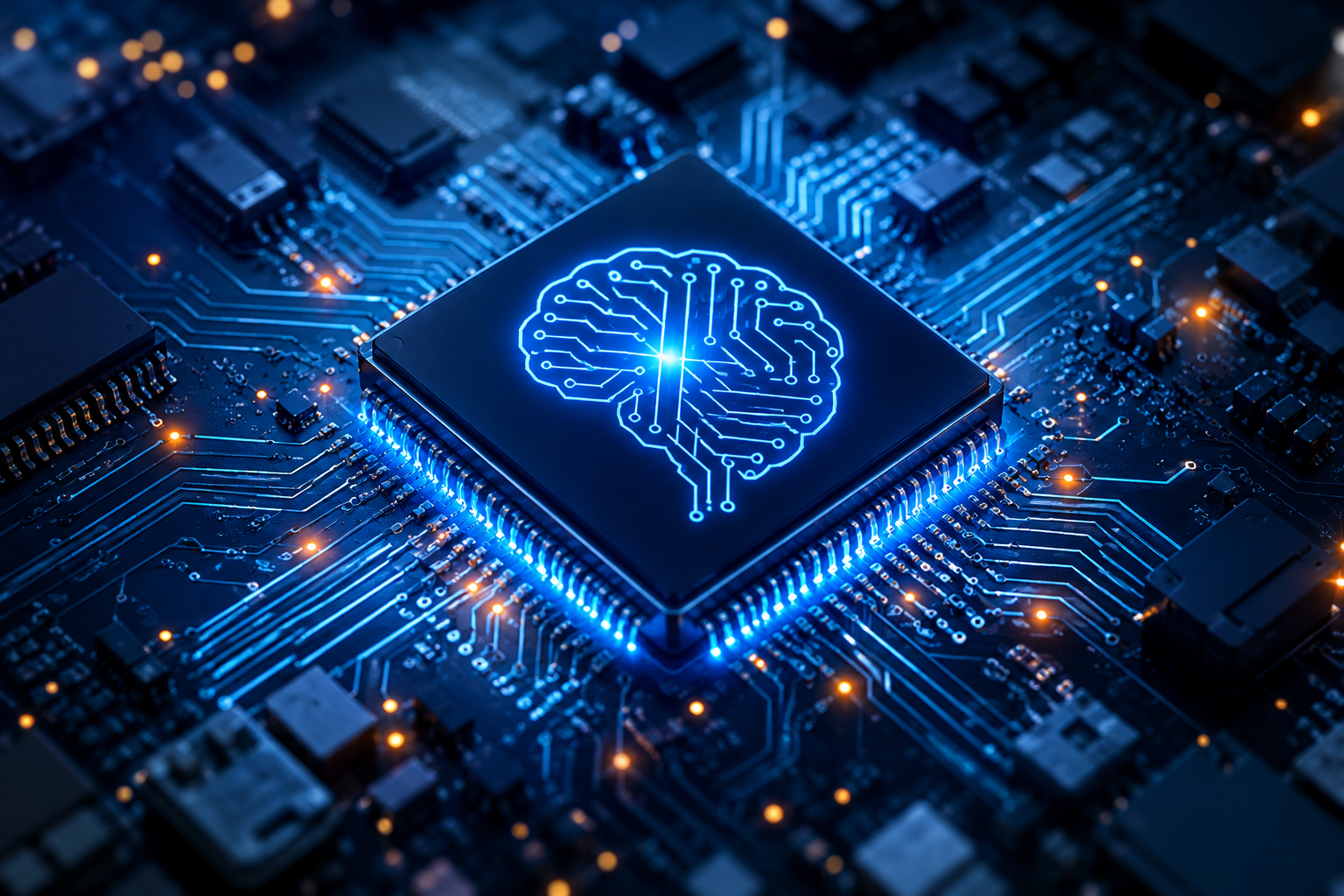
An AI chip is a processor specifically designed to accelerate artificial intelligence workloads. Unlike traditional computer processors, AI chips are optimized for the massive number of mathematical operations required by machine learning algorithms.
Modern AI systems rely on neural networks—mathematical models inspired by the way biological neurons are connected. Training and running these networks require enormous amounts of arithmetic, especially multiplication and addition involving large arrays of numbers called matrices and tensors.
AI chips are engineered to perform these operations efficiently, reducing processing time while consuming less energy than general-purpose processors performing the same tasks.
These chips appear in smartphones, laptops, autonomous vehicles, cloud data centers, robots, medical devices, satellites, and scientific research facilities.
Understanding Machine Learning
To understand AI chips, it first helps to understand machine learning.
Machine learning is a branch of artificial intelligence in which computers improve their performance by learning patterns from data rather than following only explicitly programmed instructions.
Instead of writing detailed rules for every situation, developers provide examples.
A machine learning model might analyze millions of photographs to learn what distinguishes cats from dogs. Another model may study years of weather observations to improve forecasting. A language model learns statistical relationships between words by analyzing enormous collections of text.
During learning, the computer adjusts millions or even billions of internal parameters so its predictions become increasingly accurate.
This learning process requires extraordinary computational power.
Why Ordinary CPUs Are Not Enough
For decades, the central processing unit, or CPU, served as the brain of computers. CPUs are incredibly flexible and can perform a wide variety of tasks.
However, machine learning introduces a challenge.
Neural networks often require billions of repeated mathematical operations on very large collections of numbers. CPUs are designed to execute many different types of instructions efficiently, but they typically contain a relatively small number of powerful processing cores.
While excellent for general computing, CPUs are less efficient when performing the highly repetitive calculations demanded by modern AI.
Imagine asking one skilled chef to prepare ten thousand identical meals. The chef is talented, but the task takes time.
Now imagine thousands of chefs each preparing small parts of every meal simultaneously.
This parallel approach resembles how AI chips accelerate machine learning.
The Mathematics Behind AI
At its core, machine learning is mathematics.
Every image, sound recording, sentence, or video can ultimately be represented as numbers.
Neural networks process these numbers through layers of mathematical operations.
Each artificial neuron receives numerical inputs, multiplies them by learned weights, adds additional values called biases, and then applies mathematical functions that determine the neuron’s output.
This process repeats across millions or billions of artificial neurons.
The calculations may sound simple individually, but modern AI models perform them trillions of times.
Efficiently handling these repeated operations is exactly what AI chips are designed to do.
Neural Networks Depend on Matrix Multiplication
One mathematical operation dominates modern AI more than almost any other: matrix multiplication.
A matrix is simply a rectangular arrangement of numbers.
Neural networks constantly multiply large matrices representing inputs, learned parameters, and intermediate calculations.
For example, an image recognition model may convert millions of pixels into numerical matrices before processing them through dozens or even hundreds of neural network layers.
Large language models perform similar operations while predicting the next word in a sentence.
Because matrix multiplication appears repeatedly throughout machine learning, AI chips devote much of their hardware specifically to accelerating this operation.
Parallel Processing Makes AI Fast
One of the defining characteristics of AI chips is parallel processing.
Instead of solving calculations one after another, AI chips perform enormous numbers of calculations simultaneously.
Thousands of processing elements may work together on different portions of the same mathematical problem.
Imagine trying to count every grain of sand on a beach.
One person would need an extremely long time.
If one million people each counted a tiny section simultaneously, the work would finish far more quickly.
AI chips apply this same principle to mathematical calculations.
Parallel computing dramatically reduces the time needed for both training and inference.
Training Versus Inference
Machine learning involves two major stages.
The first stage is training.
During training, the model learns from enormous datasets. It repeatedly makes predictions, measures errors, and adjusts internal parameters to improve future predictions.
Training is computationally demanding because every parameter must be updated again and again over many learning cycles.
The second stage is inference.
Inference occurs after training is complete.
The trained model receives new information and produces predictions without changing its learned knowledge.
For example, after a facial recognition system has been trained, it can identify new faces almost instantly during inference.
Training generally requires much more computational power than inference, although very large AI models also demand substantial resources when generating responses.
Graphics Processing Units Changed AI
One of the biggest breakthroughs in artificial intelligence came from graphics processing units, or GPUs.
GPUs were originally designed to render video games and computer graphics.
Creating realistic images requires performing many calculations simultaneously across millions of pixels.
This hardware architecture proved remarkably well suited for neural networks because both graphics rendering and machine learning rely heavily on parallel mathematical operations.
Researchers soon realized that GPUs could train neural networks far faster than traditional CPUs.
Today, GPUs remain among the most widely used AI processors in research and industry.
Tensor Processing Units
As AI workloads continued growing, engineers developed even more specialized processors.
One example is the Tensor Processing Unit, or TPU.
TPUs are application-specific integrated circuits designed primarily for neural network computation.
They dedicate large portions of their circuitry to matrix multiplication and tensor operations that dominate deep learning.
Because TPUs focus on a narrower range of calculations than general-purpose processors, they can achieve impressive speed and energy efficiency for many AI workloads.
Large cloud computing platforms use TPUs to train and deploy advanced machine learning models.
Neural Processing Units
Many modern smartphones and personal computers now include Neural Processing Units, often called NPUs.
Unlike cloud-based AI systems, NPUs allow artificial intelligence to run directly on personal devices.
This enables features such as speech recognition, image enhancement, language translation, background noise removal, and photo editing without always sending data to remote servers.
Running AI locally can improve privacy, reduce internet dependence, lower latency, and decrease energy consumption for many tasks.
As AI becomes increasingly integrated into everyday devices, NPUs are becoming an important component of modern consumer electronics.
How Data Moves Through an AI Chip
Processing machine learning tasks involves much more than raw computation.
Data must move efficiently between memory and processing units.
When a neural network begins processing information, input data is loaded into high-speed memory.
The AI chip retrieves portions of this data, performs mathematical operations, stores intermediate results, and sends outputs to subsequent layers.
This movement occurs billions of times.
Engineers carefully design AI chips to minimize unnecessary data transfers because moving data often consumes significant energy and time.
In many AI workloads, memory bandwidth becomes just as important as computational speed.
Specialized AI Hardware
Modern AI chips contain dedicated hardware units optimized for machine learning.
Rather than treating every calculation equally, engineers identify the operations most frequently used by neural networks and build specialized circuits that execute them exceptionally efficiently.
These specialized units may include tensor cores, matrix multiplication engines, vector processors, and other dedicated arithmetic hardware.
By eliminating unnecessary flexibility, AI chips achieve far greater performance for machine learning than general-purpose processors.
Precision and Numerical Formats
Interestingly, AI calculations often do not require the same numerical precision demanded by traditional scientific computing.
Many machine learning models perform accurately using reduced numerical precision.
Instead of always using 64-bit floating-point numbers, AI chips frequently process 32-bit, 16-bit, 8-bit, or even smaller numerical formats.
Smaller numbers occupy less memory, travel faster through circuits, and require less electrical energy.
Engineers carefully balance computational accuracy with hardware efficiency.
In many applications, lower precision produces nearly identical AI performance while dramatically increasing processing speed.
Memory Plays a Critical Role
Even the world’s fastest processor becomes inefficient if it constantly waits for data.
Memory therefore plays a crucial role in AI chip performance.
High-speed memory stores neural network parameters, intermediate calculations, and input data.
Modern AI accelerators often include sophisticated memory hierarchies that reduce delays and improve throughput.
Researchers continually seek new memory technologies capable of supporting the growing demands of increasingly large AI models.
Cooling Powerful AI Chips
Advanced AI chips perform enormous numbers of calculations every second.
As electrical current flows through billions of transistors, heat is generated.
Excessive heat reduces performance and can damage electronic components.
Large AI data centers therefore employ advanced cooling systems using carefully engineered airflow, liquid cooling technologies, or immersion cooling in specialized fluids.
Efficient cooling allows processors to sustain high computational performance while maintaining safe operating temperatures.
Energy Efficiency Matters
Artificial intelligence requires substantial computational resources.
Training state-of-the-art machine learning models may involve thousands of processors operating continuously for days or weeks.
Reducing energy consumption has therefore become one of the most important goals in AI hardware design.
Engineers develop more efficient chip architectures, advanced semiconductor manufacturing processes, optimized memory systems, and intelligent workload scheduling to reduce electricity usage.
Improving efficiency benefits both the environment and operating costs while enabling AI to expand into battery-powered devices.
AI Chips Inside Smartphones
Many people use AI chips every day without realizing it.
Modern smartphones employ AI processors for photography, facial recognition, predictive typing, language translation, augmented reality, voice assistants, and health monitoring.
When a smartphone automatically improves a night photograph or removes unwanted background noise from a video, its AI chip performs complex neural network calculations in fractions of a second.
These capabilities once required powerful cloud servers but increasingly operate directly on portable devices.
AI in Self-Driving Cars
Autonomous vehicles represent one of the most demanding applications of AI chips.
A self-driving car continuously analyzes information from cameras, radar, lidar, ultrasonic sensors, GPS, and other instruments.
The onboard AI processors identify pedestrians, recognize traffic signs, estimate vehicle positions, predict movements, and plan safe driving actions—all in real time.
Even small delays could affect safety.
Therefore, automotive AI chips emphasize both computational performance and reliability.
AI Chips in Scientific Research
Scientific discovery increasingly depends on AI hardware.
Researchers use machine learning to analyze astronomical observations, simulate protein structures, detect diseases, model climate systems, and accelerate materials discovery.
AI chips enable scientists to process enormous datasets that would otherwise require impractical amounts of time.
Rather than replacing scientific reasoning, these processors expand humanity’s ability to uncover patterns hidden within vast quantities of information.
The Future of AI Chips
AI hardware continues evolving at an extraordinary pace.
Future chips will likely become more powerful, more energy efficient, and increasingly specialized for advanced machine learning algorithms.
Researchers are exploring new semiconductor materials, three-dimensional chip architectures, optical computing, neuromorphic processors inspired by the brain, and quantum technologies that may complement certain computational tasks in the future.
As artificial intelligence becomes more deeply integrated into medicine, education, transportation, manufacturing, scientific research, and communication, AI chips will remain central to that progress.
Their development will shape not only faster computers but also entirely new ways for humans and machines to solve complex problems together.
The Invisible Engine Behind Artificial Intelligence
Every intelligent application begins with mathematics, but mathematics alone cannot power the AI revolution. It takes extraordinary hardware to transform billions of numerical calculations into real-time language translation, medical diagnosis, image generation, scientific discovery, and autonomous decision-making.
AI chips serve as the invisible engine behind these achievements. By performing vast numbers of calculations simultaneously, optimizing data movement, accelerating matrix operations, and using specialized hardware designed specifically for machine learning, they make modern artificial intelligence practical.
As AI models continue growing in capability and complexity, the evolution of AI chips will play an equally important role. Every breakthrough in intelligent software depends on advances in intelligent hardware, making AI chips one of the most important technologies shaping the future of computing and, increasingly, the future of society itself.