Imagine opening your favorite website and having it load almost instantly, even if the website’s main server is located on the other side of the world. You click a button, a page appears in a fraction of a second, images load smoothly, videos begin playing without delay, and everything feels effortless. Behind this seamless experience is a technology that most internet users never notice but use every single day: the Content Delivery Network, or CDN.
Whether you are streaming a movie, scrolling through social media, reading the news, shopping online, or playing an online game, chances are a CDN is helping deliver that content to your device. It is one of the most important technologies that makes the modern internet fast, reliable, and scalable.
Although the term “CDN” may sound highly technical, the idea behind it is surprisingly simple. Instead of making every user retrieve information from one distant server, a CDN places copies of website content in many locations around the world. This allows users to receive data from a nearby server rather than one that may be thousands of kilometers away.
Understanding how a CDN works not only helps explain why today’s internet feels so fast but also reveals how websites can serve millions—even billions—of users at the same time.
What Is a CDN?
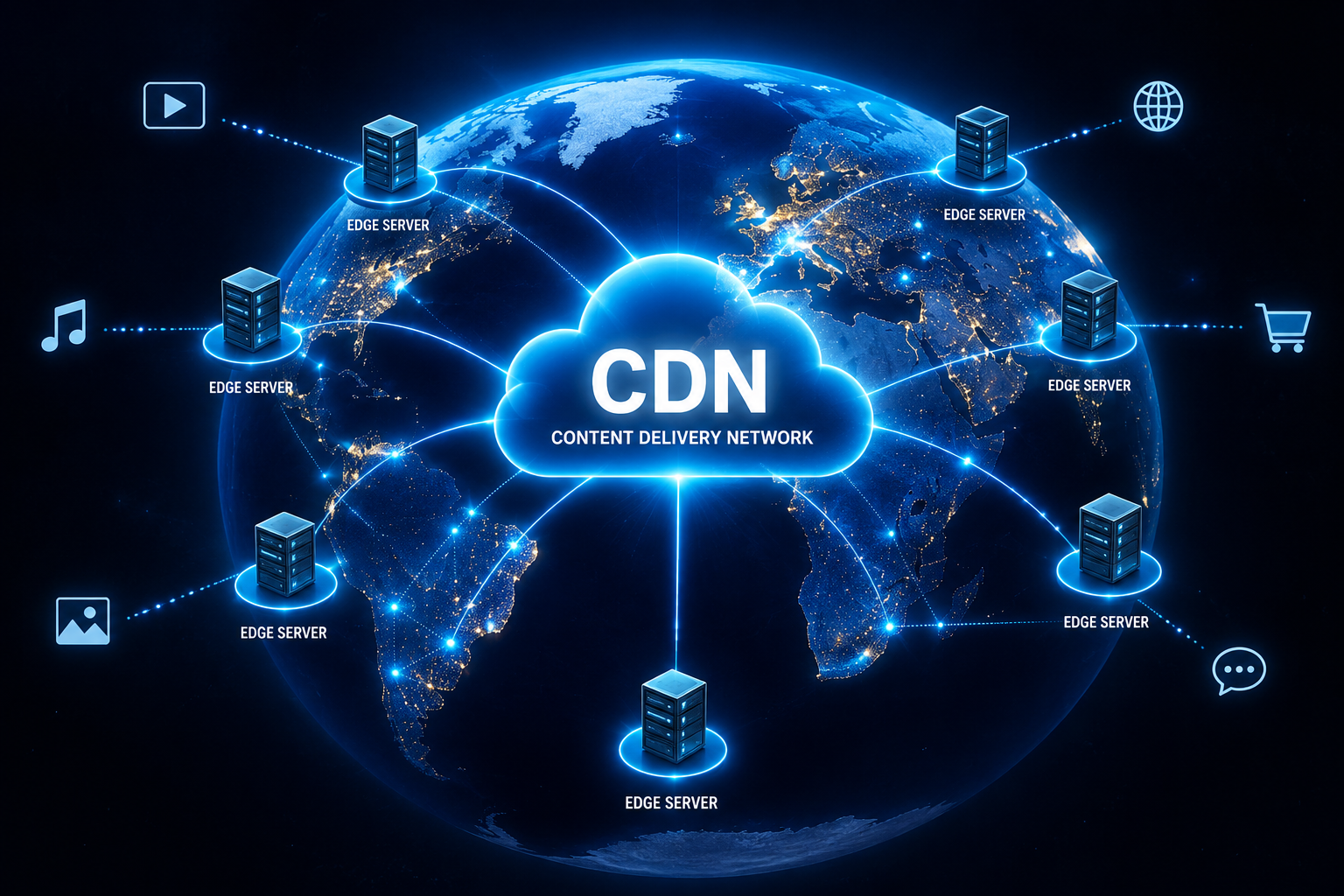
A Content Delivery Network (CDN) is a globally distributed network of servers that stores and delivers website content from locations closer to users.
Instead of relying on a single web server to deliver every file, a CDN copies certain content onto many servers located in different cities and countries. These servers are called edge servers because they are positioned closer to internet users than the website’s original server, often called the origin server.
When someone visits a website that uses a CDN, the requested content is delivered from the nearest available edge server whenever possible. This significantly reduces the distance that data must travel, resulting in faster loading times.
A CDN does not replace the website’s main server. Instead, it works alongside it, acting as a high-speed distribution system that delivers content efficiently around the world.
Why Was the CDN Invented?
When the internet was young, most websites served relatively small numbers of visitors. A single server was often enough to handle incoming requests.
As the internet expanded globally, websites became much larger and more complex. High-resolution images, videos, interactive applications, online games, and streaming services dramatically increased the amount of data that websites needed to deliver.
At the same time, millions of users from different continents began accessing the same websites.
If every visitor had to connect directly to one central server, several problems would arise.
The farther a user is from the server, the longer data takes to travel.
Heavy traffic can overwhelm a single server.
Hardware failures can make an entire website unavailable.
International connections may experience higher delays.
To solve these challenges, engineers developed CDNs, allowing websites to distribute content across many geographically separated servers.
What Does a CDN Do?
A CDN’s primary purpose is to deliver digital content quickly and efficiently.
This content may include web pages, images, videos, JavaScript files, CSS stylesheets, downloadable documents, fonts, software updates, and many other types of files.
Rather than retrieving these files from the origin server every time someone visits a website, the CDN stores copies at edge servers around the world.
When a user requests a file, the CDN checks whether the nearest edge server already has it. If it does, the file is delivered immediately.
If not, the CDN retrieves the file from the origin server, stores a copy at the edge location, and delivers it to the user. Future visitors in the same region can then receive the file directly from the nearby server.
This process is known as caching.
Understanding the Origin Server
Every website has an origin server.
The origin server is the primary location where the website’s original content is stored.
Whenever website owners publish new pages, upload images, or change files, those updates occur on the origin server first.
The CDN periodically retrieves content from the origin server and distributes copies across its network.
The origin server remains the authoritative source of the website’s data, while the CDN serves as a high-speed delivery layer.
What Is Caching?
Caching is the foundation of every CDN.
A cache is a temporary storage area where frequently requested data is kept for faster access.
Imagine a popular library.
Instead of retrieving the most requested books from a distant warehouse every time someone asks for them, the library keeps copies on nearby shelves.
Similarly, a CDN keeps copies of frequently accessed website files at edge servers.
When another visitor requests the same content, it can be delivered immediately without contacting the origin server.
Caching dramatically reduces loading time while lowering the workload on the origin server.
How Does a CDN Work?
The operation of a CDN follows a logical sequence that happens within milliseconds.
When you type a website address into your browser, your device first locates the website through the Domain Name System (DNS).
If the website uses a CDN, DNS directs your request toward the nearest or most appropriate CDN edge server rather than directly to the origin server.
The CDN evaluates which edge server can provide the fastest response based on several factors, including geographic location, network conditions, server health, and current traffic levels.
If the requested content already exists in the edge server’s cache, it is sent immediately.
If the content is missing or outdated, the edge server requests it from the origin server, stores a copy, and forwards it to your browser.
The entire process typically takes only fractions of a second.
To users, everything appears almost instantaneous.
What Is an Edge Server?
An edge server is a server positioned close to internet users.
Instead of concentrating all computing resources in one location, CDN providers deploy thousands of edge servers across cities and countries worldwide.
Because these servers are physically closer to users, data travels shorter distances.
Shorter distances generally mean lower latency and faster page loading.
Modern CDN providers may operate hundreds or even thousands of edge locations globally.
Understanding Latency
Latency is one of the most important concepts in networking.
It refers to the time required for data to travel from one point to another.
Although information travels through fiber-optic cables at a significant fraction of the speed of light, enormous distances still introduce measurable delays.
For example, data traveling halfway around the world naturally takes longer than data traveling across the same city.
A CDN reduces latency by placing servers much closer to users.
This reduction may seem small—often measured in milliseconds—but those milliseconds greatly influence how fast websites feel.
Research consistently shows that users prefer websites that respond quickly and may abandon slow-loading pages.
Why Website Speed Matters
Fast websites create better user experiences.
Visitors are more likely to stay on websites that load quickly.
Online stores benefit because customers are less likely to leave before completing purchases.
News websites can serve breaking stories more efficiently.
Streaming platforms provide smoother video playback.
Search engines also consider page speed as one of many factors influencing search rankings.
While speed alone does not determine search visibility, improving loading performance generally enhances usability and can contribute to better overall website performance.
CDN and Website Performance
A CDN improves performance in several ways.
By serving cached files locally, it reduces the distance data must travel.
Because many users receive files from edge servers instead of the origin server, the origin server handles fewer requests.
This reduces server workload and improves overall responsiveness.
CDNs also optimize network routing, choosing efficient paths across the internet.
Some providers compress files before sending them, reducing data size.
Others automatically convert images into modern formats that download more quickly without noticeably reducing quality.
Together, these optimizations make websites significantly faster.
How a CDN Handles Massive Traffic
Imagine millions of people attempting to watch the same live sports event simultaneously.
If every viewer connected directly to one server, the server could quickly become overwhelmed.
A CDN distributes requests among many servers worldwide.
Each edge server serves users within its surrounding region.
Instead of one server handling millions of requests, thousands of servers share the workload.
This distributed architecture enables websites to support enormous audiences without collapsing under heavy traffic.
CDN and Video Streaming
Modern video streaming depends heavily on CDNs.
Streaming platforms deliver enormous amounts of data every second.
High-definition and 4K videos require particularly large bandwidth.
Without geographically distributed servers, viewers would experience buffering, interruptions, and slow startup times.
CDNs reduce these problems by storing video segments near users.
As viewers watch, additional video data is continuously delivered from nearby servers, creating smooth playback.
CDN for Images
Images often represent the largest portion of many websites.
High-quality photographs, illustrations, banners, and graphics can significantly increase loading times.
A CDN accelerates image delivery through caching, compression, and optimized routing.
Some advanced CDNs even generate different image sizes automatically depending on the visitor’s device.
A smartphone receives a smaller optimized image, while a desktop computer receives a larger version.
This reduces unnecessary downloads while maintaining visual quality.
CDN and Software Downloads
Many companies distribute software updates through CDNs.
Operating system updates, mobile applications, video games, antivirus databases, and browser updates often involve gigabytes of data.
Without CDNs, centralized servers would struggle to deliver these files to millions of users simultaneously.
Distributed delivery makes large downloads faster and more reliable.
CDN and Cybersecurity
Modern CDNs provide more than speed.
Many also improve website security.
One major threat is the Distributed Denial-of-Service (DDoS) attack.
During a DDoS attack, attackers flood a website with enormous numbers of fake requests, attempting to overwhelm its servers.
Because CDNs operate large distributed networks, they can absorb and filter much of this malicious traffic before it reaches the origin server.
Many CDNs also include firewalls, bot detection, traffic filtering, encryption support, and protection against common web attacks.
These security features help websites remain available even during attempted attacks.
CDN and HTTPS
Secure websites use HTTPS to encrypt communication between browsers and servers.
Most CDNs fully support HTTPS encryption.
The CDN can securely establish encrypted connections with users while maintaining secure communication with the origin server.
This protects sensitive information such as passwords, payment details, and personal data during transmission.
Dynamic Content Versus Static Content
CDNs work exceptionally well with static content.
Static files remain identical for every visitor.
Examples include images, logos, style sheets, JavaScript files, downloadable documents, and videos.
Dynamic content changes depending on the user.
Online banking pages, personalized dashboards, shopping carts, and social media feeds often contain dynamic information.
Although dynamic content is more difficult to cache, modern CDNs have developed techniques that accelerate even these personalized services while maintaining accuracy.
Load Balancing
Many CDNs include load balancing.
Load balancing distributes incoming traffic among multiple servers.
Instead of sending every visitor to the same machine, requests are intelligently divided across available servers.
If one server becomes overloaded or unavailable, traffic automatically shifts to healthier servers.
This improves both reliability and performance.
High Availability
A major advantage of CDNs is redundancy.
Website content exists in multiple locations simultaneously.
If one data center experiences technical problems, another edge server can continue delivering content.
This reduces downtime and increases service availability.
For businesses whose websites operate around the clock, high availability is extremely valuable.
CDN and Global Websites
Suppose a company’s origin server is located in New York.
Visitors from Canada may experience excellent loading speeds.
However, users in Japan, Australia, South Africa, and Brazil would normally experience greater delays due to physical distance.
A CDN solves this problem by storing copies of website content in servers across all these regions.
Each visitor receives content from a nearby location, creating a consistent experience worldwide.
CDN and Mobile Users
Mobile internet connections vary significantly in speed and quality.
CDNs help optimize content for smartphones and tablets by reducing download sizes, compressing files, and delivering data efficiently.
This results in faster loading pages even on slower mobile networks.
As mobile internet usage continues to grow globally, CDN optimization becomes increasingly important.
CDN and Cloud Computing
Modern cloud computing frequently works together with CDNs.
Cloud platforms provide scalable computing resources and storage.
CDNs complement these services by distributing content closer to users.
Many organizations combine cloud infrastructure with global CDN networks to achieve high performance, scalability, and reliability.
Who Uses CDNs?
CDNs are used by organizations of nearly every size.
Major streaming platforms rely on CDNs to deliver movies and television shows.
Social media companies use them to display billions of photos and videos every day.
Online retailers accelerate product images and shopping experiences through CDN technology.
News organizations deliver breaking stories rapidly to global audiences.
Educational platforms distribute online courses and learning materials efficiently.
Government agencies, healthcare organizations, financial institutions, gaming companies, and scientific research organizations also depend on CDNs for fast and reliable content delivery.
Even many personal blogs and small business websites use CDNs to improve speed and security.
Are There Any Limitations?
Although CDNs provide tremendous benefits, they are not perfect solutions.
Content updates may require cache refreshing before every edge server serves the newest version.
Some highly personalized content cannot be fully cached.
Operating a global CDN network requires significant infrastructure investment, although many affordable services now exist for smaller websites.
Despite these limitations, the advantages of faster performance, lower latency, improved scalability, and stronger security generally far outweigh the challenges.
The Future of CDNs
CDN technology continues to evolve alongside the internet.
As internet traffic grows, edge computing is becoming increasingly important.
Rather than merely storing cached files, some modern CDN edge servers can perform computations close to users.
Artificial intelligence is also helping optimize traffic routing, predict demand, improve caching strategies, and detect cyber threats more effectively.
The expansion of 5G networks, the Internet of Things (IoT), virtual reality, augmented reality, and cloud gaming will place even greater demands on content delivery systems.
Future CDNs will likely become smarter, faster, and more deeply integrated into the infrastructure of the global internet.
Why CDNs Are Essential to the Modern Internet
Every day, billions of people access websites, stream videos, download software, read news, and communicate online. Much of this digital activity depends on Content Delivery Networks operating quietly behind the scenes.
By placing content closer to users, reducing latency, distributing traffic, improving reliability, and enhancing security, CDNs make the internet feel remarkably fast and dependable. Without them, many of the online experiences people now take for granted—instant page loads, smooth video streaming, responsive web applications, and globally accessible websites—would be far slower and less reliable.
Although users rarely notice a CDN working, its impact is felt every time a webpage opens in an instant, a video starts without buffering, or a website remains available during periods of massive demand. In many ways, the CDN has become one of the invisible foundations upon which the modern internet is built, enabling information to move across the world with remarkable speed and efficiency.