Imagine clicking on a website and having it load almost instantly, even though the server hosting it might be thousands of miles away. Whether you’re reading breaking news, streaming a video, shopping online, or scrolling through social media, you expect websites to respond within seconds—often in less than one. Behind this seemingly effortless experience is one of the Internet’s most important technologies: the Content Delivery Network, or CDN.
Every day, billions of people access websites from different corners of the world. Without CDNs, many of these websites would be slower, less reliable, and more vulnerable to traffic spikes. CDNs have become an essential part of the modern Internet, quietly working behind the scenes to deliver web pages, images, videos, software downloads, and countless other types of digital content with remarkable speed.
Understanding how CDNs work reveals not only why today’s websites are so much faster than they once were, but also how the Internet itself has evolved to meet the demands of a connected world.
What Is a CDN?
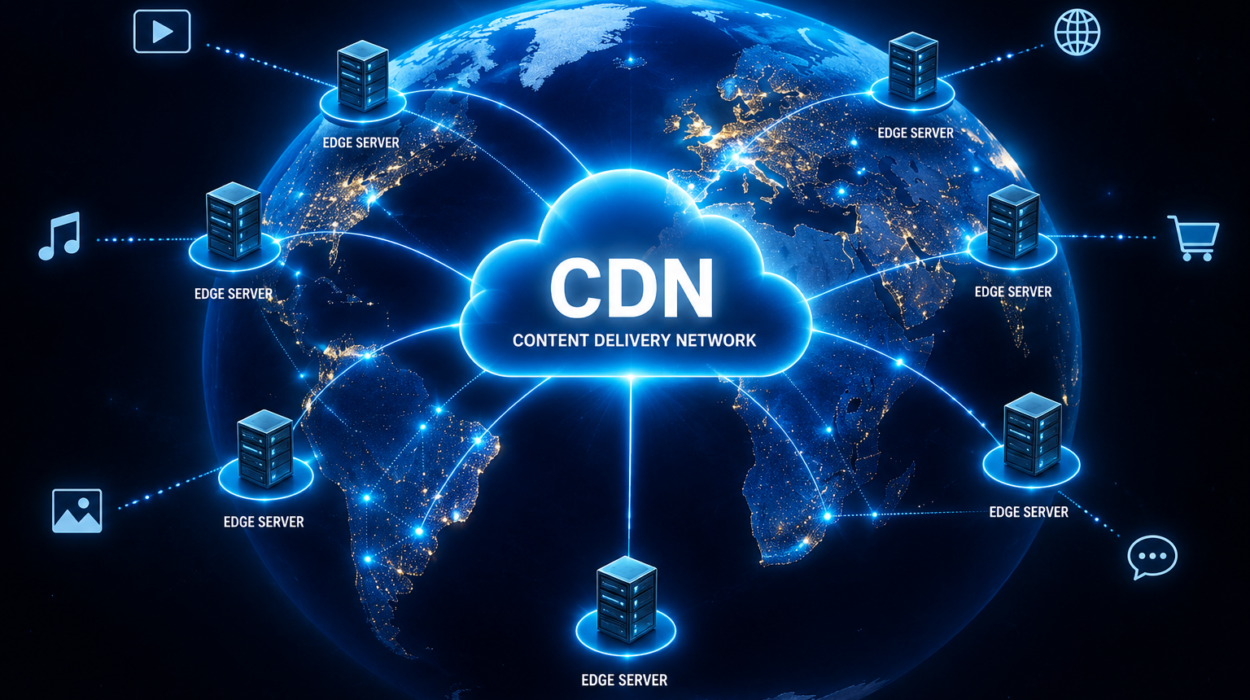
A Content Delivery Network (CDN) is a geographically distributed network of servers that stores copies of website content and delivers that content from the server closest to the visitor.
Instead of relying on a single web server located in one city or country, a CDN places copies of static content across hundreds or even thousands of servers around the world. These servers are commonly known as edge servers or Points of Presence (PoPs) because they are positioned near Internet users.
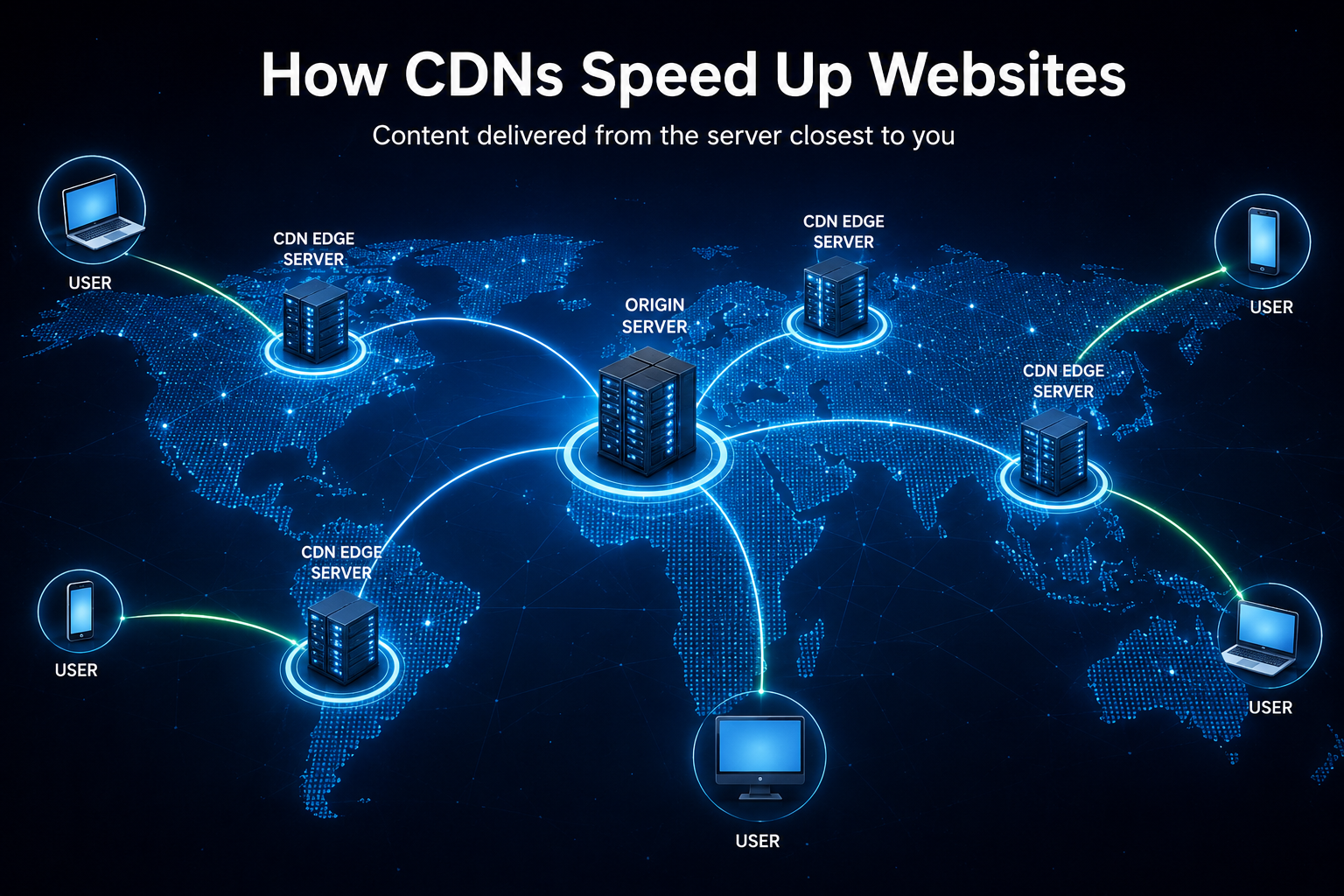
When someone visits a website using a CDN, the request is automatically directed to the nearest available edge server rather than always traveling to the website’s original hosting server. Since the data has a much shorter distance to travel, the website loads significantly faster.
In simple terms, a CDN brings the website closer to the visitor instead of forcing every visitor to reach the same distant server.
Why Distance Makes Websites Slower
One of the biggest reasons websites become slow is physical distance.
Although data travels through fiber-optic cables at nearly the speed of light, it still requires measurable time to move across continents and oceans. Every request made by a browser must travel through routers, switches, Internet service providers, and undersea cables before reaching its destination.
Imagine a website hosted only in New York.
A visitor from nearby Boston may receive the website quickly because the data travels a relatively short distance.
However, someone visiting the same website from Sydney, Tokyo, Cape Town, or São Paulo must wait longer because the information has to cross thousands of kilometers through multiple network connections.
This delay is called latency.
Latency is not determined only by Internet speed. Even an extremely fast Internet connection cannot eliminate the time required for data to travel across the globe.
CDNs solve this problem by reducing the physical distance between users and website content.
The Journey of a Website Without a CDN
When a website does not use a CDN, every visitor communicates directly with the origin server—the main server where the website is hosted.
Suppose the origin server is located in California.
If someone in Germany opens the website, every file must travel from California to Germany.
The browser requests the HTML page.
The server sends the HTML.
The browser then requests images.
The server sends the images.
Next come CSS files, JavaScript files, fonts, icons, and other resources.
Each request adds additional network travel time.
Modern websites often require dozens or even hundreds of separate files before a page appears completely.
The farther away the visitor is from the origin server, the more noticeable these delays become.
How a CDN Changes the Journey
When a CDN is added, the process becomes much more efficient.
The origin server still stores the complete website.
However, the CDN automatically copies frequently requested files to many edge servers worldwide.
Now imagine a visitor in Germany.
Instead of downloading images, style sheets, scripts, and videos from California, the visitor receives them from a nearby edge server in Frankfurt, Amsterdam, or another nearby Internet hub.
Only a much shorter network journey is required.
Because less distance means less latency, pages appear much faster.
To the visitor, the improvement often feels almost instantaneous.
Understanding Caching
The heart of every CDN is a technology called caching.
Caching means temporarily storing copies of files so they can be delivered quickly without contacting the original server every time.
Think of a popular library.
Instead of keeping every book in one distant warehouse, the library places frequently borrowed books on nearby shelves.
Readers receive them immediately without waiting for delivery from the warehouse.
A CDN works in much the same way.
Frequently requested files remain stored on edge servers until they expire or are updated.
This dramatically reduces loading time.
Which Website Files Are Cached?
CDNs work best with content that does not change frequently.
These files are known as static content.
Images are among the most commonly cached resources because the same image is usually shown to every visitor.
Website logos, icons, style sheets, JavaScript files, downloadable PDFs, fonts, videos, and software installers can also be cached effectively.
When many visitors request the same content, the CDN serves identical copies from nearby edge servers instead of repeatedly asking the origin server.
Dynamic content, such as personalized dashboards, shopping carts, or banking information, is generally handled differently because it changes for each individual user. Modern CDNs, however, can accelerate certain dynamic content using advanced networking and optimization techniques without storing sensitive personalized information.
Reducing Server Workload
A busy website may receive millions of requests every day.
Without a CDN, every image, script, stylesheet, and downloadable file comes directly from the origin server.
This places enormous pressure on the server.
As traffic grows, the server must process increasing numbers of requests, consuming bandwidth, processor time, memory, and storage resources.
Eventually, performance begins to decline.
A CDN removes much of this workload.
Since cached files are served by edge servers, the origin server receives far fewer requests.
This allows it to focus on generating dynamic content and responding to requests that cannot be cached.
The result is faster performance for everyone.
Lower Latency Means Faster Loading
Latency refers to the time required for data to travel from one point to another.
Reducing latency is one of the greatest strengths of a CDN.
Even if a website’s files are relatively small, every request requires a network round trip.
When the nearest CDN server is only a few hundred kilometers away instead of several thousand, these trips become much shorter.
Lower latency leads to faster page rendering, smoother scrolling, quicker navigation, and a more responsive browsing experience.
Visitors may not realize why a website feels faster, but they notice the improvement immediately.
Faster Images Make Websites Feel Faster
Images are often the largest part of modern web pages.
High-resolution photographs, product galleries, illustrations, and graphics can account for most of a page’s download size.
A CDN accelerates image delivery by storing copies close to visitors.
Many modern CDNs also perform intelligent image optimization.
They may automatically compress images without noticeably reducing quality.
Some convert images into newer formats such as WebP or AVIF when supported by the visitor’s browser.
Others resize images according to screen size, ensuring smartphones download smaller versions than desktop computers.
These optimizations reduce bandwidth usage while making websites load much faster.
Accelerating Videos and Large Downloads
Streaming video requires enormous amounts of data.
If every viewer downloaded videos directly from a single server, that server could quickly become overwhelmed.
CDNs distribute video files across many edge locations.
As viewers watch, video segments are delivered from nearby servers, reducing buffering and improving playback quality.
The same principle applies to software downloads, operating system updates, game patches, and large digital files.
Millions of users can download simultaneously without overloading one central server.
Better Performance During Traffic Surges
Sometimes websites experience sudden popularity.
Breaking news.
Major sporting events.
Holiday sales.
Concert ticket releases.
Product launches.
These moments can attract millions of visitors within minutes.
Without a CDN, the origin server might become overloaded.
Pages slow down or stop responding entirely.
Because CDNs distribute requests across many servers worldwide, traffic is shared rather than concentrated.
Each edge server handles visitors in its region, dramatically improving stability during periods of unusually high demand.
Improving Website Reliability
A CDN does more than improve speed.
It also increases reliability.
Large CDNs operate extensive networks with many redundant servers.
If one edge server develops a hardware problem, nearby servers automatically take over.
Visitors continue receiving website content without noticing any interruption.
Similarly, if a particular network route experiences congestion or failure, traffic can often be redirected through healthier pathways.
This redundancy helps websites remain available even when individual servers or network connections encounter problems.
Protecting Websites from Cyber Attacks
Many CDNs include important security features alongside performance improvements.
One common threat is a Distributed Denial-of-Service (DDoS) attack.
During a DDoS attack, attackers attempt to overwhelm a website by sending enormous numbers of fake requests.
A single server may struggle to handle such traffic.
A global CDN, however, can absorb and distribute these requests across its worldwide infrastructure.
Many malicious requests are filtered before they ever reach the origin server.
Modern CDNs often include Web Application Firewalls (WAFs), bot detection, rate limiting, and threat intelligence systems that help identify suspicious activity.
Although no security system is perfect, CDNs significantly strengthen website defenses.
Optimizing Network Paths
The Internet is made up of thousands of interconnected networks.
The shortest physical route is not always the fastest.
Large CDN providers continuously monitor global Internet conditions.
They detect congestion, outages, packet loss, and routing problems.
If one pathway becomes slow, traffic may automatically follow a faster alternative.
This intelligent routing further reduces delays and improves reliability.
Supporting Modern Internet Protocols
Modern CDNs continually adopt new Internet technologies that improve performance.
Protocols such as HTTP/2 and HTTP/3 allow browsers to transfer multiple files more efficiently than older versions of HTTP.
HTTP/3, which is built on the QUIC transport protocol, reduces connection setup time and performs better on unstable or mobile networks.
Many CDNs enable these protocols automatically, allowing websites to benefit without requiring major infrastructure changes.
This means visitors enjoy faster and more reliable browsing experiences simply because the CDN supports newer networking standards.
Why CDNs Improve Mobile Browsing
Mobile users often connect through cellular networks where latency fluctuates more than on wired broadband.
Signal strength changes constantly as people move between locations.
Network congestion also varies throughout the day.
Because CDNs reduce the overall distance that data travels, mobile users often experience especially noticeable improvements.
Optimized images, compressed files, faster protocols, and nearby edge servers help websites load quickly even on slower or less stable mobile connections.
This has become increasingly important as smartphones now account for the majority of global web traffic.
The Role of DNS in CDNs
When someone types a website address into a browser, the browser first uses the Domain Name System (DNS) to find the appropriate server.
CDNs integrate closely with DNS.
Instead of directing every visitor to the same origin server, the CDN’s DNS system analyzes factors such as geographic location, network conditions, and server health.
It then directs each visitor to the most appropriate edge server.
This entire process usually takes only milliseconds and happens automatically without the visitor noticing.
Dynamic Content Can Also Be Faster
People sometimes assume CDNs accelerate only static files.
While caching static resources remains their primary function, modern CDNs can also improve dynamic content.
Dynamic acceleration techniques reduce network latency between edge servers and origin servers.
Persistent optimized connections, intelligent routing, and protocol enhancements reduce delays even when content cannot be cached.
As a result, personalized web applications, online games, financial platforms, and cloud software often benefit from CDN technology as well.
CDNs Help Search Engine Optimization
Website speed has become an important aspect of user experience, and search engines consider page performance among many ranking signals.
A faster website tends to reduce visitor frustration, lower bounce rates, and encourage people to stay longer and interact with more content.
By improving loading speed, reducing latency, and increasing reliability, a CDN can contribute to stronger overall website performance, which may indirectly support search visibility and user satisfaction.
Who Uses CDNs?
Today, CDNs power much of the modern Internet.
Major news organizations use them to deliver articles quickly during breaking events.
Streaming platforms rely on them to serve high-quality video to millions of viewers.
Online retailers depend on them during busy shopping seasons.
Social media platforms use CDNs to distribute billions of images and videos every day.
Educational websites, government portals, healthcare platforms, financial institutions, software companies, and gaming services all benefit from CDN technology.
Even small personal blogs often use CDNs because they improve speed without requiring expensive hosting upgrades.
Common Misconceptions About CDNs
Some people believe that adding a CDN automatically makes every website instantly fast.
In reality, a CDN improves delivery, but it cannot fix poorly designed websites.
If pages contain excessively large images, inefficient code, unnecessary scripts, or slow databases, those problems still need optimization.
Others assume CDNs replace web hosting.
They do not.
The origin server remains essential because it stores the original website and generates dynamic content.
The CDN works alongside the hosting server by delivering cached content efficiently.
Understanding this distinction helps explain why CDNs are powerful but not magical solutions.
The Future of Content Delivery
The Internet continues to evolve as websites become richer, applications become more interactive, and users expect near-instant performance.
Future CDNs are becoming increasingly intelligent through artificial intelligence, machine learning, and edge computing.
Instead of merely storing files, edge servers are beginning to process data closer to users, enabling faster online games, real-time collaboration, personalized applications, and Internet of Things (IoT) services.
As 5G networks, fiber-optic infrastructure, and cloud computing expand, CDNs will play an even larger role in reducing latency and delivering seamless digital experiences worldwide.
Conclusion
Content Delivery Networks have transformed the way the Internet delivers information. By placing copies of website content on strategically located servers around the world, CDNs dramatically reduce the distance data must travel, lowering latency and making websites load much faster. Through intelligent caching, optimized routing, image compression, modern networking protocols, and global server infrastructure, they improve speed, reliability, scalability, and security all at once.
Although users rarely notice the technology working behind the scenes, nearly every fast website they visit is likely benefiting from a CDN. From streaming videos and reading the latest news to shopping online and accessing cloud applications, CDNs quietly ensure that digital content arrives quickly, efficiently, and reliably. As the Internet continues to grow, the role of Content Delivery Networks will become even more important, helping create a faster, more connected online world for everyone.