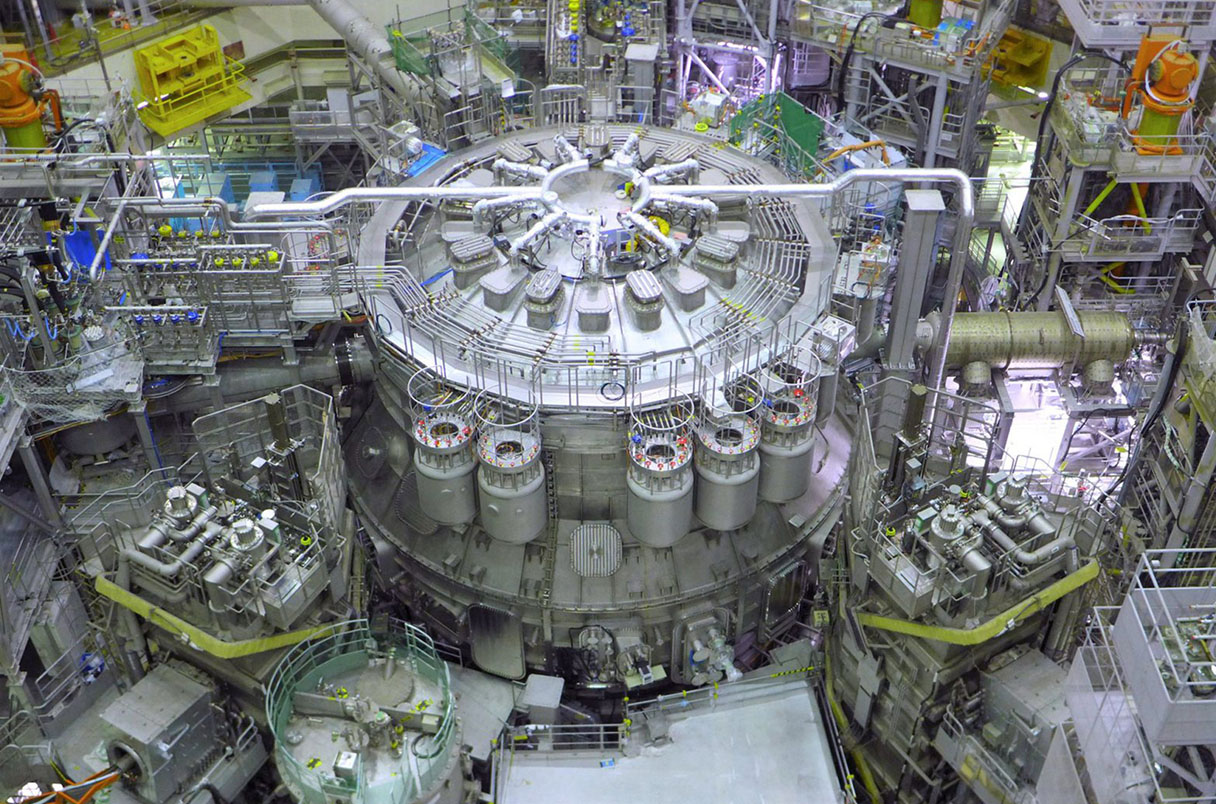
Imagine a source of energy so powerful that a small amount of fuel could produce an enormous amount of electricity, while emitting no carbon dioxide during operation and leaving behind far less long-lived radioactive waste than today’s nuclear fission reactors. It may sound like science fiction, but scientists around the world are working to make this vision a reality through nuclear fusion.
Fusion is the process that powers the Sun and every star in the universe. Every second, the Sun releases an astonishing amount of energy because tiny atomic nuclei are continuously combining under extreme temperatures and pressures. For decades, researchers have dreamed of recreating this process here on Earth—not inside a star, but inside carefully designed machines known as fusion reactors.
Although practical fusion power plants are not yet producing electricity for commercial use, recent scientific breakthroughs have brought humanity closer than ever before. Fusion reactors represent one of the most ambitious engineering challenges in history, requiring scientists to control matter at temperatures hotter than the center of the Sun.
Understanding how fusion reactors work reveals not only an extraordinary scientific achievement but also why many researchers believe fusion could one day transform the world’s energy future.
What Is Nuclear Fusion?
Nuclear fusion is a process in which two light atomic nuclei combine to form a heavier nucleus. When this happens, a small portion of their mass is converted into energy according to Albert Einstein’s famous equation:
E = mc²
This equation shows that even a tiny amount of mass can become an enormous amount of energy because the speed of light squared is an extremely large number.
Unlike burning coal, oil, or natural gas, fusion does not rely on chemical reactions. Instead, it changes the nuclei of atoms themselves. Nuclear reactions release millions of times more energy than ordinary chemical reactions because they involve the powerful forces inside atomic nuclei.
Fusion is nature’s most efficient energy-producing process. Every star in the universe shines because fusion reactions continuously release vast amounts of energy.
The Difference Between Fusion and Fission
People often confuse nuclear fusion with nuclear fission, but they are opposite processes.
Nuclear fission works by splitting heavy atoms such as uranium into smaller pieces. This process releases energy and is currently used in nuclear power plants around the world.
Fusion does the reverse. Instead of splitting large atoms, it combines very small atoms into larger ones.
Both processes release enormous amounts of energy, but fusion has several potential advantages.
Fusion fuel is abundant.
Fusion does not produce greenhouse gases during electricity generation.
Fusion cannot create an uncontrolled chain reaction like those associated with nuclear accidents in fission reactors. If the conditions inside a fusion reactor are disturbed, the plasma cools almost immediately and the fusion reaction stops naturally.
Fusion also produces much smaller quantities of long-lived radioactive waste compared with conventional nuclear fission.
These advantages make fusion one of the most attractive long-term energy technologies.
Why Fusion Produces Energy
At first glance, combining atoms might seem like it should require energy rather than produce it.
The answer lies in the structure of atomic nuclei.
Light elements such as hydrogen have relatively low nuclear binding energy. When they combine into slightly heavier elements, the resulting nucleus is more tightly bound. The difference in mass between the original nuclei and the final nucleus is released as energy.
This process is possible only for lighter elements. Beyond iron, fusion no longer releases energy but instead requires it.
That is why stars spend most of their lives fusing hydrogen into helium.
The Fuel Used in Fusion Reactors
Most experimental fusion reactors use two special forms of hydrogen called deuterium and tritium.
Hydrogen normally contains one proton.
Deuterium contains one proton and one neutron.
Tritium contains one proton and two neutrons.
When deuterium and tritium collide under the right conditions, they fuse to produce a helium nucleus and a high-energy neutron.
This reaction releases an enormous amount of energy.
Scientists favor this reaction because it occurs more easily than other fusion reactions at temperatures achievable in modern experimental reactors.
Where Fusion Fuel Comes From
One reason fusion is so appealing is that its fuel is relatively abundant.
Deuterium naturally exists in seawater. Although only a tiny fraction of hydrogen atoms are deuterium, Earth’s oceans contain enough to supply humanity’s energy needs for an incredibly long time.
Tritium is much rarer in nature because it is radioactive and decays over time.
Future fusion reactors are expected to produce much of their own tritium inside the reactor using materials containing lithium. When high-energy neutrons strike lithium atoms, nuclear reactions can create fresh tritium fuel.
Lithium itself is relatively common in Earth’s crust and oceans.
Why Fusion Is So Difficult
If fusion is such an excellent energy source, why has it taken scientists so long to develop?
The answer is simple but extraordinary.
Atomic nuclei are positively charged.
Positive charges repel one another through the electric force.
To make two nuclei fuse, they must be pushed close enough together for the strong nuclear force to overcome this electrical repulsion.
Achieving this requires incredibly high temperatures.
Inside the Sun, immense gravity squeezes atoms together under enormous pressure.
Earth does not have the Sun’s gravitational force.
Instead, scientists compensate by heating fuel to astonishing temperatures exceeding 100 million degrees Celsius—several times hotter than the Sun’s core.
At these temperatures, atoms lose their electrons and become an electrically charged gas known as plasma.
Plasma is often called the fourth state of matter.
What Is Plasma?
Most matter exists as solids, liquids, or gases.
If a gas becomes hot enough, its atoms lose electrons.
The result is plasma.
Plasma consists of free electrons and positively charged atomic nuclei moving at extremely high speeds.
Unlike ordinary gases, plasma responds strongly to electric and magnetic fields.
Because plasma is electrically charged, scientists can manipulate and confine it using powerful magnets.
Nearly all visible matter in the universe exists as plasma, including stars, lightning, and glowing nebulae.
Fusion reactors must create, heat, and control plasma with remarkable precision.
Why Reactors Cannot Touch the Plasma
No material can survive direct contact with plasma hotter than 100 million degrees Celsius.
If the plasma touched the reactor walls, it would cool rapidly while severely damaging the reactor.
The solution is surprisingly elegant.
Scientists use extremely powerful magnetic fields to suspend the plasma so it never touches the walls.
The plasma effectively floats inside an invisible magnetic cage.
Maintaining this delicate balance is one of fusion engineering’s greatest challenges.
Magnetic Confinement Fusion
The most widely studied approach to fusion is called magnetic confinement.
In this method, superconducting magnets generate powerful magnetic fields that force the charged plasma into a stable shape.
The goal is to keep the plasma hot and dense enough for fusion reactions to occur continuously.
The longer the plasma remains stable, the more fusion reactions take place.
Researchers spend enormous effort preventing tiny instabilities that can disturb the plasma and reduce performance.
The Tokamak Design
The world’s most advanced fusion reactors use a design known as a tokamak.
A tokamak has a doughnut-shaped chamber called a torus.
Inside this chamber, magnetic fields guide the plasma around the ring without allowing it to touch the walls.
Additional electric currents flowing through the plasma help generate heat and strengthen confinement.
The combination of magnetic fields creates a carefully balanced environment where fusion reactions can occur.
Many of today’s largest fusion experiments use this design because decades of research have shown it to be one of the most promising approaches.
The Stellarator
Another important reactor design is the stellarator.
Like a tokamak, it uses magnetic fields to confine plasma.
However, its magnets are twisted into highly complex three-dimensional shapes.
These unusual magnetic fields allow the stellarator to maintain plasma stability without relying as heavily on electric currents flowing through the plasma.
Although stellarators are mechanically more complicated to build, they offer potential advantages for continuous long-term operation.
Advances in computer modeling have made modern stellarators much more practical than earlier versions.
Inertial Confinement Fusion
Another strategy for achieving fusion uses powerful lasers instead of magnets.
This approach is called inertial confinement fusion.
Tiny fuel pellets containing deuterium and tritium are struck by multiple high-energy laser beams simultaneously.
The outer layer of the pellet vaporizes almost instantly.
As material blasts outward, the remaining fuel is compressed inward to extraordinary densities.
This compression briefly creates conditions suitable for fusion before the pellet rapidly expands.
The entire process lasts only tiny fractions of a second.
Although extremely short, these reactions can release substantial amounts of energy.
Heating the Plasma
Fusion reactors use several techniques to heat plasma.
Electric currents flowing through the plasma generate heat.
Powerful microwave beams transfer electromagnetic energy into the plasma.
High-energy neutral particles are injected into the plasma, where they collide with existing particles and increase the temperature.
Together, these methods gradually raise the plasma to temperatures exceeding one hundred million degrees Celsius.
Only under these extreme conditions do atomic nuclei move fast enough to overcome their mutual electrical repulsion.
Reaching Ignition
One of fusion research’s ultimate goals is achieving ignition.
Ignition occurs when fusion reactions themselves produce enough energy to keep the plasma hot without requiring as much external heating.
In this state, the reactor becomes largely self-sustaining.
Scientists measure success using something called the fusion gain factor, which compares the energy produced by fusion with the energy supplied to the fuel.
Achieving consistently high gain remains one of the major milestones toward practical fusion power plants.
Turning Fusion Energy into Electricity
Fusion reactions themselves do not directly produce electricity.
Instead, they release enormous amounts of kinetic energy.
High-energy neutrons escape the plasma and collide with a surrounding structure called the blanket.
These collisions generate heat.
The heat warms a coolant, such as water or another working fluid.
The hot coolant produces steam.
The steam spins turbines connected to electrical generators.
This process resembles how many existing power plants generate electricity, except that the heat comes from fusion rather than burning fossil fuels or splitting uranium atoms.
Why Superconducting Magnets Matter
Modern fusion reactors rely on extremely powerful superconducting magnets.
Superconductors carry electrical current with almost no resistance when cooled to very low temperatures.
These magnets generate the intense magnetic fields needed to confine plasma while consuming much less electrical power than conventional magnets.
Ironically, a fusion reactor contains one of the hottest environments humans have ever created alongside some of the coldest technology on Earth.
The superconducting magnets operate at temperatures close to absolute zero, while the plasma inside reaches more than one hundred million degrees Celsius.
The Biggest Challenges
Fusion research has made tremendous progress, but significant engineering challenges remain.
Scientists must maintain stable plasma for long periods while preventing turbulence that causes energy loss.
Materials inside the reactor must withstand intense neutron bombardment without degrading rapidly.
Efficient methods for producing and recycling tritium fuel must be perfected.
Engineers must design systems capable of operating reliably for years while remaining economically competitive.
Each challenge is substantial, but none appears fundamentally impossible according to current scientific understanding.
Recent Scientific Progress
The past decade has seen remarkable advances in fusion research.
Improved superconducting magnets have created stronger magnetic fields than ever before.
Artificial intelligence and advanced computer simulations now help scientists monitor and stabilize plasma behavior in real time.
Researchers have also achieved important milestones in laser-driven fusion experiments, including demonstrations in which fusion reactions released more energy than was delivered directly by the lasers to the fuel target. While these experiments are major scientific achievements, building commercial power plants remains a much larger engineering challenge.
International collaborations continue to push fusion technology forward at an unprecedented pace.
Why Fusion Could Change the World
If scientists succeed in developing practical fusion power plants, the impact could be enormous.
Fusion fuel is widely available.
Fusion power plants could operate continuously, unlike solar and wind energy, which depend on weather conditions.
Fusion produces no carbon dioxide during electricity generation.
It could help reduce dependence on fossil fuels while supporting growing global energy demand.
Fusion also has the potential to supply reliable electricity for industries, transportation, water desalination, hydrogen production, and future technologies that require large amounts of clean energy.
For these reasons, many researchers consider fusion one of the most promising long-term solutions for sustainable energy.
Is Fusion Safe?
No energy technology is completely free of risk, but fusion has several built-in safety advantages.
Fusion reactions require extremely precise conditions.
If those conditions are interrupted, the plasma cools rapidly and the reaction stops almost immediately.
There is no self-sustaining chain reaction like the one that occurs in nuclear fission reactors.
Fusion also produces much less long-lived radioactive waste than conventional nuclear power, although some reactor materials can become radioactive after prolonged exposure to high-energy neutrons.
Scientists continue developing materials that further reduce this issue.
Will Fusion Replace Other Energy Sources?
Fusion is unlikely to replace every existing energy technology.
Instead, it will probably become one part of a diverse energy system.
Solar panels generate electricity during daylight.
Wind turbines produce power when winds are favorable.
Hydroelectric plants depend on flowing water.
Fusion could provide reliable, continuous electricity regardless of weather or time of day.
Together, these technologies could complement one another to create cleaner and more resilient energy systems.
The Future of Fusion Reactors
Fusion reactors represent one of humanity’s greatest scientific and engineering challenges. Recreating the power of the stars on Earth requires temperatures hotter than the Sun’s core, magnetic fields of extraordinary strength, materials capable of surviving extreme environments, and an unprecedented level of technological precision.
Although commercial fusion power plants are not yet operating, decades of research have transformed fusion from a distant dream into a rapidly advancing scientific field. Each new experiment improves our understanding of plasma physics, reactor engineering, and energy production.
The journey toward practical fusion has been long because nature sets exceptionally demanding conditions for fusion to occur. Yet every major breakthrough demonstrates that these challenges can be overcome through innovation, international collaboration, and persistent scientific research.
If successful, fusion reactors could provide abundant, low-carbon, and reliable energy for generations to come. They would not simply represent another type of power plant—they would mark one of the most significant technological achievements in human history, bringing the same process that lights the stars into service for life here on Earth.