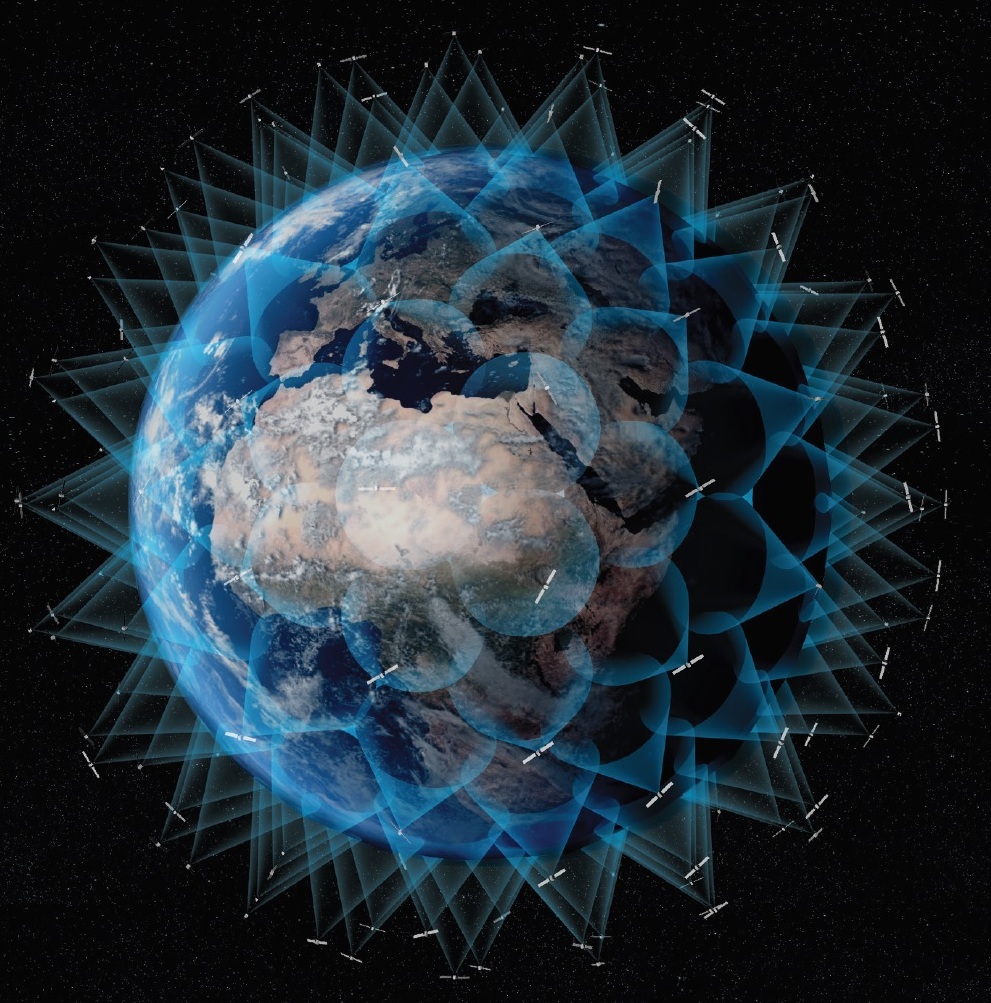
Every night, when you look up at the sky, it may seem calm, silent, and unchanged. The stars appear fixed in place, the Moon follows its familiar path, and the darkness stretches endlessly into space. But hidden from our eyes, thousands of human-made satellites are racing around Earth at incredible speeds. Every year, more of them join the growing population orbiting our planet.
A new era of space exploration has begun—not with a single giant spacecraft or a lone scientific satellite, but with enormous groups of satellites working together. These vast networks are called mega satellite constellations, and they are changing how people communicate, navigate, study Earth, and explore the universe.
These constellations promise faster internet, better global connectivity, improved disaster monitoring, and new scientific opportunities. At the same time, they raise important questions about space traffic, astronomy, and the long-term sustainability of Earth’s orbital environment.
So, what exactly are mega satellite constellations? How do they work? Why are countries and companies launching thousands of satellites instead of just a few? And what challenges come with filling Earth’s orbit with so many spacecraft?
Understanding Satellite Constellations
A satellite constellation is a group of artificial satellites that work together as a coordinated system.
Unlike a single satellite that covers only a limited area at any given time, satellites in a constellation are carefully placed in different orbits so that they can provide continuous coverage over large regions—or even the entire planet.
Each satellite communicates with ground stations, users, or other satellites in the network. Together, they perform tasks that would be impossible for a single spacecraft.
Satellite constellations are used for many purposes, including communication, navigation, weather forecasting, Earth observation, and scientific research.
What Makes a Constellation “Mega”?
A mega satellite constellation is simply a very large satellite constellation, usually consisting of hundreds, thousands, or even tens of thousands of satellites operating together.
Traditional satellite systems often included only a handful of satellites. In contrast, mega constellations are designed to create nearly continuous global coverage by distributing many smaller satellites across multiple orbital planes.
The word “mega” refers to the enormous scale of these networks rather than the size of the individual satellites. In fact, many satellites in these constellations are much smaller than older communication satellites.
Why Build Thousands of Satellites?
At first glance, launching thousands of satellites might seem unnecessary. Why not simply build a few powerful ones?
The answer lies in coverage, reliability, and performance.
A single satellite can only observe or communicate with a portion of Earth at one time. Because Earth rotates and satellites move along their orbits, one spacecraft cannot provide uninterrupted service everywhere.
By placing many satellites in carefully planned orbits, engineers ensure that when one satellite moves beyond the horizon, another quickly takes its place.
This creates continuous coverage that allows users almost anywhere on Earth to remain connected.
How Satellites Stay in Orbit
Mega satellite constellations rely on one of the most beautiful principles of physics.
Satellites remain in orbit because they are constantly falling toward Earth while moving forward at tremendous speeds.
Earth’s gravity continuously pulls the satellite inward.
At the same time, the satellite’s forward velocity causes it to miss the planet, creating a continuous free-fall around Earth.
This balance between gravity and motion allows satellites to circle the planet repeatedly without crashing into the surface.
Depending on their altitude, satellites may complete one orbit in roughly 90 minutes to several hours.
Where Are Mega Satellite Constellations Located?
Most mega satellite constellations operate in low Earth orbit (LEO).
Low Earth orbit extends from about 160 kilometers to approximately 2,000 kilometers above Earth’s surface.
Many communication constellations are placed only a few hundred kilometers above Earth.
This relatively low altitude provides several advantages.
Signals travel shorter distances, reducing communication delay, known as latency.
Satellites can transmit stronger signals using less power.
Smaller antennas can often be used on the ground.
The lower altitude also makes launching satellites less expensive compared with placing them into much higher orbits.
Why Not Use Geostationary Satellites?
For decades, many communication satellites operated in geostationary orbit, located about 35,786 kilometers above Earth’s equator.
At this altitude, a satellite circles Earth once every 24 hours, matching Earth’s rotation and appearing to remain fixed above the same location.
Geostationary satellites are excellent for television broadcasting and weather monitoring.
However, because they are so far away, radio signals take longer to travel between Earth and the satellite.
Mega constellations in low Earth orbit reduce this delay significantly, making them better suited for internet services, video calls, and other applications that require rapid communication.
How Do Mega Satellite Constellations Work?
Every satellite in the constellation functions as part of a much larger network.
When a user sends data, such as an internet request, the signal travels to a nearby satellite.
That satellite may forward the information directly to a ground station or relay it through other satellites using high-speed communication links, depending on the network’s design.
Ground stations connect the satellite system to the broader internet or communication infrastructure.
As satellites move across the sky, users are automatically transferred from one satellite to another without interrupting the connection.
This seamless handoff happens continuously, often without users noticing.
Communication Between Satellites
Many modern satellite constellations use inter-satellite links, allowing satellites to communicate directly with one another.
Some systems use radio frequencies, while others employ laser communication.
Laser links transmit information using beams of light through the vacuum of space.
Because lasers can carry enormous amounts of data at extremely high speeds, they help reduce communication delays and improve network efficiency.
The satellites essentially create a moving web of communication surrounding Earth.
Providing Internet Almost Anywhere
One of the primary goals of mega satellite constellations is to provide broadband internet access across the globe.
Many remote communities lack reliable internet because building fiber-optic cables across mountains, deserts, forests, or oceans is expensive and sometimes impossible.
Satellite constellations can reach these areas without requiring extensive ground infrastructure.
Ships crossing oceans, aircraft flying between continents, scientific stations in polar regions, and isolated villages may all benefit from satellite-based internet connections.
This expanded connectivity can improve education, healthcare, scientific collaboration, and economic opportunities.
Earth Observation and Environmental Monitoring
Not all mega satellite constellations focus on communication.
Some are designed to observe Earth continuously.
Large networks of observation satellites monitor forests, glaciers, oceans, agricultural land, weather systems, wildfires, floods, and changing coastlines.
Because multiple satellites repeatedly pass over the same locations, scientists can collect fresh data much more frequently than with a single spacecraft.
This helps researchers better understand climate change, natural disasters, ecosystem health, and environmental change.
Navigation and Positioning
Satellite constellations also support global navigation.
Navigation systems determine a receiver’s location by measuring signals from multiple satellites at the same time.
Precise timing allows computers to calculate position with remarkable accuracy.
These systems help guide airplanes, ships, cars, smartphones, emergency responders, and scientific instruments.
Without satellite constellations, many modern navigation technologies would not exist.
Weather Forecasting
Weather satellites are another important example of coordinated satellite systems.
By monitoring clouds, storms, temperatures, humidity, ocean conditions, and atmospheric motion, satellites provide essential information used in weather forecasting.
Frequent observations improve prediction accuracy and help meteorologists monitor rapidly developing events such as hurricanes and severe storms.
This information saves lives by allowing earlier warnings before dangerous weather arrives.
Scientific Research
Mega satellite constellations also support scientific research.
Scientists use satellites to study Earth’s magnetic field, atmospheric composition, cosmic radiation, ocean circulation, ice sheets, and even tiny changes in Earth’s gravitational field.
These observations improve our understanding of our planet and help answer important scientific questions about environmental processes and Earth’s changing climate.
The Technology Inside Each Satellite
Although many satellites in mega constellations are relatively small, they contain sophisticated technology.
Each satellite typically includes solar panels that convert sunlight into electricity.
Rechargeable batteries provide power while the satellite passes through Earth’s shadow.
Computers control onboard systems.
Radio antennas or laser communication equipment send and receive information.
Navigation systems determine the satellite’s precise position.
Small propulsion systems may perform gentle adjustments to maintain the desired orbit or avoid collisions.
Despite their compact size, these satellites function as highly advanced robotic spacecraft.
Launching So Many Satellites
Building thousands of satellites would mean little without efficient ways to launch them.
Modern rockets can carry dozens of satellites during a single mission.
Once in space, the satellites are released into carefully planned orbits.
Over time, onboard propulsion systems fine-tune their positions within the constellation.
The increasing ability to reuse rocket components has also helped reduce launch costs, making large constellations more economically feasible than in previous decades.
Challenges of Mega Satellite Constellations
While mega satellite constellations offer many benefits, they also create significant challenges.
The growing number of satellites increases the complexity of managing Earth’s orbital environment.
Operators must carefully monitor spacecraft positions to reduce the risk of collisions.
Every satellite occupies valuable orbital space and must be tracked continuously.
As the number of satellites grows, coordination becomes increasingly important.
The Problem of Space Debris
One major concern is space debris, sometimes called space junk.
This includes inactive satellites, spent rocket components, and fragments produced by previous collisions or explosions.
Even tiny pieces of debris travel at extremely high speeds, making them capable of damaging operational spacecraft.
If collisions create additional debris, future collisions become more likely.
To reduce this risk, many modern satellites are designed to leave orbit at the end of their operational lives, allowing them to re-enter Earth’s atmosphere and burn up safely.
Responsible space operations are becoming increasingly important as orbital activity grows.
Challenges for Astronomy
Astronomers have also expressed concerns about mega satellite constellations.
Large numbers of satellites can appear as bright streaks across astronomical images, especially during twilight when satellites remain illuminated by the Sun while the ground is already dark.
These streaks can interfere with observations of distant galaxies, faint stars, and other astronomical objects.
Scientists, observatories, and satellite operators are working together to explore methods for reducing satellite brightness and minimizing impacts on astronomical research.
Managing Space Traffic
As more satellites enter orbit, managing space traffic becomes increasingly complex.
Organizations around the world track tens of thousands of objects in orbit, including active satellites and debris.
Operators sometimes perform collision-avoidance maneuvers when calculations indicate a close approach between spacecraft.
Future traffic management systems may become even more sophisticated, helping ensure safe operations in increasingly crowded orbital regions.
International Cooperation
Outer space belongs to no single nation.
Because satellites travel around the entire planet, international cooperation plays a vital role.
Countries, space agencies, scientists, and commercial companies work together to develop standards for satellite operations, communication frequencies, orbital safety, and responsible use of space.
Effective cooperation will become even more important as satellite constellations continue to expand.
The Future of Mega Satellite Constellations
The number of satellites orbiting Earth is expected to continue growing during the coming decades.
Future constellations may provide faster global internet, improved environmental monitoring, more accurate navigation, enhanced disaster response, and stronger support for scientific research.
Advances in miniaturization, artificial intelligence, laser communication, electric propulsion, and reusable launch systems are likely to make satellite networks even more capable.
At the same time, engineers, scientists, and policymakers must ensure that Earth’s orbital environment remains safe and sustainable for future generations.
Balancing technological progress with responsible stewardship of space will be one of humanity’s greatest challenges in the years ahead.
Conclusion
Mega satellite constellations represent one of the most significant transformations in the history of space technology. Instead of relying on a few large spacecraft, these systems use hundreds or thousands of coordinated satellites to create powerful global networks capable of providing communication, navigation, Earth observation, scientific research, and many other essential services.
As these constellations continue to grow, they have the potential to connect remote communities, improve disaster response, advance scientific discovery, and reshape how people communicate across the planet. Yet they also remind us that space is a shared environment requiring careful management, international cooperation, and responsible innovation. The skies above Earth are becoming busier than ever before, and the choices humanity makes today will shape the future of space for generations to come.