Imagine standing on a remote mountain where there are no cell towers, no fiber-optic cables, and no nearby towns. Yet, with a small dish pointed toward the sky, you open your laptop, watch a live video, join an online meeting, or send a message to someone on the other side of the world. It almost feels like magic.
But there is no magic involved. Instead, there is an extraordinary network of satellites orbiting high above Earth, constantly sending and receiving signals across the planet. These spacecraft act like invisible bridges in space, connecting people in places where traditional internet services cannot easily reach.
Satellite internet has become one of the most exciting developments in modern communication. It brings high-speed internet to remote villages, ships crossing oceans, airplanes flying thousands of meters above Earth, scientific research stations in polar regions, and even disaster areas where communication networks have failed.
But how does internet data travel through space? How can satellites orbiting hundreds or even thousands of kilometers above Earth connect your phone or computer to websites located on the other side of the planet?
The answer lies in a remarkable combination of physics, radio waves, orbital mechanics, advanced engineering, and computer networking.
What Is Satellite Internet?
Satellite internet is a method of providing internet access using communication satellites that orbit Earth.
Unlike traditional internet services that rely mainly on underground fiber-optic cables, telephone lines, or cellular towers, satellite internet sends data through space using radio waves.
Your device connects to a satellite dish or specialized terminal. That equipment communicates with a satellite overhead, which then relays the information to ground stations connected to the global internet. The requested information travels back along the same general path, allowing you to browse websites, stream videos, make video calls, or send emails.
The entire process happens so quickly that users often notice little or no delay, depending on the type of satellite system being used.
Why Was Satellite Internet Developed?
Traditional internet infrastructure requires physical cables, towers, and other equipment.
In cities, installing fiber-optic networks is often practical because many people live close together.
In remote deserts, forests, mountains, islands, or oceans, laying thousands of kilometers of cable can be extremely expensive or even impossible.
Satellite internet solves this problem by using space instead of extensive ground infrastructure.
As long as users have suitable equipment and an unobstructed view of the sky, they can often access the internet even in isolated locations.
This capability has become increasingly important as internet access is recognized as a key tool for education, healthcare, business, emergency response, and scientific research.
The Journey of Internet Data
Every time you visit a website, your computer sends a request asking for information.
With satellite internet, this request follows an extraordinary journey.
First, your computer or smartphone sends the request to a modem.
The modem communicates with a satellite dish or electronic antenna.
The antenna converts the digital information into radio signals.
These radio waves travel upward through Earth’s atmosphere toward a communication satellite orbiting far above the planet.
The satellite receives the signal, processes or relays it, and directs it toward a ground station connected to the internet.
The ground station retrieves the requested webpage, video, or other information from internet servers.
That information is then transmitted back to the satellite, which sends it to your satellite terminal.
Finally, your modem converts the radio signal back into digital data that your device can display.
This entire round trip often occurs within fractions of a second.
Understanding Communication Satellites
Communication satellites are specialized spacecraft designed to receive, amplify, process, and retransmit radio signals.
They orbit Earth continuously while carrying antennas, electronic equipment, power systems, computers, and communication hardware.
Most communication satellites generate electricity using large solar panels.
Rechargeable batteries keep the satellite operating when it passes through Earth’s shadow.
Highly reliable onboard computers monitor every system, ensuring continuous operation for many years.
Some communication satellites remain operational for well over a decade.
Radio Waves Carry Internet Signals
Satellite internet depends on radio waves.
Radio waves are a form of electromagnetic radiation, just like visible light, microwaves, and X-rays. Unlike sound waves, radio waves do not require air to travel. They can move through the vacuum of space at the speed of light, approximately 299,792 kilometers per second.
Different frequency bands are used for satellite communication.
These frequencies are carefully selected because they can carry large amounts of digital information while minimizing interference.
Ground equipment and satellites must transmit and receive signals using precisely matched frequencies.
The Role of Satellite Dishes
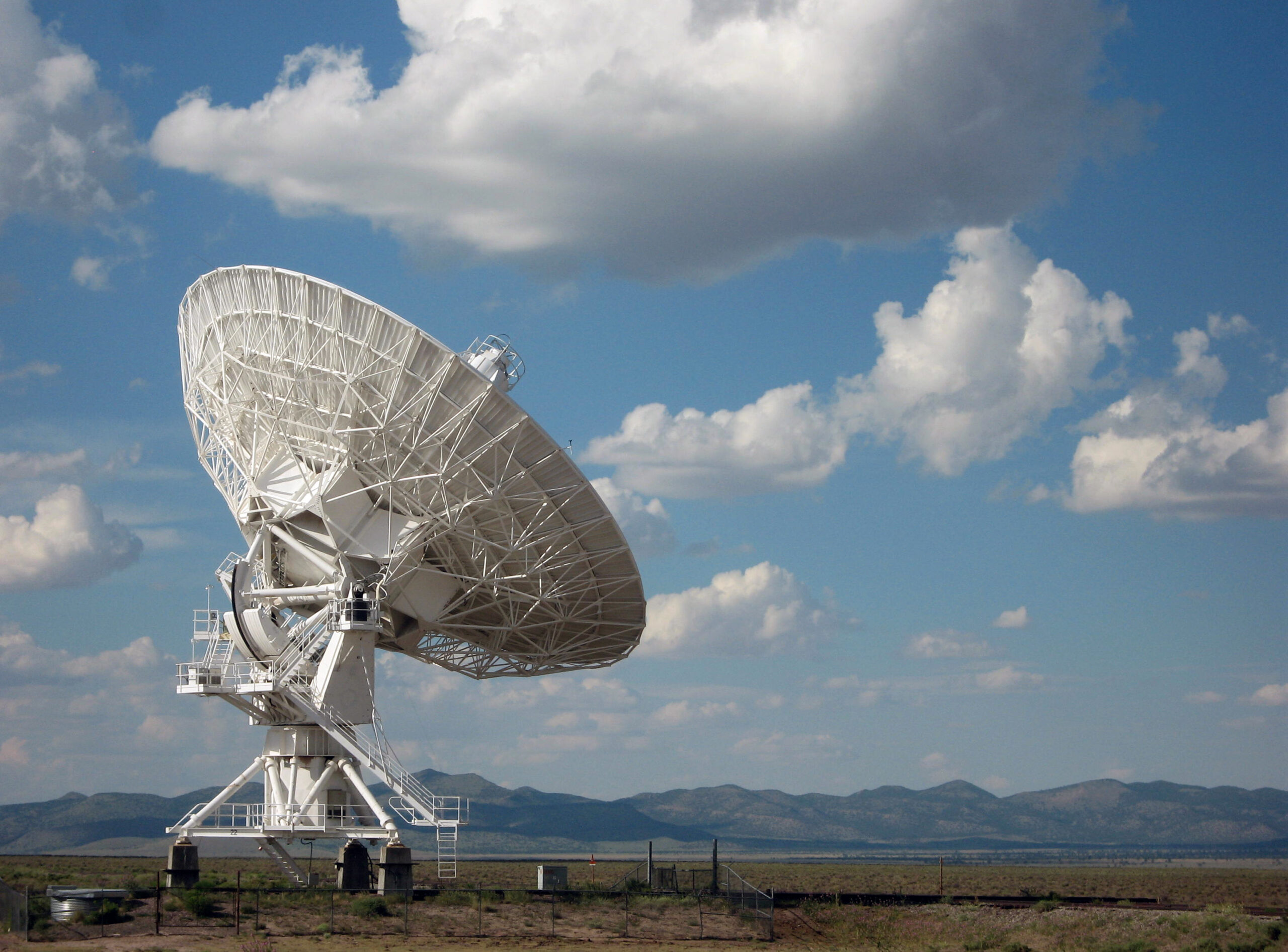
The satellite dish at a user’s location plays an essential role.
Although it resembles a simple metal bowl, its shape is carefully engineered.
Its curved surface reflects incoming radio waves toward a receiving antenna positioned at the dish’s focal point.
When transmitting, the process works in reverse.
The dish concentrates outgoing radio signals into a narrow beam aimed precisely at the satellite.
Even small pointing errors can reduce signal quality, which is why proper alignment is so important.
Modern electronically steered antennas can automatically track satellites without physically moving large mechanical parts.
Ground Stations Connect Space to the Internet
Satellites alone cannot provide internet access.
Ground stations act as the bridge between satellites and the worldwide internet.
These facilities contain large antennas, powerful communication equipment, networking hardware, and high-speed fiber-optic connections.
When your request reaches the ground station, it enters the global internet, where it is routed to the appropriate website, cloud service, or online platform.
The response then travels back through the same communication chain.
Ground stations operate continuously, managing enormous volumes of data every second.
Different Types of Satellite Orbits
Not all communication satellites orbit Earth at the same height.
Their altitude greatly influences how they perform.
Some satellites operate in geostationary orbit, approximately 35,786 kilometers above Earth’s equator.
At this altitude, a satellite completes one orbit in the same amount of time Earth rotates. As a result, it appears to remain fixed above the same location.
Because these satellites stay in one position relative to the ground, satellite dishes can remain pointed in a single direction.
However, the great distance means signals must travel much farther, increasing communication delay.
Low Earth Orbit Satellites
A newer generation of satellite internet uses Low Earth Orbit (LEO) satellites.
These satellites typically orbit a few hundred to about two thousand kilometers above Earth.
Because they are much closer to the planet, radio signals travel a far shorter distance.
This significantly reduces latency, making internet activities such as video conferencing, online gaming, and interactive applications more responsive.
Since LEO satellites move rapidly across the sky, many satellites work together as a constellation. As one satellite moves beyond view, another takes over the connection, providing continuous service.
Medium Earth Orbit Satellites
Some communication systems use Medium Earth Orbit (MEO) satellites.
These orbit between Low Earth Orbit and geostationary orbit.
They offer a balance between coverage area and communication delay.
Although less common for consumer internet than LEO or geostationary systems, MEO satellites play important roles in communication and navigation services.
What Is Latency?
One of the most important concepts in internet communication is latency.
Latency is the time required for data to travel from one point to another and back again.
Every communication system has some latency because signals require time to travel, even at the speed of light.
Geostationary satellite systems generally have higher latency because signals must travel tens of thousands of kilometers into space and back.
LEO systems reduce this delay considerably because their satellites orbit much closer to Earth.
Lower latency improves activities that require rapid two-way communication.
Why Weather Sometimes Affects Satellite Internet
Satellite signals must travel through Earth’s atmosphere.
Heavy rain, dense snow, severe storms, or thick clouds can weaken certain radio frequencies, reducing signal strength.
This phenomenon is known as rain fade.
Modern satellite systems compensate for weather in several ways.
They adjust transmission power, use advanced signal processing, select suitable frequency bands, and incorporate error-correction techniques to maintain reliable communication whenever possible.
Although severe weather can temporarily affect performance, modern systems are much more resilient than earlier generations.
How Satellites Stay in Orbit
Communication satellites do not remain in space by accident.
They continuously move forward at very high speeds.
At the same time, Earth’s gravity pulls them inward.
Because of this balance between forward motion and gravity, satellites remain in orbit rather than falling directly to Earth.
This principle was first explained by the physics of orbital motion.
Small onboard thrusters occasionally make adjustments to keep satellites in their intended positions.
How Satellites Know Where to Send Data
Communication satellites do not simply broadcast information randomly across Earth.
Instead, they use highly focused antennas that direct radio signals toward specific regions.
Modern satellites create multiple coverage areas called spot beams.
Each beam serves a different geographic region.
This allows satellites to reuse radio frequencies efficiently while increasing total network capacity.
Sophisticated onboard electronics determine where incoming signals should be transmitted.
Encryption Keeps Information Secure
Security is an essential part of satellite internet.
Data traveling between users, satellites, and ground stations is typically protected using strong encryption.
Encryption converts readable information into coded data that can only be understood by authorized devices possessing the correct cryptographic keys.
This helps protect personal information, financial transactions, and private communications from unauthorized access.
The Role of Computer Networks
Satellite internet is much more than satellites alone.
It depends upon complex computer networks that manage billions of data packets every day.
Routers determine the best paths for information.
Servers store websites, videos, and online applications.
Network management systems monitor traffic, optimize performance, and respond to changing conditions.
Together, these systems ensure that users receive information quickly and reliably.
Advantages of Satellite Internet
One of satellite internet’s greatest strengths is its broad coverage.
Unlike fiber-optic networks that require physical cables, satellites can serve enormous geographic areas from orbit.
This makes internet access possible in locations where building traditional infrastructure would be difficult or prohibitively expensive.
Satellite internet also provides valuable backup communication during natural disasters when earthquakes, hurricanes, floods, or wildfires damage ground-based networks.
Emergency responders often depend on satellite communication when conventional systems become unavailable.
Ships, aircraft, research expeditions, and humanitarian missions also benefit from reliable satellite connectivity.
Challenges of Satellite Internet
Although satellite internet offers remarkable capabilities, it also faces important challenges.
Launching satellites into space is extremely expensive.
Spacecraft must survive harsh conditions including intense radiation, extreme temperatures, and microscopic debris traveling at tremendous speeds.
Ground equipment must remain precisely aligned with satellites.
Managing thousands of satellites safely requires careful coordination to reduce the risk of collisions.
Engineers must also address increasing demand for bandwidth as more people stream videos, participate in online meetings, and use cloud-based services.
Battery technology, spacecraft reliability, and efficient radio spectrum management remain active areas of research and development.
Satellite Internet and Remote Communities
Perhaps the greatest impact of satellite internet is its ability to connect communities that have long remained isolated.
Students in remote villages can access online education.
Doctors can consult specialists through telemedicine.
Farmers can receive weather forecasts and market information.
Researchers in polar regions can communicate with colleagues around the world.
Families separated by great distances can stay connected through video calls.
In many places, satellite internet is helping reduce the digital divide by bringing access to information where traditional infrastructure has never reached.
The Future of Satellite Internet
Satellite internet continues to evolve rapidly.
Large constellations of Low Earth Orbit satellites are expanding global coverage.
Advances in antenna technology are making user equipment smaller, lighter, and easier to install.
Improved satellites can process more data while consuming less power.
Artificial intelligence is beginning to assist with network management, helping optimize traffic and predict maintenance needs.
Future satellites may communicate directly with one another using laser links, allowing data to travel through space without always returning to ground stations along the route. These inter-satellite optical links have the potential to improve network efficiency and reduce dependence on intermediate ground infrastructure for some connections.
As technology advances, satellite internet is expected to become faster, more reliable, and more widely available.
Conclusion
Satellite internet is one of humanity’s most impressive achievements in communication technology. By combining the principles of physics, radio waves, orbital mechanics, electronics, and computer networking, it allows information to travel from a device on Earth to a satellite in space and back again in an instant. This remarkable system makes it possible for people to connect to the global internet from mountains, deserts, oceans, forests, and other places where traditional networks cannot easily reach.
As satellites become more advanced and new generations of spacecraft enter orbit, satellite internet is transforming the way the world stays connected. It is expanding educational opportunities, supporting scientific research, improving emergency communication, enabling global business, and bringing millions of people closer to the digital world. What once seemed like an impossible dream—using space to connect everyday lives—has become one of the defining technologies of the modern age.