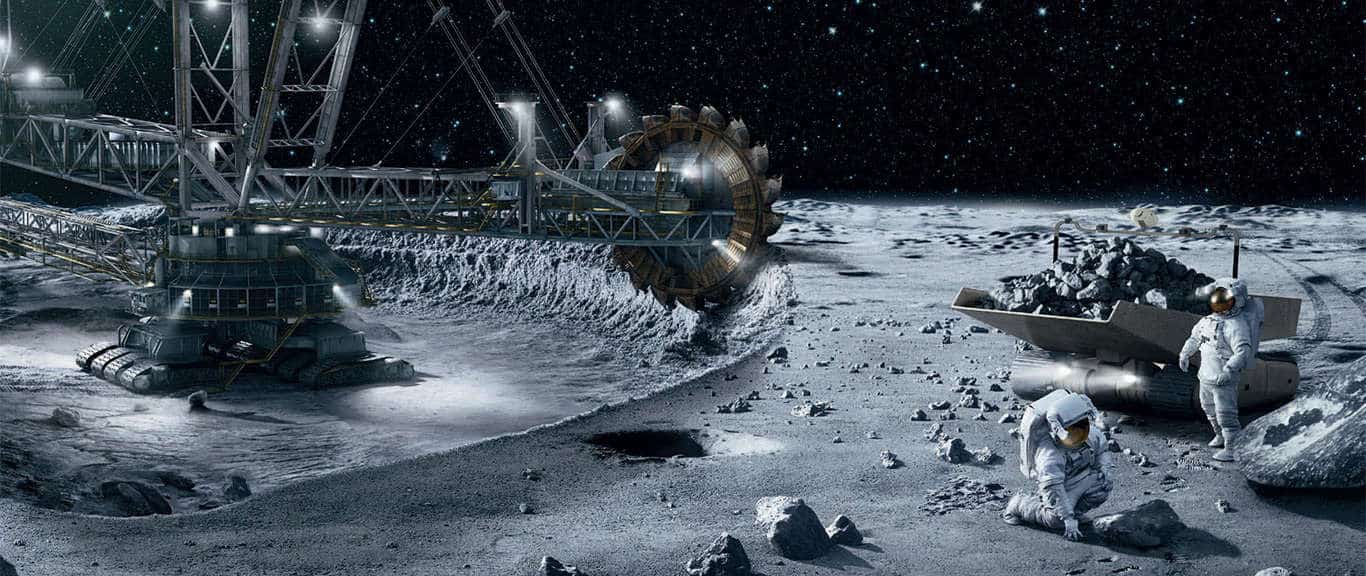
Imagine standing beneath a sky filled with countless stars and realizing that many of those tiny points of light are surrounded by worlds rich in valuable resources. Hidden within asteroids, the Moon, and even distant planets are enormous quantities of metals, minerals, water, and other materials that could one day help humanity build spacecraft, support colonies beyond Earth, and deepen our understanding of the Solar System.
For centuries, people have mined Earth’s mountains, deserts, and oceans for the resources needed to build civilizations. Today, scientists and engineers are beginning to look beyond our planet. Instead of asking what lies beneath Earth’s surface, they are asking a far more ambitious question: What valuable resources exist in space, and can we use them?
This exciting idea is known as space mining. Although it may sound like science fiction, space mining is a serious area of scientific research and technological development. While no commercial mining operation has yet taken place beyond Earth, researchers around the world are studying how it might become possible in the future.
Space mining represents much more than the search for valuable materials. It is about learning how humans can live, work, and explore far beyond our home planet.
What Is Space Mining?
Space mining is the process of extracting useful materials from celestial bodies such as asteroids, the Moon, planets, or their moons. These materials could include metals, minerals, water, and gases that may support future space missions or, in some cases, eventually be transported to Earth if doing so becomes economically and technically feasible.
Unlike traditional mining on Earth, space mining takes place in environments with little or no atmosphere, very low gravity, intense radiation, and extreme temperatures. These conditions require entirely new technologies and methods.
The goal of space mining is not simply to collect valuable substances. It is also to provide resources where they are needed most—in space itself. By obtaining materials away from Earth, future missions could reduce the need to launch every kilogram of fuel, water, or construction material from our planet.
Why Is Space Mining Important?
Launching materials into space is extremely expensive because rockets must overcome Earth’s powerful gravity. Every additional kilogram of cargo requires more fuel, making long-distance space exploration difficult and costly.
If astronauts could obtain water, oxygen, fuel, and building materials directly from the Moon or asteroids, future missions could become much more efficient.
Instead of transporting everything from Earth, explorers might produce many essential resources where they are needed.
This idea is known as in-situ resource utilization, often shortened to ISRU. It is considered one of the most promising strategies for sustainable exploration of the Moon, Mars, and beyond.
Space mining could also reduce dependence on Earth’s limited natural resources over the very long term, although this possibility remains speculative and faces major technical and economic challenges.
Where Could Space Mining Take Place?
Several locations in our Solar System are considered potential targets.
The Moon is one of the closest and most accessible destinations. Scientists believe its surface contains useful materials such as oxygen locked inside rocks, metals, and water ice in permanently shadowed polar craters.
Asteroids are another major focus. Many are thought to contain metals, rocky materials, water-bearing minerals, and carbon-rich compounds formed during the early history of the Solar System.
Mars may eventually become another important location. Its rocks, soil, atmosphere, and polar ice could provide resources for future human settlements.
Some of the icy moons orbiting the giant planets also contain enormous amounts of water ice, although they are much farther away and remain beyond the reach of current mining technology.
Why Are Asteroids So Interesting?
Asteroids are among the most attractive targets for future mining because many formed during the earliest stages of Solar System evolution.
Unlike Earth, which has undergone billions of years of geological change, many asteroids have remained relatively unchanged. They preserve ancient materials from the birth of the planets.
Different types of asteroids contain different resources.
Some are rich in rocky minerals.
Others contain significant amounts of carbon compounds and water-bearing materials.
Certain metallic asteroids are believed to contain large amounts of iron, nickel, and other metals.
Studying these objects not only offers possible future resources but also provides valuable scientific information about how the Solar System formed.
Water: One of the Most Valuable Resources in Space
When people think about mining, they often imagine gold or precious metals.
In space, however, water may be even more valuable.
Water supports human life by providing drinking water.
It can be used for hygiene and food preparation.
Plants require water to grow.
Most importantly, water can be separated into hydrogen and oxygen using electricity through a process called electrolysis.
Hydrogen and oxygen are important rocket propellants.
Oxygen is also essential for breathing.
If astronauts can produce these materials directly in space, future exploration could become far more practical.
For this reason, water is considered one of the highest-priority resources for future space mining.
Mining the Moon
The Moon is humanity’s nearest celestial neighbor and one of the leading candidates for future resource extraction.
Its surface is covered by a layer of loose rocky material called regolith.
Regolith contains oxygen chemically bound within minerals.
Although humans cannot breathe oxygen in this form, scientists are developing techniques to separate oxygen from lunar rocks.
The Moon also contains aluminum, titanium, silicon, iron, magnesium, and other useful elements.
Perhaps most exciting is the discovery of water ice inside permanently shadowed craters near the lunar poles. Because these regions receive little or no direct sunlight, temperatures remain extremely low, allowing ice to survive for billions of years.
This frozen water could one day support lunar bases and future missions deeper into the Solar System.
Could We Mine Mars?
Mars possesses many resources that future explorers may use.
Its atmosphere is composed mostly of carbon dioxide.
Future technologies may convert this carbon dioxide into oxygen and other useful products.
Water ice exists beneath the Martian surface and within its polar ice caps.
Martian rocks contain minerals that could potentially provide metals and building materials.
Although mining on Mars presents enormous engineering challenges, these local resources may eventually support long-term human exploration.
How Would Space Mining Work?
Mining in space is very different from mining on Earth.
There are no conventional roads, heavy trucks, or large mining crews.
Instead, scientists envision highly automated robotic systems performing much of the work.
Robotic spacecraft would first identify suitable mining locations using cameras, spectrometers, radar, and other scientific instruments.
After landing, robotic machines might drill into rocks, collect loose material, excavate ice deposits, or gather surface regolith.
The collected material could then be processed using specialized equipment that separates useful substances from unwanted material.
Some resources might be stored for local use, while others could potentially be transported elsewhere in space.
Robots Will Play a Major Role
Because space environments are dangerous for humans, robots are expected to perform much of the early mining work.
Modern robotic systems can already carry out complex tasks on Earth and in space.
Future mining robots may operate semi-autonomously, making certain decisions while remaining supervised by engineers on Earth or astronauts stationed nearby.
Artificial intelligence may help these robots navigate uneven terrain, avoid hazards, identify valuable materials, and optimize mining operations.
Robotic mining would reduce risks to human crews while allowing continuous operation in harsh environments.
Identifying Valuable Resources
Before mining begins, scientists must determine exactly what materials are present.
Spacecraft use sophisticated scientific instruments to analyze the composition of celestial bodies.
Spectrometers measure how different materials absorb and reflect light.
Radar systems probe beneath surfaces.
Cameras provide detailed images of geological features.
Some missions collect samples and return them to Earth for laboratory analysis.
These investigations help scientists understand which locations may be suitable for future resource extraction.
Processing Materials in Space
Mining is only the first step.
Raw materials must also be processed.
On the Moon, oxygen may be extracted from minerals through chemical and thermal processes.
Water ice must be melted and purified.
Metal-bearing rocks require methods that separate useful metals from surrounding minerals.
Some processing methods may use heat from concentrated sunlight.
Others may rely on electricity generated by solar panels or future nuclear power systems.
Scientists continue to study the most efficient ways to process materials under space conditions.
Building with Space Resources
One of the most exciting possibilities is using mined materials to construct buildings, roads, landing pads, and spacecraft components.
Transporting construction materials from Earth is extremely expensive.
Instead, future explorers may produce bricks, concrete-like materials, or metal components using local resources.
Researchers are even studying ways to use lunar or Martian soil in advanced manufacturing techniques such as three-dimensional printing.
Building infrastructure from local materials could make long-term space settlements much more practical.
Scientific Benefits of Space Mining
Space mining is not only about obtaining resources.
Every exploration mission expands scientific knowledge.
Studying asteroids helps researchers understand the earliest stages of planetary formation.
Examining lunar rocks reveals the Moon’s geological history.
Investigating Martian minerals provides clues about the planet’s ancient environment and whether conditions may once have supported microbial life.
The technologies developed for mining also improve robotics, remote sensing, materials science, and planetary exploration.
Engineering Challenges
Although the concept is exciting, space mining faces many obstacles.
Extreme temperatures can damage equipment.
Fine dust may interfere with mechanical systems.
Low gravity changes how materials behave during excavation.
Communication delays make remote operation more difficult, especially on distant worlds.
Machines must survive radiation, vacuum conditions, and years of continuous operation with limited maintenance.
Developing reliable systems capable of overcoming these challenges remains a major engineering task.
Economic Challenges
Even if mining is technically possible, it must also make economic sense.
Launching spacecraft, developing advanced robots, and operating missions require enormous investments.
Scientists and economists continue studying whether future mining operations can become financially sustainable.
For many experts, the greatest value may initially come from supporting exploration missions rather than transporting large quantities of minerals back to Earth.
Using resources directly in space could provide greater economic benefits than returning them to our planet.
Environmental Considerations
As humanity expands into space, responsible exploration becomes increasingly important.
Scientists emphasize that mining activities should avoid unnecessary contamination of other worlds.
Some celestial bodies may preserve valuable scientific evidence about the early Solar System.
Others could contain environments worthy of protection for future research.
International discussions continue regarding how to balance exploration, scientific preservation, and resource use.
Careful planning will help ensure that future activities remain sustainable and scientifically responsible.
International Cooperation
Space exploration has often brought nations together.
Future space mining may involve cooperation among governments, scientific organizations, universities, and private companies.
International agreements already establish important principles for the peaceful exploration and use of outer space, while discussions continue about how resources extracted from celestial bodies should be managed.
As technology advances, international cooperation will likely remain essential for ensuring safe and responsible activities beyond Earth.
Space Mining and the Future of Human Exploration
Many scientists believe that space mining could become a key part of humanity’s future in space.
Permanent lunar bases may rely on locally produced oxygen and water.
Mars missions may manufacture fuel before astronauts return to Earth.
Deep-space expeditions could refuel using resources obtained from asteroids instead of carrying all necessary supplies from Earth.
These capabilities could allow humans to travel farther than ever before while reducing the enormous costs associated with launching everything from Earth.
Although these goals remain for the future, research continues to move steadily forward.
Is Space Mining Happening Today?
At present, commercial space mining has not yet begun.
However, important progress has already been made.
Several robotic missions have successfully visited asteroids, collected samples, and returned them to Earth for scientific study. Lunar missions have mapped water ice and analyzed surface materials in unprecedented detail. Researchers are also developing technologies that could one day extract oxygen from lunar regolith and process resources directly on the Moon.
These achievements represent important first steps toward future resource utilization beyond Earth.
The Future of Space Mining
The coming decades may witness remarkable advances.
Improved robotic systems, more efficient spacecraft, stronger artificial intelligence, better battery technology, and advanced manufacturing methods could gradually make space mining more practical.
Future astronauts may live in lunar habitats built partly from local materials.
Spacecraft may refuel using hydrogen and oxygen produced from extraterrestrial water.
Construction of large space telescopes, research stations, and even future settlements may depend on resources obtained beyond Earth.
While many challenges remain, each new mission brings humanity closer to understanding how these possibilities might become reality.
Conclusion
Space mining is the idea of extracting useful resources from the Moon, asteroids, Mars, and other celestial bodies to support future exploration and, potentially, long-term human activity beyond Earth. Although commercial mining in space has not yet become a reality, scientists and engineers are actively developing the technologies needed to make it possible.
More than simply searching for valuable minerals, space mining represents a new chapter in humanity’s relationship with the cosmos. It combines astronomy, geology, engineering, robotics, chemistry, and physics in a shared effort to explore the Solar System more sustainably. As technology continues to advance, the resources hidden among distant worlds may one day help build lunar bases, fuel missions to Mars, and expand humanity’s presence across space—transforming what was once a dream into one of the greatest scientific achievements of the future.