Imagine standing before a locked door that has trillions of possible keys. A traditional computer tries one key after another with remarkable speed, but eventually the sheer number of possibilities becomes overwhelming. A quantum computer approaches certain kinds of problems in a fundamentally different way, using the strange and fascinating laws of quantum physics to process information in ways that ordinary computers cannot.
This idea has captured the imagination of scientists, engineers, and technology companies around the world. Quantum computing promises to solve some of the most challenging scientific and mathematical problems ever encountered, from designing new medicines to understanding complex molecules and improving secure communications.
But how does a quantum computer actually work?
The answer lies deep within the strange world of quantum mechanics, where particles do not behave according to the familiar rules of everyday life. Understanding how quantum computers work requires a journey into this microscopic world, where information is stored, manipulated, and measured in ways that seem almost unbelievable but are supported by decades of scientific experiments.
The Difference Between Classical and Quantum Computers
To understand quantum computers, it is helpful to begin with the computers we use every day.
Every smartphone, laptop, gaming console, and supercomputer is a classical computer. No matter how different these devices appear on the outside, they all process information using the same basic building block: the bit.
A classical bit can exist in one of only two states.
It is either 0 or 1.
Everything a traditional computer does—from displaying a photograph to launching a spacecraft—ultimately depends on enormous strings of these binary digits.
Inside a processor, billions of tiny electronic switches called transistors rapidly change between the states of 0 and 1. These switches perform logical operations that allow the computer to calculate, store information, and execute programs.
Quantum computers work differently.
Instead of ordinary bits, they use quantum bits, or qubits, which obey the laws of quantum mechanics rather than classical physics.
This single difference creates an entirely new way of processing information.
What Is a Qubit?
A qubit is the basic unit of information in a quantum computer.
Unlike a classical bit, which must always be either 0 or 1, a qubit is a physical quantum system that can exist in a quantum state described by a combination of the basis states labeled 0 and 1 until it is measured.
This property allows quantum computers to perform calculations using the unique behavior of quantum systems rather than relying solely on electrical switching.
Qubits are not imaginary mathematical objects.
They are real physical systems created in laboratories.
Scientists build qubits using several different technologies.
Some qubits are made from tiny superconducting electrical circuits cooled to temperatures only a fraction of a degree above absolute zero.
Others use electrically charged atoms called ions, individual neutral atoms held in place by lasers, photons traveling through optical systems, or semiconductor devices similar to those used in modern electronics.
Although these technologies differ, they all seek to create stable quantum systems that can reliably store and manipulate information.
The Quantum World Is Different
Our everyday experience teaches us that objects have definite properties.
A book rests on a table.
A light switch is on or off.
A ball is either moving or standing still.
Quantum particles do not always behave this way.
Electrons, photons, and atoms obey quantum mechanics, a branch of physics that describes nature on extremely small scales.
In this world, particles can display behaviors that seem surprising when compared with ordinary experience.
Quantum computers take advantage of these behaviors instead of trying to avoid them.
Rather than forcing quantum systems to behave like classical machines, engineers design computers that work with the laws of quantum physics.
Superposition: A New Way to Represent Information
One of the most important ideas behind quantum computing is superposition.
In classical computing, every bit has one definite value at any given moment.
A qubit is different.
Before it is measured, a qubit can exist in a quantum state that is a combination of the basis states 0 and 1. This state is described mathematically by probability amplitudes, which determine the likelihood of different measurement outcomes.
This does not mean a qubit literally contains both values in the everyday sense. Instead, it means its behavior is governed by quantum mechanics, allowing algorithms to manipulate information in ways that have no classical equivalent.
Superposition provides quantum computers with a richer mathematical space for computation.
Visualizing Superposition
Imagine a globe.
A classical bit is like standing at either the North Pole or the South Pole.
Those are the only two possibilities.
A qubit is different.
Its quantum state can be represented as any point on the surface of an abstract sphere known as the Bloch sphere.
This mathematical picture illustrates that qubits have many possible quantum states beyond the simple values of 0 and 1.
When the qubit is finally measured, however, the result is always either 0 or 1.
The power of quantum computing comes from how quantum states evolve before that measurement takes place.
Entanglement: Connecting Qubits
Perhaps the most remarkable feature of quantum computing is entanglement.
When two qubits become entangled, their quantum states become linked in such a way that they must be described together rather than independently.
Measuring one qubit provides information about the correlated state of the other, even if the qubits are separated by large distances.
Entanglement does not allow information to travel faster than light, and it does not violate Einstein’s theory of relativity. Instead, it reflects one of the most fundamental and experimentally verified features of quantum mechanics.
Quantum algorithms rely heavily on entanglement because it enables complex relationships between qubits that classical systems cannot efficiently reproduce.
Quantum Interference
Another essential principle is quantum interference.
Quantum states behave somewhat like waves.
When waves meet, they can strengthen one another or cancel one another out.
Quantum algorithms exploit this behavior.
Engineers design sequences of operations that amplify the probability of correct answers while reducing the probability of incorrect ones.
Instead of blindly searching through every possible solution, quantum algorithms carefully guide interference toward the desired result.
This is one reason quantum computers can outperform classical computers on certain specialized problems.
Preparing the Qubits
Every quantum computation begins by preparing qubits in carefully controlled quantum states.
Scientists use lasers, microwave pulses, electrical signals, or magnetic fields depending on the type of quantum hardware.
These control systems place qubits into the desired starting configuration before calculations begin.
Preparing qubits accurately is essential because even tiny errors at this stage can affect the final result.
Modern quantum computers require extraordinary precision.
Quantum Gates
Classical computers perform calculations using logic gates such as AND, OR, and NOT.
Quantum computers use quantum gates.
A quantum gate changes the state of one or more qubits according to the laws of quantum mechanics.
Unlike classical logic gates, quantum gates often produce superposition and entanglement.
By applying many quantum gates in sequence, a quantum computer performs increasingly complex calculations.
These sequences are called quantum circuits.
Designing efficient quantum circuits is one of the central challenges of quantum programming.
Running a Quantum Algorithm
A quantum algorithm is a carefully designed sequence of quantum operations.
It begins by initializing the qubits.
Next, quantum gates manipulate the qubits through many intermediate states.
During this process, superposition, entanglement, and interference work together to shape the probabilities of different outcomes.
Finally, the qubits are measured.
The measurement produces ordinary classical information—zeros and ones—that can be interpreted by conventional computers.
The quantum computer itself performs the uniquely quantum part of the calculation, while classical computers often handle the remaining computational tasks.
Measurement: Turning Quantum Information into Classical Results
Measurement is one of the most important steps in quantum computing.
Before measurement, qubits exist in quantum states.
After measurement, they produce ordinary classical values.
Each measurement returns either 0 or 1 for every qubit.
Because quantum mechanics is probabilistic, the outcome of a single run may vary.
To obtain reliable answers, quantum algorithms are typically executed many times.
Researchers analyze the collection of measurement results to identify the most probable solution.
This repeated sampling is a normal part of quantum computation.
Why Quantum Computers Need Extremely Low Temperatures
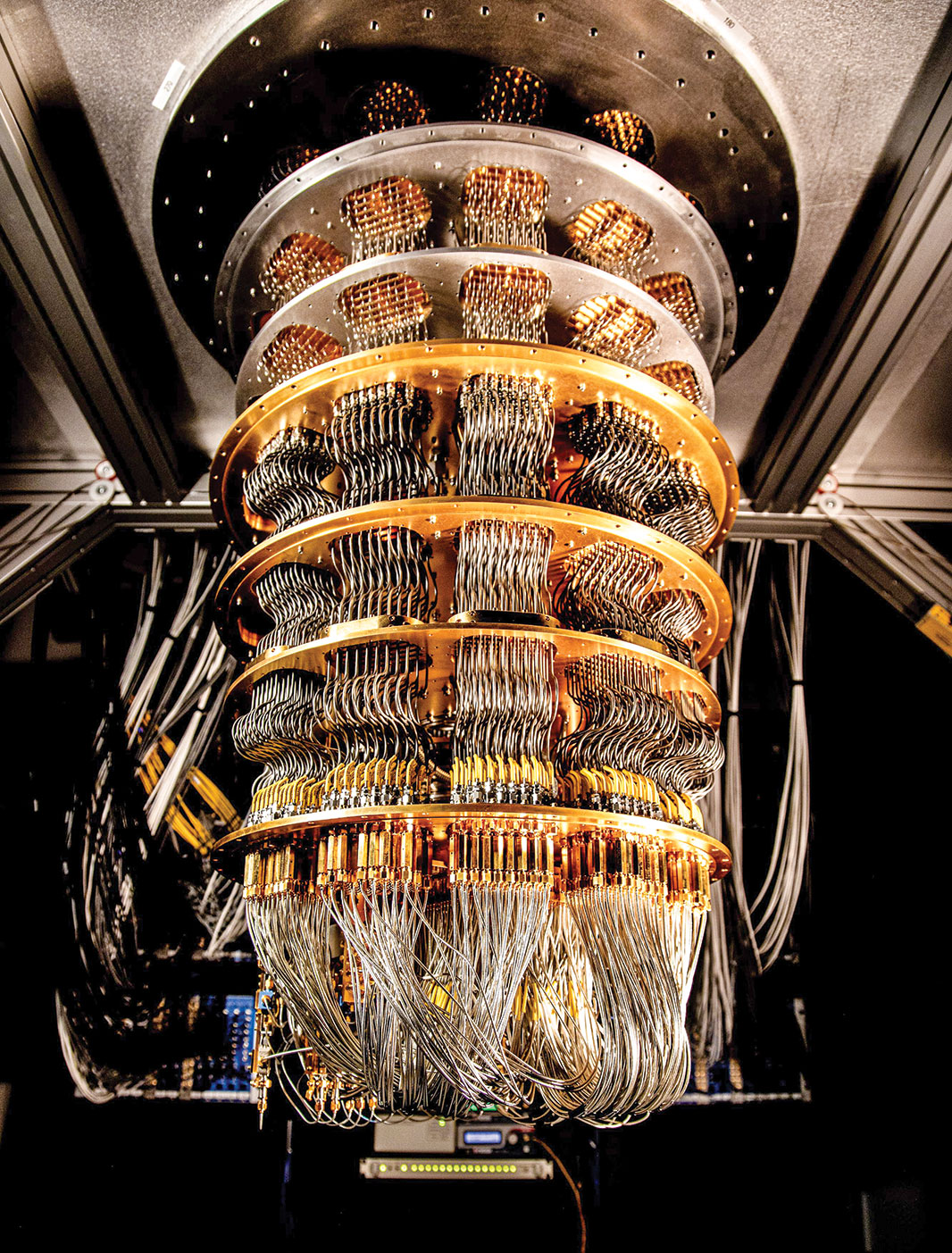
Many quantum computers operate at temperatures only a tiny fraction of a degree above absolute zero, the coldest temperature physically possible.
At these temperatures, superconducting materials lose electrical resistance, allowing delicate quantum effects to persist long enough for computation.
Special refrigerators called dilution refrigerators create these extremely cold environments.
Inside these systems, multiple layers of shielding protect the qubits from heat, electromagnetic interference, and other disturbances.
Without this protection, quantum states would disappear almost immediately.
Not all quantum computing technologies require such extreme cooling. For example, trapped-ion and photonic systems operate under different physical conditions, but all approaches must carefully isolate qubits from unwanted environmental interactions.
Decoherence: The Biggest Challenge
Quantum states are extremely fragile.
Interactions with the surrounding environment gradually destroy the delicate quantum behavior needed for computation.
This process is known as decoherence.
Even tiny vibrations, stray electromagnetic fields, temperature fluctuations, or interactions with nearby particles can introduce errors.
Decoherence limits how long qubits remain useful.
Scientists devote enormous effort to extending these lifetimes so that longer and more complicated calculations become possible.
Reducing decoherence is one of the greatest engineering challenges in quantum computing.
Quantum Error Correction
Ordinary computers correct errors relatively easily because bits remain stable.
Quantum computers face a much harder problem.
Qubits cannot simply be copied because quantum mechanics includes a principle known as the no-cloning theorem, which states that an unknown quantum state cannot be perfectly duplicated.
Instead, scientists use quantum error correction.
Rather than storing information in a single physical qubit, they spread it across many carefully entangled physical qubits.
This creates a more reliable logical qubit that can detect and correct certain types of errors without directly measuring and destroying the encoded quantum information.
Although quantum error correction requires many additional qubits, it is considered essential for building practical large-scale quantum computers.
Different Ways to Build Quantum Computers
Researchers have developed several competing technologies for building quantum computers.
Superconducting quantum computers use tiny electrical circuits cooled to extremely low temperatures.
Trapped-ion quantum computers store information in electrically charged atoms held by electromagnetic fields.
Neutral-atom systems trap individual atoms using lasers.
Photonic quantum computers use particles of light.
Silicon-based quantum computers adapt techniques developed by the semiconductor industry.
Each technology has unique strengths.
Some provide longer coherence times.
Others perform operations more quickly.
Some are easier to manufacture on larger scales.
Scientists continue improving every approach because no single technology has yet solved all the challenges of quantum computing.
Working Together with Classical Computers
Quantum computers do not work alone.
In nearly every practical application, they operate alongside classical computers.
The classical computer prepares data, controls the quantum hardware, sends instructions, collects measurement results, and analyzes the output.
The quantum processor performs only the parts of the calculation where quantum mechanics offers an advantage.
This partnership is expected to remain important even after quantum computers become much more powerful.
Future computing systems will likely combine classical and quantum processors, allowing each to perform the tasks they handle best.
Why Quantum Computers Cannot Solve Every Problem
The excitement surrounding quantum computing sometimes creates unrealistic expectations.
Quantum computers are not universal speed machines.
Many everyday tasks remain more efficient on classical computers.
Editing documents, streaming videos, browsing the internet, managing databases, and performing simple calculations are unlikely to benefit from quantum hardware.
Instead, quantum computers are expected to excel in specialized areas such as quantum simulation, certain optimization problems, parts of cryptography, and specific mathematical computations.
Their greatest strength lies in solving problems that naturally involve quantum systems or that have algorithms specifically designed to exploit quantum mechanics.
Real-World Applications
Researchers believe quantum computers could eventually transform many scientific fields.
In chemistry, they may simulate complex molecules more accurately than classical computers, helping scientists understand chemical reactions in unprecedented detail.
In medicine, improved molecular simulations could accelerate drug discovery and support the development of new therapies.
In materials science, quantum computers may help design better batteries, superconductors, catalysts, and advanced electronic materials.
Optimization problems in transportation, manufacturing, finance, and logistics may also benefit from future quantum algorithms.
Artificial intelligence researchers are exploring whether quantum computing can improve certain machine learning techniques, although this field remains highly experimental.
Each of these possibilities depends on continued advances in quantum hardware and software.
Why Building a Useful Quantum Computer Is So Difficult
Creating a practical quantum computer requires solving many engineering problems simultaneously.
Qubits must remain stable.
Errors must be minimized.
Quantum gates must operate with extremely high precision.
Control electronics must synchronize thousands or even millions of operations.
Cryogenic systems must maintain incredibly low temperatures for some hardware platforms.
Software must translate complex scientific problems into efficient quantum circuits.
Scaling from today’s experimental machines to future fault-tolerant quantum computers will require advances across physics, engineering, computer science, and mathematics.
The Future of Quantum Computing
Quantum computing remains one of the most exciting frontiers of modern science and technology.
Researchers around the world continue improving qubit quality, reducing errors, developing better quantum algorithms, and creating more reliable hardware.
Although today’s quantum computers are still limited, progress has been remarkably rapid over the past two decades.
Future systems may contain millions of physical qubits working together through sophisticated quantum error correction to create large numbers of reliable logical qubits.
If these goals are achieved, quantum computers could solve scientific problems that are currently beyond humanity’s computational reach.
The exact timeline remains uncertain, but the direction of progress is clear.
Why Understanding How Quantum Computers Work Matters
Quantum computers are unlike any machines humanity has built before. Instead of relying solely on electrical switches that represent zeros and ones, they harness the strange but well-established principles of quantum mechanics to process information in fundamentally new ways. Through superposition, entanglement, interference, and carefully designed quantum algorithms, these remarkable machines can tackle certain problems that challenge even the most powerful classical supercomputers.
While they are unlikely to replace laptops or smartphones, quantum computers are expected to become specialized scientific tools capable of transforming research in chemistry, medicine, materials science, optimization, and cryptography. Their development represents not just a technological milestone but also a profound demonstration of how deeply our understanding of nature can reshape the tools we build.
Every quantum computer is the result of decades of discoveries in physics, mathematics, engineering, and computer science. As researchers continue to overcome challenges such as decoherence, error correction, and scalability, these machines move steadily closer to practical use. Whether helping scientists discover life-saving medicines, design revolutionary materials, or explore the mysteries of the universe, quantum computers have the potential to become one of the most significant technological achievements of the modern age.