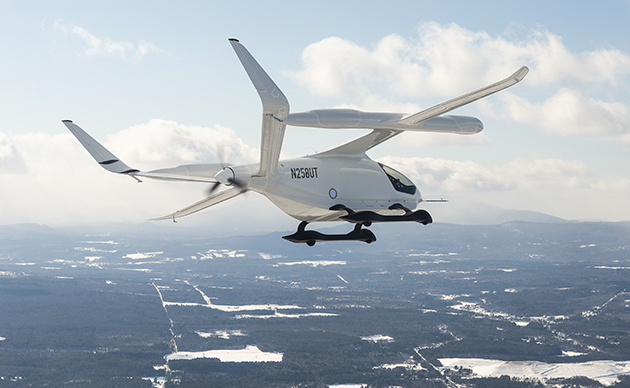
Imagine standing on the roof of a city building as a quiet aircraft gently lifts straight into the sky. There is no long runway, no roaring jet engine, and no dramatic acceleration. Instead, the aircraft rises smoothly, almost like a giant drone, before tilting forward and flying toward its destination. It may sound like a scene from a futuristic movie, but this vision is becoming increasingly real through a new generation of aircraft known as eVTOLs.
Engineers, scientists, and aviation companies around the world are developing eVTOL aircraft to transform short-distance travel. These innovative vehicles are designed to make transportation faster, cleaner, and more efficient, especially in crowded urban areas where traffic congestion wastes countless hours every day.
Although eVTOL aircraft are still in the early stages of commercial deployment, they represent one of the most exciting advances in modern aviation. They combine decades of aerospace engineering with breakthroughs in electric propulsion, battery technology, computer systems, and advanced materials.
But what exactly is an eVTOL aircraft? How does it rise vertically into the air? How can it transition from hovering like a helicopter to flying like an airplane? The answers lie in the fascinating science of flight.
What Does eVTOL Mean?
The term eVTOL stands for Electric Vertical Takeoff and Landing.
Each part of the name describes an important feature.
The letter “e” stands for electric, meaning the aircraft is powered by electricity instead of traditional jet fuel or aviation gasoline.
“VTOL” stands for Vertical Takeoff and Landing, which means the aircraft can lift off and land straight up and down without requiring a runway.
Unlike conventional airplanes that need long runways for takeoff, eVTOL aircraft can operate from relatively small landing areas. These dedicated facilities are often called vertiports, where aircraft can safely take off, land, recharge, and prepare for their next flight.
Why Are eVTOL Aircraft Being Developed?
Modern cities face growing transportation challenges.
Roads become increasingly crowded as populations grow. Traffic congestion wastes time, increases fuel consumption, and contributes to air pollution.
Engineers believe that using low-altitude airspace for short trips could reduce pressure on roads while providing much faster travel between destinations.
An eVTOL aircraft could carry passengers across a city in a fraction of the time required by a car during heavy traffic.
Beyond passenger transportation, eVTOL technology may also support emergency medical services, disaster response, cargo delivery, infrastructure inspection, and transportation to remote locations.
The goal is not to replace conventional airplanes but to create an entirely new category of regional and urban transportation.
The Four Forces of Flight
Every aircraft, including an eVTOL, must overcome four fundamental forces.
The first is gravity, which constantly pulls the aircraft toward Earth.
The second is lift, the upward force that allows the aircraft to leave the ground.
The third is thrust, which moves the aircraft upward during vertical flight or forward during cruising.
The fourth is drag, the resistance created by air as the aircraft moves.
For successful flight, engineers carefully design the aircraft so that lift can overcome gravity and thrust can overcome drag.
Balancing these forces is one of the central challenges of aerospace engineering.
How Does an eVTOL Lift Off Vertically?
One of the defining features of an eVTOL is its ability to take off vertically.
Instead of accelerating down a runway, multiple electric propellers or rotors spin rapidly to push air downward.
According to Newton’s Third Law of Motion, every action produces an equal and opposite reaction. As the propellers force air downward, an equal upward force pushes the aircraft into the sky.
This upward force is called lift.
Many eVTOL designs use several smaller rotors rather than one or two large ones. Multiple rotors improve stability, distribute lifting forces more evenly, and can provide additional redundancy if a motor or propeller fails.
The aircraft rises steadily until it reaches a safe altitude.
Electric Motors Power the Aircraft
Unlike conventional helicopters that rely on fuel-burning engines, eVTOL aircraft typically use electric motors.
Electric motors convert electrical energy into mechanical rotation.
When electricity flows through the motor, magnetic fields cause the rotor inside the motor to spin. This spinning motion turns the propellers.
Electric motors offer several important advantages.
They respond almost instantly to changes in power.
They contain fewer moving parts than many combustion engines.
They require less routine maintenance.
They operate much more quietly.
They produce no direct exhaust emissions during flight.
These characteristics make electric propulsion especially attractive for aircraft operating near cities.
Where Does the Electricity Come From?
Electric motors require a reliable source of electrical energy.
Most current eVTOL aircraft use large rechargeable lithium-ion battery packs.
These batteries store electrical energy chemically and deliver power to the motors during flight.
The batteries are among the heaviest components of the aircraft.
Engineers must carefully balance battery capacity with aircraft weight because heavier batteries provide more stored energy but also require more lift to keep the aircraft airborne.
Researchers are actively developing new battery technologies with higher energy density, faster charging times, and improved safety.
Future aircraft may also use hydrogen fuel cells or other advanced energy storage systems if they become practical for aviation.
Why Multiple Propellers Are Better
Many people notice that eVTOL aircraft often have numerous propellers instead of just one.
There are several engineering reasons for this design.
Multiple propellers distribute lifting forces more evenly across the aircraft.
They allow highly precise control during hovering.
They reduce the load placed on each motor.
In many designs, they improve redundancy because the aircraft may be able to tolerate certain failures while maintaining controlled flight, depending on the specific certification and design.
Modern computers constantly adjust the speed of individual propellers to maintain balance.
This continuous coordination allows remarkably smooth flight.
Hovering in Mid-Air
One of the most impressive abilities of an eVTOL aircraft is hovering.
Hovering means remaining nearly stationary in the air without moving forward or backward.
To achieve this, the upward lift generated by the propellers must closely balance the downward pull of gravity.
At the same time, the aircraft must remain level despite wind, changing air currents, and passenger movement.
Dozens of onboard sensors continuously measure the aircraft’s position and orientation.
Powerful computers analyze this information many times each second and adjust each motor accordingly.
These rapid corrections allow stable hovering.
Transitioning to Forward Flight
After taking off vertically, many eVTOL aircraft begin moving toward their destination.
This stage is called the transition.
Different aircraft accomplish this in different ways.
Some tilt their entire rotors forward.
Others tilt only the propellers.
Some use separate sets of propellers for vertical lift and forward flight.
As the aircraft gains forward speed, wings begin generating aerodynamic lift, much like those of a conventional airplane.
Once enough lift comes from the wings, some vertical propellers reduce their workload or stop operating, depending on the aircraft’s design.
This transition increases efficiency because wings generate lift more efficiently than relying entirely on powered rotors during forward flight.
The Role of Wings
Not every eVTOL looks like a helicopter.
Many designs include fixed wings.
During cruising flight, air flowing over these wings creates lift through aerodynamic principles.
The wing’s shape causes air pressure to differ above and below the wing, contributing to lift while the aircraft moves forward. A complete explanation also involves the wing’s angle of attack and the downward deflection of air.
Using wings allows the aircraft to travel farther while consuming less energy than continuous vertical flight.
This is one reason many eVTOL aircraft resemble a combination of an airplane and a multicopter drone.
Flight Computers Make Everything Possible
Modern eVTOL aircraft depend heavily on advanced computer systems.
Flying a vehicle with numerous independently controlled propellers would be extremely difficult without computer assistance.
Flight computers constantly monitor information from many onboard sensors.
They measure altitude.
They calculate speed.
They detect orientation.
They monitor battery condition.
They evaluate motor performance.
They compensate for wind.
They help maintain stability.
These systems perform thousands of calculations every second.
Many adjustments happen automatically before passengers even notice changing conditions.
Sensors That Guide the Aircraft
An eVTOL relies on a network of sophisticated sensors.
Satellite navigation systems help determine geographic position.
Inertial measurement units detect acceleration and rotation.
Barometric sensors estimate altitude.
Radar and other detection systems may monitor nearby aircraft.
Cameras observe surrounding objects.
Some aircraft also use LiDAR technology to create highly detailed three-dimensional maps of nearby obstacles.
Together, these sensors provide the aircraft with an accurate understanding of its environment.
Artificial Intelligence and Automation
Artificial intelligence is becoming increasingly important in modern aviation.
AI systems can assist with route planning, obstacle detection, weather analysis, energy management, and predictive maintenance.
Many eVTOL aircraft are expected to include high levels of automation.
However, commercial passenger operations are expected to remain subject to aviation regulations, and many aircraft are initially planned to operate with trained pilots while certification and operational experience continue to develop.
Automation supports safety but does not eliminate the need for rigorous engineering and oversight.
Materials That Keep the Aircraft Lightweight
Weight is one of the greatest challenges in aviation.
A heavier aircraft requires more lift, which demands more energy.
To reduce weight while maintaining strength, many eVTOL aircraft use advanced composite materials.
Carbon-fiber composites are particularly popular because they are extremely strong while remaining much lighter than many traditional metals.
Engineers also use lightweight aluminum alloys, titanium in selected components, and other advanced materials to improve efficiency.
Every kilogram saved increases the aircraft’s performance.
How Do eVTOL Aircraft Land?
Landing is essentially the reverse of takeoff.
As the aircraft approaches its destination, onboard computers gradually reduce forward speed.
If the aircraft uses tilting propellers, they rotate upward again to generate vertical lift.
The aircraft enters a stable hover.
The computer carefully adjusts each motor to maintain balance while descending.
Eventually, the landing gear gently touches the ground.
The motors then slow to a stop.
Throughout the landing process, sensors continuously monitor position, wind conditions, and altitude.
Are eVTOL Aircraft Safe?
Safety is the most important consideration in aviation.
Manufacturers design eVTOL aircraft with multiple layers of protection.
Many aircraft include numerous independent motors.
Battery systems often contain sophisticated monitoring equipment.
Flight-control computers are designed with redundancy so backup systems can take over if necessary.
Before passenger service begins, aircraft must undergo extensive testing to demonstrate compliance with aviation safety regulations established by national aviation authorities.
This certification process can take years.
Noise Reduction
One major advantage of many eVTOL aircraft is reduced noise.
Traditional helicopters generate much of their noise from large rotor blades and powerful combustion engines.
Electric motors are generally quieter.
Many smaller propellers can also distribute sound differently than a single large rotor, although overall noise depends on the aircraft’s design and operating conditions.
Reducing noise is essential if aircraft are to operate regularly near homes, offices, schools, and hospitals.
Environmental Benefits
Many people are interested in eVTOL aircraft because of their potential environmental advantages.
Electric propulsion eliminates direct exhaust emissions during flight.
When charged using electricity generated from renewable sources, overall greenhouse gas emissions may be lower than those of comparable fossil-fuel-powered transportation.
However, the total environmental impact also depends on battery production, electricity generation, aircraft manufacturing, and recycling.
Scientists continue studying the complete environmental footprint of electric aviation.
Challenges That Still Need Solutions
Despite remarkable progress, several important challenges remain.
Battery technology must continue improving to provide longer flight ranges.
Charging infrastructure must become widely available.
Vertiports need to be built in suitable locations.
Air traffic systems must safely manage increasing numbers of low-altitude aircraft.
Manufacturing costs must decrease before widespread personal ownership becomes practical.
Public confidence, pilot training, maintenance standards, and regulatory approval will also play critical roles.
These challenges are significant, but researchers around the world are actively working to solve them.
The Future of eVTOL Aircraft
The coming decades may bring dramatic changes to urban transportation.
As batteries become more powerful, electric motors become more efficient, and computer systems become increasingly intelligent, eVTOL aircraft could become an important part of everyday travel.
Future cities may include networks of vertiports connected by carefully managed aerial routes.
Passengers could book short flights through mobile applications much like ride-sharing services today.
Emergency medical teams may reach patients faster.
Businesses may transport workers more efficiently.
Remote communities may gain improved transportation options.
Although widespread adoption will take time, the scientific foundation is already being built.
Conclusion
eVTOL aircraft represent one of the most exciting developments in modern aerospace engineering. By combining electric propulsion, vertical takeoff and landing, advanced computer systems, lightweight materials, and sophisticated flight-control technology, these aircraft offer a new approach to short-distance air travel. Instead of relying on long runways, they can rise vertically, transition smoothly into forward flight, and land with remarkable precision.
While important challenges remain—including battery performance, infrastructure, certification, and air traffic management—the rapid pace of technological progress continues to bring eVTOL aircraft closer to everyday use. They are more than futuristic machines; they are the product of decades of scientific research and engineering innovation. As these technologies mature, eVTOL aircraft have the potential to reshape transportation, making cities more connected and opening a new chapter in the history of human flight.