The internet has become an essential part of modern life. We stream movies in ultra-high definition, attend virtual meetings, play online games, back up precious photos to the cloud, and connect with people around the world in an instant. Behind these everyday experiences lies an extraordinary technology that quietly carries enormous amounts of information across cities, countries, and even oceans. That technology is fiber-optic internet.
Unlike traditional internet connections that send electrical signals through copper wires, fiber-optic internet uses pulses of light traveling through strands of glass thinner than a human hair. It may sound like science fiction, but this remarkable technology is based on well-established principles of physics and has transformed the way the world communicates.
Fiber-optic networks are now considered the gold standard for internet connectivity because they are incredibly fast, highly reliable, and capable of carrying vast amounts of data over long distances. Understanding how fiber-optic internet works reveals not only the brilliance of modern engineering but also the fascinating science of light itself.
What Is Fiber-Optic Internet?
Fiber-optic internet is a broadband communication technology that transmits digital information using light rather than electricity. Instead of electrical currents flowing through metal wires, tiny flashes of laser or LED light travel through extremely thin strands of glass or specialized plastic called optical fibers.
Each flash of light represents digital data. These light pulses travel at incredible speeds, carrying everything from emails and websites to video calls and online games.
Although the information moves as light, it is still the familiar digital language of computers. Every webpage, song, video, and message is broken into billions of binary digits, known as bits. Fiber-optic systems encode these bits into rapid light pulses that race through optical fibers toward their destination.
The result is an internet connection capable of delivering enormous amounts of data with exceptional speed and reliability.
Why Light Is Used Instead of Electricity
Traditional internet connections, such as DSL and older cable technologies, transmit information using electrical signals flowing through copper wires.
While electricity has served communication systems well for decades, it has important limitations. Electrical signals gradually weaken as they travel, are vulnerable to electromagnetic interference, and have finite bandwidth.
Light offers several remarkable advantages.
Light travels extraordinarily fast.
It experiences very little signal loss inside optical fibers.
It is immune to electromagnetic interference from nearby electrical equipment.
Different colors, or wavelengths, of light can carry multiple streams of information simultaneously.
These properties allow fiber-optic cables to transmit vastly more data than conventional copper cables.
What Is an Optical Fiber?
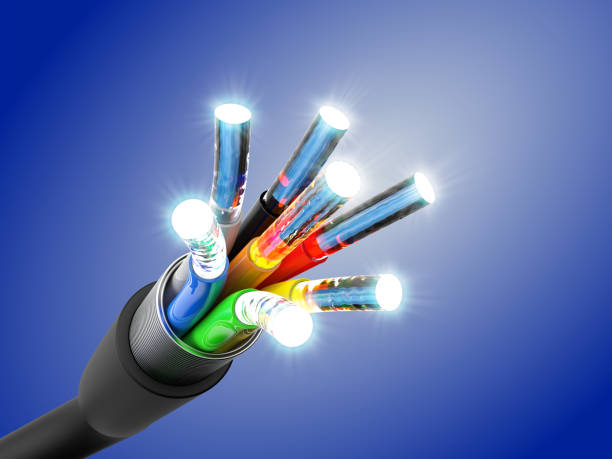
An optical fiber is an incredibly thin strand of transparent material designed specifically to guide light.
Most optical fibers are made from highly purified silica glass. Despite being made of glass, these fibers are surprisingly flexible and durable. A single optical fiber is often about the thickness of a human hair.
Each fiber consists of three important layers.
At the center is the core, where the light travels.
Surrounding the core is the cladding, which has a slightly lower refractive index than the core.
The outermost layer is a protective coating that shields the fiber from moisture, scratches, and physical damage.
This carefully engineered structure allows light to remain trapped inside the fiber even when the cable bends around corners.
The Amazing Physics of Total Internal Reflection
One of the most fascinating principles behind fiber-optic internet is a phenomenon called total internal reflection.
Normally, light changes direction when it moves from one material into another. This behavior is known as refraction and explains why a straw appears bent inside a glass of water.
However, under the right conditions, something even more remarkable happens.
When light traveling inside the fiber’s core reaches the boundary with the cladding at a sufficiently shallow angle, it does not escape. Instead, it reflects completely back into the core.
This repeated reflection continues thousands or even millions of times as the light moves through the fiber.
Although the light appears to travel in a straight line overall, it is actually bouncing continuously along the inside of the cable while remaining trapped.
This process allows optical fibers to guide light over hundreds of kilometers with very little loss of signal.
Turning Internet Data Into Light
Computers and smartphones process information using electrical signals.
Optical fibers carry light.
Somehow, the internet must convert between these two forms.
The process begins at networking equipment called an optical transmitter.
A laser diode or light-emitting diode rapidly turns on and off, producing extremely fast flashes of light.
Each flash represents binary data.
For example, one pulse may represent a binary 1, while the absence of a pulse represents a binary 0.
In reality, modern fiber-optic systems use much more sophisticated encoding methods that allow multiple bits to be represented by changes in light intensity, phase, wavelength, or polarization.
These advanced techniques dramatically increase the amount of information that can travel through a single fiber.
Traveling at Nearly the Speed of Light
Light moves through a vacuum at approximately 299,792 kilometers per second (186,282 miles per second).
Inside glass fibers, light slows because it interacts with the material.
Even so, it still travels at roughly two-thirds the speed of light in a vacuum, or about 200,000 kilometers per second (124,000 miles per second).
This means information can travel from one city to another in just milliseconds.
Although internet speed is often limited by networking equipment, routing, congestion, and processing delays, the physical transmission of light itself is astonishingly fast.
How Information Travels Across Long Distances
The global internet spans millions of kilometers.
Fiber-optic cables connect neighborhoods, cities, countries, and continents.
As light travels through very long fibers, a small amount of its energy is gradually lost due to absorption and scattering within the glass.
To overcome this, telecommunications companies install optical amplifiers along major routes.
Unlike older systems that converted light back into electrical signals for amplification, modern optical amplifiers strengthen the light directly.
One common technology uses erbium-doped fiber amplifiers, which boost optical signals without converting them into electricity.
This innovation allows data to travel hundreds or even thousands of kilometers efficiently.
The Incredible Capacity of Fiber
One of fiber optics’ greatest strengths is its enormous bandwidth.
Bandwidth refers to the amount of information that can be transmitted in a given period.
Fiber-optic cables can carry tremendous amounts of data because they use light frequencies that are far higher than radio waves or electrical signals.
Modern systems often transmit multiple wavelengths of light simultaneously through the same fiber.
Each wavelength acts like its own independent communication channel.
This technique, known as wavelength-division multiplexing, dramatically increases capacity.
A single fiber can carry terabits of data every second, enough to support millions of simultaneous internet connections.
Researchers continue pushing these limits even further through advances in optical engineering.
How Fiber Reaches Your Home
Many internet providers now offer fiber-to-the-home, often abbreviated as FTTH.
In this system, optical fiber extends directly from the provider’s network to the customer’s building.
Inside the home, an optical network terminal converts incoming light signals into electrical signals that routers, computers, televisions, and smartphones can use.
The router then distributes the internet connection through Ethernet cables or Wi-Fi.
Because the signal travels almost entirely through fiber, users experience exceptionally high speeds and reliable performance.
Fiber to the Home Versus Other Fiber Networks
Not every fiber network reaches directly into every building.
Some systems use fiber only for part of the journey.
Fiber to the Cabinet brings fiber close to neighborhoods before switching to copper wiring for the final distance.
Fiber to the Building delivers fiber into apartment buildings while using internal wiring to reach individual units.
Fiber to the Premises is a broader term describing fiber connections extending directly to homes or businesses.
The closer fiber reaches to the user, the higher the potential internet performance.
Why Fiber Internet Is So Fast
Several scientific and engineering advantages contribute to fiber’s impressive speed.
Optical fibers have extremely high bandwidth.
Signal loss is very low.
Light experiences minimal interference.
Modern lasers transmit data with extraordinary precision.
Advanced modulation techniques pack enormous amounts of information into each pulse.
Powerful networking equipment manages traffic efficiently.
Together, these factors enable internet speeds that often reach one gigabit per second, two gigabits, five gigabits, ten gigabits, or even faster in some networks.
Symmetrical Upload and Download Speeds
Many traditional broadband technologies provide much faster downloads than uploads.
This design reflected earlier internet usage patterns when people mostly consumed online content.
Today’s internet is different.
People upload videos, join video conferences, synchronize cloud storage, livestream games, and work remotely.
Fiber networks often provide symmetrical connections, meaning upload and download speeds are equally fast.
This makes fiber especially valuable for businesses, content creators, students, researchers, and professionals working from home.
Why Fiber Is More Reliable
Reliability is just as important as speed.
Because fiber uses light rather than electricity, it is naturally resistant to electromagnetic interference.
Nearby power lines, electrical storms, industrial machinery, and radio signals have little effect on optical transmission.
Fiber also experiences less signal degradation over long distances.
This stability results in fewer dropped connections and more consistent internet performance.
Undersea Fiber-Optic Cables
One of the world’s greatest engineering achievements lies hidden beneath the oceans.
More than 95 percent of international internet traffic travels through submarine fiber-optic cables.
These cables stretch across the Atlantic, Pacific, Indian, and Arctic Oceans, connecting continents with astonishing efficiency.
Although satellites play important communication roles, fiber-optic cables carry far more data while providing significantly lower latency.
Specially designed ships carefully lay these cables across the ocean floor.
Despite operating in challenging environments thousands of meters underwater, many continue functioning reliably for decades.
The Difference Between Fiber and Satellite Internet
Satellite internet sends signals between Earth and orbiting satellites using radio waves.
Fiber sends light directly through optical cables.
Because light inside fiber follows a relatively direct route, latency is usually much lower.
Satellite signals must travel thousands of kilometers into space and back.
This additional distance increases communication delays.
For activities such as online gaming, video conferencing, financial trading, and cloud computing, fiber generally offers superior responsiveness.
However, satellite internet remains invaluable in remote regions where laying fiber is impractical.
Fiber and the Future of Artificial Intelligence
Artificial intelligence depends on enormous amounts of data moving between computers.
Training advanced AI models involves transferring petabytes of information across data centers.
Fiber-optic networks provide the bandwidth needed for these demanding workloads.
Cloud computing, machine learning, autonomous vehicles, smart cities, and scientific supercomputers all rely heavily on high-capacity optical communication.
As AI continues expanding, fiber infrastructure will become even more essential.
How Fiber Supports Streaming and Gaming
Watching a movie online may seem simple, but behind the scenes enormous amounts of data move continuously.
High-definition and 4K videos require sustained high-speed connections.
Cloud gaming demands low latency and stable performance.
Fiber’s high bandwidth allows multiple devices in a household to stream, download, and communicate simultaneously without significant slowdowns.
This capability becomes increasingly important as connected devices continue multiplying.
Is Fiber Internet Completely Unlimited?
Fiber technology itself has enormous capacity, but service plans depend on internet providers.
Some providers offer unlimited data usage.
Others may impose monthly data caps or speed limits based on subscription levels.
The underlying optical fiber is usually capable of carrying much more data than individual customers currently use.
Network management, pricing, and infrastructure determine the practical experience.
Challenges of Expanding Fiber Networks
Although fiber offers tremendous advantages, deploying it is expensive.
Installing underground cables often requires digging trenches, obtaining permits, and coordinating with local infrastructure.
Urban construction can be complex.
Mountainous terrain, rivers, forests, and remote communities present additional engineering challenges.
Despite these costs, many governments and telecommunications companies continue investing heavily in fiber because its long-term benefits outweigh the initial expense.
Can Fiber Cables Break?
Like any physical infrastructure, fiber cables can be damaged.
Construction work, earthquakes, accidental cuts, severe storms, or ship anchors may interrupt service.
However, telecommunications networks often include redundant routes.
If one cable is damaged, traffic may automatically reroute through another path.
Engineers continuously monitor fiber networks to detect and repair problems as quickly as possible.
The Future of Fiber-Optic Technology
Scientists continue developing faster optical communication systems.
New laser technologies, improved optical amplifiers, advanced modulation techniques, and better signal processing are pushing transmission rates ever higher.
Researchers are exploring hollow-core optical fibers that allow light to travel through air instead of solid glass, potentially reducing latency even further.
Quantum communication is another exciting frontier.
Future quantum networks may use specially prepared photons to exchange information with unprecedented levels of security.
Although still under development, these technologies build directly upon the same optical principles that power today’s internet.
Why Fiber-Optic Internet Is Transforming the Digital World
Fiber-optic internet represents one of humanity’s greatest achievements in communication technology. By harnessing the remarkable properties of light and the physics of total internal reflection, engineers have created networks capable of transmitting vast amounts of information across neighborhoods, countries, and oceans with extraordinary speed and reliability.
Every video call with family, every online class, every streamed movie, every scientific discovery shared across continents, and every cloud-based service depends on the invisible journey of light through delicate strands of glass. What appears to users as an instant internet connection is actually the result of decades of scientific research in optics, materials science, electronics, and telecommunications.
As our world becomes increasingly connected and data-driven, fiber-optic technology will remain at the heart of global communication. From supporting artificial intelligence and medical research to enabling future innovations we cannot yet imagine, these tiny glass fibers continue to illuminate not only our internet connections but also the future of human progress.