The internet has become as essential to modern life as electricity and clean water. It connects us to work, education, entertainment, healthcare, shopping, and the people we care about. Whether you’re streaming a movie in 4K, attending a video meeting, playing online games, or backing up family photos to the cloud, the quality of your internet connection shapes your daily experience.
When choosing a home internet service, two of the most common options are fiber internet and cable internet. At first glance, both can seem very similar. Both offer high-speed connections, both can support multiple devices, and both allow you to browse the web, stream videos, and download files. However, beneath the surface, they rely on very different technologies, and those differences can have a significant impact on speed, reliability, latency, and future performance.
Understanding how fiber and cable internet work can help you make an informed decision about which service best fits your needs.
What Is Fiber Internet?
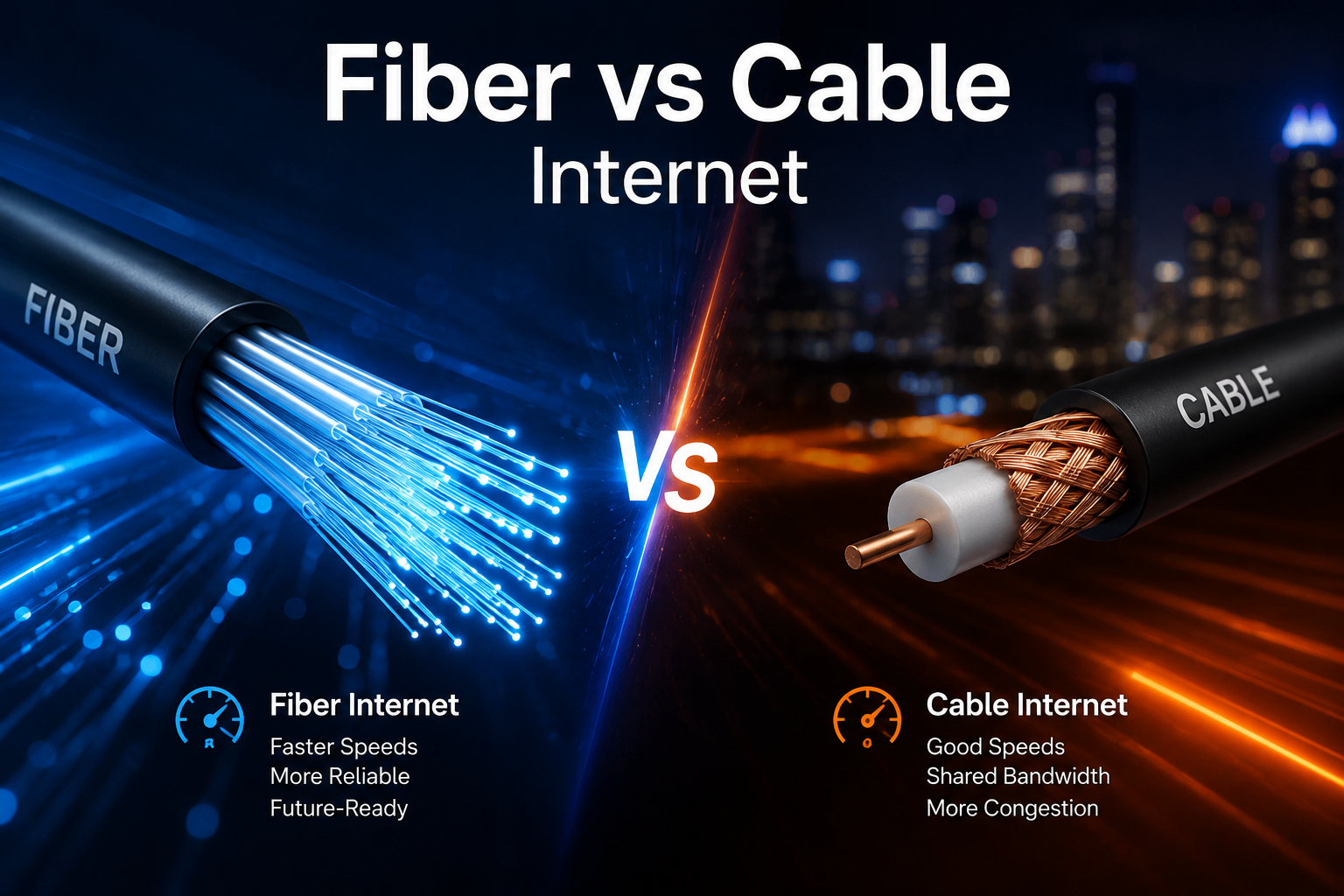
Fiber internet is a broadband technology that transmits data as pulses of light through extremely thin strands of glass or plastic called optical fibers.
Unlike traditional electrical cables, optical fibers carry information using light generated by tiny lasers or light-emitting devices. These light signals travel through the fiber by repeatedly reflecting off the inner walls of the cable, allowing data to move over long distances with remarkably little signal loss.
Because light travels incredibly fast and experiences minimal interference inside optical fibers, fiber internet can deliver exceptionally high speeds while maintaining excellent reliability.
Modern fiber networks commonly provide download and upload speeds ranging from hundreds of megabits per second (Mbps) to several gigabits per second (Gbps). Some providers now offer residential plans reaching 10 Gbps or more.
What Is Cable Internet?
Cable internet delivers data using the same coaxial cable network that was originally built to provide cable television.
A coaxial cable contains a central copper conductor surrounded by insulating material and metallic shielding. Instead of using light, cable internet transmits information as electrical signals traveling through this copper conductor.
Over the years, cable internet technology has improved dramatically. Modern cable systems use standards known as DOCSIS (Data Over Cable Service Interface Specification), allowing providers to deliver download speeds exceeding one gigabit per second in many areas.
Although cable internet remains one of the most widely available broadband technologies, it operates differently from fiber, leading to important performance differences.
How Fiber Internet Works
Fiber internet begins at the provider’s network, where data is converted into flashes of light.
These light pulses travel through optical fibers at nearly the speed of light inside the cable. Because the fiber is designed to keep light contained within its core through a phenomenon called total internal reflection, the signals remain strong even across long distances.
At your home, an Optical Network Terminal (ONT) converts these light signals back into electrical signals that your router and devices can understand.
Throughout this journey, very little signal strength is lost, allowing fiber networks to maintain excellent performance over many kilometers.
How Cable Internet Works
Cable internet starts at the internet service provider’s network and sends electrical signals through coaxial cables toward neighborhoods and homes.
A cable modem inside your home receives these electrical signals and translates them into digital data that computers, smartphones, and other devices can use.
Unlike fiber, many cable networks share bandwidth among multiple homes within the same neighborhood. As more people use the network simultaneously, especially during evenings when internet usage peaks, available bandwidth may become divided among users.
This shared architecture can sometimes reduce speeds during periods of heavy demand.
The Technology Behind Optical Fiber
Optical fiber is one of the greatest engineering achievements of the modern world.
Each fiber strand is astonishingly thin—often about the width of a human hair.
It consists of two main parts.
The inner core carries the light.
The surrounding cladding has a slightly different optical property that keeps light trapped inside the core.
As light travels down the fiber, it continually reflects off the boundary between these layers without escaping.
Because light experiences very little resistance compared with electricity moving through copper wire, optical fibers can carry enormous amounts of data while maintaining exceptional signal quality.
The Technology Behind Coaxial Cable
Coaxial cable has served communication systems for decades.
Its central copper conductor carries electrical signals, while layers of insulation and metallic shielding protect those signals from outside electromagnetic interference.
Coaxial cables can carry both television signals and internet traffic simultaneously.
Although modern cable technology has become highly advanced, electrical signals naturally weaken over distance more than light signals traveling through optical fibers.
This often requires amplifiers or additional network equipment along longer cable routes.
Speed Comparison
One of the biggest differences between fiber and cable internet is speed.
Fiber internet is capable of delivering extraordinarily high speeds because light can carry tremendous amounts of information with minimal signal degradation.
Residential fiber plans commonly offer speeds from 300 Mbps to several gigabits per second.
Cable internet has also become impressively fast. Many cable providers now offer download speeds between 300 Mbps and 1 Gbps, with some exceeding these figures using the latest DOCSIS standards.
For many households, both technologies provide more than enough download speed for everyday activities.
However, the greatest distinction appears when comparing upload performance.
Upload Speeds
Fiber internet usually provides symmetrical speeds, meaning upload and download speeds are the same or nearly the same.
For example, a fiber plan advertised as 1 Gbps often provides approximately 1 Gbps for both downloading and uploading.
This balanced performance is especially valuable for activities such as uploading large videos, cloud backups, video conferencing, remote work, online collaboration, and live streaming.
Cable internet, by contrast, usually provides asymmetrical speeds.
Download speeds are often much higher than upload speeds.
For example, a cable connection might provide 500 Mbps downloads but only 20 to 50 Mbps uploads.
For users who regularly upload large files or create online content, this difference can become very noticeable.
Latency
Latency refers to the time required for data to travel between your device and its destination.
It is measured in milliseconds.
Lower latency means faster communication between devices.
Fiber internet generally offers lower latency than cable because light signals travel efficiently with fewer processing delays.
This makes fiber especially attractive for online gaming, virtual reality, video conferencing, financial trading, and other applications requiring rapid responses.
Cable internet also provides reasonably low latency for most users, but it may experience slightly higher delays due to its network design and shared infrastructure.
Reliability
Internet reliability matters just as much as speed.
Fiber connections are highly resistant to environmental interference.
Since fiber carries light rather than electricity, it is immune to electromagnetic interference produced by nearby electrical equipment, radio transmitters, or power lines.
Optical fibers also resist many types of signal degradation affecting copper cables.
Cable internet is generally reliable as well, but electrical signals can occasionally be affected by weather conditions, damaged cables, aging infrastructure, or electromagnetic interference.
Both technologies have become highly dependable, but fiber typically provides more consistent performance.
Performance During Busy Hours
One important difference between the two technologies involves network congestion.
Many cable systems share available bandwidth among numerous households connected to the same neighborhood network.
When many users stream videos, download games, or participate in video meetings simultaneously, speeds may decrease.
Fiber networks often experience less congestion because providers frequently allocate bandwidth more efficiently, and the technology itself supports much higher overall capacity.
As internet usage continues increasing worldwide, fiber infrastructure offers greater room for future growth.
Streaming Movies and TV
Both fiber and cable internet can easily support modern video streaming.
Watching movies in Full HD or 4K resolution generally requires only a fraction of the speed available from today’s broadband services.
For a single television, either technology performs very well.
The difference becomes more noticeable in larger households where several people stream different videos simultaneously while others work, game, or attend online classes.
Fiber’s larger bandwidth and symmetrical speeds allow it to handle these situations more comfortably.
Online Gaming
Online games require more than raw download speed.
Low latency and stable connections are often more important.
Fiber’s lower latency helps reduce input delay, making gameplay feel smoother and more responsive.
Competitive multiplayer games particularly benefit from these faster response times.
Cable internet also supports online gaming very well, especially on well-maintained networks.
However, occasional congestion during peak hours may increase latency slightly.
Video Calls and Remote Work
Remote work has become an important part of modern life.
Video meetings require both downloading and uploading data continuously.
Fiber’s symmetrical upload speeds allow high-quality video calls with fewer interruptions, even while other family members use the internet.
Cable internet performs well for ordinary video conferencing, but heavy uploading from multiple users can sometimes reduce call quality.
Large File Transfers
Photographers, filmmakers, software developers, researchers, and businesses often work with enormous files.
Uploading these files to cloud storage can take considerable time.
A one-gigabyte upload that finishes quickly on fiber may require significantly longer on a cable connection because of lower upload speeds.
For professionals who frequently move large amounts of data, fiber offers a substantial advantage.
Network Capacity
Fiber optic cables have enormous bandwidth potential.
Scientists and engineers continue increasing the amount of data transmitted through a single optical fiber by using advanced techniques that send multiple wavelengths of light simultaneously.
This means today’s fiber infrastructure is well prepared for future technologies requiring even greater data capacity.
Cable systems continue improving through newer DOCSIS standards, but copper cables have more fundamental physical limitations than optical fibers.
Weather and Environmental Effects
Fiber optic cables do not carry electrical current, making them resistant to lightning-induced electrical surges and electromagnetic interference.
However, physical damage from construction work, severe storms, or accidental cuts can still interrupt service.
Cable systems are also durable but may be somewhat more vulnerable to electrical disturbances because they rely on copper conductors carrying electrical signals.
In everyday use, both systems provide dependable service when properly maintained.
Installation Differences
Installing fiber internet often requires new fiber optic lines extending directly to homes or neighborhoods.
Because this infrastructure is relatively new in many regions, fiber availability may still be limited.
Cable internet usually uses existing coaxial television infrastructure that has been installed across many communities for decades.
This widespread infrastructure makes cable internet available to far more households in many countries.
Availability often becomes the deciding factor for many consumers.
Cost Considerations
Prices vary depending on country, provider, speed, and promotional offers.
Historically, fiber internet tended to cost more than cable because building fiber networks requires substantial investment.
Today, however, competition has narrowed the price difference considerably.
In many areas, fiber plans now cost roughly the same as cable while providing higher performance.
When comparing services, it’s important to consider both monthly cost and the speeds actually provided.
Security
Both fiber and cable internet providers use encryption and network security technologies to protect customer data.
From a physical standpoint, tapping into fiber optic cables without detection is generally more difficult than intercepting electrical signals in copper cables.
Nevertheless, the overall security of an internet connection depends much more on encryption protocols, secure websites, software updates, strong passwords, and good cybersecurity practices than on the transmission medium itself.
Which Internet Is Better for Families?
Modern households often contain dozens of connected devices.
Smartphones, laptops, tablets, smart televisions, gaming consoles, security cameras, voice assistants, and smart home appliances may all use the internet simultaneously.
Fiber’s higher capacity allows it to manage these multiple connections with greater ease.
Cable internet also performs well for most families, especially when internet usage is moderate.
As households continue adding more connected devices, however, fiber offers greater flexibility for future demands.
The Future of Broadband
Around the world, governments and internet providers are investing heavily in fiber optic infrastructure.
The increasing popularity of cloud computing, artificial intelligence, virtual reality, augmented reality, remote healthcare, and ultra-high-definition streaming requires faster and more reliable internet connections.
Fiber’s enormous capacity makes it well suited for these emerging technologies.
At the same time, cable technology continues advancing through newer DOCSIS standards, enabling higher speeds and improved efficiency over existing networks.
Both technologies will remain important, but fiber is widely viewed as the long-term foundation for next-generation broadband.
Choosing Between Fiber and Cable Internet
The best choice depends on your needs, your location, and the services available in your area.
If fiber internet is available at a competitive price, it generally offers the best combination of speed, upload performance, low latency, reliability, and future scalability. It is particularly well suited for households with many connected devices, remote workers, content creators, gamers, and anyone who regularly uploads large files or relies on cloud-based services.
Cable internet remains an excellent option where fiber is unavailable. It delivers fast download speeds, supports streaming, gaming, online learning, and everyday browsing, and continues to improve through advances in network technology. For many households, it provides more than enough performance for daily internet use.
Final Thoughts
Fiber and cable internet represent two remarkable achievements in communication technology, each built on different scientific principles. Fiber uses pulses of light traveling through hair-thin strands of glass to move enormous amounts of data with exceptional speed and reliability. Cable internet uses electrical signals flowing through coaxial copper cables, a technology that has evolved over decades to deliver fast broadband to millions of homes.
For most users, either connection can provide an excellent online experience. Yet fiber’s symmetrical speeds, lower latency, higher capacity, and greater resistance to interference give it clear technical advantages, especially as our dependence on high-speed internet continues to grow.
As digital technologies become increasingly woven into everyday life, understanding the science behind these internet connections helps us appreciate the remarkable engineering that allows information to travel across cities, countries, and oceans in the blink of an eye.