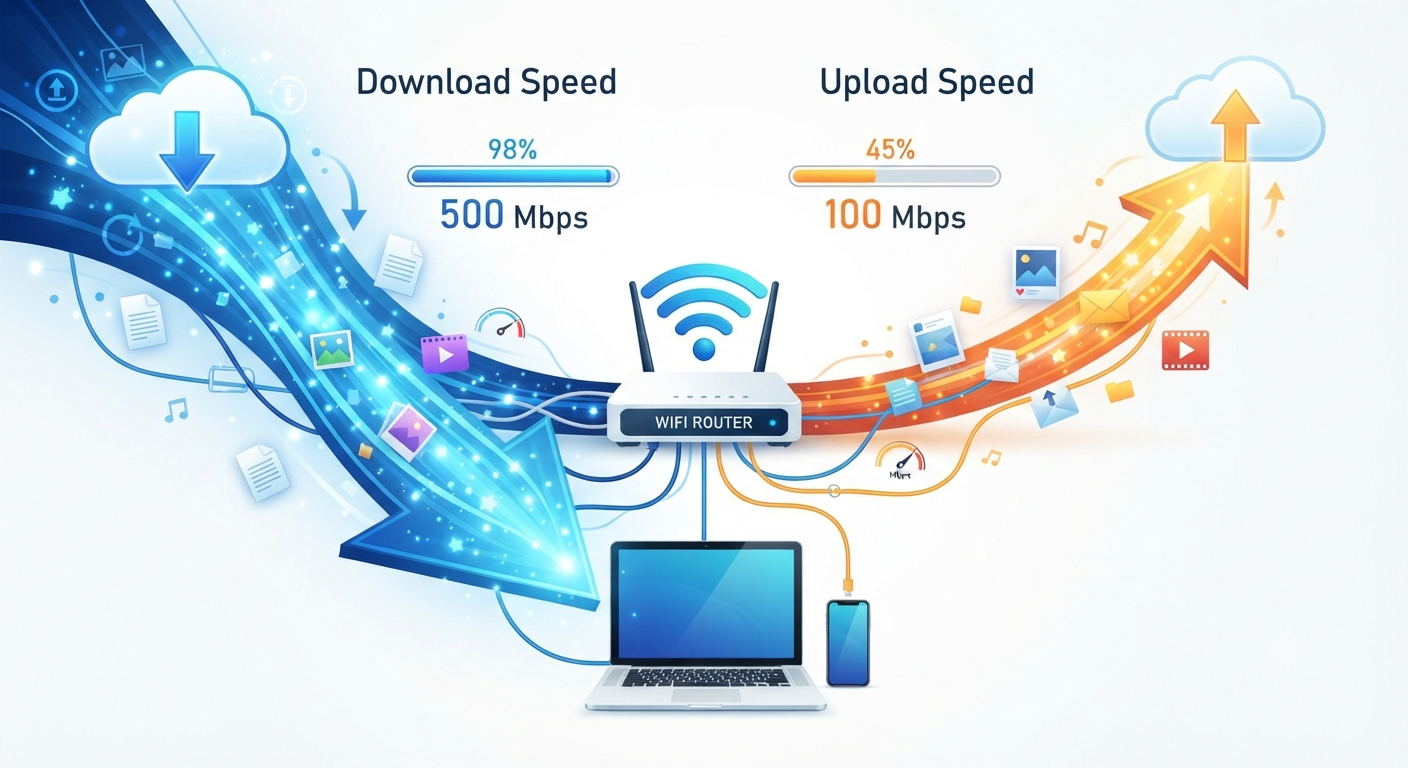
Have you ever wondered why a movie streams instantly but uploading a video to the cloud seems to take forever? Or why your internet package advertises blazing-fast speeds, yet video calls occasionally become blurry or freeze? The answer often lies in the difference between download speed and upload speed.
Although these two terms are frequently mentioned by internet service providers, many people only have a general idea of what they mean. In reality, download speed and upload speed perform very different roles, and understanding them can help you choose the right internet plan, solve connection problems, and get the best possible online experience.
Every time you browse a website, stream a movie, send an email, upload photos, join a video conference, or play an online game, both download and upload speeds are working together behind the scenes. While they are measured in the same units, they describe two completely different directions of data movement.
What Is Internet Speed?
Internet speed refers to how quickly data travels between your device and the internet. Whenever you use the internet, information is constantly moving back and forth.
Imagine the internet as a highway connecting your home to millions of computers around the world. Data travels along this highway in both directions. Sometimes information is coming toward you, and sometimes your device is sending information away.
The speed at which data moves determines how responsive your online experience feels.
Internet speed is typically measured in bits per second (bps). Modern internet connections are usually expressed in megabits per second (Mbps) or gigabits per second (Gbps).
One megabit equals one million bits, while one gigabit equals one billion bits.
The higher the speed, the more data can be transferred every second.
What Is Download Speed?
Download speed measures how fast your device receives data from the internet.
Whenever information travels from a website, server, or cloud service to your computer, smartphone, tablet, or television, you are downloading data.
For most internet users, downloading happens almost constantly.
When you open a webpage, the text, images, videos, and code are downloaded to your browser.
When you watch a movie on a streaming platform, each part of the video is downloaded before it is displayed.
When you install a game, update an app, receive an email, or view social media posts, download speed determines how quickly everything appears on your screen.
In simple terms, download speed controls how fast content reaches you.
What Is Upload Speed?
Upload speed measures how quickly your device sends data to the internet.
Whenever you share something online, your device is uploading information.
Uploading happens more often than many people realize.
Sending an email with attachments requires uploading.
Posting photos on social media involves uploading.
Backing up files to cloud storage uses upload bandwidth.
Video conferencing continuously uploads your camera and microphone data.
Livestreaming, sharing large videos, syncing documents across devices, and hosting online content all depend heavily on upload speed.
Simply put, upload speed determines how quickly your information reaches others.
The Fundamental Difference Between Download and Upload Speed
The main difference lies in the direction that data travels.
Download speed describes data moving from the internet to your device.
Upload speed describes data moving from your device to the internet.
Although both involve transferring information, they serve completely different purposes.
Whenever you stream a movie, most of the data flows toward you.
Whenever you upload vacation photos to cloud storage, the data flows away from you.
Modern internet use often involves both simultaneously. During a video call, for example, you download the other person’s video while uploading your own.
Why Download Speed Is Usually Faster
Most home internet connections provide much faster download speeds than upload speeds.
This design reflects how most people use the internet.
The average user spends far more time consuming content than creating it.
Streaming videos, browsing websites, reading news articles, downloading apps, and listening to music require much more downloading than uploading.
As a result, many internet technologies—including cable internet and some wireless networks—are intentionally designed with asymmetric speeds.
For example, an internet plan may advertise:
300 Mbps download
20 Mbps upload
This does not mean the connection is slow.
Instead, it reflects typical internet usage patterns.
Symmetrical Internet Speeds
Some internet connections provide identical download and upload speeds.
These are called symmetrical connections.
A symmetrical connection might offer:
500 Mbps download
500 Mbps upload
Or even:
1 Gbps download
1 Gbps upload
Fiber-optic internet is the technology most commonly capable of providing symmetrical speeds because fiber networks have much greater capacity than many traditional broadband technologies.
Symmetrical speeds are especially valuable for professionals, businesses, remote workers, content creators, and anyone who regularly uploads large amounts of data.
How Download Speed Affects Everyday Activities
Download speed influences nearly every online activity.
When you stream movies in high definition or 4K resolution, your device continuously downloads video data.
When you browse websites, each page must download text, images, fonts, and scripts.
Software updates often involve downloading several gigabytes of data.
Online gaming requires downloading game files, updates, maps, and other resources.
Music streaming services constantly download small portions of songs while they play.
If download speed is too low, videos may buffer, websites load slowly, and downloads take much longer to complete.
How Upload Speed Affects Everyday Activities
Upload speed becomes especially important whenever you create or share content.
Cloud storage services such as file backups require your device to upload data.
Video calls continuously upload your camera and voice.
Remote work often involves uploading presentations, reports, and documents.
Students submitting assignments online depend on upload performance.
Content creators uploading YouTube videos may spend hours waiting if upload speeds are limited.
Professional photographers and videographers often upload hundreds of gigabytes of files, making fast upload speeds extremely valuable.
Even smart home security cameras continuously upload recorded footage to cloud servers.
Why Video Calls Depend on Both Speeds
Video conferencing is one of the best examples of why download and upload speeds matter equally.
During a video meeting, your computer receives video from other participants while simultaneously sending your own video and audio.
If your download speed is poor, other people’s video may freeze or appear blurry.
If your upload speed is poor, everyone else experiences problems seeing or hearing you.
Many people mistakenly assume their internet is fast because streaming movies works perfectly, yet their video calls perform poorly because upload bandwidth is insufficient.
Online Gaming and Internet Speed
Many gamers believe faster download speed automatically improves gaming performance.
In reality, online gaming depends more on stable connections and low latency than extremely high download speeds.
Games continuously exchange relatively small amounts of information between players and game servers.
Download speed affects how quickly games install and receive updates.
Upload speed helps send player actions to game servers.
If upload performance is unstable, gameplay may feel delayed even when download speeds are excellent.
Streaming Movies and Television
Streaming services primarily rely on download speed.
As you watch a movie, your device continually downloads video data.
Higher resolutions require more bandwidth.
Standard-definition video requires relatively little download capacity.
High-definition video requires considerably more.
Ultra-high-definition 4K streaming demands even greater bandwidth because each frame contains far more visual information.
If download speed cannot keep up, buffering occurs while the device waits for more data.
Uploading Photos and Videos
Modern smartphones can capture enormous photo and video files.
A single minute of 4K video may occupy hundreds of megabytes.
Uploading these files to cloud storage or social media requires sufficient upload speed.
With slow upload speeds, transferring large videos may take several minutes—or even hours.
Faster upload speeds dramatically reduce waiting times.
Cloud Computing and File Synchronization
Cloud services have transformed how people work.
Documents stored in cloud platforms automatically synchronize between devices.
Whenever changes are made, updated files must be uploaded before other devices can download them.
This constant synchronization depends heavily on upload speed.
Professionals working with large design files, engineering projects, or scientific datasets particularly benefit from faster upload connections.
Download Speed and Software Updates
Modern operating systems frequently release updates containing security improvements and new features.
These updates can range from a few megabytes to several gigabytes.
Download speed determines how quickly these updates arrive.
Fast connections reduce waiting time and make keeping devices secure much easier.
Upload Speed and Content Creation
Today’s digital economy has created millions of content creators.
YouTubers upload videos.
Podcasters upload audio.
Graphic designers upload artwork.
Software developers upload applications.
Researchers upload scientific datasets.
Every creator depends on reliable upload performance.
For someone producing online content every day, upload speed may be even more important than download speed.
How Internet Service Providers Advertise Speed
Most internet advertisements emphasize download speed.
This is because download performance attracts the largest number of customers.
A package advertised as “500 Mbps Internet” usually refers primarily to download speed.
Upload speed may be listed separately in the detailed specifications.
Understanding both values helps consumers choose plans that match their actual internet usage.
Factors That Affect Both Download and Upload Speed
Even with a fast internet plan, many factors influence actual performance.
Wi-Fi signal strength affects wireless connections.
Older routers may limit maximum speeds.
Network congestion can reduce available bandwidth during busy periods.
The performance of websites or cloud servers also matters.
Your own device’s hardware and software can influence transfer rates.
Distance from the Wi-Fi router, interference from walls, neighboring wireless networks, and outdated networking equipment may all reduce real-world speeds.
Measuring Internet Speed
Speed tests measure download speed, upload speed, and latency.
During a test, your device exchanges data with a nearby server.
The results provide estimates of how quickly your connection receives and sends information.
Because internet conditions change throughout the day, multiple tests often provide a more accurate picture than a single measurement.
How Much Download Speed Do You Really Need?
The ideal download speed depends on how your household uses the internet.
Someone who primarily reads emails and browses websites requires far less bandwidth than a family simultaneously streaming multiple 4K movies while downloading large games.
As internet-connected devices become more common—including smart televisions, tablets, phones, gaming consoles, and smart home systems—households often benefit from higher download capacity.
However, extremely high advertised speeds provide little advantage if everyday internet usage remains relatively light.
How Much Upload Speed Do You Need?
Upload requirements vary even more.
Casual users who occasionally send emails and upload photos generally need modest upload bandwidth.
Remote workers attending daily video meetings benefit from faster uploads.
Professional livestreamers, photographers, software developers, architects, engineers, and video editors often require significantly higher upload speeds because they regularly transfer very large files.
As cloud computing continues expanding, upload speed is becoming increasingly important for many users.
Fiber, Cable, DSL, Satellite, and Mobile Networks
Different internet technologies offer different download and upload capabilities.
Fiber-optic internet typically provides the fastest and most balanced performance because it transmits data using pulses of light through extremely thin strands of glass.
Cable internet generally offers high download speeds but often lower upload speeds due to the way its network is designed.
DSL connections usually provide lower speeds than modern fiber or cable services because they use traditional telephone lines.
Satellite internet has improved dramatically in recent years but may experience higher latency because signals travel vast distances between Earth and satellites.
Mobile networks such as 4G and 5G can deliver impressive download and upload performance, although speeds vary depending on signal strength, network congestion, and location.
Why Faster Isn’t Always Better
Many people assume purchasing the fastest available internet plan automatically improves every online activity.
In reality, the relationship is more complicated.
If a streaming service only sends video at a certain bitrate, increasing your download speed beyond that requirement produces little visible improvement.
Similarly, uploading a file cannot exceed the maximum speed supported by the receiving server.
Other factors—including latency, reliability, Wi-Fi quality, and network stability—often have a greater impact on everyday internet performance than raw speed alone.
The Future of Internet Speeds
Internet technology continues advancing rapidly.
Fiber-optic networks are expanding worldwide.
New Wi-Fi standards deliver faster wireless performance inside homes and offices.
5G and future 6G mobile technologies promise greater speeds and lower latency.
Cloud computing, virtual reality, augmented reality, artificial intelligence, remote collaboration, and increasingly connected devices will place greater demands on both download and upload performance.
As people create and share more digital content than ever before, upload speed is becoming nearly as important as download speed.
Conclusion
Download speed and upload speed are two essential parts of every internet connection, but they serve different purposes. Download speed determines how quickly information reaches your device, while upload speed determines how quickly your device sends information to the internet.
Most online activities rely on both working together. Streaming movies, browsing websites, and downloading software depend heavily on download speed, while video calls, cloud backups, social media uploads, online collaboration, and content creation require strong upload performance. As our lives become increasingly connected through cloud services, remote work, and digital communication, understanding the difference between these two speeds helps you choose the right internet service and enjoy a faster, smoother, and more reliable online experience.