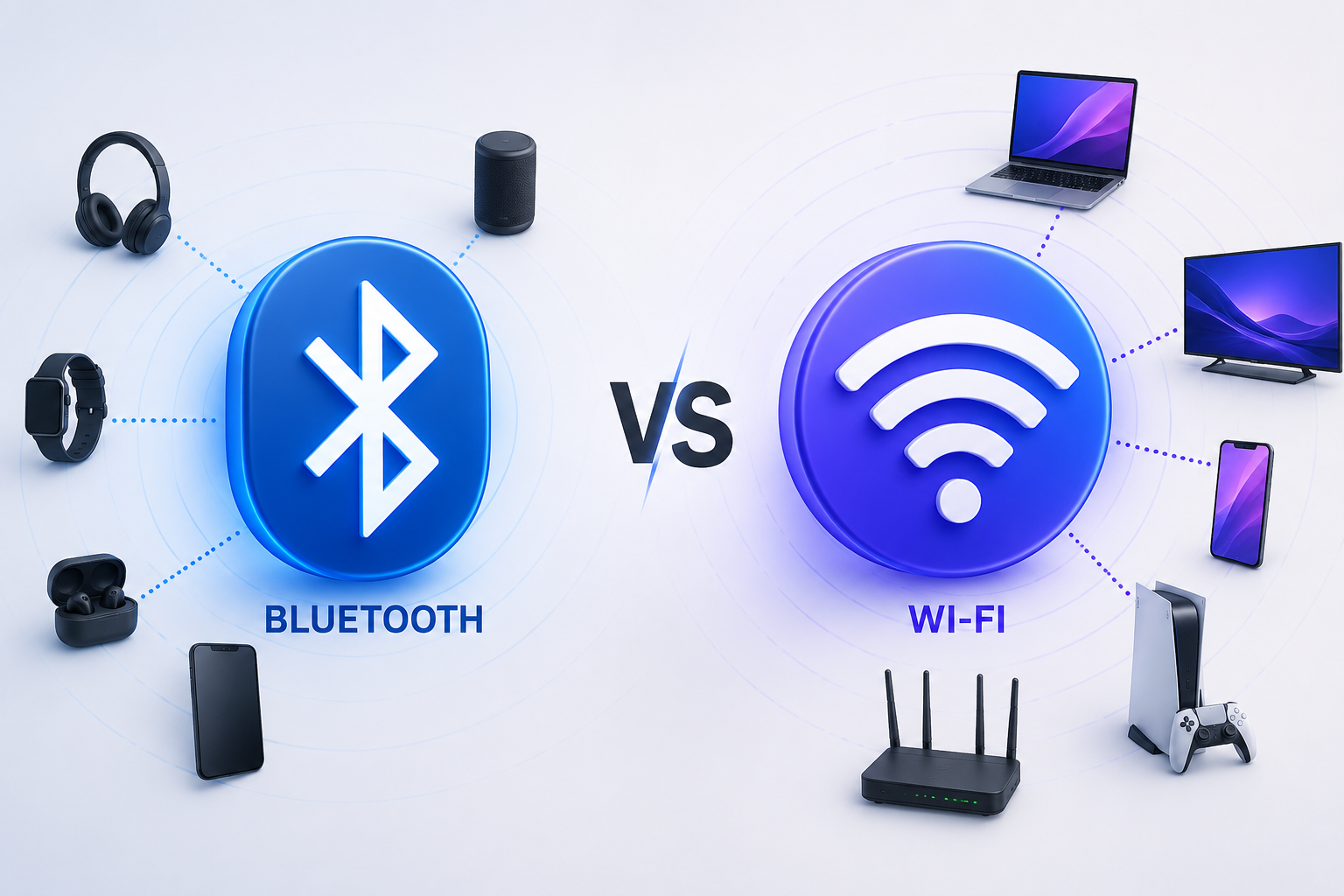
Imagine you’re listening to music through wireless earbuds while your laptop downloads a large file over the internet. Two invisible technologies are working around you at the same time. Your earbuds are probably connected through Bluetooth, while your laptop is using Wi-Fi to access the internet. Although both technologies communicate using radio waves and eliminate the need for cables, they were designed with very different goals in mind.
Because Bluetooth and Wi-Fi are so common, many people assume they are simply different versions of the same wireless technology. In reality, they solve different problems. One is built for connecting nearby devices with minimal power consumption, while the other is designed to move large amounts of data across homes, offices, and public spaces at high speeds.
Understanding how Bluetooth and Wi-Fi work—and when each one is the better choice—can help you get better performance from your devices, improve battery life, troubleshoot connection problems, and make smarter technology decisions.
What Is Bluetooth?
Bluetooth is a short-range wireless communication technology that allows nearby devices to exchange data without using cables. It was created to replace wired connections for personal electronic devices while consuming very little power.
Today, Bluetooth is found in billions of products around the world. Wireless headphones, earbuds, smartwatches, keyboards, computer mice, fitness trackers, game controllers, hearing aids, smart locks, car entertainment systems, and countless other devices rely on Bluetooth for everyday communication.
Unlike an internet connection, Bluetooth creates a direct wireless link between devices. When you pair your phone with wireless earbuds, for example, the phone sends audio directly to the earbuds without needing a Wi-Fi network or mobile data connection.
Bluetooth has evolved significantly since its introduction in the late 1990s. Modern versions provide faster speeds, better reliability, improved security, and longer battery life than earlier generations.
What Is Wi-Fi?
Wi-Fi is a wireless networking technology that allows devices to connect to local networks and the internet using radio waves. Instead of connecting just two nearby devices, Wi-Fi enables many devices to communicate with one another through a wireless router or access point.
Most homes, schools, businesses, airports, hotels, and cafés use Wi-Fi to provide internet access. Smartphones, laptops, tablets, smart TVs, gaming consoles, security cameras, printers, and smart home devices often depend on Wi-Fi for high-speed communication.
Wi-Fi is designed to transfer large amounts of data quickly. Streaming ultra-high-definition movies, downloading software updates, joining video meetings, cloud gaming, and browsing websites all rely on Wi-Fi’s ability to move information efficiently over relatively long distances.
Modern Wi-Fi standards continue to improve performance, offering higher speeds, lower latency, and better support for multiple connected devices.
The Main Purpose of Each Technology
Although both technologies use wireless signals, their primary purposes are different.
Bluetooth focuses on connecting nearby devices directly with minimal power consumption. It is ideal when only small or moderate amounts of data need to be exchanged over short distances.
Wi-Fi focuses on creating a high-speed wireless network capable of connecting many devices simultaneously while providing internet access and supporting demanding applications.
In simple terms, Bluetooth is usually about device-to-device communication, while Wi-Fi is usually about network communication.
How Bluetooth and Wi-Fi Work
Both Bluetooth and Wi-Fi transmit information using electromagnetic radio waves, but they communicate in different ways.
Bluetooth devices first discover one another and then establish a secure connection known as pairing. Once paired, they exchange data using carefully coordinated radio transmissions that minimize power usage.
Wi-Fi devices connect to a wireless router or access point. The router acts as a central hub that manages communication between connected devices and routes internet traffic to and from the wider internet.
Although both technologies often operate in the 2.4 gigahertz (GHz) radio band, they use different communication techniques to reduce interference and maximize performance.
Speed Comparison
One of the biggest differences between Bluetooth and Wi-Fi is speed.
Bluetooth is optimized for efficiency rather than maximum data transfer rates. While recent Bluetooth versions are considerably faster than earlier ones, they are still primarily intended for audio streaming, accessory communication, and transferring relatively small files.
Wi-Fi, on the other hand, is designed for high-speed networking. Modern Wi-Fi standards can transfer data hundreds or even thousands of times faster than typical Bluetooth connections under ideal conditions.
This enormous speed difference explains why downloading a large movie over Bluetooth would be impractical, while Wi-Fi can complete the same task quickly.
Range Comparison
Bluetooth works best over relatively short distances.
Most consumer Bluetooth devices operate reliably within the same room, although exact range depends on the device class, antenna design, obstacles such as walls, and environmental conditions. Some long-range Bluetooth devices can communicate over much greater distances in open areas, but everyday accessories are generally intended for nearby use.
Wi-Fi typically covers much larger areas.
A single wireless router can often provide coverage throughout an apartment or house, and businesses frequently use multiple access points to create wireless networks covering entire office buildings, schools, hospitals, or stadiums.
Because Wi-Fi is designed for wider coverage, it remains connected even when users move from room to room.
Power Consumption
Battery life is one of Bluetooth’s greatest strengths.
Bluetooth was specifically designed to use very little energy. This allows small battery-powered devices such as wireless earbuds, smartwatches, fitness trackers, and medical sensors to operate for long periods without frequent charging.
Bluetooth Low Energy (BLE), introduced in later versions of the Bluetooth standard, further reduced power consumption while maintaining reliable communication. BLE has become especially important for wearable devices, health monitors, smart home sensors, and Internet of Things (IoT) products.
Wi-Fi generally consumes more power because it continuously transfers larger amounts of data and maintains more complex network communication. As a result, devices that rely heavily on Wi-Fi often require larger batteries or more frequent charging.
Internet Access
Perhaps the easiest way to distinguish the two technologies is by asking one simple question:
Does it provide internet access?
Bluetooth usually does not.
Bluetooth simply connects nearby devices. For example, wireless headphones receive audio from a smartphone, but the internet connection itself comes from Wi-Fi or a mobile cellular network.
Wi-Fi, by contrast, is specifically designed to connect devices to local networks and the internet through a wireless router or access point.
Although Bluetooth can sometimes share an internet connection through tethering, this is much less common than using Wi-Fi.
Number of Connected Devices
Bluetooth generally supports fewer active device connections at the same time.
A smartphone may connect simultaneously to wireless earbuds, a smartwatch, and a car’s infotainment system, but Bluetooth networks remain relatively small.
Wi-Fi networks are built to support many connected devices simultaneously.
Modern home routers often manage dozens of devices, while enterprise-grade networks can support hundreds or even thousands of users through multiple access points.
This scalability makes Wi-Fi ideal for homes filled with smart devices and workplaces with many connected employees.
Audio Performance
Bluetooth has become the standard technology for wireless audio.
Most wireless headphones, earbuds, portable speakers, and vehicle audio systems rely on Bluetooth because it provides sufficient bandwidth for high-quality audio while consuming little power.
Modern Bluetooth audio codecs significantly improve sound quality and reduce latency compared with older implementations.
Wi-Fi can also carry audio, particularly in multi-room speaker systems and smart home entertainment platforms, where higher bandwidth allows lossless or high-resolution audio streaming. However, for everyday wireless headphones and portable speakers, Bluetooth remains the dominant choice due to its simplicity and energy efficiency.
File Transfers
Both Bluetooth and Wi-Fi can transfer files, but their performance differs dramatically.
Bluetooth works well for sharing photos, documents, contact information, or other relatively small files between nearby devices.
Large video files, software packages, or extensive backups are much better suited to Wi-Fi because of its much higher data transfer speed.
Many modern smartphones automatically switch to Wi-Fi-based transfer methods when large amounts of data need to be moved.
Gaming Performance
Gaming places demanding requirements on wireless communication.
Online gaming benefits greatly from Wi-Fi because it provides higher speeds and lower latency than Bluetooth for internet connectivity.
Bluetooth remains useful for connecting wireless game controllers, keyboards, mice, and certain gaming accessories.
Some competitive gamers prefer wired accessories because even tiny communication delays can affect performance, but Bluetooth has improved substantially over recent generations.
Security
Both Bluetooth and Wi-Fi include built-in security features.
Bluetooth uses encryption, authentication, and secure pairing procedures to help protect communications between devices. However, leaving Bluetooth permanently enabled and pairing with unknown devices can increase security risks.
Wi-Fi security depends heavily on proper network configuration. Modern routers commonly use WPA3 or WPA2 encryption to protect wireless communications. Strong passwords, updated firmware, and secure router settings significantly improve protection against unauthorized access.
No wireless technology is completely immune to attacks, but keeping software updated and following good security practices greatly reduces risk.
Interference
Because Bluetooth and many Wi-Fi networks operate in the same 2.4 GHz frequency band, they can sometimes interfere with one another.
Microwave ovens, cordless phones, baby monitors, and numerous other wireless devices also use nearby frequencies.
Fortunately, modern Bluetooth and Wi-Fi technologies include sophisticated methods to reduce interference automatically.
Bluetooth rapidly changes frequencies during communication, while modern Wi-Fi systems intelligently select less crowded channels and may also operate in the 5 GHz or 6 GHz bands, depending on the hardware and regional regulations.
Bluetooth in Everyday Life
Bluetooth quietly powers countless daily activities.
You answer a phone call using wireless earbuds while cooking dinner.
Your smartwatch automatically synchronizes health data with your smartphone.
A wireless keyboard connects instantly to your laptop.
Your car plays music from your phone without plugging in a cable.
A fitness tracker sends workout information to a health app.
Each of these experiences depends on Bluetooth’s ability to create reliable short-range connections while preserving battery life.
Wi-Fi in Everyday Life
Wi-Fi forms the backbone of modern digital life.
Families stream movies on multiple televisions while children attend online classes and parents participate in video meetings.
Cloud backups happen automatically in the background.
Smart home cameras upload security footage.
Voice assistants respond instantly to questions.
Gaming consoles download updates while laptops synchronize files with cloud storage.
All these activities require the high bandwidth and networking capabilities that Wi-Fi provides.
Bluetooth Low Energy and the Internet of Things
One of Bluetooth’s most important developments is Bluetooth Low Energy.
BLE allows tiny devices to operate for months or even years on small batteries.
This capability has fueled the rapid growth of the Internet of Things, where sensors, wearable devices, medical equipment, environmental monitors, smart locks, asset trackers, and industrial systems communicate efficiently while using minimal energy.
As smart technology continues expanding, Bluetooth Low Energy is expected to remain one of the key communication technologies enabling connected devices.
The Evolution of Wi-Fi
Wi-Fi has advanced rapidly over the past two decades.
Each new generation has introduced faster speeds, greater capacity, lower latency, improved energy efficiency, and stronger security.
Modern Wi-Fi technologies better handle crowded environments where dozens of devices compete for bandwidth simultaneously.
As internet speeds continue increasing and applications such as virtual reality, cloud gaming, artificial intelligence, and ultra-high-definition streaming become more demanding, Wi-Fi continues evolving to meet these growing requirements.
Can Bluetooth and Wi-Fi Work Together?
Absolutely.
In fact, they often operate simultaneously without users even noticing.
A smartphone may use Wi-Fi to stream music from an online service while sending that music to wireless earbuds through Bluetooth.
A smartwatch may communicate with a phone using Bluetooth while the phone downloads software updates through Wi-Fi.
A smart television may receive internet content over Wi-Fi while using Bluetooth to connect to a wireless remote control or headphones.
Rather than competing technologies, Bluetooth and Wi-Fi frequently complement one another.
Which Technology Is Better?
Neither Bluetooth nor Wi-Fi is universally better because they were created for different purposes.
Bluetooth excels at connecting nearby devices while minimizing power consumption. It is the ideal choice for wireless accessories, wearable electronics, and low-energy communication.
Wi-Fi excels at providing fast wireless networking and internet access across homes, businesses, and public spaces. It is the preferred solution for streaming, downloading, online gaming, cloud computing, and connecting multiple devices simultaneously.
The best choice depends entirely on what you want your devices to do.
The Future of Wireless Connectivity
Wireless communication continues to evolve at an extraordinary pace. Researchers are developing faster Wi-Fi standards, more efficient Bluetooth technologies, and new methods of reducing latency, increasing security, and improving energy efficiency.
Artificial intelligence is beginning to help wireless networks optimize performance automatically. Future devices may seamlessly switch between Bluetooth, Wi-Fi, cellular networks, and other communication technologies without users even noticing. Smart homes, autonomous vehicles, wearable health monitors, industrial automation, and augmented reality systems will all depend on increasingly intelligent wireless connections.
Although Bluetooth and Wi-Fi serve different roles, together they have transformed the way people interact with technology. They have removed countless cables from daily life, connected billions of devices around the world, and made instant wireless communication an ordinary part of modern living. As these technologies continue to improve, they will remain essential building blocks of our increasingly connected future.