Imagine waking up one morning to discover that the digital locks protecting your bank account, private messages, medical records, and even government secrets have suddenly become easy to open. It sounds like the plot of a science fiction movie, but it reflects a real question that scientists, cybersecurity experts, and governments around the world are asking today: Could quantum computers become a serious threat to cybersecurity?
For decades, our digital world has relied on encryption to keep information safe. Every time you shop online, send an email, use a messaging app, or log into a website, encryption works quietly in the background to protect your data from criminals and spies. Traditional computers have made this system reliable because breaking modern encryption would take an unimaginably long time.
But quantum computing introduces a completely different way of solving certain problems. Instead of simply making computers faster, it changes how some calculations are performed. That difference has sparked excitement among scientists—and concern among cybersecurity experts.
Does this mean quantum computers will soon crack every password on Earth? Is the internet about to become unsafe? Or is the reality more complicated?
The answer is both reassuring and fascinating.
Understanding Cybersecurity
Before exploring quantum computers, it helps to understand what cybersecurity really means.
Cybersecurity is the practice of protecting computers, networks, devices, and digital information from unauthorized access, theft, damage, or disruption. Every day, billions of people rely on cybersecurity without even realizing it.
When you unlock your phone using a fingerprint, send money through an online bank, connect to a secure website, or chat through an encrypted messaging app, cybersecurity is working behind the scenes.
Without strong cybersecurity, modern society would struggle to function. Hospitals, airports, power stations, governments, businesses, and communication networks all depend on digital security.
At the heart of this protection lies one powerful idea: encryption.
What Is Encryption?
Encryption is the process of turning readable information into coded information.
Imagine writing a letter in a secret language that only your friend understands. Anyone else who intercepts the letter sees meaningless symbols instead of the original message.
Modern encryption works in a similar way, except it uses mathematics instead of secret alphabets.
When you enter your credit card number on a secure website, your device encrypts the information before sending it across the internet. Even if someone intercepts the data during transmission, they cannot easily understand it without the correct cryptographic key.
Encryption protects far more than financial transactions.
It safeguards medical records, government communications, military information, cloud storage, emails, online shopping, social media accounts, and countless other digital services.
In many ways, encryption is one of the invisible foundations of the modern internet.
Why Modern Encryption Is So Strong
Modern encryption does not depend on hiding secret algorithms.
Instead, it depends on mathematical problems that are extremely difficult for ordinary computers to solve.
One famous example involves multiplying two very large prime numbers together.
A traditional computer can perform this multiplication quickly.
However, if someone only knows the final product and tries to determine the original prime numbers, the task becomes enormously difficult.
As the numbers grow larger, the problem becomes dramatically harder.
Even the world’s fastest supercomputers would need an impractically long time to solve certain versions of these problems using known classical methods.
This mathematical difficulty is what keeps many encryption systems secure today.
Enter Quantum Computing
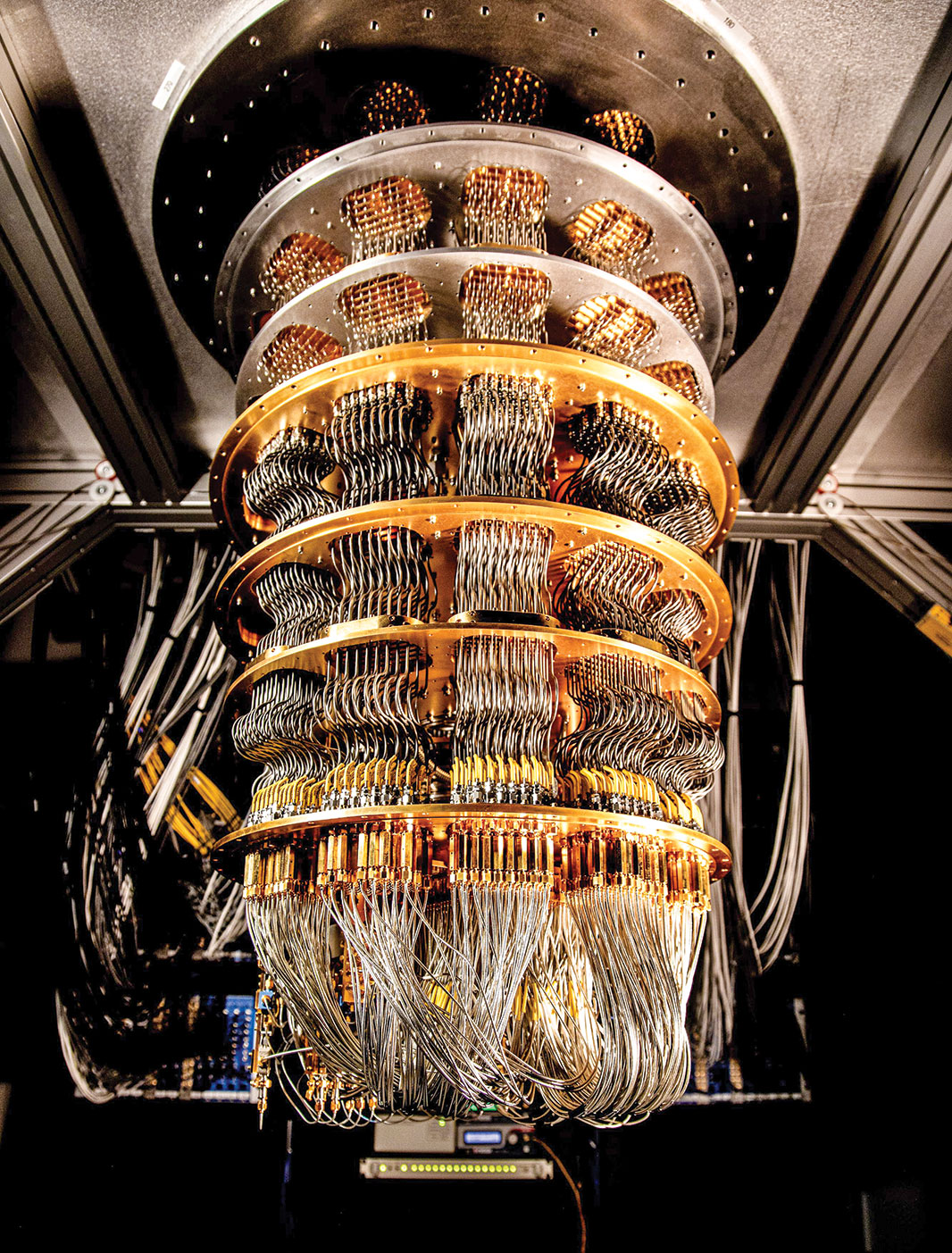
Quantum computers are not simply faster versions of today’s computers.
They operate according to the laws of quantum mechanics, the branch of physics that describes nature at extremely small scales.
Traditional computers store information using bits.
Each bit has one of two possible values: 0 or 1.
Quantum computers use quantum bits, or qubits.
Unlike ordinary bits, qubits can exist in combinations of states described by quantum mechanics until they are measured.
They can also become connected through a phenomenon called entanglement, allowing groups of qubits to exhibit correlations that have no equivalent in classical computing.
These unusual properties allow quantum computers to solve certain kinds of problems much more efficiently than classical computers.
It is important to remember one crucial point.
Quantum computers are not faster at everything.
Many everyday computing tasks may see little or no advantage.
Their strength lies in solving particular mathematical problems that are exceptionally difficult for classical machines.
Why Quantum Computers Worry Cybersecurity Experts
The concern comes from the fact that some of today’s most widely used public-key encryption systems rely on mathematical problems that quantum computers could solve much more efficiently than classical computers.
In 1994, mathematician Peter Shor developed a quantum algorithm now known as Shor’s algorithm.
This algorithm showed that a sufficiently powerful quantum computer could efficiently solve certain mathematical problems that are believed to be hard for classical computers, including integer factorization and the discrete logarithm problem.
These problems form the foundation of several widely used public-key cryptographic systems.
If a future quantum computer becomes large and reliable enough to run Shor’s algorithm on practical key sizes, those encryption systems could be broken far more quickly than with today’s computers.
This discovery transformed quantum computing from an interesting scientific idea into a major cybersecurity issue.
Does This Mean Every Password Is at Risk?
Not exactly.
Many people imagine that quantum computers will instantly crack every password on Earth.
That is not how things work.
Passwords themselves are usually protected through cryptographic hashing and authentication systems rather than the public-key algorithms most affected by Shor’s algorithm.
Moreover, many online services include protections such as rate limits, account lockouts, and multi-factor authentication that prevent attackers from making unlimited guesses.
Quantum computing does offer some advantages for searching large spaces. For example, Grover’s algorithm can speed up brute-force searches, but it provides a quadratic speedup rather than an exponential one. In practice, this means sufficiently long and randomly generated passwords remain highly effective, especially when systems use appropriate key lengths.
Strong passwords therefore remain an essential part of cybersecurity.
The Biggest Risk Is Public-Key Encryption
The greatest concern involves the cryptographic systems that help establish secure internet connections and verify digital identities.
Many secure websites, digital certificates, software updates, email encryption systems, and virtual private networks rely on public-key cryptography.
If large-scale fault-tolerant quantum computers become practical, some of these widely deployed algorithms could become vulnerable unless they are replaced.
This is why governments, technology companies, and security researchers are already preparing for the transition to new forms of cryptography.
The “Harvest Now, Decrypt Later” Concern
One reason experts are acting early is a strategy known as “harvest now, decrypt later.”
Imagine an attacker intercepts encrypted information today.
Even if they cannot read it now, they may store the encrypted data for years.
If powerful quantum computers become available in the future, they might attempt to decrypt that archived information.
This possibility is especially important for data that must remain confidential for decades, such as government records, military communications, diplomatic messages, medical information, scientific research, or valuable intellectual property.
For information that only needs to remain secret briefly, the risk is generally much smaller.
Can Quantum Computers Break Everything?
No.
This is one of the biggest misconceptions.
Not every encryption method is vulnerable to quantum attacks.
Many forms of symmetric encryption, including widely used algorithms such as AES, are believed to remain resistant to known quantum attacks when appropriate key sizes are used. Quantum algorithms like Grover’s algorithm can reduce the effective security level, but increasing key lengths can compensate for that reduction.
In other words, the cybersecurity challenge is significant, but it is not a complete collapse of digital security.
Some cryptographic tools will need replacement.
Others can remain secure with suitable adjustments.
Building Quantum-Resistant Encryption
Fortunately, cybersecurity experts have not been waiting for quantum computers to arrive.
Researchers have spent many years developing post-quantum cryptography, also called quantum-resistant cryptography.
These cryptographic systems are designed to resist attacks from both classical and quantum computers.
Instead of relying on mathematical problems vulnerable to Shor’s algorithm, they use different mathematical foundations that are currently believed to remain secure against known quantum attacks.
Scientists worldwide continue testing these methods to ensure they are both secure and practical.
A Global Effort to Prepare
Preparing for the quantum era has become an international priority.
Governments, universities, technology companies, and cybersecurity organizations are working together to develop and deploy stronger cryptographic standards.
Standardization efforts have identified new algorithms intended to replace vulnerable public-key systems over time.
This transition will take years because billions of devices, websites, software systems, communication networks, financial institutions, and government services depend on existing encryption technologies.
Updating global digital infrastructure is a massive undertaking, but it is already underway.
How Close Are We to Dangerous Quantum Computers?
This is perhaps the most common question.
Today’s quantum computers are remarkable scientific achievements, but they remain limited.
Current devices contain relatively small numbers of qubits and are affected by noise and errors that make long, complex calculations difficult.
Researchers are actively working on improving qubit quality, error correction, and system scalability.
Although progress has been impressive, experts generally agree that quantum computers capable of breaking widely used public-key encryption do not yet exist.
Predicting exactly when such machines might become practical is difficult because major engineering challenges remain.
The future is uncertain, which is precisely why preparation is happening now rather than later.
Quantum Computing Also Strengthens Cybersecurity
Interestingly, quantum technology is not only a threat.
It may also become a powerful tool for protecting information.
One promising field is Quantum Key Distribution (QKD).
QKD uses principles of quantum physics to help two parties establish shared cryptographic keys while allowing attempts at eavesdropping to be detected under appropriate conditions.
Unlike traditional communication methods, this approach relies on the behavior of quantum states rather than assumptions about computational difficulty.
QKD is not a replacement for all forms of encryption and requires specialized infrastructure, but it demonstrates that quantum physics can enhance security as well as challenge it.
Researchers are also exploring other quantum technologies that could improve secure communications and sensing.
What About Everyday Internet Users?
For most people, there is no need to panic.
Individuals are unlikely to notice the transition to quantum-resistant security.
Software developers, cloud providers, operating system companies, internet browsers, banks, and online services are expected to update their systems over time.
Just as most people never think about the encryption protecting their online banking today, future security upgrades will largely happen behind the scenes.
Users can still improve their personal cybersecurity by keeping devices updated, using strong unique passwords, enabling multi-factor authentication, and installing software from trusted sources.
These habits remain valuable regardless of advances in quantum computing.
Industries Facing the Greatest Challenges
Some industries face greater urgency than others.
Financial institutions process enormous numbers of secure transactions every day.
Healthcare organizations store sensitive patient information that may need to remain confidential for many years.
Governments protect classified intelligence and national security communications.
Technology companies manage cloud services used by millions of customers.
Energy systems, transportation networks, telecommunications, and critical infrastructure all rely on secure digital communication.
These sectors are investing heavily in planning for the transition to post-quantum cryptography because replacing cryptographic systems across large networks requires careful coordination.
Quantum Computing Beyond Cybersecurity
Although cybersecurity often receives the most attention, quantum computing has many exciting potential applications.
Scientists hope quantum computers may eventually help simulate complex molecules for drug discovery, design new materials, improve optimization problems, advance chemistry research, and deepen our understanding of fundamental physics.
Many of these applications could benefit society enormously.
Quantum computing is therefore neither inherently good nor bad.
Like many powerful technologies, its impact depends on how people use it and how responsibly society prepares for its challenges.
Separating Science from Science Fiction
Popular movies sometimes portray quantum computers as magical machines capable of instantly solving every problem.
Reality is much more nuanced.
Quantum computers cannot read minds.
They cannot instantly hack every device.
They cannot replace every classical computer.
Instead, they represent a specialized technology with remarkable strengths for certain tasks and clear limitations for others.
Understanding these differences helps replace fear with informed curiosity.
The real story is not about unstoppable machines taking over the internet.
It is about scientists recognizing a future challenge early enough to build better defenses before that challenge becomes a widespread reality.
The Future of Cybersecurity in the Quantum Age
History shows that cybersecurity is constantly evolving.
Every new technology creates new opportunities and new risks.
The invention of the internet brought incredible benefits alongside cybercrime.
The rise of smartphones transformed communication while introducing new security challenges.
Cloud computing changed how information is stored and shared.
Artificial intelligence is reshaping both cyber defense and cyberattacks.
Quantum computing represents another chapter in this ongoing evolution.
Unlike sudden disasters, the transition to quantum-resistant cybersecurity is expected to happen gradually. Researchers, governments, standards organizations, and technology companies are already working to strengthen digital defenses before large-scale quantum computers become capable of threatening today’s widely used public-key cryptography.
Rather than signaling the end of cybersecurity, quantum computing is driving one of the largest upgrades in digital security ever undertaken.
A Future Built on Preparation, Not Panic
Quantum computers have the potential to change cybersecurity in profound ways. Their ability to solve certain mathematical problems much more efficiently than classical computers means that some of today’s widely used encryption methods will eventually need to be replaced. This challenge is real, scientifically grounded, and taken seriously by experts around the world.
At the same time, the situation is far from hopeless. Powerful quantum computers capable of breaking modern public-key encryption are not yet available, and the global cybersecurity community has been preparing for years. New quantum-resistant cryptographic systems are being developed, tested, standardized, and gradually deployed to protect the digital world before the threat becomes practical.
The story of quantum computing is ultimately one of human ingenuity. The same scientific curiosity that revealed the vulnerability has also inspired the search for stronger defenses. As quantum technology continues to advance, cybersecurity will evolve alongside it, ensuring that trust, privacy, and secure communication remain central to our increasingly connected world.