Imagine asking your phone for directions, watching a streaming service recommend the perfect movie, translating a foreign language instantly, or chatting with a computer that can answer questions almost like a human. Just a few decades ago, these abilities belonged only in science fiction. Today, they are part of everyday life.
Behind many of these remarkable technologies lies Artificial Intelligence, often called AI.
Artificial Intelligence has become one of the most transformative scientific and technological developments of the twenty-first century. It is changing how people work, learn, communicate, travel, create, and solve problems. From hospitals and schools to farms, factories, and spacecraft, AI is becoming an increasingly important tool across nearly every field.
Despite its growing presence, AI is also one of the most misunderstood technologies. Some people imagine intelligent robots that think exactly like humans. Others fear machines taking over the world. The reality is both less dramatic and far more fascinating.
Artificial Intelligence is not magic. It is not consciousness. It is not a digital brain with emotions or desires. Instead, it is a scientific and engineering discipline focused on building computer systems that can perform tasks requiring forms of intelligence that humans naturally possess.
Understanding AI begins with understanding intelligence itself.
What Does Artificial Intelligence Mean?
Artificial Intelligence is a branch of computer science that develops systems capable of performing tasks that typically require human intelligence.
These tasks include recognizing images, understanding speech, translating languages, solving problems, making predictions, learning from experience, and generating text, music, or images.
The word “artificial” means something created by humans rather than occurring naturally.
The word “intelligence” refers to the ability to acquire knowledge, reason, adapt, solve problems, and make decisions.
Put together, Artificial Intelligence refers to computer systems designed to carry out certain intelligent behaviors.
However, today’s AI does not think like a human being. Instead, it uses mathematical models, algorithms, and large amounts of data to identify patterns and produce useful outputs.
Intelligence Is More Than Knowledge
Human intelligence involves far more than memorizing facts.
People learn from experience.
They recognize faces.
They understand language.
They plan for the future.
They imagine possibilities.
They adapt to unfamiliar situations.
They combine reasoning with emotion, creativity, and social understanding.
Scientists still do not fully understand how the human brain achieves all these abilities.
Artificial Intelligence does not attempt to copy every aspect of human intelligence. Instead, researchers focus on building systems that can perform specific cognitive tasks effectively.
In many cases, AI can perform a narrow task extremely well while remaining incapable of handling unrelated problems.
For example, an AI system that identifies tumors in medical images cannot automatically drive a car or write a novel unless it has been designed and trained for those purposes.
A Brief History of Artificial Intelligence
The dream of creating intelligent machines is much older than modern computers.
Ancient myths described artificial beings brought to life through magic or craftsmanship. As mathematics and engineering advanced, philosophers and inventors began wondering whether reasoning itself could be mechanized.
The modern scientific field of Artificial Intelligence emerged during the mid-twentieth century.
The invention of electronic computers demonstrated that machines could perform calculations at extraordinary speeds.
Researchers soon began asking a bold question:
Could computers someday perform tasks associated with human intelligence?
In 1956, a group of scientists gathered at a workshop that is widely regarded as the birth of AI as a formal academic field. They believed that many aspects of intelligence might eventually be described precisely enough for machines to simulate them.
Progress proved slower than early researchers expected.
Computers lacked sufficient processing power.
Data was limited.
Many problems turned out to be much more difficult than anticipated.
During certain periods, enthusiasm declined, leading to what historians call “AI winters,” when funding and research slowed significantly.
Advances in computing power, larger datasets, improved algorithms, and specialized hardware eventually transformed the field.
During the twenty-first century, AI experienced rapid progress, especially in machine learning and deep learning, making many practical applications possible.
How Does Artificial Intelligence Work?
Although different AI systems use different techniques, most modern AI follows a similar general process.
First, the system receives information.
This information may consist of photographs, written text, spoken language, medical records, weather observations, scientific measurements, or countless other forms of data.
Next, mathematical algorithms analyze patterns within that data.
Instead of memorizing every individual example, many AI systems learn statistical relationships that help them make predictions or decisions.
Finally, the AI produces an output.
It might recognize an object in a photograph.
It could translate a sentence.
It may recommend a product.
It might generate an image or answer a question.
Importantly, AI does not “understand” information in the same way humans do. Rather, it identifies complex patterns that allow it to produce useful results.
The Importance of Data
Data is the foundation of modern Artificial Intelligence.
Every AI system learns from information.
For example, an AI designed to recognize cats in photographs must learn from many examples of cats and non-cats.
A language model learns from large collections of written text.
A weather forecasting system analyzes decades of atmospheric observations.
The quality of an AI system depends heavily on the quality of its data.
Incomplete, inaccurate, or biased data can produce unreliable or unfair outcomes.
For this reason, scientists spend enormous effort collecting, organizing, cleaning, and evaluating datasets before training AI systems.
Machine Learning
One of the most important branches of AI is machine learning.
Traditional computer programs follow explicit instructions written by programmers.
Machine learning works differently.
Instead of telling the computer every rule, researchers allow algorithms to discover useful patterns from examples.
Imagine teaching a child to recognize apples.
Rather than listing every possible characteristic, you simply show many apples.
Eventually, the child recognizes new apples independently.
Machine learning operates in a similar way.
Algorithms improve their performance by analyzing examples and adjusting internal mathematical parameters.
The more suitable data they receive, the better they often become at specific tasks.
Deep Learning
Deep learning is a specialized area within machine learning.
It uses mathematical structures called artificial neural networks, inspired loosely by the organization of neurons in the brain, although they function very differently from biological brains.
Deep learning has driven many recent advances in AI.
It enables computers to recognize speech, identify objects in photographs, translate languages, generate realistic images, and understand increasingly complex patterns.
Large language models, image-generation systems, and many modern voice assistants rely heavily on deep learning techniques.
These systems often contain billions of adjustable mathematical parameters that are optimized during training using powerful computers.
Can AI Really Learn?
The word “learning” can be misleading.
Humans learn through understanding, experience, reasoning, curiosity, and social interaction.
AI learning is different.
When researchers say an AI system learns, they mean it adjusts its mathematical parameters to improve performance based on data.
It does not become curious.
It does not develop personal goals.
It does not suddenly become conscious.
Its learning is statistical rather than experiential.
Nevertheless, this statistical learning can produce remarkably capable systems.
Types of Artificial Intelligence
Most AI that exists today belongs to a category known as narrow AI, sometimes called weak AI.
Narrow AI is designed for specific tasks.
Examples include language translation, facial recognition, recommendation systems, medical image analysis, and voice assistants.
These systems may perform exceptionally well within their specialized domains but cannot apply their abilities broadly like humans.
Researchers also discuss the possibility of Artificial General Intelligence (AGI).
AGI would possess flexible intelligence comparable to that of humans across many different tasks.
Such a system could learn new skills, reason across domains, adapt to unfamiliar situations, and transfer knowledge efficiently.
Despite considerable research, AGI has not been achieved.
Some scientists believe it may eventually become possible, while others argue that important scientific breakthroughs are still required.
Beyond AGI lies the hypothetical concept of Artificial Superintelligence, referring to intelligence that greatly exceeds human capabilities across nearly every field.
This idea remains speculative and belongs to discussions about possible future technologies rather than current scientific reality.
Natural Language Processing
Humans communicate through language.
Teaching computers to understand and generate language has become one of AI’s greatest achievements.
This field is known as Natural Language Processing, often abbreviated as NLP.
Modern language models can answer questions, summarize documents, translate languages, generate stories, assist programmers, and help people write more effectively.
However, these systems do not truly comprehend language as humans do.
Instead, they learn statistical relationships among words, sentences, and ideas from enormous amounts of text.
This allows them to generate remarkably fluent responses while still making occasional mistakes or producing inaccurate information.
Computer Vision
Humans recognize faces, objects, colors, movement, and expressions almost effortlessly.
Helping computers interpret visual information is the goal of computer vision.
AI systems can now identify tumors in medical scans, inspect manufactured products for defects, detect obstacles for autonomous vehicles, analyze satellite imagery, recognize plant diseases, and assist scientific research.
These systems process images as numerical information, identifying patterns far too subtle or complex for traditional programming methods.
Robotics and Artificial Intelligence
Robotics and AI are related but distinct fields.
A robot is a physical machine capable of interacting with the environment.
Artificial Intelligence provides some robots with decision-making abilities.
Not every robot uses AI.
Many factory robots simply repeat programmed movements.
Conversely, many AI systems exist entirely within software and have no physical body at all.
When AI and robotics are combined, machines become more adaptable.
They can navigate unfamiliar environments, recognize objects, avoid obstacles, and interact more effectively with people.
AI in Healthcare
Artificial Intelligence is transforming medicine in many important ways.
Researchers use AI to analyze medical images, identify disease patterns, predict health risks, discover new drug candidates, and assist physicians in making clinical decisions.
AI can process enormous volumes of medical data much faster than humans.
However, AI does not replace doctors.
Medical professionals provide clinical judgment, ethical decision-making, communication, and patient care that AI cannot replicate.
The most effective healthcare systems increasingly combine human expertise with AI assistance.
AI in Education
Education is also changing through Artificial Intelligence.
AI-powered learning platforms can adapt lessons to individual students.
Language-learning applications provide personalized practice.
Writing assistants help improve grammar and organization.
Educational software can identify concepts that students find difficult and recommend additional practice.
Teachers remain essential because education involves motivation, creativity, emotional support, ethical guidance, and social interaction.
AI serves best as a powerful educational tool rather than a replacement for educators.
AI in Transportation
Transportation increasingly relies on Artificial Intelligence.
Navigation applications estimate travel times by analyzing traffic patterns.
Airlines optimize flight schedules using AI.
Railway systems monitor operations.
Researchers continue developing autonomous vehicles capable of navigating roads with limited or no human input under certain conditions.
Although significant progress has been made, fully autonomous driving remains a challenging scientific and engineering problem requiring continued research and careful safety evaluation.
AI in Science
Artificial Intelligence has become an invaluable scientific tool.
Astronomers analyze enormous collections of telescope observations using AI.
Biologists study protein structures and genetic data.
Climate scientists improve environmental models.
Chemists accelerate materials discovery.
Physicists process data from particle accelerators.
Rather than replacing scientists, AI allows researchers to analyze information on scales previously impossible.
Many discoveries now emerge through collaboration between human expertise and computational intelligence.
AI in Everyday Life
Many people interact with Artificial Intelligence dozens of times each day without realizing it.
Email services filter spam.
Smartphones organize photographs.
Streaming platforms recommend entertainment.
Online stores suggest products.
Maps identify efficient travel routes.
Voice assistants answer spoken questions.
Banks detect fraudulent transactions.
Social media platforms personalize content.
Search engines rank billions of webpages.
These applications illustrate how deeply AI has become integrated into modern society.
The Benefits of Artificial Intelligence
Artificial Intelligence offers enormous potential.
It can process information rapidly.
It can identify patterns invisible to humans.
It performs repetitive tasks consistently.
It assists scientific research.
It improves accessibility through speech recognition, translation, and image descriptions.
It helps businesses optimize operations.
It supports disaster prediction, environmental monitoring, and medical diagnosis.
Properly developed and responsibly used, AI can enhance productivity while enabling people to focus more on creativity, critical thinking, and complex decision-making.
The Challenges and Risks
Artificial Intelligence also presents significant challenges.
AI systems can inherit biases present in training data.
They may generate inaccurate information.
Privacy concerns arise when systems analyze personal data.
Automation may change employment patterns across many industries.
Cybersecurity threats may become more sophisticated.
Questions about transparency, accountability, and fairness remain active areas of research.
Scientists, engineers, policymakers, ethicists, educators, and the public continue working together to develop frameworks that encourage responsible AI development while minimizing potential harms.
Can AI Think Like Humans?
This question remains one of the most debated topics in science and philosophy.
Current AI systems do not possess consciousness.
They do not experience emotions.
They do not have subjective awareness.
They do not understand the world in the way humans do.
Instead, they process information using mathematical computations.
Although their outputs may sometimes resemble human reasoning, this similarity does not necessarily indicate genuine understanding or conscious thought.
Researchers continue studying intelligence, cognition, neuroscience, and computer science to better understand both biological and artificial forms of intelligence.
Will AI Replace Humans?
Artificial Intelligence will undoubtedly change many jobs.
Some repetitive tasks may become automated.
Other professions will evolve as people learn to work alongside AI systems.
History shows that technological revolutions often eliminate certain tasks while creating entirely new industries and careers.
Human qualities such as empathy, creativity, ethical judgment, leadership, social understanding, and complex problem-solving remain extraordinarily valuable.
Rather than replacing humanity as a whole, AI is more likely to reshape how many kinds of work are performed.
Success will increasingly depend on collaboration between human intelligence and artificial intelligence.
The Future of Artificial Intelligence
Artificial Intelligence continues advancing rapidly.
Researchers are developing more efficient algorithms, safer systems, improved reasoning capabilities, and better methods for reducing errors and bias.
Future AI may contribute to cleaner energy, more accurate weather forecasting, faster scientific discoveries, improved healthcare, personalized education, sustainable agriculture, and deeper exploration of space.
Many important questions remain unanswered.
How can AI become more reliable?
How should powerful AI systems be governed?
How can society ensure that AI benefits everyone?
Answering these questions will require cooperation across science, engineering, law, ethics, economics, and international policy.
Why Artificial Intelligence Matters
Artificial Intelligence is more than another technological invention. It represents a new way of using computation to solve problems that once seemed uniquely human. By recognizing patterns, learning from data, and assisting with complex tasks, AI is expanding the capabilities of people across nearly every area of life.
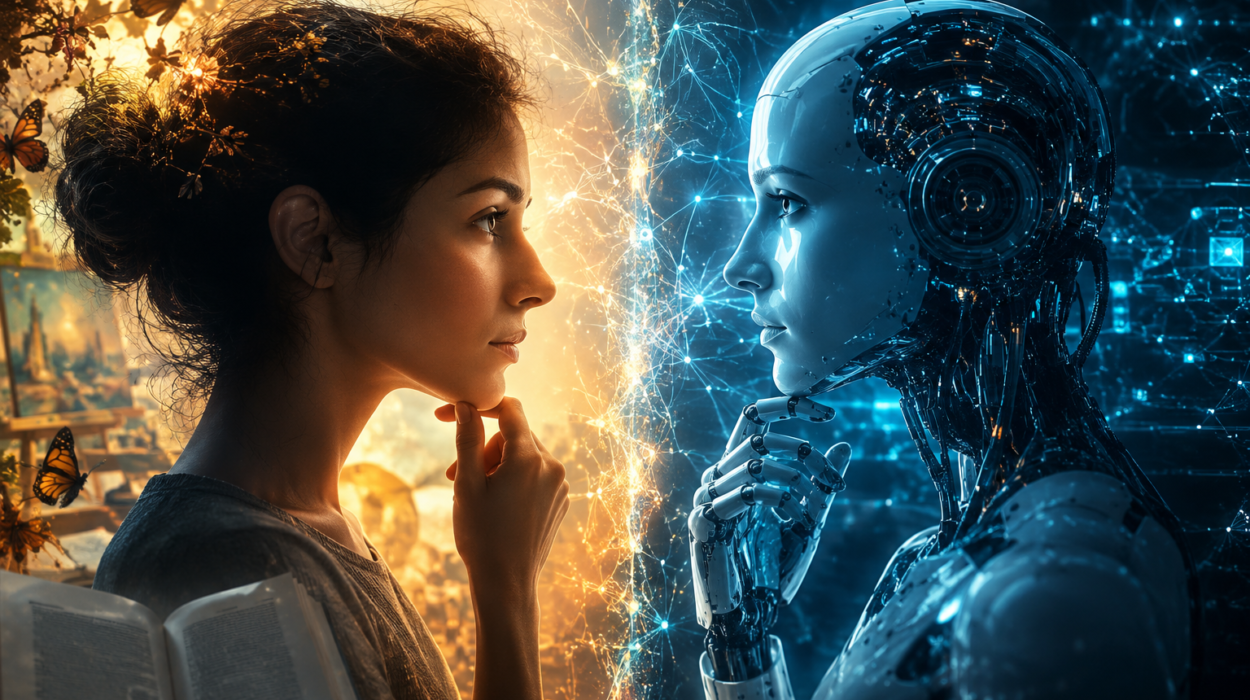
At the same time, AI reminds us of the remarkable nature of human intelligence. While machines can analyze vast amounts of data and perform specialized tasks with extraordinary speed, humans bring curiosity, imagination, empathy, moral reasoning, and lived experience to every decision they make. These qualities remain central to science, culture, and society.
The future of Artificial Intelligence will not be determined by technology alone. It will be shaped by the choices people make about how AI is designed, used, regulated, and shared. If developed responsibly and guided by scientific evidence and ethical principles, Artificial Intelligence has the potential to become one of humanity’s most powerful tools—not because it replaces human intelligence, but because it complements and amplifies it in ways that were once thought impossible.