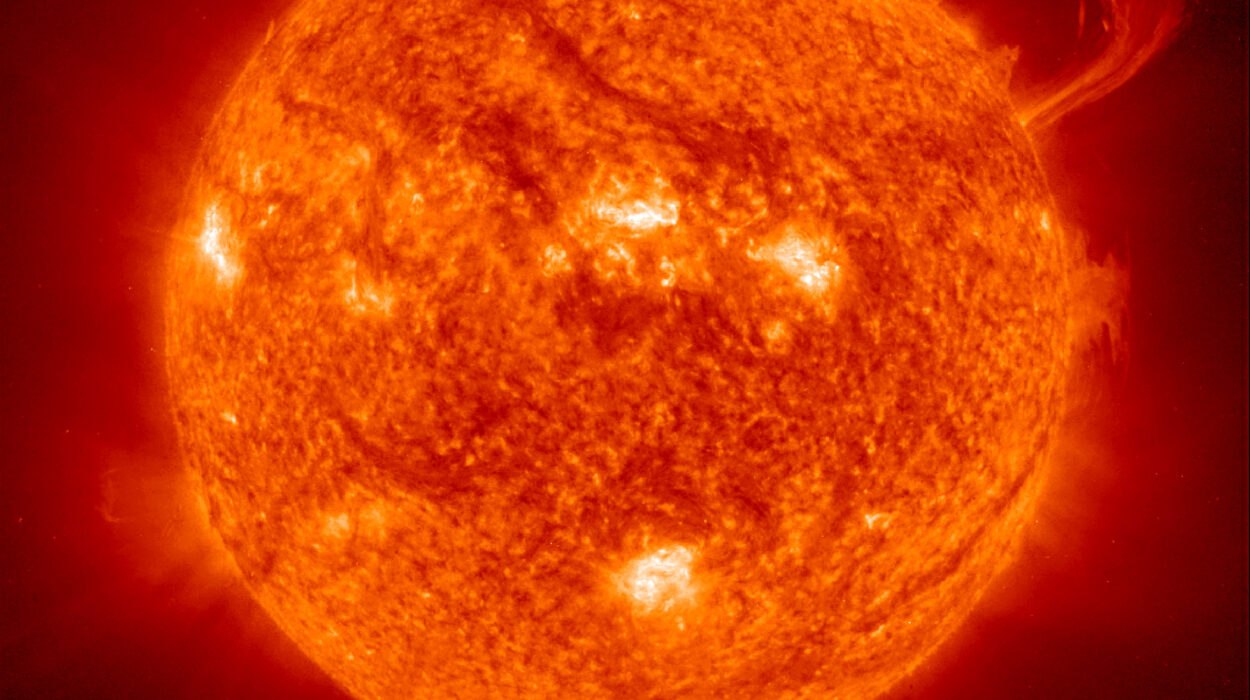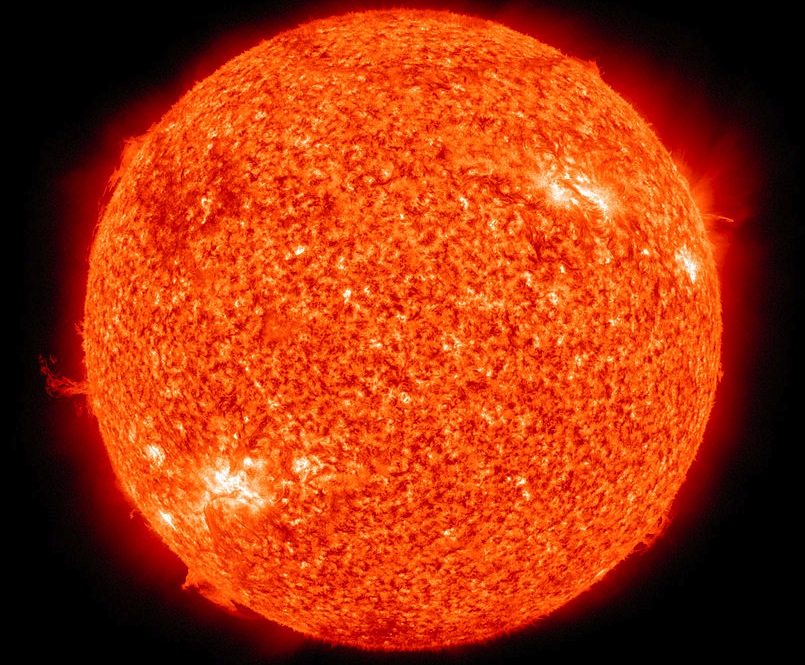
Every morning, the Sun rises without fail. It lights our skies, warms our planet, powers the weather, helps plants grow, and makes life on Earth possible. Because this happens every day, it is easy to take the Sun for granted. Yet behind its calm golden appearance lies one of the most powerful natural engines in the universe.
Every second, the Sun releases an unimaginable amount of energy—more than humanity could ever produce using all the technologies it has developed. This energy has been flowing across space for billions of years, traveling nearly 150 million kilometers (93 million miles) before reaching Earth in just over eight minutes.
But just how much energy does the Sun actually produce? The answer is so enormous that it challenges the limits of human imagination. Understanding it not only reveals the incredible power of our nearest star but also helps explain how stars work throughout the universe.
The Sun Is a Giant Nuclear Power Plant
The Sun is not burning like a campfire or a candle. Fire requires oxygen, but space is almost a vacuum, where there is essentially no oxygen to sustain combustion.
Instead, the Sun generates energy through nuclear fusion, a process that takes place deep within its core. Here, temperatures reach about 15 million degrees Celsius (27 million degrees Fahrenheit), while pressure is so immense that hydrogen atoms are forced together.
When hydrogen nuclei fuse, they form helium. During this process, a tiny amount of mass is converted directly into energy, exactly as described by Albert Einstein’s famous equation:
E = mc²
This simple equation shows that even a very small amount of mass can become an enormous amount of energy because the speed of light squared is an incredibly large number.
The Sun has been carrying out this process continuously for about 4.6 billion years, and it still contains enough hydrogen fuel to continue shining for roughly another 5 billion years.
The Sun’s Total Energy Output
Scientists measure the total amount of energy a star emits using a quantity called luminosity.
The Sun’s luminosity is approximately:
3.828 × 10²⁶ watts
A watt is one joule of energy released every second. This means the Sun produces about:
382,800,000,000,000,000,000,000,000 watts
every single second.
Writing this number in ordinary form hardly makes it easier to understand because it contains twenty-six digits.
Another way to think about it is that the Sun releases about:
382 septillion joules of energy every second.
That amount of energy is beyond anything humans encounter in everyday life.
What Does That Number Really Mean?
Numbers this large are difficult to picture, so comparisons help.
Human civilization currently uses roughly 20 terawatts of power on average, or about 20 trillion watts.
The Sun produces nearly 20 trillion times more power than humanity uses at any given moment.
In just one second, the Sun emits far more energy than human civilization has consumed throughout its entire history.
Even if every power plant on Earth operated at full capacity continuously for millions of years, they would still produce only a tiny fraction of the energy the Sun releases in a single second.
This comparison highlights just how extraordinary our nearest star truly is.
How Much Mass Does the Sun Turn Into Energy?
One of the most remarkable facts about the Sun is that it literally converts matter into energy.
Every second, about 600 million metric tons of hydrogen undergo nuclear fusion in the Sun’s core.
Most of this hydrogen becomes helium, but not all of the original mass remains.
Approximately 596 million metric tons become helium, while the remaining 4 million metric tons are converted directly into energy.
Although losing four million metric tons every second sounds enormous, the Sun is so massive—containing about 2 × 10³⁰ kilograms of matter—that this loss is tiny compared with its total mass.
Even after billions of years, the Sun has lost only a very small fraction of its original mass through this process.
How Does the Energy Escape the Sun?
The energy created in the Sun’s core does not immediately reach space.
Instead, it begins a remarkable journey.
The energy is first produced as high-energy gamma rays deep inside the core.
These photons repeatedly collide with particles inside the dense interior. Every collision changes their direction, energy, and path.
Rather than traveling straight outward, photons perform what scientists call a random walk.
Because of these countless interactions, a photon created in the core may take tens of thousands to hundreds of thousands of years, and possibly even longer according to some models, to reach the Sun’s visible surface.
Once the energy finally reaches the surface, called the photosphere, it escapes into space as visible light, infrared radiation, ultraviolet radiation, and other forms of electromagnetic radiation.
From there, it travels to Earth in only about 8 minutes and 20 seconds.
How Much Solar Energy Reaches Earth?
Although the Sun emits energy equally in nearly every direction, Earth intercepts only a tiny fraction.
Our planet occupies an extremely small area compared with the enormous sphere over which the Sun’s energy spreads.
At Earth’s average distance from the Sun, each square meter facing directly toward the Sun receives about 1,361 watts of solar power outside Earth’s atmosphere. This value is known as the solar constant.
The atmosphere reflects, scatters, and absorbs some of this energy before it reaches the ground.
On a clear day around noon, sunlight striking Earth’s surface can provide roughly 1,000 watts per square meter, although the exact amount depends on location, season, weather, and the Sun’s position in the sky.
Even this tiny share is enough to power Earth’s climate, drive ocean currents, fuel photosynthesis, and sustain nearly every ecosystem.
The Sun Powers Life on Earth
Almost every form of life depends directly or indirectly on solar energy.
Plants capture sunlight through photosynthesis, converting carbon dioxide and water into sugars while releasing oxygen.
Animals depend on plants either by eating them directly or by eating other animals that consume plants.
Even humans ultimately obtain most of their food energy from sunlight stored in plants.
The oxygen we breathe, the crops we harvest, the forests that regulate Earth’s climate, and the ecosystems that support biodiversity all owe their existence to the Sun.
Without its continuous energy supply, Earth would quickly become a frozen, lifeless world.
The Sun Also Drives Earth’s Weather
The atmosphere is constantly in motion because different parts of Earth receive different amounts of solar energy.
The equator receives more direct sunlight than the poles.
This uneven heating creates temperature differences that drive winds, ocean currents, storms, and weather systems.
The water cycle also depends entirely on solar energy.
Sunlight evaporates water from oceans, lakes, and rivers.
The water vapor forms clouds.
Eventually, it falls back as rain or snow.
Without the Sun, there would be no rainfall, no rivers flowing to the sea, and no weather as we know it.
Can We Capture the Sun’s Energy?
Humans have learned to harness a small portion of the Sun’s enormous energy.
Solar panels convert sunlight directly into electricity using the photovoltaic effect.
Solar thermal systems use sunlight to produce heat for homes, industries, and power generation.
Because the Sun provides far more energy than humanity currently needs, solar power has become one of the world’s fastest-growing renewable energy sources.
Modern solar technology continues to improve, making electricity generation cleaner, more affordable, and more efficient.
Although we capture only a tiny fraction of the Sun’s output, it is already transforming how the world generates energy.
The Sun’s Energy Will Not Last Forever
The Sun may seem eternal, but like all stars, it has a finite lifetime.
Over billions of years, hydrogen in the core is gradually consumed.
As hydrogen becomes depleted, the Sun will undergo major changes.
About 5 billion years from now, it is expected to expand into a red giant, becoming much larger and brighter than it is today.
Eventually, it will shed its outer layers, creating a beautiful planetary nebula.
The remaining core will become a white dwarf, a dense stellar remnant that slowly cools over billions of years.
Fortunately, these events are so far in the future that they pose no concern for humanity today.
How Scientists Measure the Sun’s Energy
Scientists cannot place an energy meter on the Sun, but they can determine its power with remarkable accuracy.
They measure the amount of sunlight reaching Earth using satellites and ground-based instruments.
Knowing Earth’s average distance from the Sun allows them to calculate how much energy spreads over an imaginary sphere surrounding the Sun at that distance.
By applying the well-established laws of geometry and radiation, astronomers determine the Sun’s total luminosity with great precision.
These calculations have been confirmed through decades of observations and are fundamental to modern astronomy.
Why the Sun Is So Stable
One reason life has been able to evolve on Earth is the Sun’s remarkable stability.
Inside the Sun, two opposing forces remain in delicate balance.
Gravity constantly pulls material inward.
At the same time, the immense pressure created by nuclear fusion pushes outward.
This balance, known as hydrostatic equilibrium, has kept the Sun stable for billions of years.
If fusion slowed significantly, gravity would compress the core until temperatures and pressures increased enough to accelerate fusion again.
If fusion became too intense, the Sun would expand slightly, reducing the core temperature and slowing the reactions.
This natural feedback helps the Sun maintain a relatively steady energy output over very long timescales.
The Sun Compared with Other Stars
Although the Sun is astonishingly powerful by human standards, it is not among the most energetic stars in the universe.
Some massive blue stars produce hundreds of thousands or even millions of times more energy than the Sun.
On the other hand, many small red dwarf stars emit only a tiny fraction of the Sun’s luminosity.
Astronomers classify the Sun as a G-type main-sequence star, often called a yellow dwarf.
It is considered an average-sized star, yet its steady energy output has created the conditions necessary for life to flourish on Earth.
The Future of Solar Energy Research
Scientists continue studying the Sun in extraordinary detail.
Spacecraft such as the Parker Solar Probe and the Solar Orbiter are helping researchers understand the Sun’s magnetic field, solar wind, and explosive events such as solar flares and coronal mass ejections.
These missions not only deepen our understanding of stellar physics but also improve our ability to predict space weather, which can affect satellites, communication systems, navigation networks, and electrical power grids on Earth.
Every new discovery reveals more about how our nearest star works and how stars throughout the universe generate energy.
A Star of Extraordinary Power
The Sun produces approximately 3.828 × 10²⁶ watts of energy every second, making it one of the most powerful objects in our cosmic neighborhood. Through the process of nuclear fusion, it transforms millions of tons of matter into energy each second, illuminating the Solar System and sustaining life on Earth.
Its light fuels forests, powers weather, drives ocean currents, and provides the energy stored in nearly all of the food we eat. Every sunrise is a reminder that our planet depends on a star whose power is almost beyond imagination.
The next time sunlight warms your face or brightens the morning sky, it is worth remembering that those rays began their journey in the heart of the Sun, where hydrogen atoms fused together in one of nature’s most extraordinary processes. That ancient energy crossed millions of kilometers of space to reach Earth, making every moment of daylight a direct connection to the incredible power of our nearest star.