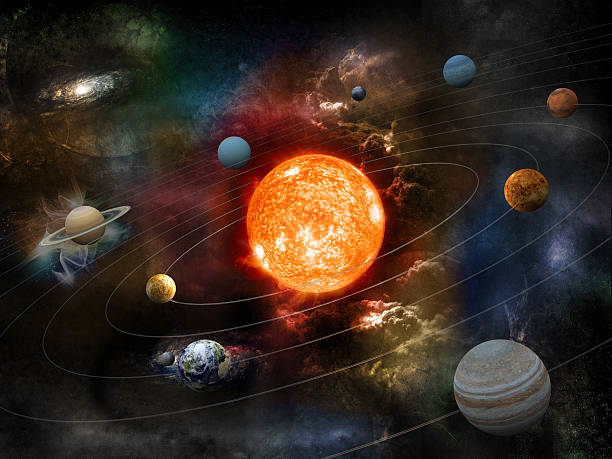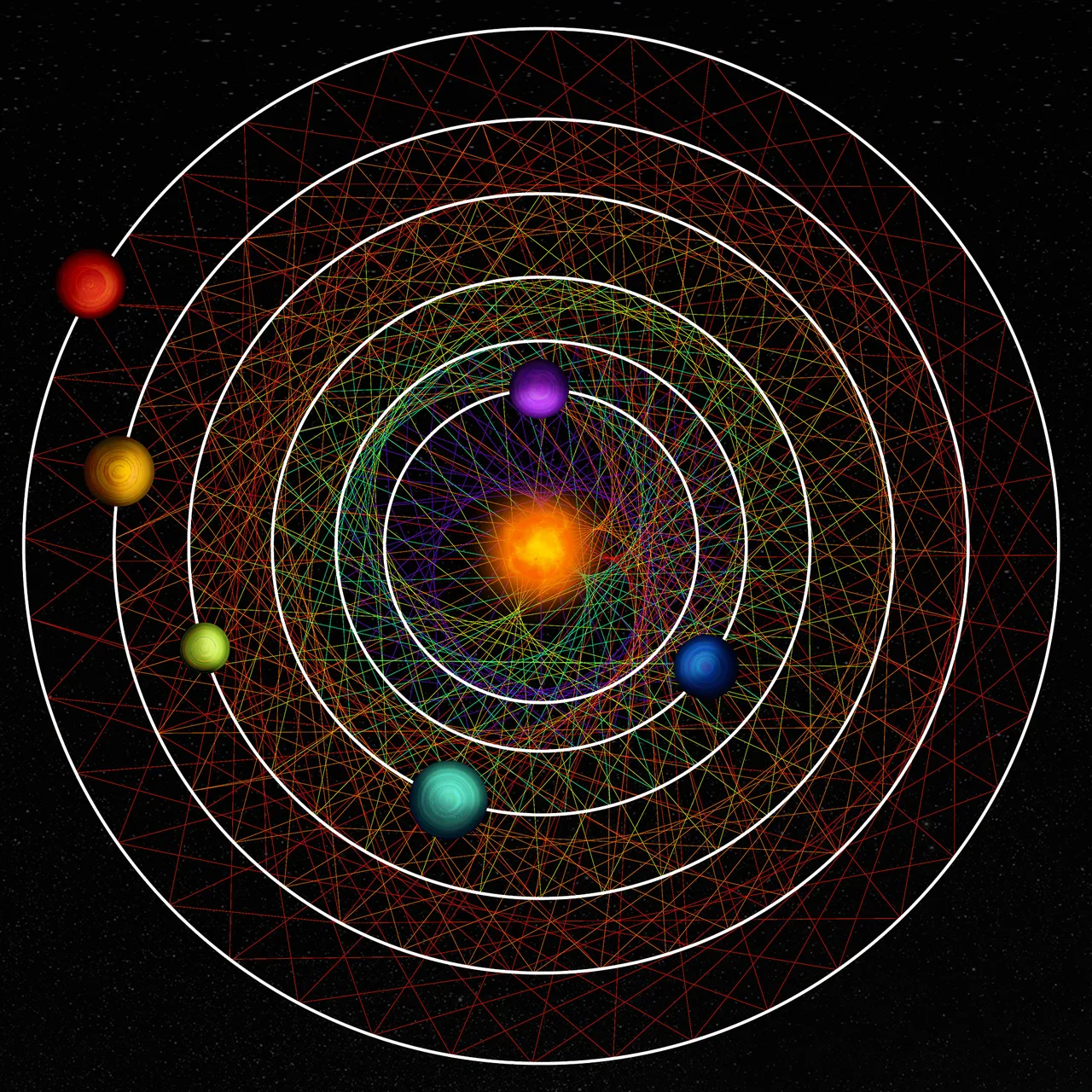
Look up at the night sky, and you are witnessing one of nature’s most beautiful dances. The Moon circles Earth. Earth journeys around the Sun. The planets travel through the Solar System in graceful paths that have continued for billions of years. Far beyond our galaxy, stars orbit the centers of galaxies, while galaxies themselves move through vast clusters shaped by gravity.
These endless cosmic journeys are all made possible by one fundamental concept in physics and astronomy: the orbit.
An orbit is much more than an invisible path in space. It is the result of a delicate balance between motion and gravity. Without orbits, there would be no years, no seasons, no stable planetary systems, and perhaps no life on Earth. Every satellite that provides GPS navigation, weather forecasts, television broadcasts, and internet services depends on carefully calculated orbits. Every mission to the Moon, Mars, or beyond begins with understanding how objects move under gravity.
Although the idea of an orbit may seem complicated at first, it is actually based on a surprisingly simple principle that governs everything from a thrown baseball to the movement of entire galaxies.
What Is an Orbit?
An orbit is the curved path that one object follows as it moves around another object because of gravity.
Whenever a smaller object moves near a much more massive object, gravity pulls it inward. If the smaller object is also moving sideways with enough speed, it does not simply fall straight down. Instead, it continually “falls around” the larger object, creating an orbit.
In astronomy, planets orbit stars, moons orbit planets, artificial satellites orbit Earth, and stars orbit the centers of galaxies.
An orbit is not a physical track or road in space. It is an invisible path determined entirely by the laws of gravity and motion.
Why Do Orbits Happen?
The secret behind every orbit is the balance between two things: gravity and forward motion.
Gravity constantly pulls an object toward the larger body.
At the same time, the object is already moving sideways.
If gravity acted alone, the object would fall directly toward the larger body.
If the object’s sideways speed were too great and gravity were absent, it would travel away in a straight line forever.
When these two effects are balanced correctly, the object continuously curves around the larger body.
Imagine swinging a ball attached to a string. The string constantly pulls the ball inward while the ball keeps moving forward. The result is a circular path. In space, gravity plays the role of the string, although there is no physical connection between the two objects.
Isaac Newton’s Brilliant Insight
One of the greatest breakthroughs in science came from Sir Isaac Newton during the seventeenth century.
Newton realized that the same force causing an apple to fall from a tree also keeps the Moon in orbit around Earth.
Before Newton, many people believed that celestial objects followed entirely different rules from objects on Earth.
Newton showed that the same universal law of gravity governs both.
He imagined firing a cannonball from the top of a very high mountain. If fired slowly, the cannonball would fall to Earth. If fired faster, it would travel farther before landing.
If fired fast enough—and ignoring air resistance—the cannonball would keep falling toward Earth while Earth’s surface curved away beneath it. Instead of hitting the ground, it would continuously circle the planet.
This thought experiment perfectly illustrates how an orbit works.
Gravity Never Turns Off
One common misunderstanding is that astronauts or satellites in orbit have escaped Earth’s gravity.
In reality, Earth’s gravity remains very strong even hundreds of kilometers above the surface.
For example, astronauts aboard the International Space Station experience about 90% of the gravitational pull felt at Earth’s surface.
They appear weightless not because gravity has disappeared, but because they and the spacecraft are constantly falling together around Earth.
This continuous free fall creates the sensation of weightlessness.
Circular and Elliptical Orbits
Not every orbit is perfectly round.
A circular orbit has the same distance from the central object at every point along its path.
An elliptical orbit is shaped like a stretched circle, called an ellipse.
Most natural orbits in the universe are elliptical.
Johannes Kepler discovered in the early seventeenth century that planets travel around the Sun in elliptical orbits rather than perfect circles.
Earth’s orbit, for example, is slightly elliptical, although it is very close to circular.
Some objects follow highly elongated elliptical paths that carry them very close to the object they orbit before sending them much farther away.
Many comets have extremely elongated orbits around the Sun.
Kepler’s Laws of Planetary Motion
Johannes Kepler carefully analyzed decades of astronomical observations and discovered three remarkable patterns.
He found that planets move in elliptical orbits with the Sun located at one focus of the ellipse.
He also discovered that planets move faster when they are closer to the Sun and slower when they are farther away.
Finally, he found a mathematical relationship between a planet’s distance from the Sun and the time it takes to complete one orbit.
These discoveries laid the foundation for Newton’s later explanation of gravity.
Even today, Kepler’s laws remain essential for understanding planetary motion and designing spacecraft trajectories.
What Determines an Orbit?
Several factors determine the shape and size of an orbit.
The mass of the central object plays a major role. More massive objects exert stronger gravitational forces.
The speed of the orbiting object is equally important. Too little speed causes the object to fall inward. Too much speed allows it to escape entirely.
The distance between the two objects also affects the orbit. Gravity becomes weaker as distance increases.
Together, these factors determine whether an object follows a circular orbit, an elliptical orbit, or escapes into space.
Orbital Speed
Objects closer to the body they orbit must travel faster.
The International Space Station circles Earth at about 28,000 kilometers per hour (roughly 17,500 miles per hour), completing one orbit in about 90 minutes.
The Moon travels much more slowly because it is much farther from Earth.
Mercury, being the closest planet to the Sun, moves much faster than Neptune, the outermost major planet.
This relationship is one of the fundamental characteristics of orbital motion.
Earth’s Orbit Around the Sun
Earth completes one orbit around the Sun in approximately 365.25 days.
This journey defines one year.
Earth travels around the Sun at an average speed of nearly 30 kilometers per second, or about 107,000 kilometers per hour (66,600 miles per hour).
Despite this incredible speed, we do not feel Earth’s motion because everything around us moves with the planet.
Earth’s slightly elliptical orbit is remarkably stable, allowing life to thrive over billions of years.
The Moon’s Orbit Around Earth
The Moon orbits Earth at an average distance of about 384,400 kilometers (238,855 miles).
It completes one orbit in about 27.3 days relative to the distant stars.
Because Earth is also moving around the Sun, the cycle of lunar phases—from one new moon to the next—takes about 29.5 days.
The Moon’s gravitational interaction with Earth produces ocean tides, gradually slows Earth’s rotation, and slowly causes the Moon to drift away from Earth by about 3.8 centimeters each year.
Artificial Satellites
Humans have learned to place satellites into orbit around Earth for many purposes.
Communication satellites relay television, telephone, and internet signals.
Weather satellites monitor storms, hurricanes, and climate.
Navigation satellites provide accurate positioning for GPS and similar systems.
Scientific satellites observe Earth’s atmosphere, study the Sun, or explore the distant universe.
Military satellites support national security and reconnaissance.
Every satellite remains in orbit because engineers carefully calculate its speed, altitude, and direction.
Different Types of Earth Orbits
Satellites are placed into different orbits depending on their mission.
Low Earth Orbit lies a few hundred to about two thousand kilometers above Earth’s surface. Many scientific spacecraft, Earth-observing satellites, and the International Space Station operate here because they are relatively close to the planet.
Medium Earth Orbit is commonly used by navigation satellite systems, providing wide coverage while remaining closer than the highest satellite orbits.
Geostationary Orbit is located about 35,786 kilometers (22,236 miles) above Earth’s equator. A satellite in this orbit circles Earth once every 24 hours, matching Earth’s rotation. As a result, it appears to remain fixed above the same location on Earth’s surface, making it ideal for weather monitoring and communications.
Highly elliptical orbits are useful for missions that require long periods over certain regions of Earth.
Escape Velocity
An object does not have to remain in orbit forever.
If it reaches a sufficiently high speed known as escape velocity, it can completely overcome the gravitational attraction of the larger body.
For Earth, escape velocity is about 11.2 kilometers per second (approximately 25,000 miles per hour).
Spacecraft traveling to the Moon, Mars, or other planets must achieve this speed relative to Earth before beginning their journeys through the Solar System.
Orbits Throughout the Solar System
Every major object in the Solar System follows an orbit.
The planets orbit the Sun.
Moons orbit planets.
Asteroids orbit the Sun, mostly within the asteroid belt between Mars and Jupiter.
Comets travel around the Sun in elongated elliptical orbits that can take decades, centuries, or even thousands of years to complete.
Even dwarf planets like Pluto follow their own distinctive paths around the Sun.
Together, these countless orbits create the dynamic architecture of our Solar System.
Binary Stars and Exoplanets
Not all orbits involve planets and stars in the familiar way.
Many stars exist in binary systems where two stars orbit their common center of mass.
Some systems contain three or more stars locked in intricate gravitational dances.
Thousands of planets discovered around other stars—known as exoplanets—orbit their own suns.
Studying these orbits helps astronomers estimate planetary masses, climates, and even the possibility of life elsewhere in the universe.
Orbits Around Black Holes
Black holes also have orbits.
Stars can orbit supermassive black holes at the centers of galaxies.
Astronomers have observed stars moving around the supermassive black hole at the center of the Milky Way, providing some of the strongest evidence that such black holes exist.
Matter falling toward a black hole often forms a rapidly spinning disk called an accretion disk before eventually crossing the event horizon.
These extreme environments test our understanding of gravity under the most intense conditions known.
Galaxies in Motion
Orbits are not limited to planets and stars.
Within galaxies, billions of stars orbit the galactic center.
Our own Sun completes one orbit around the center of the Milky Way approximately every 225 to 250 million years.
Galaxies themselves can orbit one another within clusters of galaxies, influenced by the enormous gravitational pull of visible matter and dark matter.
The universe is filled with motion on every scale.
Can Orbits Change?
Although many orbits remain stable for millions or even billions of years, they are not always permanent.
Gravitational interactions with other objects can gradually alter an orbit.
Atmospheric drag slowly causes low-altitude satellites to lose energy and eventually re-enter Earth’s atmosphere.
Close encounters between planets, moons, asteroids, or comets can significantly reshape orbital paths.
Over immense spans of time, entire planetary systems can evolve through these interactions.
Why Understanding Orbits Is Important
The science of orbits affects everyday life more than most people realize.
Satellite navigation allows smartphones to provide directions.
Weather satellites improve storm forecasting and help protect lives.
Communication satellites connect people across continents.
Space agencies rely on orbital mechanics to explore the Moon, Mars, asteroids, and beyond.
Astronomers use orbital motion to measure the masses of planets, stars, and even invisible black holes.
Understanding orbits has become essential for both modern technology and scientific discovery.
The Beauty of Orbital Motion
One of the most remarkable aspects of the universe is that simple physical laws produce such breathtaking complexity.
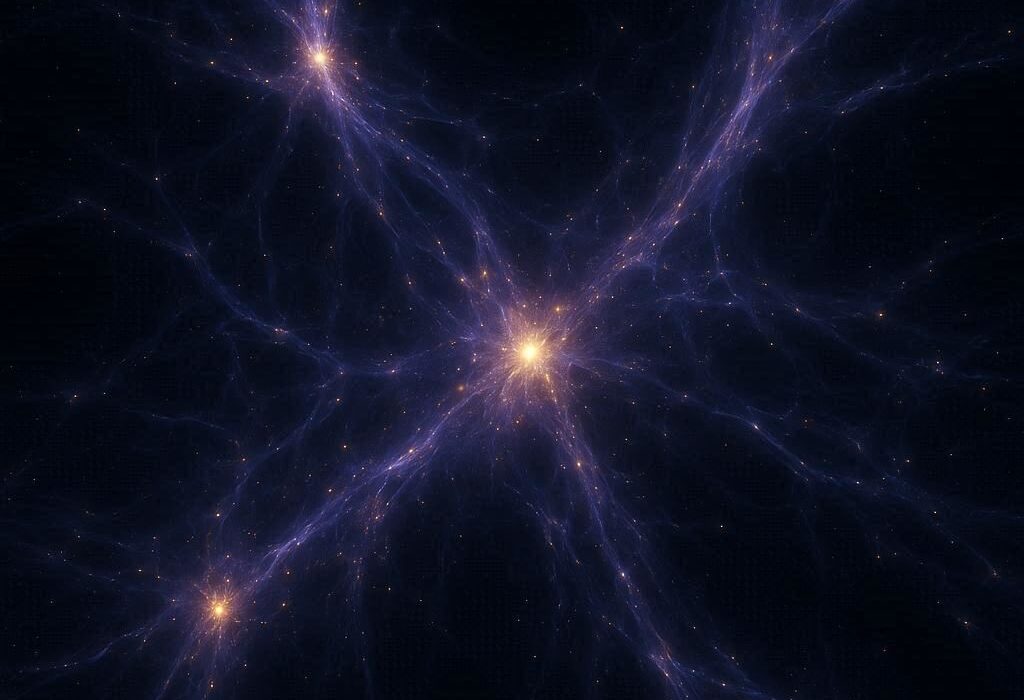
The same gravitational principles that keep the Moon circling Earth also guide planets around stars, stars around galaxies, and galaxies through the vast cosmic web.
An orbit is more than just a path through space. It is evidence of the delicate balance between motion and gravity—a balance that has shaped the universe for more than 13 billion years.
Every sunrise, every changing season, every eclipse, every satellite transmission, and every deep-space mission is possible because of this elegant cosmic dance. By understanding orbits, we gain not only a deeper appreciation of astronomy and physics but also a clearer understanding of our own place in the ever-moving universe.