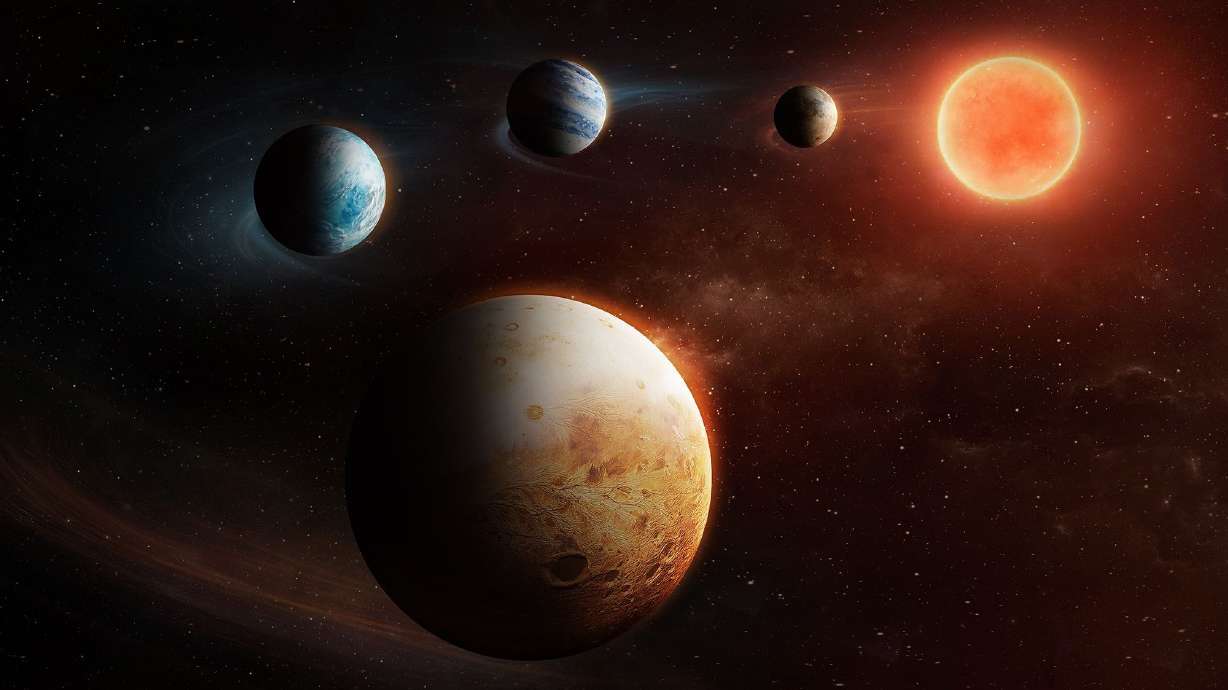
For thousands of years, people looked up at the night sky and noticed something remarkable. The stars seemed fixed in place, but a handful of bright objects slowly wandered across the heavens. These “wandering stars,” which we now know are planets, followed predictable paths. Yet one question remained unanswered for centuries: Why do planets move the way they do?
At first glance, it might seem natural to imagine that planets travel around the Sun in perfect circles. After all, circles appear smooth, symmetrical, and complete. Ancient astronomers even believed that circles represented perfection, making them the obvious choice for celestial motion.
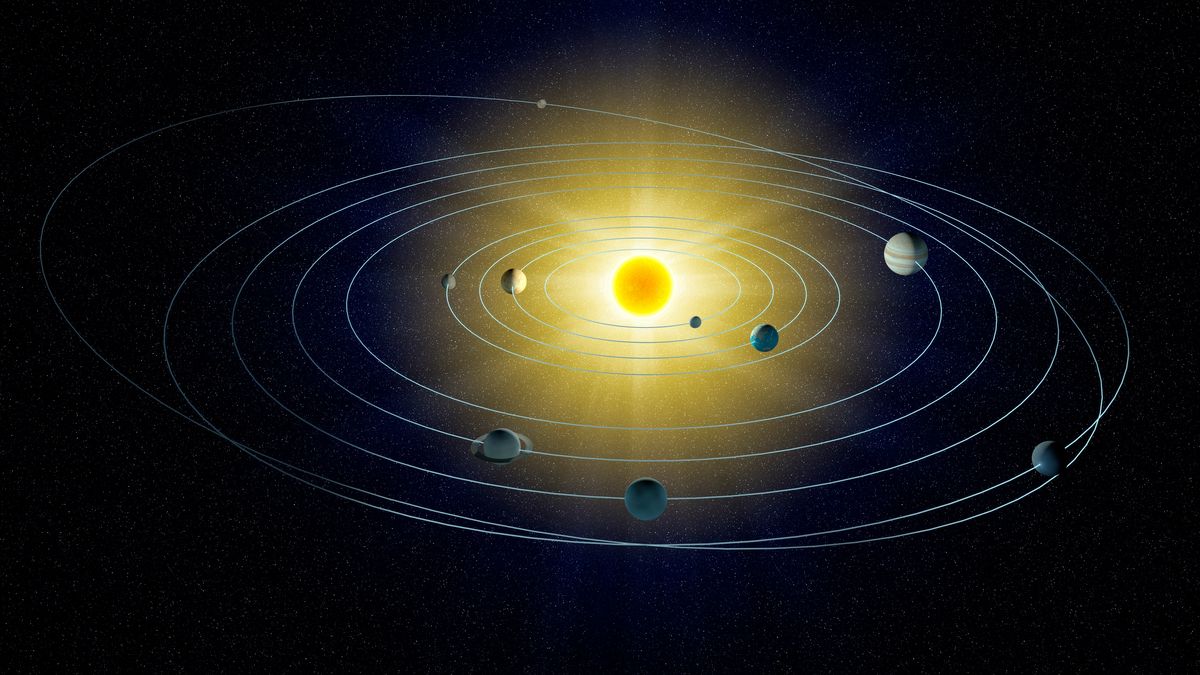
But nature had a surprise waiting. Careful observations eventually revealed that planets do not move in perfect circles. Instead, every planet in our Solar System follows an elliptical orbit—a slightly stretched-out circle. This discovery completely transformed astronomy and laid the foundation for modern physics.
Understanding why planetary orbits are elliptical is one of the greatest success stories in science. It combines careful observation, elegant mathematics, and the fundamental force that governs the cosmos: gravity.
What Is an Ellipse?
Before exploring why planets move in elliptical paths, it helps to understand what an ellipse actually is.
An ellipse is a closed curve that resembles a flattened or stretched circle. If a circle is perfectly round in every direction, an ellipse is slightly longer in one direction than the other.
One of the defining features of an ellipse is that it has two special points called foci. Instead of placing the central object exactly in the middle, an elliptical orbit places it at one of these two foci.
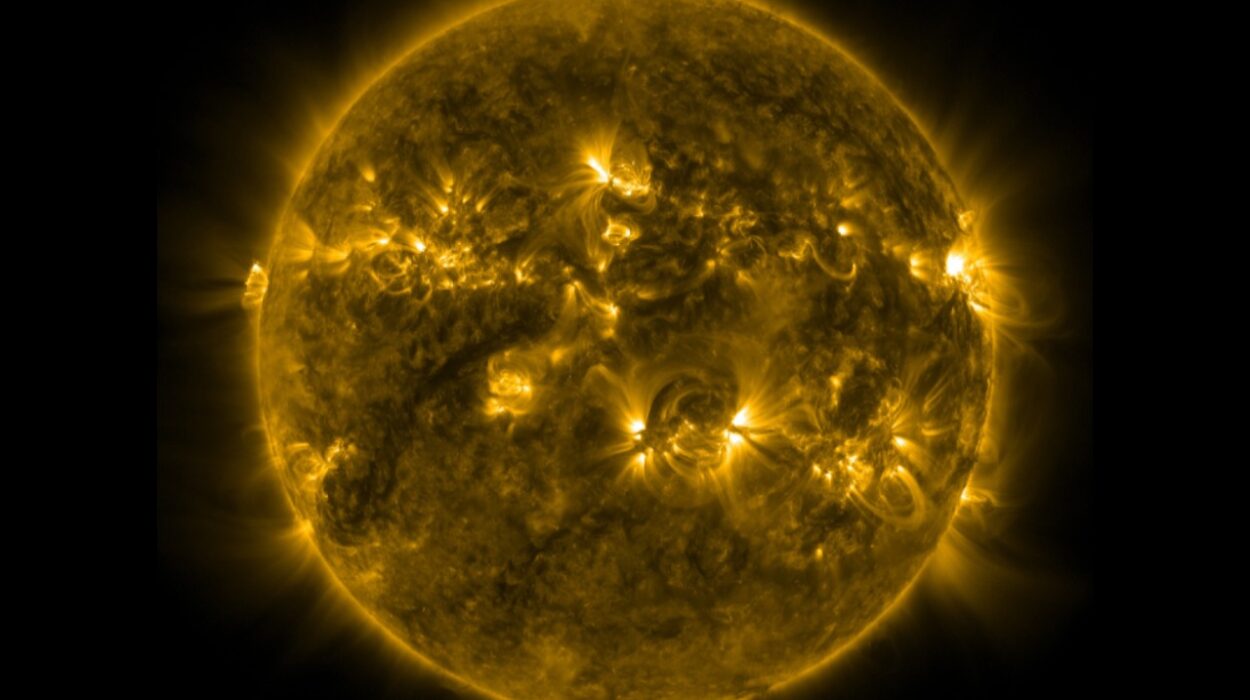
In the Solar System, the Sun occupies one focus of each planet’s orbit, not the exact center.
This simple geometric fact explains many of the changing distances and speeds of planets as they travel around the Sun.
Ancient Beliefs About Planetary Motion
Long before telescopes existed, astronomers carefully tracked the movements of the planets.
Ancient Greek philosophers believed that heavenly bodies should move in perfect circles because circles were considered the most perfect geometric shape.
This idea became deeply rooted in astronomy.
For centuries, astronomers created increasingly complicated systems of circles within circles—called epicycles—to explain planetary motion.
Although these models could approximately predict planetary positions, they became incredibly complex and still failed to perfectly match observations.
Nature, it turned out, was much simpler than those elaborate models suggested.
Johannes Kepler Changed Everything
The breakthrough came in the early seventeenth century through the work of the German astronomer Johannes Kepler.
Kepler had access to decades of extraordinarily precise observations collected by the Danish astronomer Tycho Brahe.
As Kepler analyzed this treasure trove of data, he noticed something astonishing.
The planets did not fit circular orbits.
After years of painstaking calculations, Kepler discovered that the observations matched perfectly if the planets traveled in ellipses instead.
This became Kepler’s First Law of Planetary Motion, which states:
Every planet moves around the Sun in an elliptical orbit, with the Sun located at one focus of the ellipse.
This law revolutionized astronomy because it described planetary motion far more accurately than any previous model.
Gravity Is the Real Reason
Kepler described how planets move, but he could not explain why.
The answer came later through the work of Isaac Newton.
Newton realized that every object with mass attracts every other object through gravity.
The Sun contains about 99.8% of the mass of the Solar System, giving it an enormous gravitational pull.
Gravity constantly attracts each planet toward the Sun.
At the same time, every planet is already moving sideways through space.
These two motions happen simultaneously.
Gravity pulls inward.
The planet’s motion carries it forward.
The result is a continuous curved path around the Sun.
Without gravity, Earth would travel in a straight line into deep space.
Without its forward motion, Earth would fall directly into the Sun.
Instead, the balance between these effects creates an orbit.
Why Isn’t the Orbit a Perfect Circle?
This is perhaps the most interesting question.
A perfectly circular orbit is actually a very special case.
For a planet to remain in an exact circle, several conditions must be met perfectly.
Its speed must have exactly the right value.
Its direction must be exactly perpendicular to the gravitational pull.
Its distance from the Sun must remain constant.
Even tiny differences in these conditions naturally produce an ellipse instead of a circle.
Nature rarely creates perfect circles.
Instead, gravitational interactions during the formation of planetary systems almost always produce slightly stretched orbits.
Ellipses are therefore the normal outcome of gravity acting on moving objects.
The Birth of Planetary Orbits
To understand why planets begin with elliptical paths, we must travel back about 4.6 billion years.
The Solar System formed from a gigantic rotating cloud of gas and dust called the solar nebula.
As gravity caused this cloud to collapse, most of its material collected in the center, forming the young Sun.
The remaining gas and dust continued orbiting the newborn star.
Tiny particles collided and stuck together.
Over millions of years, they grew into rocks, planetesimals, protoplanets, and eventually full-sized planets.
These countless collisions and gravitational interactions gave each developing planet a unique speed and direction.
Rather than settling into mathematically perfect circles, the planets naturally acquired slightly elliptical orbits.
The Shape of Earth’s Orbit
Many people imagine Earth’s orbit as strongly oval-shaped.
In reality, it is almost circular.
Earth’s orbit has an eccentricity of approximately 0.0167.
Eccentricity measures how stretched an ellipse is.
An eccentricity of zero represents a perfect circle.
Values closer to one indicate increasingly elongated ellipses.
Earth’s eccentricity is so small that its orbit appears nearly circular.
The distance between Earth and the Sun changes by only about 5 million kilometers (3 million miles) over the course of a year.
Considering the average distance is about 150 million kilometers (93 million miles), this difference is relatively small.
Some Planets Have More Elliptical Orbits
Not every planet travels in an orbit as close to circular as Earth’s.
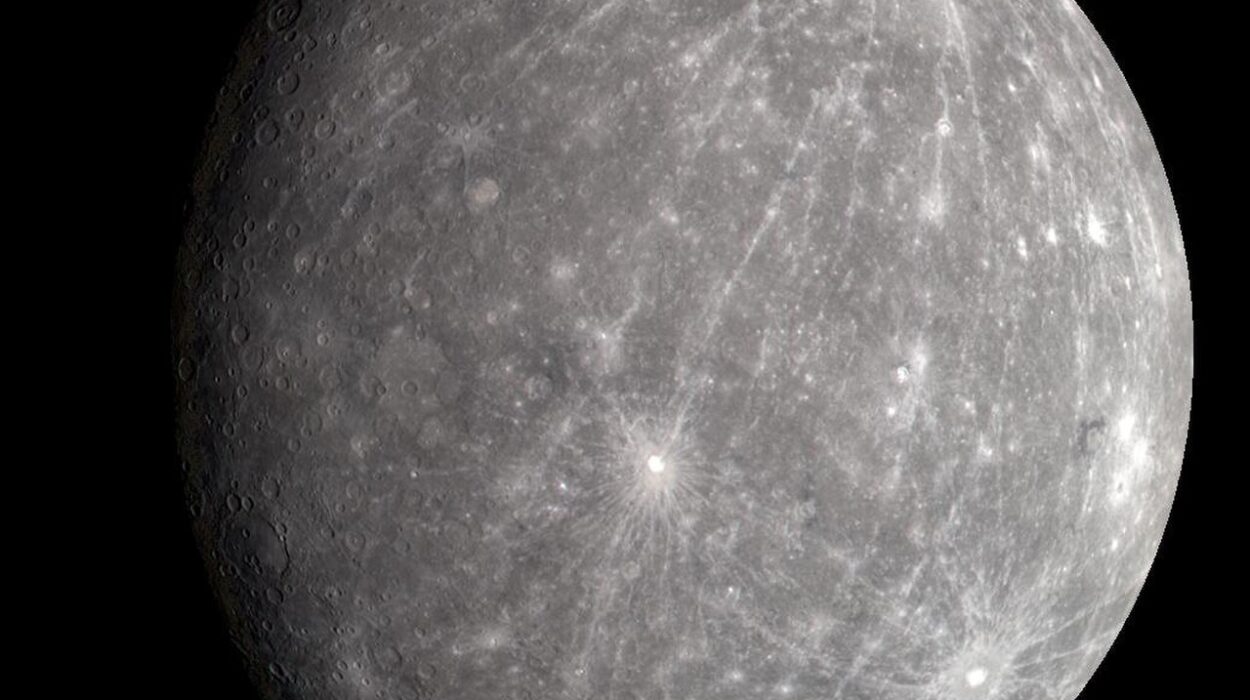
Mercury has the most elliptical orbit among the eight major planets.
Its eccentricity is about 0.206.
As Mercury moves around the Sun, its distance changes dramatically.
This variation influences its orbital speed and contributes to its extreme temperature differences.
Mars also has a more noticeable elliptical orbit than Earth.
By contrast, Venus follows one of the most circular planetary paths in the Solar System.
Each planet’s orbit reflects the unique history of its formation and billions of years of gravitational interactions.
Planets Do Not Move at Constant Speed
One of Kepler’s most important discoveries was that planets do not travel at a constant speed.
Instead, they move faster when they are closer to the Sun and slower when they are farther away.
This behavior follows naturally from gravity.
When a planet approaches the Sun, gravity becomes stronger, accelerating the planet.
As it moves away, gravity slows it down.
This changing speed is described by Kepler’s Second Law, often called the Law of Equal Areas.
It states that a line connecting a planet and the Sun sweeps out equal areas in equal intervals of time.
Although this sounds mathematical, it simply means that planets automatically speed up and slow down in just the right way to maintain their orbits.
Energy and Elliptical Motion
Physics provides another way to understand elliptical orbits.
Every orbit is governed by a balance between kinetic energy, associated with motion, and gravitational potential energy, associated with position in a gravitational field.
As a planet approaches the Sun, gravitational potential energy decreases while kinetic energy increases.
The planet speeds up.
As it moves farther away, some of its kinetic energy converts back into gravitational potential energy.
The planet slows down.
This continuous exchange of energy produces the graceful rhythm of elliptical motion.
Throughout the journey, the planet’s total mechanical energy remains constant if no significant external forces act on it.
Why Doesn’t the Sun Stay Still?
Although we often say that planets orbit the Sun, the reality is slightly more complicated.
The Sun also moves.
Both the Sun and each planet orbit their common center of mass, known as the barycenter.
Because the Sun is vastly more massive than any planet, this center usually lies very close to the Sun’s center.
As a result, the Sun appears almost stationary while the planets perform most of the visible motion.
For massive planets like Jupiter, however, the barycenter can lie just outside the Sun itself, causing the Sun to wobble slightly.
Astronomers even use similar stellar wobbles to discover planets orbiting distant stars.
Can Orbits Change?
Planetary orbits are remarkably stable, but they are not completely fixed forever.
The gravitational pull of other planets slowly alters each orbit over long periods.
These subtle changes can affect eccentricity, orientation, and orbital shape over thousands to millions of years.
For Earth, these slow variations are known as Milankovitch cycles.
They influence the distribution of sunlight reaching our planet and have contributed to the timing of ice ages over geological timescales.
Although these changes are gradual, they demonstrate that planetary orbits remain dynamic rather than perfectly permanent.
Elliptical Orbits Beyond the Solar System
Elliptical orbits are not unique to our Solar System.
Thousands of exoplanets discovered around distant stars also travel in elliptical paths.
Some have nearly circular orbits like Earth’s.
Others follow extremely elongated ellipses that bring them very close to their stars before carrying them far away again.
These discoveries show that elliptical motion is a universal consequence of gravity throughout the cosmos.
Whether around a small red dwarf, a giant blue star, or even a supermassive black hole, objects naturally follow paths determined by gravity and motion.
Do Comets Also Follow Ellipses?
Comets provide some of the most dramatic examples of elliptical orbits.
Many famous comets spend decades or even centuries traveling through the cold outer Solar System before diving close to the Sun.
Halley’s Comet, for example, follows a highly elongated elliptical orbit that takes about 76 years to complete.
As it approaches the Sun, solar heat vaporizes its icy surface, creating the spectacular glowing coma and tail that make comets so beautiful.
After passing the Sun, gravity sends the comet back toward the distant reaches of the Solar System.
Could an Orbit Be Something Other Than an Ellipse?
Yes.
According to Newton’s laws of gravity, the path of an object depends on its speed.
If an object moves relatively slowly, gravity produces a closed elliptical orbit.
If its speed is exactly equal to the escape velocity, it follows a parabolic path.
If it moves even faster, it travels along a hyperbolic trajectory and escapes forever.
Some comets entering the Solar System from interstellar space follow hyperbolic paths because they are not gravitationally bound to the Sun.
The recently observed interstellar visitors ʻOumuamua and 2I/Borisov are well-known examples.
Einstein Refined the Picture
Newton’s theory explains planetary orbits with remarkable accuracy.
However, it is not the complete story.
Albert Einstein’s general theory of relativity provides an even more accurate description of gravity.
Instead of viewing gravity as a force acting across space, Einstein described gravity as the curvature of spacetime caused by mass.
Planets move along the curved geometry created by the Sun.
For most planets, the differences between Newton’s predictions and Einstein’s are tiny.
Mercury, however, experiences a measurable shift in its orbit that Newton’s theory alone cannot fully explain.
Einstein’s equations account for this effect precisely, providing one of the earliest and most important confirmations of general relativity.
Why Elliptical Orbits Matter
Understanding elliptical orbits has transformed science and technology.
Space agencies use orbital mechanics to send spacecraft to the Moon, Mars, Jupiter, and beyond.
Artificial satellites rely on the same gravitational principles discovered centuries ago.
Astronomers predict planetary positions years or even centuries in advance using orbital calculations.
Knowledge of elliptical motion also helps scientists understand asteroid impacts, comet encounters, planetary formation, and the architecture of distant planetary systems.
What began as a puzzle about wandering lights in the night sky has become one of the foundations of modern space exploration.
The Beauty of Nature’s Design
Elliptical orbits remind us that nature does not always choose what appears simplest to the human eye. While perfect circles once seemed to symbolize celestial perfection, the universe revealed something even more elegant. The graceful ellipse, shaped by the interplay of gravity and motion, describes the paths of planets with extraordinary precision.
Every year, Earth completes another journey around the Sun along this nearly circular ellipse, carrying oceans, forests, cities, and billions of people through space at astonishing speed. The same physical laws guide Mercury close to the Sun, Neptune in the icy outer Solar System, distant exoplanets around other stars, and even galaxies interacting across the universe.
The discovery that planetary orbits are elliptical was more than a correction to ancient astronomy—it was a turning point in humanity’s understanding of nature. It showed that the universe follows consistent, discoverable laws, and that by observing carefully and thinking deeply, we can uncover the hidden patterns that govern everything from the motion of a single planet to the evolution of the cosmos itself.