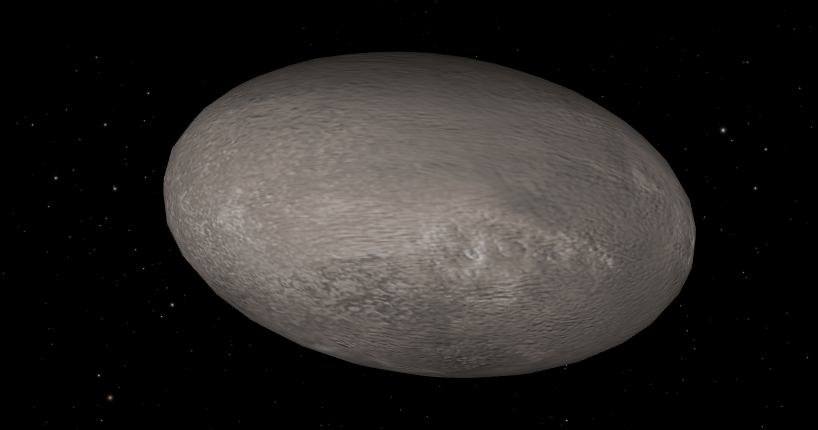
Far beyond the familiar worlds of Mercury, Venus, Earth, and Neptune lies a mysterious region filled with icy objects that have remained largely unchanged since the birth of the Solar System. Among these distant frozen worlds is one of the strangest objects astronomers have ever discovered—a dwarf planet unlike any other. It spins so fast that it has been stretched into the shape of an elongated football. It has a ring, two moons, an icy surface that shines brightly in the darkness, and a history that tells a dramatic story of ancient cosmic collisions.
This remarkable world is Haumea, one of the five officially recognized dwarf planets in our Solar System. Although it is incredibly far away, Haumea has become one of the most fascinating objects for scientists because it challenges many of our ideas about how planets and other celestial bodies form and evolve.
Haumea may not be as famous as Pluto, but it is every bit as extraordinary.
Where Is Haumea?
Haumea orbits the Sun in the Kuiper Belt, a vast region of icy bodies beyond Neptune. The Kuiper Belt stretches billions of kilometers into space and contains millions of frozen objects, including dwarf planets, comets, and ancient leftovers from the formation of the Solar System.
On average, Haumea is about 43 astronomical units (AU) from the Sun. One astronomical unit is the average distance between Earth and the Sun, which is about 150 million kilometers (93 million miles). This means Haumea is typically more than 6 billion kilometers (3.7 billion miles) away from the Sun.
At such an enormous distance, sunlight reaching Haumea is only a tiny fraction of what Earth receives. The Sun would appear as an exceptionally bright star rather than the large glowing disk we see from Earth.
The Discovery of Haumea
Haumea was discovered in 2004, although the announcement of its discovery became the subject of an unusual scientific controversy involving two research teams.
One team, led by American astronomer Michael E. Brown, had independently identified the object, while another team from Spain also reported its discovery. After careful review, the International Astronomical Union recognized the object and officially named it Haumea in 2008.
The name comes from Haumea, the Hawaiian goddess of fertility and childbirth. The choice reflects both the object’s Hawaiian discovery connection and the fact that Haumea appears to have produced a family of smaller icy objects through a massive collision long ago.
Why Is Haumea Called a Dwarf Planet?
A dwarf planet is an object that orbits the Sun, is massive enough for its own gravity to shape it into a nearly rounded body, but has not cleared other objects from its orbital neighborhood.
Haumea meets these requirements, making it one of the officially recognized dwarf planets alongside Pluto, Eris, Makemake, and Ceres.
However, Haumea differs dramatically from the others because its extremely rapid rotation has distorted its shape far beyond what scientists normally expect for a dwarf planet.
A Shape Unlike Almost Anything Else
Most large objects in space become roughly spherical because gravity pulls equally in every direction.
Haumea is an astonishing exception.
Instead of being nearly round, it is stretched into an elongated, rugby ball–like or football-like shape.
Scientists estimate that Haumea is roughly 2,300 kilometers (1,430 miles) long along its longest axis but much narrower across its shorter dimensions.
This unusual shape is caused by one incredible fact.
Haumea spins extraordinarily fast.
The Fastest-Spinning Dwarf Planet
Haumea completes one full rotation in only about 3.9 hours.
For comparison, Earth takes about 24 hours to rotate once, while Pluto rotates in about 6.4 Earth days.
Haumea’s rapid spin creates enormous centrifugal effects that pull material outward around its equator, stretching the entire body into its unusual elongated form.
It is the fastest rotating large object known in the Solar System that has reached hydrostatic equilibrium, where gravity and rotation determine its overall shape.
Scientists believe that if Haumea spun much faster, it could begin breaking apart.
What Is Haumea Made Of?
Haumea is composed primarily of rock and water ice.
Its outer surface is covered with an unusually bright layer of crystalline water ice, making it one of the most reflective large objects in the outer Solar System.
Unlike the dirty, dark surfaces of many distant Kuiper Belt objects, Haumea reflects a significant amount of the sunlight that reaches it.
The presence of crystalline water ice is especially intriguing because intense cosmic radiation should gradually transform it into a less organized form over millions of years.
This suggests that some process—such as impacts, internal heating, or resurfacing—has refreshed parts of Haumea’s icy surface during its history.
An Ancient Cosmic Collision
One of the most fascinating ideas about Haumea is that it experienced a giant collision billions of years ago.
Scientists believe another large object struck Haumea early in Solar System history.
The tremendous impact may have blasted away much of its icy outer layer while also causing Haumea to spin much faster.
Fragments from this collision were thrown into space.
Many of those fragments continue to orbit the Sun today as members of the Haumea family, a group of Kuiper Belt objects that share remarkably similar orbits and surface compositions.
This is the first recognized collision family among large icy objects in the outer Solar System.
Studying these objects helps scientists reconstruct events that happened more than four billion years ago.
Haumea Has Its Own Ring
For many years, astronomers believed only the giant planets possessed rings.
That assumption changed when scientists discovered rings around several much smaller objects.
In 2017, astronomers made an exciting discovery.
Haumea has a ring.
The ring was detected when Haumea passed in front of a distant star, briefly blocking its light in an event called a stellar occultation. Careful observations revealed additional dips in brightness before and after the main occultation, indicating the presence of a narrow ring encircling the dwarf planet.
Haumea became the first known trans-Neptunian object with a confirmed ring.
The ring appears to orbit close to Haumea’s equatorial plane and is likely made of countless small icy particles.
Scientists are still investigating how the ring formed. It may have originated from material ejected during ancient impacts or from debris shed as Haumea’s rapid rotation altered its surface.
Haumea’s Two Moons
Haumea has two known natural satellites.
The larger moon is Hiʻiaka, named after one of the daughters of the Hawaiian goddess Haumea.
Hiʻiaka is thought to be about 310 kilometers (190 miles) across and orbits the dwarf planet approximately every 49 days.
The smaller moon is Namaka, another daughter in Hawaiian mythology.
Namaka follows a more complex orbit and is much smaller than Hiʻiaka.
Astronomers believe both moons may have formed from debris created by the giant collision that reshaped Haumea long ago.
Studying these moons helps scientists estimate Haumea’s mass and better understand its history.
How Long Is a Year on Haumea?
Because Haumea is so far from the Sun, it travels very slowly around its enormous orbit.
One Haumean year lasts about 284 Earth years.
That means someone born when Haumea completed one orbit would never witness another Haumean year during a normal human lifetime.
Its orbit is also noticeably elliptical, meaning its distance from the Sun changes throughout its journey.
How Cold Is Haumea?
Haumea exists in one of the coldest environments in the Solar System.
Surface temperatures are estimated to be around 50 kelvins, or approximately −223°C (−369°F), although temperatures vary depending on location and sunlight.
At these temperatures, water ice is as hard as rock.
Volatile substances behave very differently from how they do on Earth, and almost everything remains permanently frozen.
Does Haumea Have an Atmosphere?
Current observations indicate that Haumea does not possess a significant atmosphere.
Its gravity is too weak to retain gases for long periods under the conditions of the outer Solar System.
Any gases released from its surface would quickly escape into space.
Without an atmosphere, Haumea’s icy surface is directly exposed to sunlight, cosmic radiation, and impacts from tiny meteoroids.
How Big Is Haumea?
Haumea is one of the largest known objects beyond Neptune.
Although it is smaller than Pluto, it is still enormous compared with most asteroids.
Its mass is estimated to be roughly one-third that of Pluto, yet its rapid rotation makes determining its exact dimensions more challenging than for nearly spherical worlds.
Despite its unusual appearance, Haumea contains enough mass for gravity to shape its interior into equilibrium under the influence of its rapid spin.
Why Is Haumea So Bright?
One surprising feature of Haumea is its high reflectivity.
Astronomers call this property albedo, which measures how much sunlight a surface reflects.
Haumea has one of the highest albedos among large objects in the outer Solar System because its surface is covered by relatively clean water ice.
Scientists have also identified a darker reddish region on part of Haumea’s surface. The origin of this feature remains uncertain, but it could be related to localized differences in composition or the aftermath of an ancient impact.
Could a Spacecraft Visit Haumea?
No spacecraft has ever visited Haumea.
Its enormous distance from Earth makes such a mission extremely difficult.
Even the fastest spacecraft launched so far would require many years, and likely decades, to reach the distant dwarf planet, depending on the mission design and planetary alignments.
Future advances in propulsion technology may one day make detailed exploration possible.
A spacecraft orbiting Haumea could reveal its geology, study its ring and moons, examine its unusual shape up close, and provide invaluable clues about the early Solar System.
What Can Haumea Teach Us?
Haumea is much more than an isolated icy world.
It acts as a natural laboratory for studying planetary formation, giant impacts, rotational physics, rings around small bodies, and the evolution of distant objects beyond Neptune.
Its unusual shape demonstrates how rapid rotation can reshape an entire world.
Its collision family preserves evidence of a violent event that occurred billions of years ago.
Its bright icy surface offers clues about processes that continue to alter distant objects even in the frozen outskirts of the Solar System.
Every new observation helps astronomers understand how the Solar System evolved from a cloud of gas and dust into the diverse collection of worlds we see today.
Haumea Compared with Pluto
Although both Pluto and Haumea are dwarf planets in the Kuiper Belt, they are remarkably different.
Pluto is nearly spherical, while Haumea is dramatically elongated because of its rapid rotation. Pluto takes more than six Earth days to complete one rotation, whereas Haumea spins in less than four hours. Pluto has a thin atmosphere that changes with its distance from the Sun, but Haumea has no substantial atmosphere. Pluto is slightly larger and more massive, while Haumea stands out for its ring, collision family, and unusually reflective icy surface.
These differences remind us that dwarf planets are not simply smaller versions of the major planets. Each one has its own unique history and personality.
Why Haumea Fascinates Astronomers
Haumea continues to surprise scientists because it combines several rare characteristics in a single object. It is one of the fastest-spinning large bodies in the Solar System, one of the few small worlds known to possess a ring, one of the brightest objects in the Kuiper Belt, and the center of a family of collision fragments that reveal an ancient cosmic catastrophe.
Every observation of Haumea adds another piece to the story of how our Solar System formed more than 4.5 billion years ago. Even from billions of kilometers away, this distant dwarf planet reminds us that the universe is full of worlds unlike anything we could have imagined. Hidden in the cold darkness beyond Neptune, Haumea stands as a striking example of nature’s ability to create extraordinary places through the timeless forces of gravity, motion, and cosmic change.