For decades, Pluto captured the imagination of people around the world as the ninth planet of our Solar System. Children memorized its place at the edge of the planetary family, and scientists wondered what secrets this distant, icy world might hold. Then, in 2006, everything changed. Pluto was officially reclassified as a dwarf planet, sparking one of the biggest debates in modern astronomy.
But losing its status as a planet did not make Pluto any less fascinating.
Today, Pluto is recognized as one of the most remarkable worlds in the Solar System. It has towering mountains made of water ice, enormous glaciers of frozen nitrogen, a surprisingly complex atmosphere, blue skies, changing seasons, and even signs that a hidden ocean may exist beneath its frozen surface.
Far from being just a tiny frozen rock, Pluto has become one of the most exciting places ever explored by humanity.
Where Is Pluto?
Pluto orbits the Sun in the distant outer Solar System, far beyond Neptune, the eighth planet. It belongs to a vast region called the Kuiper Belt, a doughnut-shaped zone filled with millions of icy objects left over from the formation of the Solar System more than 4.5 billion years ago.
On average, Pluto is about 5.9 billion kilometers (3.7 billion miles) from the Sun. Because its orbit is highly elliptical, this distance changes significantly over time.
Sunlight reaching Pluto is incredibly weak. At noon on Pluto, the Sun appears much smaller than it does from Earth and shines only as a very bright star-like disk. Even so, there is enough sunlight to create daytime and cast shadows.
The Discovery of Pluto
The search for Pluto began because astronomers believed there might be another planet beyond Neptune influencing the orbits of known planets.
After years of searching, American astronomer Clyde Tombaugh discovered Pluto on February 18, 1930, at the Lowell Observatory in Arizona.
He found it by carefully comparing photographs of the night sky taken several days apart. Among countless stars, one tiny point of light had moved.
That moving object was Pluto.
The discovery was celebrated worldwide, and Pluto quickly became known as the ninth planet.
How Pluto Got Its Name
The name “Pluto” came from an 11-year-old English schoolgirl named Venetia Burney.
She suggested naming the newly discovered world after the Roman god of the underworld because Pluto was so dark and distant from the Sun.
Professional astronomers liked the idea, and the name was officially adopted in 1930.
Interestingly, the first two letters of Pluto—P and L—also honored Percival Lowell, whose earlier search efforts inspired the discovery.
Why Is Pluto No Longer a Planet?
For more than 75 years, Pluto was considered the Solar System’s ninth planet.
However, during the late twentieth century, astronomers began discovering many other icy worlds beyond Neptune.
Some of these newly discovered objects were similar to Pluto in size.
Then, in 2005, astronomers discovered Eris, another distant object nearly as large as Pluto.
Scientists faced an important question.
Should all these newly found worlds become planets?
Or should the definition of a planet be changed?
In 2006, the International Astronomical Union (IAU) created an official definition of a planet.
According to this definition, a planet must orbit the Sun, have enough gravity to become nearly round, and clear most other objects from its orbital neighborhood.
Pluto satisfies the first two requirements but not the third.
Its orbit lies within the Kuiper Belt, where many icy objects share the same region of space.
Because of this, Pluto was reclassified as a dwarf planet.
Although the decision remains controversial among some scientists and the public, Pluto’s scientific importance has only grown since then.
What Is a Dwarf Planet?
A dwarf planet is a celestial body that orbits the Sun and has enough gravity to become nearly spherical but has not cleared neighboring objects from its orbit.
Unlike small asteroids, dwarf planets are large enough for their own gravity to shape them into rounded worlds.
Pluto is one of several recognized dwarf planets in the Solar System, along with Ceres, Eris, Haumea, and Makemake.
Scientists continue discovering additional candidates.
How Big Is Pluto?
Pluto is much smaller than Earth’s Moon.
It has a diameter of about 2,377 kilometers (1,477 miles).
If Pluto were placed across the continental United States, it would stretch from roughly the Atlantic Coast to the Rocky Mountains.
Its mass is only about 0.2% of Earth’s mass.
Despite its small size, Pluto is large enough to have mountains, valleys, glaciers, weather, and multiple moons.
What Is Pluto Made Of?
Pluto is primarily composed of rock and various kinds of ice.
Unlike the familiar ice found in a freezer, Pluto contains frozen nitrogen, methane, and carbon monoxide covering much of its surface.
Deep beneath these icy layers lies a rocky interior.
Scientists believe Pluto’s interior may contain enough heat from radioactive elements to keep part of its underground water from freezing completely.
If so, Pluto could hide a vast subsurface ocean beneath its frozen crust.
A World of Ice That Isn’t Boring
Before spacecraft visited Pluto, many scientists expected it to be a frozen, inactive world covered with ancient impact craters.
Instead, Pluto turned out to be astonishingly dynamic.
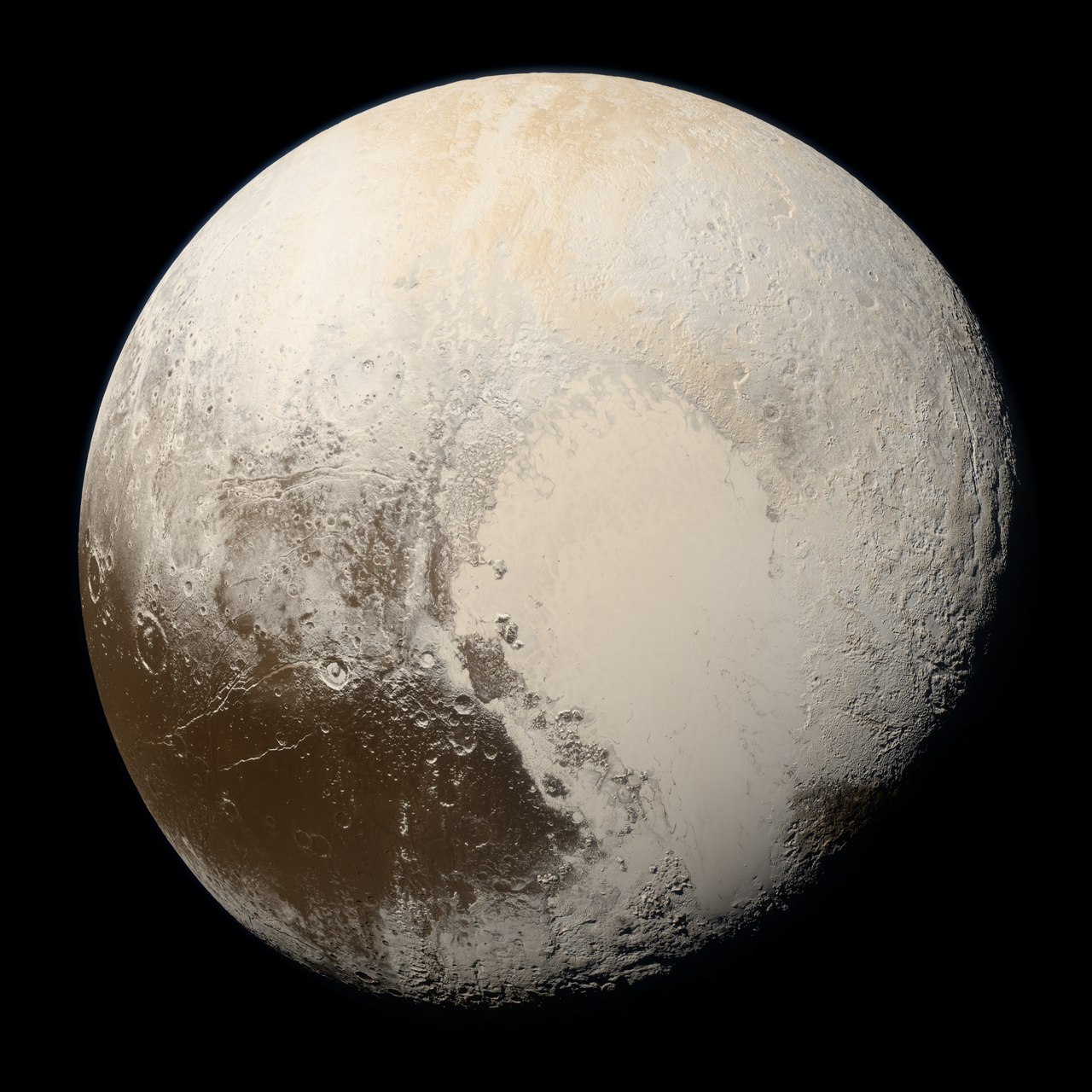
Its surface displays remarkable diversity, with bright icy plains, dark regions, rugged mountains, deep valleys, and complex geological features.
Different types of ice slowly flow across the landscape much like glaciers on Earth.
This activity suggests Pluto is far more geologically active than scientists once imagined.
Sputnik Planitia: Pluto’s Frozen Heart
One of Pluto’s most famous features is a giant heart-shaped region visible even in distant telescope images.
The western half of this heart is called Sputnik Planitia.
This enormous basin is filled with nitrogen ice.
Unlike ordinary glaciers on Earth, Pluto’s nitrogen ice slowly flows over millions of years, constantly reshaping the landscape.
Scientists believe convection within this frozen nitrogen causes the surface to slowly circulate, replacing older ice with newer material.
As a result, Sputnik Planitia contains surprisingly few impact craters, indicating it is geologically young.
Mountains Made of Water Ice
On Earth, mountains are made mostly of rock.
On Pluto, many mountains consist primarily of water ice.
At Pluto’s extremely low temperatures, water ice becomes as hard and strong as solid rock.
Some mountains rise more than 3,500 meters (11,500 feet) high.
Their existence surprised scientists because they indicate Pluto has experienced significant geological activity.
Does Pluto Have an Atmosphere?
Yes.
Although extremely thin, Pluto has a real atmosphere.
It is composed mostly of nitrogen, with smaller amounts of methane and carbon monoxide.
As Pluto travels farther from the Sun, temperatures fall so low that much of its atmosphere freezes onto the surface.
Later, when Pluto moves closer to the Sun, sunlight warms the frozen nitrogen, causing it to sublimate directly into gas.
In this way, Pluto’s atmosphere grows and shrinks over the course of its long year.
Why Does Pluto Have Blue Skies?
One of the most unexpected discoveries made by NASA’s New Horizons spacecraft was that Pluto has blue skies.
Tiny particles suspended in its atmosphere scatter sunlight in a way that makes the sky appear bluish.
Although the mechanism differs from Earth’s atmospheric scattering, the result is visually similar.
Standing on Pluto during daylight, an astronaut would see a faint blue haze above the icy landscape.
The Seasons on Pluto
A single year on Pluto lasts about 248 Earth years.
Because Pluto rotates on a highly tilted axis, its seasons are unusually extreme.
Some regions remain in sunlight for decades.
Others stay in darkness just as long.
As Pluto slowly moves around the Sun, sunlight shifts across its surface, causing frozen gases to evaporate in some places and freeze in others.
These seasonal changes continually reshape the dwarf planet’s appearance.
A Day on Pluto
Despite its incredibly long year, Pluto rotates relatively quickly.
One full day lasts about 6.4 Earth days.
Interestingly, Pluto and its largest moon are tidally locked.
This means each always keeps the same face toward the other, much like the Moon always shows the same side to Earth.
Pluto’s Five Moons
Pluto has five known natural satellites.
The largest is Charon, discovered in 1978.
The other four smaller moons are Styx, Nix, Kerberos, and Hydra.
Charon is extraordinary because it is unusually large compared to Pluto.
Its diameter is about half that of Pluto.
Instead of simply orbiting Pluto, both bodies orbit a shared center of gravity located outside Pluto itself.
For this reason, some astronomers describe the Pluto–Charon system as a double dwarf planet system.
Charon Is a Fascinating World
Charon is far more than just Pluto’s moon.
It has giant cliffs stretching hundreds of kilometers, enormous canyons, mysterious red-colored polar regions, and ancient impact craters.
Like Pluto, Charon challenges scientists’ expectations.
Its complex geology suggests it also experienced a surprisingly active past.
The New Horizons Mission
For decades after Pluto’s discovery, no spacecraft had ever visited it.
Everything changed on July 14, 2015.
NASA’s New Horizons spacecraft flew past Pluto after traveling nearly ten years through space.
The mission transformed our understanding of this distant world.
It returned breathtaking images of icy mountains, enormous glaciers, layered atmospheric haze, strange landforms, and unexpected geological activity.
Scientists had expected a frozen relic.
Instead, they found an active and incredibly diverse world.
Even years after the flyby, researchers continue analyzing the treasure trove of data collected during the mission.
Could Pluto Have an Ocean?
One of the most exciting questions about Pluto concerns what lies beneath its icy crust.
Several lines of evidence suggest Pluto may contain a buried ocean of liquid water beneath hundreds of kilometers of ice.
This hidden ocean, if it exists, would be kept from freezing completely by heat generated inside Pluto from the slow radioactive decay of certain elements within its rocky interior, possibly aided by insulating layers of ice.
Scientists continue studying New Horizons data to better understand Pluto’s internal structure.
How Cold Is Pluto?
Pluto is one of the coldest known worlds in the Solar System.
Surface temperatures typically range from about −240°C to −218°C (−400°F to −360°F).
At these temperatures, nitrogen, methane, and carbon monoxide exist as solid ice.
Even water ice becomes extremely hard.
The cold is so intense that materials behave very differently than they do on Earth.
Pluto’s Strange Orbit
Pluto’s orbit differs from those of the eight major planets.
It is both more elongated and more tilted.
For about 20 years during each orbit, Pluto actually comes closer to the Sun than Neptune.
This last occurred between 1979 and 1999.
Even during those periods, the two worlds never collide because their orbital paths are arranged in a stable gravitational relationship called an orbital resonance.
Can Humans Visit Pluto?
Reaching Pluto is an enormous challenge.
New Horizons traveled for nearly 9.5 years before arriving.
Using today’s technology, sending astronauts there would require an extremely long and difficult journey.
In addition to the vast distance, explorers would face intense cold, almost no atmospheric pressure, and very limited sunlight.
For now, robotic spacecraft remain the best way to study Pluto.
Future missions may one day orbit the dwarf planet instead of simply flying past it.
Why Pluto Still Matters
Some people believe Pluto became less important after losing its planetary status.
The opposite is true.
Pluto has become one of the most scientifically valuable worlds in the Solar System.
Studying Pluto helps astronomers understand how planets and other icy bodies formed billions of years ago.
It offers clues about the Kuiper Belt, the early Solar System, geological activity on icy worlds, and the evolution of planetary atmospheres.
Each new discovery raises fresh questions about distant worlds beyond Neptune.
Pluto in Popular Culture
Few astronomical objects have captured public affection like Pluto.
Its reclassification sparked passionate debates in classrooms, museums, scientific conferences, and around family dinner tables.
Many people still think of Pluto as the ninth planet, while others embrace its role as the prototype of an entirely new class of worlds.
Regardless of its official classification, Pluto remains one of the most beloved objects in astronomy.
The Future of Pluto Exploration
Scientists continue proposing new missions to Pluto and the Kuiper Belt.
An orbiter could spend years studying Pluto’s atmosphere, geology, moons, and possible underground ocean in extraordinary detail.
More advanced instruments might reveal how Pluto’s climate changes over time or determine whether liquid water truly exists beneath its icy surface.
As space exploration advances, Pluto will almost certainly remain a destination of great scientific interest.
Conclusion
Pluto may no longer be classified as a major planet, but it has proven to be one of the Solar System’s greatest surprises. What once appeared to be a tiny, frozen world at the edge of the Sun’s domain is now known to be a dynamic landscape filled with towering icy mountains, flowing glaciers, seasonal weather, a delicate atmosphere, and the intriguing possibility of a hidden ocean beneath its surface.
Its discovery reshaped our understanding of the Solar System, and its exploration by New Horizons revealed that even the smallest worlds can hold extraordinary secrets. Pluto reminds us that science is not about preserving old ideas—it is about following evidence wherever it leads. Whether we call it a dwarf planet or simply an amazing world, Pluto continues to inspire curiosity, challenge expectations, and reveal just how diverse and wonderful our cosmic neighborhood truly is.