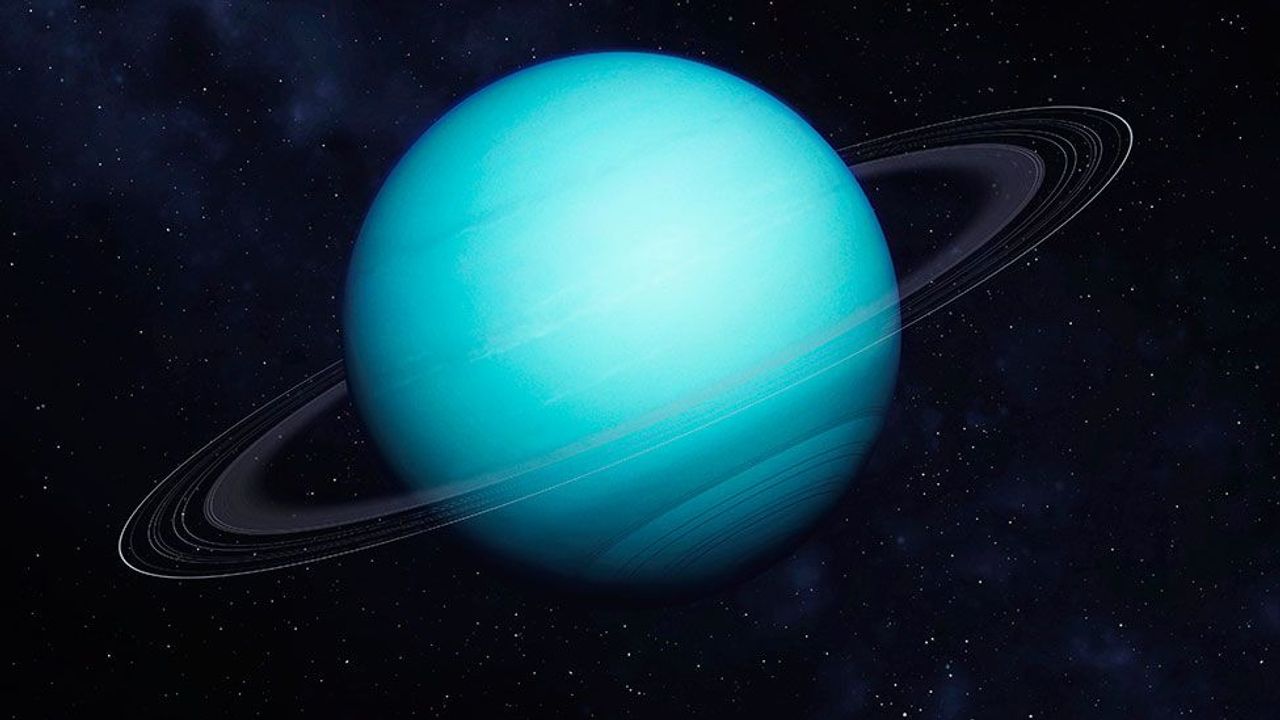
Far beyond the warmth of the Sun, where sunlight is nearly 400 times weaker than it is on Earth, a mysterious blue-green world quietly circles our star. This distant planet is Uranus, the seventh planet from the Sun and one of the most unusual worlds in our Solar System. At first glance, Uranus may look like a giant ball of gas, much like Jupiter or Saturn. But beneath its calm appearance lies a strange interior unlike any other planet we know.
Uranus is not simply a giant sphere of hydrogen and helium. Instead, it is a world packed with exotic materials, crushing pressures, and temperatures reaching thousands of degrees. Deep inside, water, ammonia, and methane exist in forms that would seem almost impossible on Earth. Scientists even think that tiny diamonds may be raining through parts of the planet’s interior.
So, what exactly is Uranus made of? The answer takes us on a fascinating journey from its pale blue atmosphere to its mysterious core.
Uranus Is an Ice Giant
To understand what Uranus is made of, it helps to know what kind of planet it is.
Astronomers classify Uranus as an ice giant, a category it shares only with Neptune. Although the word “ice” may suggest a frozen world, it means something very different in planetary science.
In astronomy, “ices” are substances such as water, ammonia, and methane that were frozen when the Solar System formed in its cold outer regions. Inside Uranus, these materials are not ordinary ice cubes. Instead, they exist as incredibly hot, dense fluids or exotic forms of matter because of the immense pressure.
This makes Uranus fundamentally different from Jupiter and Saturn, which are known as gas giants because they contain much larger amounts of hydrogen and helium.
The Layers of Uranus
Like Earth, Uranus is not made of a single material. Instead, it has several distinct layers, each with its own composition and physical properties.
The outermost layer is the atmosphere.
Below that lies a vast, dense mantle rich in water, ammonia, and methane.
At the center is a rocky core made mostly of heavier elements.
Together, these layers create one of the most unusual interiors in the Solar System.
The Atmosphere: Mostly Hydrogen and Helium
The visible part of Uranus is its atmosphere.
Hydrogen is the most abundant gas, making up about 80 percent of the atmosphere by number of molecules. Helium is the second most common gas, accounting for roughly 15 percent. The remaining few percent includes methane along with trace amounts of other compounds.
Although methane represents only a small fraction of the atmosphere, it has an enormous impact on the planet’s appearance.
Methane absorbs red wavelengths of sunlight while reflecting blue and green light back into space. This selective absorption gives Uranus its beautiful blue-green color, making it instantly recognizable among the planets.
Scientists have also detected tiny amounts of water vapor, ammonia, hydrogen sulfide, and various hydrocarbons produced when sunlight breaks apart methane molecules high in the atmosphere.
Clouds on Uranus
The atmosphere of Uranus is not empty.
It contains several layers of clouds forming at different altitudes.
The highest clouds are thought to contain methane ice crystals.
Deeper clouds may consist of hydrogen sulfide.
Even farther below, where temperatures and pressures are much greater, clouds of ammonia and water may exist.
Unlike Earth’s fluffy water clouds, these clouds are made from chemicals that behave very differently under Uranus’s extreme conditions.
Powerful winds race through the atmosphere at speeds exceeding 900 kilometers (560 miles) per hour in some regions, creating dynamic weather despite the planet’s great distance from the Sun.
Why Uranus Looks Blue
One of Uranus’s most striking features is its gentle blue-green color.
The reason is methane.
Sunlight contains all visible colors. When sunlight reaches Uranus, methane molecules absorb much of the red light while allowing more blue and green wavelengths to escape back into space.
As a result, our eyes—and spacecraft cameras—see Uranus as a blue-green planet.
Small particles and hazes in the upper atmosphere also influence the planet’s exact shade by scattering sunlight.
The Mantle: A World of Exotic Fluids
Beneath the atmosphere lies the largest part of Uranus.
This enormous mantle contains most of the planet’s mass and consists mainly of water, ammonia, and methane.
However, these substances are nothing like the liquids or gases we know on Earth.
The pressure inside Uranus rises to millions of times Earth’s atmospheric pressure.
Temperatures climb to several thousand degrees Celsius.
Under these extraordinary conditions, water becomes a dense, electrically conductive fluid rather than familiar ice or liquid water.
Ammonia and methane are also compressed into hot, dense fluids.
Scientists sometimes refer to this region as an “icy” mantle, but it is actually a superheated ocean of exotic materials.
Superionic Water: A Strange Form of Matter
One of the most fascinating discoveries in planetary science is the possibility that Uranus contains superionic water.
This unusual state of matter forms only under enormous pressures and temperatures.
In superionic water, oxygen atoms arrange themselves into a solid crystal-like structure while hydrogen ions move freely through it almost like a liquid.
This bizarre material behaves both like a solid and a liquid at the same time.
Laboratory experiments and computer simulations suggest that superionic water may exist deep inside Uranus and Neptune.
If so, it could help explain the unusual magnetic fields observed around these planets.
Could It Rain Diamonds?
One of the most exciting ideas about Uranus is the possibility of diamond rain.
Deep inside the planet, methane molecules experience such extreme pressure that their carbon atoms may separate from the hydrogen.
Those carbon atoms could then bond together, forming diamonds.
Computer models and laboratory experiments indicate that these diamonds might slowly sink through the mantle toward the planet’s center.
Although scientists have not directly observed diamond rain on Uranus, the physics supporting this possibility is considered plausible.
If it occurs, countless tiny diamonds may continuously fall through the planet’s deep interior.
The Rocky Core
At the center of Uranus lies a relatively small but dense core.
Scientists believe it consists mainly of rock and metals, including materials rich in silicon, oxygen, magnesium, and iron.
The exact composition remains uncertain because no spacecraft has ever directly explored the planet’s interior.
The core may reach temperatures of several thousand degrees Celsius despite Uranus receiving very little heat from the distant Sun.
The tremendous pressure created by the planet’s overlying layers keeps these materials compressed into an incredibly dense state.
Hydrogen and Helium Still Matter
Although Uranus contains much less hydrogen and helium than Jupiter or Saturn, these gases are still extremely important.
They form the atmosphere and contribute significantly to the planet’s outer layers.
Hydrogen is the most abundant element in the universe, and helium is the second most abundant.
Both were created shortly after the Big Bang, making them among the oldest materials found anywhere in the Solar System.
Their presence in Uranus provides clues about how the planet formed more than 4.5 billion years ago.
Why Uranus Is Called an Ice Giant
The name “ice giant” can be confusing because Uranus is not filled with ordinary frozen ice.
Planetary scientists use the term because the planet contains much larger amounts of water, ammonia, and methane than Jupiter and Saturn.
During the early Solar System, these substances condensed as solid ices in the cold outer regions where Uranus formed.
Today, however, the immense pressure inside the planet has transformed them into hot, dense, and exotic forms that are far removed from anything we experience on Earth.
The Mystery of Uranus’s Interior
Despite decades of research, scientists still know surprisingly little about what lies inside Uranus.
Only one spacecraft, Voyager 2, has ever flown past the planet. During its brief visit in 1986, it revealed a surprisingly bland-looking world with a strange magnetic field and an unusual sideways rotation.
Because the spacecraft only made a quick flyby, many questions remain unanswered.
Researchers continue using powerful telescopes, computer simulations, laboratory experiments, and observations of the planet’s gravity and magnetic field to improve models of its interior.
Future space missions could dramatically expand our understanding of what Uranus is truly made of.
How Scientists Know What Uranus Is Made Of
No human has ever visited Uranus, and no spacecraft has landed there.
Instead, scientists combine several kinds of evidence.
Spectroscopy allows astronomers to identify gases in the atmosphere by analyzing how the planet absorbs and emits light.
Measurements of the planet’s mass and size reveal its average density.
Gravity measurements help estimate how mass is distributed inside the planet.
Magnetic field observations provide clues about the electrically conductive materials hidden beneath the atmosphere.
Laboratory experiments recreate some of Uranus’s extreme pressures and temperatures, while advanced computer models simulate how different materials behave under those extraordinary conditions.
Together, these methods provide the best picture currently available of the planet’s composition.
Uranus Compared with Other Giant Planets
Although Uranus is often grouped with the other giant planets, its composition is quite distinctive.
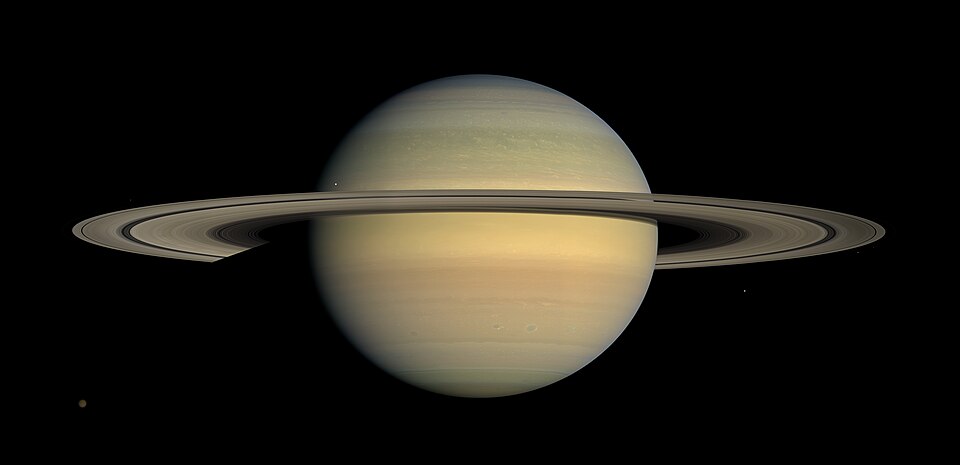
Jupiter and Saturn are dominated by hydrogen and helium, with only relatively small amounts of heavier materials.
Uranus and Neptune, by contrast, contain much larger proportions of water, ammonia, and methane beneath thinner hydrogen-helium atmospheres.
This difference affects nearly everything about the planets, including their density, magnetic fields, internal structure, and evolution.
It also provides important clues about the conditions that existed when the outer Solar System formed billions of years ago.
Why Studying Uranus Matters
Understanding what Uranus is made of is about much more than learning about one distant planet.
Ice giants appear to be among the most common types of planets discovered around other stars. By studying Uranus, scientists gain valuable insights into countless exoplanets throughout the Milky Way.
The planet also offers a natural laboratory for exploring matter under conditions impossible to reproduce fully on Earth.
Its exotic interior helps researchers test theories about planetary formation, atmospheric chemistry, magnetic fields, and the behavior of materials at extreme pressures.
Every new discovery about Uranus improves our understanding not only of our own Solar System but also of planetary systems across the universe.
Conclusion
Uranus is far more than a simple ball of gas. It is a complex world made of multiple layers, each more extraordinary than the last. Its atmosphere is dominated by hydrogen and helium, while methane gives the planet its beautiful blue-green color. Beneath the clouds lies an immense mantle composed primarily of water, ammonia, and methane compressed into superheated, high-pressure fluids unlike anything found on Earth. At its center rests a dense rocky core, hidden beneath thousands of kilometers of exotic material.
Although scientists have learned a great deal about Uranus since its discovery, much remains mysterious. Questions about its unusual interior, strange magnetic field, possible superionic water, and even the possibility of diamond rain continue to inspire new research.
As future missions venture back to the outer Solar System, Uranus may finally reveal the secrets hidden beneath its tranquil blue surface, showing us that even the most distant worlds have remarkable stories waiting to be discovered.