On a clear night, if you look toward the sky, you may notice a bright object glowing with a gentle reddish color. Long before telescopes existed, people across ancient civilizations wondered what this mysterious “red star” was. It inspired myths, stories, and even fear. Today, we know that glowing object is not a star at all—it is Mars, one of Earth’s closest planetary neighbors and one of the most fascinating worlds in our Solar System.
Mars has captured human imagination for thousands of years. It is the planet where scientists hope to answer one of humanity’s greatest questions: Has life ever existed beyond Earth? It is also the world that many people dream humans will one day call a second home.
Although Mars appears dry, cold, and lifeless today, it tells the story of a planet that was once dramatically different. Ancient rivers flowed across its surface, lakes filled deep basins, volcanoes erupted on a colossal scale, and a thicker atmosphere may have supported a much warmer environment. Every new mission to Mars reveals another piece of this extraordinary puzzle.
Understanding Mars is not just about learning another planet’s story. It also helps us understand Earth’s past, the evolution of rocky planets, and the possibility of life elsewhere in the universe.
Mars at a Glance
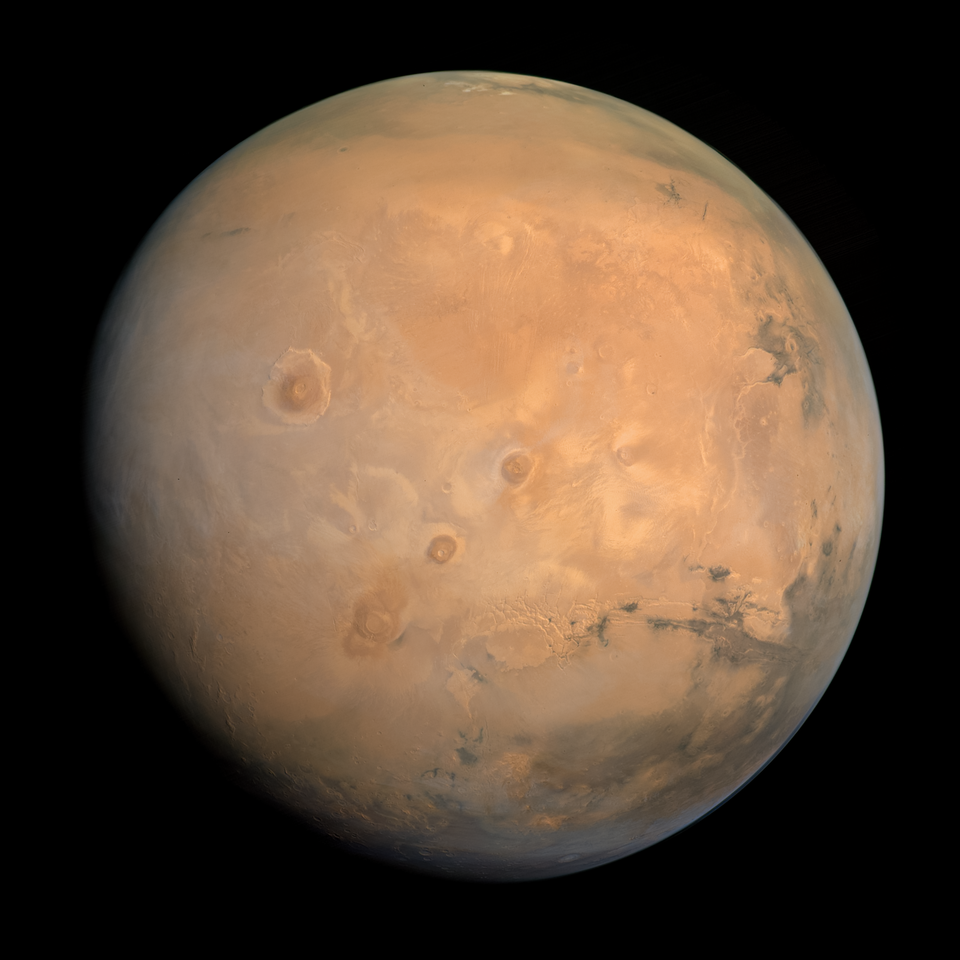
Mars is the fourth planet from the Sun, located between Earth and Jupiter. It is often called the Red Planet because iron-rich minerals in its rocks and dust have rusted over billions of years, giving the planet its distinctive reddish appearance.
Mars is much smaller than Earth. Its diameter is about 6,779 kilometers (4,212 miles), making it roughly half the size of our planet. If Earth were the size of a basketball, Mars would be about the size of a softball.
Although smaller than Earth, Mars has some of the most spectacular landscapes in the Solar System. Towering volcanoes, enormous canyons, ancient river valleys, frozen polar ice caps, and vast deserts cover its surface.
Mars is classified as a terrestrial planet, meaning it has a rocky surface similar to those of Mercury, Venus, and Earth.
Why Is Mars Red?
The famous red color of Mars comes from iron oxide, commonly known as rust.
Billions of years ago, iron in Martian rocks reacted with oxygen, forming a layer of reddish dust that now blankets much of the planet. Winds constantly move this fine dust across the surface, giving Mars its familiar rusty appearance when viewed from space or through a telescope.
Interestingly, if you could dig beneath the dusty surface, many rocks would appear gray or darker in color rather than bright red.
Where Is Mars Located?
Mars orbits the Sun at an average distance of about 228 million kilometers (142 million miles), making it farther from the Sun than Earth.
Because of this greater distance, Mars receives less sunlight. On average, the sunlight reaching Mars is only about 43 percent as strong as the sunlight Earth receives.
This reduced solar energy is one of the main reasons Mars is much colder than Earth.
The Size and Gravity of Mars
Mars may look large in telescope images, but it is actually a relatively small planet.
Its mass is only about 11 percent of Earth’s.
Because of its smaller size, Mars has much weaker gravity. Standing on Mars, you would weigh only about 38 percent of what you weigh on Earth.
A person weighing 100 pounds on Earth would weigh only about 38 pounds on Mars.
This lower gravity affects everything from how dust moves to how future astronauts might walk across the surface.
How Long Is a Day on Mars?
One of the most Earth-like features of Mars is the length of its day.
A Martian day, known as a sol, lasts approximately 24 hours and 39 minutes.
This is only about 39 minutes longer than an Earth day.
Because of this similarity, scientists planning future human missions believe astronauts could adapt relatively easily to the Martian daily cycle.
How Long Is a Year on Mars?
While a Martian day is similar to Earth’s, a Martian year is much longer.
Mars takes about 687 Earth days to complete one orbit around the Sun.
This means one year on Mars lasts nearly two Earth years.
The longer orbit also causes seasons that last much longer than Earth’s seasons.
Does Mars Have Seasons?
Yes, Mars experiences four seasons, just like Earth.
This happens because Mars is tilted on its axis by about 25 degrees, very close to Earth’s tilt of approximately 23.5 degrees.
As Mars travels around the Sun, different parts of the planet receive varying amounts of sunlight, producing spring, summer, autumn, and winter.
However, because Mars has a much longer year, each season lasts roughly twice as long as an Earth season.
The Atmosphere of Mars
Mars has an atmosphere, but it is extremely thin.
Its atmospheric pressure at the surface averages less than 1 percent of Earth’s sea-level pressure.
The atmosphere is composed mostly of carbon dioxide, with small amounts of nitrogen, argon, oxygen, and water vapor.
Because the atmosphere is so thin, it cannot trap heat efficiently.
As a result, temperatures change dramatically between day and night.
The thin atmosphere also offers very little protection from harmful ultraviolet radiation and energetic particles from space.
How Cold Is Mars?
Mars is a very cold world.
The average surface temperature is about minus 63 degrees Celsius (minus 81 degrees Fahrenheit).
Near the equator during summer afternoons, temperatures may briefly rise above the freezing point of water.
At night, however, temperatures can plunge well below minus 100 degrees Celsius.
Near the poles during winter, temperatures can fall below minus 125 degrees Celsius.
These extreme temperature swings are caused largely by the planet’s thin atmosphere.
The Surface of Mars
Mars is a world of breathtaking geological diversity.
Its surface contains dusty plains, rocky deserts, giant volcanoes, impact craters, winding valleys, ancient river channels, sand dunes, and frozen polar regions.
The landscape tells the story of billions of years of volcanic activity, asteroid impacts, erosion, and changing climates.
Unlike Earth, Mars has no oceans covering much of its surface today.
Instead, vast dry plains stretch for thousands of kilometers beneath a dusty sky.
Olympus Mons: The Largest Volcano
Mars is home to the largest volcano ever discovered in the Solar System.
Olympus Mons rises approximately 22 kilometers (14 miles) above the surrounding plains.
That makes it nearly three times taller than Mount Everest when measured from sea level on Earth.
Its enormous base stretches roughly 600 kilometers (370 miles) across.
Scientists believe Olympus Mons grew so large because Mars lacks moving tectonic plates. On Earth, shifting plates carry volcanoes away from their magma sources, limiting their growth. On Mars, the crust remained relatively stationary, allowing volcanic eruptions to build the same mountain over millions of years.
Valles Marineris: A Giant Canyon System
Mars also contains one of the largest canyon systems in the Solar System.
Valles Marineris extends for about 4,000 kilometers (2,500 miles).
In some places, it reaches depths of more than 7 kilometers (4 miles).
If placed on Earth, it would stretch across much of the continental United States.
Scientists think the canyon formed mainly as the Martian crust cracked and stretched during the planet’s geological evolution, with additional shaping by landslides and erosion.
Water on Mars
One of the most exciting discoveries about Mars is that water once flowed across its surface.
Spacecraft have photographed dried river valleys, ancient lakebeds, branching stream networks, and minerals that typically form in the presence of liquid water.
Billions of years ago, Mars likely had rivers flowing into lakes and possibly even temporary seas.
Today, liquid water is generally unstable on the surface because of the planet’s low atmospheric pressure and cold temperatures.
However, large amounts of water remain frozen.
Water ice exists beneath the surface, inside polar ice caps, and in some underground deposits.
Scientists continue studying whether salty liquid water might occasionally exist for brief periods under very specific conditions, though clear evidence for stable surface liquid water today remains lacking.
The Polar Ice Caps
The north and south poles of Mars are covered by enormous ice caps.
These contain both water ice and frozen carbon dioxide, often called dry ice.
As the seasons change, carbon dioxide freezes during winter and sublimates back into gas during warmer months.
This seasonal cycle causes the polar caps to grow and shrink each Martian year.
The water ice locked inside these polar regions represents one of the largest known reservoirs of water on Mars.
Dust Storms
Mars is famous for its powerful dust storms.
Some storms remain small and local.
Others grow large enough to cover the entire planet.
These global dust storms can last for weeks or even months.
Although the Martian atmosphere is thin, high winds can lift extremely fine dust into the sky.
The dust can block sunlight, lowering temperatures and reducing the amount of solar energy reaching robotic spacecraft powered by solar panels.
Understanding these storms is essential for planning future human exploration.
Does Mars Have Moons?
Mars has two small moons named Phobos and Deimos.
They are much smaller than Earth’s Moon and have irregular shapes, resembling captured asteroids.
Phobos orbits extremely close to Mars and is gradually moving inward.
Scientists predict that tens of millions of years from now, Phobos may either crash into Mars or break apart, potentially forming a temporary ring around the planet.
Deimos orbits farther away and follows a more stable path.
Is There Life on Mars?
Perhaps no question about Mars is more fascinating than whether life has ever existed there.
So far, no confirmed evidence of life has been found.
However, Mars remains one of the most promising places in the Solar System to search for signs of ancient microbial life.
Billions of years ago, Mars had flowing water, volcanic activity, and conditions that may have been suitable for simple microorganisms.
Today, robotic rovers search for ancient organic molecules, study rocks that formed in water, and collect samples that may one day be returned to Earth for detailed analysis.
Scientists are also interested in whether microscopic life could survive underground, where conditions are more protected from radiation and extreme temperatures.
The search continues.
Exploring Mars
Mars has become one of the most explored planets beyond Earth.
Since the 1960s, dozens of spacecraft have been sent to study it.
Orbiters map the planet from above.
Landers study conditions directly on the surface.
Rovers drive across the landscape, examining rocks, drilling samples, and searching for evidence of ancient environments.
These robotic explorers have transformed our understanding of Mars.
They have discovered ancient river deltas, lake sediments, organic molecules, seasonal weather patterns, underground ice, and countless geological features that reveal the planet’s complex history.
Each mission builds upon the discoveries of those before it.
Can Humans Live on Mars?
Many scientists and engineers hope that humans will eventually set foot on Mars.
However, living there would be extremely challenging.
Astronauts would need habitats protected from radiation, systems to generate oxygen and water, reliable food production, and methods to survive the planet’s cold temperatures and thin atmosphere.
Scientists are developing technologies that could use Martian resources, such as extracting oxygen from carbon dioxide and obtaining water from underground ice.
Even with these advances, establishing a permanent human presence on Mars would require overcoming enormous scientific and engineering challenges.
Why Scientists Study Mars
Mars is more than just another planet.
It serves as a natural laboratory for understanding how rocky planets evolve.
By comparing Mars with Earth and Venus, scientists learn why neighboring planets can develop such different environments.
Studying Mars also helps researchers understand the history of water, climate change, volcanic activity, planetary interiors, and the conditions necessary for life.
The lessons learned from Mars improve our understanding not only of our own Solar System but also of rocky planets orbiting distant stars.
Mars in Human Culture
For thousands of years, Mars has inspired myths, literature, art, and science fiction.
Ancient Romans named the planet after their god of war because of its blood-red appearance.
Writers imagined canals, civilizations, and alien worlds long before spacecraft revealed the planet’s true nature.
Today, Mars continues to inspire books, films, scientific research, and dreams of future exploration.
It represents both a scientific frontier and a symbol of humanity’s desire to explore the unknown.
The Future of Mars Exploration
The coming decades promise exciting new discoveries.
Scientists plan to return carefully selected rock samples from Mars to Earth, where laboratories can analyze them with instruments far more advanced than those carried by spacecraft.
Future missions may send astronauts to explore regions that robots cannot easily reach.
New orbiters will map hidden underground structures, while advanced rovers will continue searching for clues about ancient environments and possible signs of past life.
Each mission brings humanity closer to answering one of the greatest scientific questions of all: Are we alone in the universe?
Conclusion
Mars is a world of remarkable contrasts. It is cold yet once flowed with rivers. It is dry yet holds vast stores of frozen water. It appears lifeless today, yet preserves evidence of environments that may once have supported life. Its towering volcanoes, immense canyons, frozen poles, and ancient landscapes make it one of the most extraordinary planets in our Solar System.
As scientists continue exploring Mars with increasingly sophisticated spacecraft—and perhaps one day with human explorers—the Red Planet remains a place of mystery, discovery, and hope. Every photograph, every rock sample, and every new finding deepens our understanding not only of Mars itself but also of Earth’s history and humanity’s place in the vast universe.