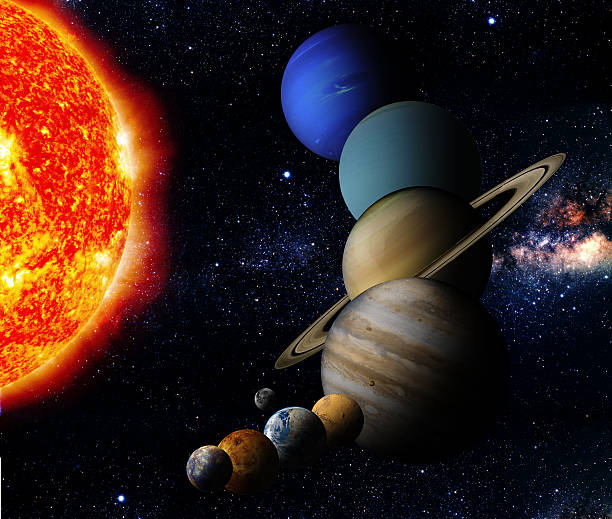
On a clear night, the Solar System feels timeless. The Moon rises just as it has for billions of years. The planets continue their silent journeys around the Sun. Comets occasionally return from the darkness, and Earth spins faithfully through another day. It is easy to imagine that this grand cosmic clock will keep ticking forever.
But the universe tells a different story.
Nothing in nature lasts forever—not mountains, not stars, not galaxies, and not even entire planetary systems. The Solar System, despite its incredible stability, is not eternal. It was born about 4.6 billion years ago, it has evolved ever since, and one day it will reach its end.
That end is not something humanity needs to fear. It lies billions of years in the future, far beyond the lifespan of civilizations, continents, or even most species that have ever lived on Earth. Yet understanding the future of the Solar System reveals one of the most fascinating stories in astronomy—a story of gravity, stellar evolution, planetary motion, and the relentless passage of cosmic time.
The Solar System Is Not Frozen in Time
Although the Solar System often appears calm and unchanging, it is constantly moving.
Every planet races around the Sun at tremendous speed. Earth travels at nearly 30 kilometers (18.5 miles) every second. Mercury completes an orbit in just 88 days, while Neptune takes about 165 Earth years.
The Moon slowly drifts away from Earth by about 3.8 centimeters (1.5 inches) each year due to tidal interactions. Asteroids occasionally collide with one another. Comets are nudged into new orbits. Tiny particles of dust spiral toward the Sun under the influence of sunlight.
Even the Sun itself is changing.
These changes happen so slowly that they are almost impossible to notice during a human lifetime, but over millions and billions of years, they reshape the Solar System.
How Long Has the Solar System Already Existed?
Scientists estimate that the Solar System formed approximately 4.6 billion years ago from a giant cloud of gas and dust.
Gravity pulled this cloud together until a young Sun ignited at its center. Around it, leftover material gradually formed planets, moons, asteroids, and comets.
By cosmic standards, the Solar System is middle-aged.
The Sun has already spent about half of its expected lifetime converting hydrogen into helium inside its core. It still has roughly another five billion years before it undergoes dramatic changes.
This means the Solar System is much closer to its beginning than its end, but its most dramatic chapters are still ahead.
Gravity Holds Everything Together
The Solar System survives because of gravity.
The Sun contains about 99.8 percent of all the mass in the Solar System. Its enormous gravitational pull keeps the planets in stable orbits.
Each planet follows a carefully balanced path.
If a planet moved much slower, it would spiral toward the Sun.
If it moved much faster, it could escape into interstellar space.
Instead, gravity and motion work together to create stable orbits that have lasted for billions of years.
This balance is one of the reasons the Solar System has remained remarkably stable.
Is the Solar System Completely Stable?
For a long time, scientists believed the planets followed perfectly predictable paths forever.
Modern computer simulations have shown the situation is more complicated.
The planets constantly tug on one another through gravity. These tiny interactions gradually alter their orbits over enormous periods of time.
This phenomenon is known as orbital chaos.
Chaos does not mean the planets suddenly begin crashing into each other. Instead, it means that extremely small differences in planetary positions today can eventually produce significantly different orbital paths after hundreds of millions or billions of years.
Even so, most simulations indicate that the Solar System will remain largely stable for several billion more years.
The probability of a catastrophic planetary collision before the Sun’s death is considered very low.
The Sun Is Slowly Growing Brighter
Although the Sun appears constant, it becomes slightly brighter over time.
As hydrogen is converted into helium in its core, the Sun’s internal structure gradually changes.
Every billion years or so, the Sun becomes roughly 10 percent more luminous.
That may not sound dramatic, but over long timescales it has enormous consequences for Earth.
A brighter Sun means more energy reaches our planet.
Temperatures slowly rise.
The atmosphere changes.
Eventually, Earth’s oceans begin to evaporate.
This transformation begins long before the Sun reaches the end of its life.
Earth’s Future Is Not Forever
Earth will not remain habitable indefinitely.
Scientists estimate that in roughly one to two billion years, increasing solar brightness will trigger a runaway greenhouse effect.
Water vapor will accumulate in the atmosphere, trapping additional heat.
The oceans will gradually disappear into space as sunlight breaks apart water molecules and hydrogen escapes Earth’s gravity.
Without liquid water, life as we know it would no longer survive.
Long before the Sun dies, Earth will likely become a dry, intensely hot world resembling a far more extreme version of present-day Venus.
What Happens When the Sun Runs Out of Hydrogen?
The Sun shines because nuclear fusion converts hydrogen into helium deep inside its core.
Eventually, after about 10 billion years of total lifetime, most of the core hydrogen will be exhausted.
When this happens, gravity begins compressing the core.
The core grows hotter.
Hydrogen fusion continues in a shell surrounding the core.
Meanwhile, the Sun’s outer layers begin expanding dramatically.
The Sun enters a new stage known as the red giant phase.
The Sun Will Become a Red Giant
The red giant stage will completely transform the Solar System.
The Sun’s diameter will increase hundreds of times.
Instead of appearing as it does today, it will swell into an enormous glowing sphere.
Mercury will almost certainly be engulfed.
Venus is also expected to disappear inside the expanding Sun.
The fate of Earth is more uncertain.
Many models suggest Earth will also be swallowed.
Other calculations indicate Earth’s orbit may move outward slightly as the Sun loses mass, but tidal interactions with the Sun’s expanded outer atmosphere are expected to pull Earth inward.
Most astronomers conclude that Earth is unlikely to survive.
If our planet is not physically consumed, its surface will already have become completely uninhabitable long before then.
What Happens to the Outer Planets?
While the inner planets face destruction, the outer Solar System experiences a different future.
As the Sun loses mass, its gravitational pull weakens.
The surviving planets slowly drift into wider orbits.
Jupiter, Saturn, Uranus, and Neptune are expected to survive the red giant phase.
Their moons may also survive.
Interestingly, some icy moons that are frozen today could temporarily become warm enough to host liquid water beneath their surfaces.
For a brief period in cosmic history, regions far beyond Earth’s current orbit might actually become more hospitable than Earth itself.
The Sun Will Shed Its Outer Layers
After the red giant stage, the Sun becomes unstable.
It begins losing its outer atmosphere into space.
These glowing clouds of gas form what astronomers call a planetary nebula.
Despite the name, planetary nebulae have nothing to do with planets.
They are beautiful expanding shells of gas illuminated by the hot stellar core left behind.
The Sun’s outer layers will drift into interstellar space, enriching the galaxy with carbon, oxygen, nitrogen, and other elements that future stars and planets may one day use.
The Sun Will Become a White Dwarf
After shedding its outer layers, only the Sun’s incredibly dense core remains.
This remnant is called a white dwarf.
A white dwarf is roughly the size of Earth but contains about half the Sun’s original mass.
No longer powered by nuclear fusion, it shines only because it is still extremely hot.
Over billions of years, it slowly cools.
The white dwarf will remain surrounded by whatever planets, moons, asteroids, and comets survive the Sun’s earlier transformation.
The Solar System will become a quiet, dark place orbiting a fading stellar ember.
Could Planets Escape?
As the Sun loses mass, planetary orbits expand.
Most planets should remain gravitationally bound.
However, over trillions of years, passing stars could gradually disturb these wider orbits.
Although stars are separated by enormous distances, the Milky Way contains hundreds of billions of them.
Occasionally, one passes close enough to slightly alter the paths of distant objects.
These repeated encounters slowly reshape planetary systems across the galaxy.
Some planets may eventually be ejected into interstellar space, becoming lonely “rogue planets” drifting between the stars.
What About Asteroids and Comets?
Small bodies are even more vulnerable.
The Kuiper Belt and the distant Oort Cloud contain trillions of icy objects.
Passing stars, giant molecular clouds, and the Milky Way’s tidal forces gradually disturb these distant reservoirs.
Over immense spans of time, many comets will either fall toward the inner Solar System, be thrown into interstellar space, or collide with planets or the Sun.
The Solar System slowly loses material throughout its lifetime.
The Moon’s Long Goodbye
Earth’s Moon is also changing.
Because of tidal interactions, it moves away from Earth by a few centimeters every year.
Billions of years from now, the Moon will orbit much farther away than it does today.
Its gradual retreat slows Earth’s rotation.
Days become longer.
Eventually, however, the Sun’s evolution overtakes these slow tidal changes.
Earth’s final fate depends far more on the Sun than on the Moon.
Could Another Star Destroy the Solar System?
The galaxy is enormous.
Stars constantly orbit the Milky Way’s center.
Although close stellar encounters are rare, they do happen over billions of years.
A nearby passing star could perturb the distant Oort Cloud, sending comets inward.
A much closer encounter could alter planetary orbits.
Fortunately, such extremely close encounters are extraordinarily unlikely during the Sun’s remaining lifetime.
The greatest threat to the Solar System comes not from outside, but from the natural evolution of its own star.
Will the Milky Way’s Collision Affect the Solar System?
About 4 to 5 billion years from now, the Milky Way and the Andromeda Galaxy are expected to merge.
This sounds catastrophic, but galaxies are mostly empty space.
Individual stars are so widely separated that direct stellar collisions are extremely unlikely.
The Solar System will probably survive the galactic merger.
Its position within the newly formed galaxy may change, but the planets themselves are expected to remain largely unaffected by the collision.
Ironically, the Sun’s transformation into a red giant is likely to have a much greater impact on Earth than the collision of two giant galaxies.
The Solar System After Trillions of Years
Long after the Sun becomes a white dwarf, the Solar System continues evolving.
The white dwarf gradually cools for trillions of years.
Planetary orbits continue shifting slowly.
Occasional stellar encounters remove planets or distant icy bodies.
Eventually, the Solar System may no longer resemble the orderly planetary family we know today.
Some planets could escape.
Others may remain orbiting the cooling white dwarf.
The system becomes darker, quieter, and increasingly isolated.
Does Anything Last Forever?
The story of the Solar System reflects one of the deepest truths in astronomy.
Everything changes.
Stars are born and die.
Planets form and disappear.
Galaxies collide.
Even the universe itself evolves.
The Solar System has endured for nearly half the age of the universe, yet it is only one chapter in a much larger cosmic story.
Its atoms were forged inside even older stars that lived and died billions of years before the Sun existed.
Likewise, the elements released when the Sun eventually sheds its outer layers may one day become part of entirely new stars, planets, and perhaps even living worlds.
Conclusion
The Solar System will not last forever, but its end lies unimaginably far in the future. Over the next several billion years, the planets will continue orbiting, the Sun will gradually grow brighter, and Earth will slowly become less hospitable. Eventually, the Sun will expand into a red giant, transforming or destroying the inner planets before ending its life as a white dwarf.
Yet this ending is not simply a tale of destruction. It is part of the natural life cycle of stars. The same physical laws that created the Solar System will continue shaping new worlds long after our own has faded. In the vast universe, endings are often the beginnings of something new, and while our Solar System is temporary, the cosmic processes that gave it life continue across the galaxy, creating countless opportunities for new stars, new planets, and new stories to unfold.