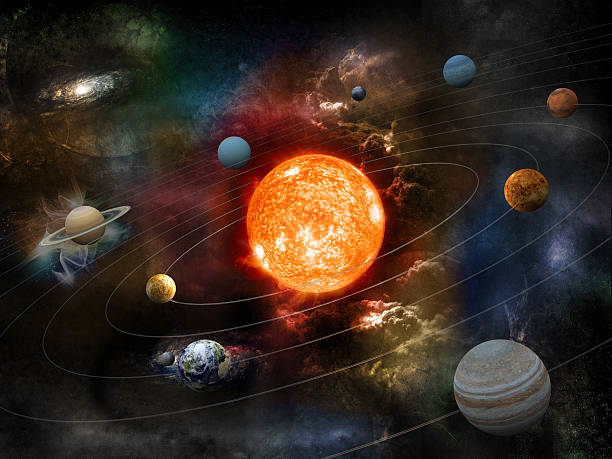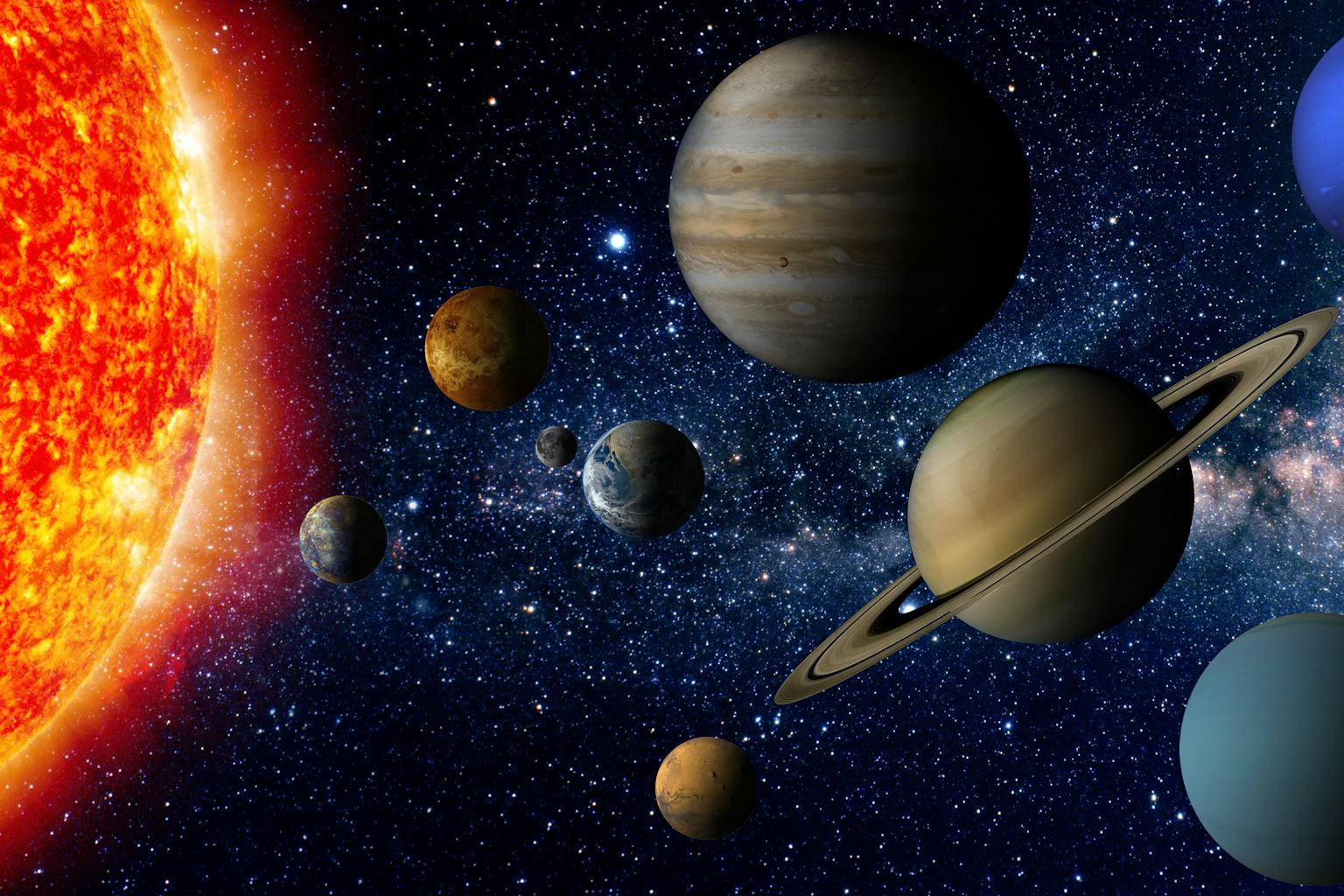
If you could somehow travel far above the Solar System and look down from an immense distance, you might notice something surprising. The Sun would sit at the center like a brilliant golden beacon, while nearly all the planets would circle it within the same broad, thin plane. Mercury, Venus, Earth, Mars, Jupiter, Saturn, Uranus, and Neptune do not orbit the Sun in random directions like bees buzzing around a flower. Instead, they move along paths that are remarkably aligned, forming what looks like a giant cosmic disk.
At first glance, this seems almost too orderly. Space is unimaginably vast and three-dimensional, so why didn’t the planets end up orbiting in every possible direction? Why is the Solar System so flat?
The answer lies in events that happened about 4.6 billion years ago, long before Earth existed, when our Solar System was nothing more than a cold cloud of gas and dust drifting through the Milky Way. Understanding why the Solar System is flat means retracing its incredible journey from a chaotic cloud to the beautifully organized planetary system we see today.
A Giant Cloud Was the Beginning of Everything
The story begins inside a massive molecular cloud, a vast region of space filled with hydrogen gas, helium, tiny dust grains, and traces of heavier elements created by earlier generations of stars.
For millions of years, this cloud drifted quietly through the galaxy. It was cold, dark, and enormous, stretching across many light-years. Although it appeared peaceful, gravity was slowly pulling the cloud inward.
Eventually, something disturbed the balance. A nearby supernova explosion, the shock wave from another star-forming region, or the cloud’s own gravitational instability may have triggered its collapse.
As gravity became stronger than the outward pressure of the gas, the cloud began shrinking.
This collapse marked the birth of the Solar System.
Gravity Pulls Inward
Gravity always attracts matter toward the center of mass. As the enormous cloud collapsed, billions upon billions of particles moved inward.
At first, the cloud may have been irregularly shaped.
But gravity does not pull only large objects. Every tiny grain of dust and every atom of gas felt its influence.
The cloud became denser toward its center, where more and more material accumulated.
Eventually, this central region became so dense and hot that it would ignite nuclear fusion and become our Sun.
But another force was quietly shaping everything else.
The Hidden Role of Rotation
Even before the cloud began collapsing, it was almost certainly rotating—perhaps incredibly slowly.
The rotation might have been nearly impossible to notice. One complete turn could have taken millions of years.
Yet that tiny spin changed everything.
As the cloud shrank under gravity, its rotation sped up dramatically.
This happens because of a physical principle called the conservation of angular momentum.
A familiar example is an ice skater spinning with arms outstretched. When the skater pulls their arms inward, they spin much faster, even though no one pushes them.
The collapsing cloud behaved in much the same way.
As its size decreased, its rotation accelerated.
This increasing spin became one of the most important forces shaping the newborn Solar System.
A Battle Between Gravity and Rotation
Now two powerful effects were competing.
Gravity tried to pull material directly toward the center.
Rotation tried to keep material moving sideways.
Near the poles of the spinning cloud, gravity had relatively little resistance. Material could continue falling inward.
Near the cloud’s equator, however, rotation became increasingly important.
Particles moving around the center possessed angular momentum, making it difficult for them to plunge straight inward.
Instead, they spread outward around the middle.
Over time, the cloud became flatter and flatter.
Rather than remaining a sphere, it gradually transformed into a rotating disk.
Astronomers call this structure a protoplanetary disk.
This thin disk became the birthplace of every planet in our Solar System.
Why a Disk Forms Naturally
The formation of a disk is not unusual.
It is actually one of the most common outcomes whenever gravity acts on a rotating cloud.
Imagine tossing pizza dough into the air.
As it spins, the dough spreads outward into a flat circle.
Although the physics is different in detail, the general idea is similar.
Rotation naturally favors flattening.
In space, countless collisions between dust particles also helped.
Whenever particles moved above or below the main disk, collisions reduced their vertical motion.
Over millions of years, these countless tiny interactions gradually settled most material into nearly the same plane.
The result was an increasingly thin disk surrounding the young Sun.
The Birthplace of the Planets
Inside this rotating disk, microscopic dust grains repeatedly collided.
Some collisions caused particles to stick together.
Tiny grains became pebbles.
Pebbles became rocks.
Rocks grew into kilometer-sized bodies called planetesimals.
Gravity then took over once again.
Larger objects attracted smaller ones, growing into planetary embryos.
Eventually, these became the planets.
Because nearly all of the building material already occupied the same disk, the newly forming planets naturally inherited similar orbital planes.
They did not have to “choose” to orbit together.
Their birthplace determined the paths they would follow.
Why the Planets Orbit in the Same Direction
The planets are not only arranged in nearly the same plane.
They also travel around the Sun in the same direction.
This is another consequence of the original rotating disk.
Every planet formed from material already moving around the Sun in the same direction.
Changing direction would require enormous forces that simply were not present.
As a result, Mercury, Venus, Earth, Mars, Jupiter, Saturn, Uranus, and Neptune all orbit the Sun counterclockwise when viewed from above Earth’s North Pole.
Most moons within the Solar System also orbit their planets in this same general direction because they formed from smaller disks surrounding young planets.
The Solar System Is Not Perfectly Flat
Although people often describe the Solar System as flat, this is a simplification.
The planets are not located within one perfectly thin sheet.
Each orbit is tilted slightly.
Mercury’s orbit is inclined by about 7 degrees relative to Earth’s orbital plane.
Venus is tilted by about 3.4 degrees.
Mars differs by about 1.9 degrees.
Jupiter’s orbit is inclined by roughly 1.3 degrees.
Even these are relatively small angles on astronomical scales.
If the Solar System were reduced to the size of a dinner plate, most planetary orbits would remain astonishingly close to its surface.
Astronomers define Earth’s orbital plane as the ecliptic, and the other major planets orbit close to this reference plane.
Why Some Objects Have Highly Tilted Orbits
Not every object follows the main planetary plane.
Many asteroids, comets, and dwarf planets travel along more inclined paths.
Some even orbit at steep angles.
Others move in highly elongated orbits that carry them far above and below the planetary disk.
Why?
Many of these objects formed in more distant regions where gravitational interactions were stronger and more chaotic.
Over billions of years, close encounters with giant planets, especially Jupiter and Neptune, altered many orbits.
Some icy bodies from the distant Oort Cloud approach the Sun from almost any direction.
These long-period comets often have highly inclined or even retrograde orbits, meaning they travel opposite the planets.
Their unusual paths reflect the complex gravitational history of the outer Solar System rather than the orderly conditions in the original protoplanetary disk.
The Giant Planets Changed the Solar System
The early Solar System was far from peaceful.
After the planets formed, they continued interacting gravitationally.
Jupiter, being the most massive planet, played a particularly important role.
Its gravity scattered countless smaller bodies.
Some were thrown into the asteroid belt.
Others became distant comets.
Still others were ejected from the Solar System entirely.
These interactions slightly altered the planets’ orbits but did not erase the overall flat structure established during the Solar System’s birth.
Rings Around Planets Tell the Same Story
One of the strongest pieces of evidence supporting this process can be seen much closer to home.
Look at Saturn.
Its magnificent rings form an extremely thin disk surrounding the planet.
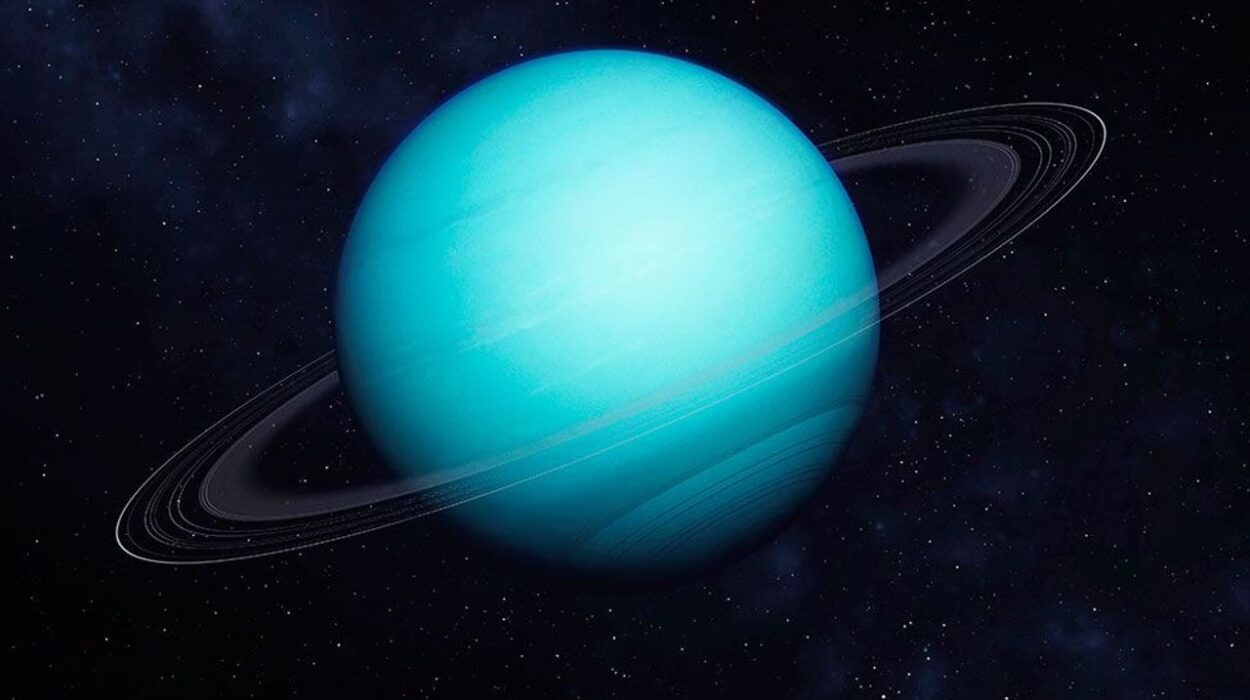
Jupiter, Uranus, and Neptune also possess ring systems.
These rings exist because particles orbiting a rotating object naturally settle into flat disks through repeated collisions and gravitational interactions.
The same physical principles that shaped Saturn’s rings also shaped the entire Solar System on a vastly larger scale.
Other Solar Systems Are Flat Too
For centuries, humans knew only one planetary system.
Today, astronomers have discovered thousands of planets orbiting other stars.
Many of these distant planetary systems also appear remarkably flat.
Even more compelling are observations of young stars surrounded by glowing protoplanetary disks.
Powerful telescopes such as the Atacama Large Millimeter/submillimeter Array (ALMA) have captured extraordinary images of these disks.
Many display rings, gaps, spirals, and other structures where new planets are actively forming.
These observations allow astronomers to witness processes very similar to those that created our own Solar System billions of years ago.
They confirm that flat planetary systems are not unusual.
They are a natural consequence of star formation throughout the universe.
Why Gravity Alone Cannot Explain It
One might wonder whether gravity itself always creates flat systems.
The answer is no.
If gravity acted alone without rotation, a collapsing cloud would become increasingly spherical as material fell inward from all directions.
Rotation is the crucial ingredient.
It introduces angular momentum, preventing material from collapsing equally in every direction.
The faster the cloud spins, the stronger this flattening effect becomes.
The Solar System owes its shape not simply to gravity, but to the elegant balance between gravity and angular momentum.
Could the Solar System Ever Stop Being Flat?
Over billions of years, the planetary orbits slowly evolve because of their mutual gravitational influences.
Tiny changes accumulate over immense periods.
However, these effects are generally modest.
The planets remain gravitationally stable, and the Solar System is expected to retain its overall disk-like structure for billions of years to come.
Only an extraordinarily rare event, such as a close encounter with another star or a major gravitational disturbance, could dramatically disrupt this arrangement.
Such events are extremely unlikely during the Sun’s remaining lifetime.
A Cosmic Pattern Found Everywhere
The flattening seen in the Solar System is part of a much larger pattern throughout the universe.
Galaxies often form rotating disks.
Accretion disks surround newborn stars.
Disks feed growing black holes.
Planetary rings encircle giant planets.
Again and again, whenever gravity gathers rotating material together, disks naturally emerge.
This recurring pattern reflects one of the most beautiful principles in physics: simple laws acting over immense spans of space and time can produce extraordinary order.
The Story Hidden in Every Planetary Orbit
Every time Earth completes another journey around the Sun, it quietly preserves a memory from 4.6 billion years ago.
Its nearly flat orbit is not a coincidence.
It is a fossil record of the giant rotating cloud from which our entire planetary system emerged.
The same is true for every other major planet.
Together, they continue tracing the shape of the ancient protoplanetary disk that disappeared billions of years ago but left behind an enduring signature written across the Solar System itself.
Conclusion
The Solar System is flat because it formed from a rotating cloud of gas and dust that collapsed under gravity about 4.6 billion years ago. As the cloud shrank, its rotation accelerated due to the conservation of angular momentum, causing material to spread into a thin, spinning disk. Within this protoplanetary disk, dust grains merged into larger bodies, eventually forming the Sun, planets, moons, asteroids, and many other objects. Since the planets all formed within the same disk, they naturally orbit the Sun along nearly the same plane and in the same direction.
What appears today as an orderly arrangement of planetary orbits is the lasting imprint of a dramatic cosmic transformation. The flatness of the Solar System is not an accident, but the inevitable outcome of some of the most fundamental laws of physics—gravity, motion, and angular momentum—working together over millions of years to shape one small corner of our galaxy into the remarkable planetary system we call home.