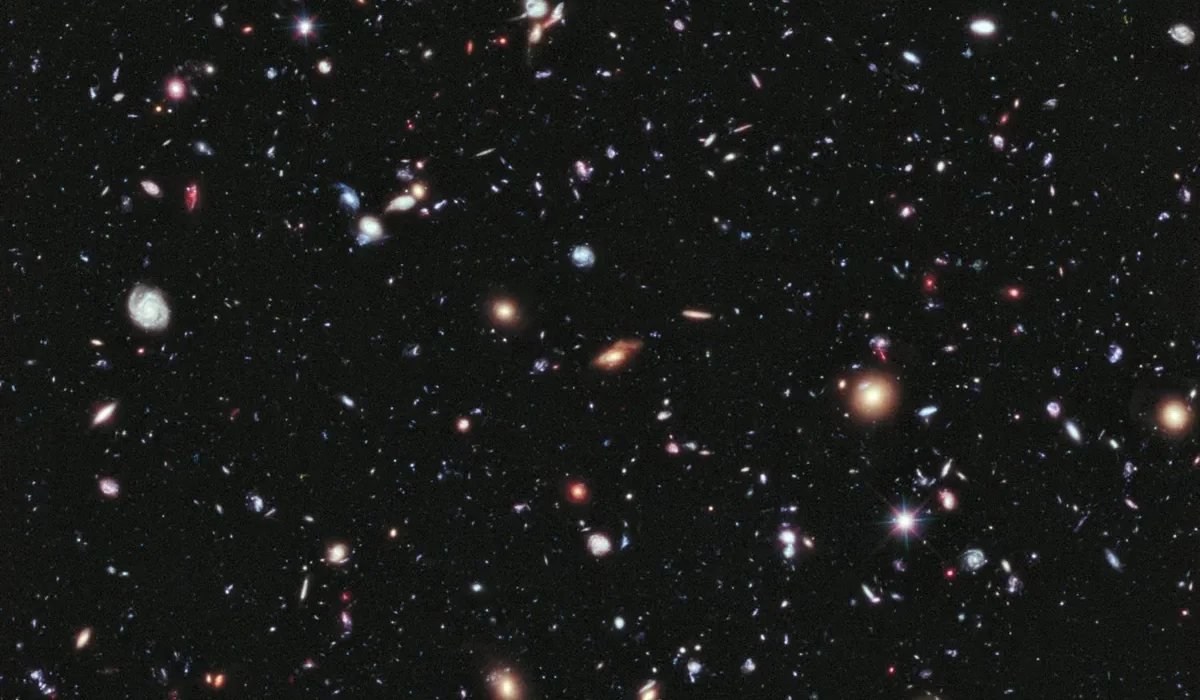
On a clear night, when you look up at the stars, space appears peaceful, endless, and silent. It is easy to imagine it as a vast ocean stretching beyond imagination. Yet hidden behind that breathtaking beauty is one of the harshest environments in the universe. Space is unimaginably cold. Far beyond Earth’s warm atmosphere, temperatures can plunge to levels that seem almost impossible, cold enough to freeze gases, stop ordinary chemical reactions, and challenge even the most advanced spacecraft.
But why is space so cold? If the Sun is an enormous ball of nuclear fire with a surface temperature of nearly 5,500°C (9,932°F), why isn’t all of space warm? Why can astronauts feel intense sunlight while objects in shadow become extremely cold? And why is the average temperature of the universe only a few degrees above absolute zero?
The answer lies in the nature of heat itself. Understanding why space is cold requires exploring how energy travels, what a vacuum really is, and how the universe has evolved since the Big Bang.
Understanding What Temperature Really Means
Before answering why space is cold, it is important to understand what temperature actually measures.
Temperature is a measure of the average kinetic energy of particles—the tiny atoms and molecules that make up matter. The faster these particles move, the hotter something is. The slower they move, the colder it becomes.
On Earth, air is filled with trillions upon trillions of molecules. These constantly collide with one another, transferring energy through conduction and convection. This is why warm air can heat your skin, and why a hot cup of coffee gradually cools as it transfers heat to the surrounding air.
In space, however, the situation is entirely different.
Space Is Almost Completely Empty
One of the biggest misconceptions is that space is simply “cold air.”
In reality, space contains almost no air at all.
The vast regions between planets and stars are nearly perfect vacuums. A vacuum is an area with extremely little matter. While space is not completely empty—it contains a few atoms, molecules, dust particles, and cosmic rays—the density is incredibly low.
For comparison, a single cubic centimeter of Earth’s atmosphere contains roughly 25 quintillion molecules at sea level. The same volume in interstellar space may contain only a few atoms.
Because there are so few particles, there is almost nothing available to carry heat from one place to another.
This is one of the main reasons space is so cold.
Heat Needs a Way to Travel
Heat moves from warmer objects to cooler ones in three primary ways: conduction, convection, and radiation.
Conduction occurs when objects touch each other, allowing energetic particles to collide and transfer energy.
Convection happens when fluids such as air or water circulate, carrying heat with them.
Radiation transfers energy through electromagnetic waves, allowing heat to travel even through empty space.
On Earth, conduction and convection are responsible for much of the heat we experience every day.
In space, however, conduction and convection are almost impossible because there are virtually no particles to carry energy.
Only radiation remains.
That means an object in space receives heat only if it absorbs radiation from a nearby source, such as the Sun or a star.
Otherwise, it continuously radiates its own heat into the darkness and becomes colder over time.
The Vacuum of Space Cannot Hold Heat
People often think of cold as something that exists by itself.
Scientifically, cold is not a substance or force. Instead, cold simply means the absence of thermal energy.
A vacuum cannot “store” warmth because there are almost no particles to contain heat.
Imagine standing beside a campfire on Earth.
The air around the fire becomes warm because countless molecules absorb energy and spread it throughout the surrounding atmosphere.
Now imagine removing every air molecule around the fire.
Without air, there would be no warm breeze reaching you.
You would only feel the fire’s infrared radiation if it directly reached your body.
That is much closer to what happens in space.
The vacuum itself does not make things cold. Rather, it provides no efficient way to retain or transfer heat.
The Average Temperature of Space
Scientists estimate that the average temperature of deep space is about 2.7 Kelvin, which equals −270.45°C (−454.81°F).
This is only about three degrees above absolute zero, the lowest possible temperature.
Absolute zero, defined as 0 Kelvin or −273.15°C (−459.67°F), is the point where particles possess their minimum possible thermal energy according to quantum mechanics. Although quantum effects prevent particles from becoming completely motionless, absolute zero represents the theoretical lower limit of temperature.
Why is deep space close to this incredibly low temperature?
The answer takes us back nearly 13.8 billion years.
The Echo of the Big Bang
The universe began with the Big Bang, an event in which space itself expanded from an extremely hot and dense state.
In its earliest moments, temperatures reached unimaginable levels.
As the universe expanded, it also cooled.
Over billions of years, radiation left over from the Big Bang stretched into longer wavelengths as space expanded. Today, this ancient radiation fills every direction of the universe.
Scientists call it the Cosmic Microwave Background (CMB).
Discovered in 1965, the Cosmic Microwave Background is one of the strongest pieces of evidence supporting the Big Bang theory.
Its temperature is remarkably uniform across the universe at approximately 2.725 Kelvin.
Because this faint microwave radiation fills all of space, it establishes the average temperature of the universe.
Even the emptiest regions of space are bathed in this ancient glow.
Why the Sun Doesn’t Heat All of Space
At first glance, this seems confusing.
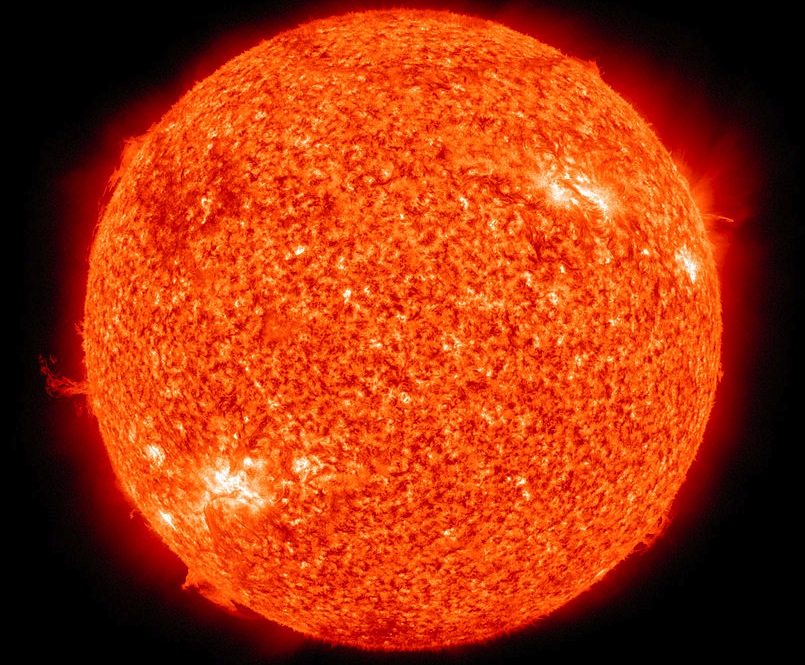
The Sun continuously releases enormous amounts of energy—about 3.8 × 10²⁶ watts every second.
Why doesn’t all of space become warm?
The answer lies in distance.
Radiation spreads outward in every direction.
As it travels farther from the Sun, the same amount of energy becomes distributed across increasingly larger areas.
This follows the inverse-square law, meaning that the intensity of sunlight decreases rapidly with distance.
Earth receives only a tiny fraction of the Sun’s total energy.
Planets farther away receive much less.
Beyond our Solar System, sunlight becomes extremely weak compared with the vastness of interstellar space.
Since stars are separated by enormous distances, most regions of the universe receive very little radiation from nearby stars.
As a result, space between stars remains extraordinarily cold.
Why Earth Stays Warm
Earth is not warm simply because it is close to the Sun.
Our atmosphere plays an equally important role.
Sunlight reaches Earth’s surface through radiation.
The surface absorbs this energy and becomes warm.
It then emits infrared radiation.
Certain gases in the atmosphere—including water vapor, carbon dioxide, methane, and others—absorb and re-emit part of this infrared energy, slowing the rate at which heat escapes into space. This natural process, known as the greenhouse effect, keeps Earth’s average surface temperature around 15°C (59°F) instead of approximately −18°C (0°F), which would be expected without it.
Without an atmosphere, our planet would experience much more extreme temperature swings.
The Moon provides a perfect example.
Why the Moon Is So Hot and So Cold
The Moon has almost no atmosphere.
As a result, its surface cannot trap heat.
When sunlight shines directly on the Moon, temperatures can reach about 127°C (261°F).
During the lunar night, when sunlight disappears for roughly two Earth weeks, temperatures can fall to around −173°C (−279°F).
This enormous temperature difference demonstrates how important an atmosphere is for regulating heat.
Earth’s atmosphere acts like an insulating blanket.
The Moon has almost none.
Space Near Earth Is Not Always Extremely Cold
People often imagine astronauts floating in freezing darkness.
The reality is more complicated.
An astronaut in direct sunlight can actually become very hot.
The side of a spacecraft facing the Sun absorbs intense solar radiation.
Meanwhile, the side facing away from the Sun can become extremely cold because it radiates heat into space.
This creates dramatic temperature differences over very short distances.
Spacecraft therefore require sophisticated thermal control systems.
These systems use insulation, reflective coatings, heat pipes, radiators, and heaters to maintain safe temperatures for both astronauts and equipment.
Without careful temperature regulation, electronics could fail, batteries could stop functioning efficiently, and instruments could become damaged.
Why Astronauts Don’t Instantly Freeze
Movies often portray astronauts instantly freezing when exposed to space.
This is scientifically inaccurate.
Although space is extremely cold, a vacuum removes heat much more slowly than cold air or cold water.
On Earth, icy water cools your body rapidly because water molecules efficiently carry heat away.
In space, there are almost no particles touching your body.
Instead, your body would lose heat mainly by emitting infrared radiation, which is a much slower process.
The absence of atmospheric pressure would create far more immediate dangers than the cold itself, making exposure to space life-threatening for several reasons unrelated to rapid freezing.
Can Anything Be Colder Than Space?
Surprisingly, yes.
Scientists have produced temperatures even closer to absolute zero inside specialized laboratories.
Using advanced cooling techniques such as laser cooling and evaporative cooling, researchers have cooled atoms to tiny fractions of a degree above absolute zero.
These experiments allow physicists to study exotic quantum phenomena, including Bose–Einstein condensates, where atoms behave collectively as a single quantum system.
Ironically, some of the coldest known places in the universe exist not in outer space but inside carefully controlled laboratories on Earth.
The Coldest Natural Places in the Universe
While most of deep space sits near 2.7 Kelvin, some regions become even colder.
One remarkable example is the Boomerang Nebula, located about 5,000 light-years from Earth.
Gas expanding rapidly from this dying star cools so efficiently that parts of the nebula reach approximately 1 Kelvin, making it even colder than the Cosmic Microwave Background.
This unusual cooling occurs because rapidly expanding gas loses internal energy, lowering its temperature dramatically.
The Boomerang Nebula is currently considered the coldest naturally known place in the universe.
Black Space Is Not Empty of Energy
Although space appears dark, it is not truly empty.
Photons travel continuously between stars and galaxies.
Cosmic rays race through the universe at nearly the speed of light.
Magnetic fields stretch across galaxies.
Invisible dark matter appears to influence the motions of galaxies through its gravitational effects.
Neutrinos, nearly massless particles produced in stars and other energetic events, pass through space—and through Earth itself—by the trillions every second.
Quantum physics also suggests that even empty space contains fluctuating quantum fields.
Despite these fascinating forms of energy, none provide enough heat to significantly warm the vast emptiness between stars.
Why Understanding Space’s Temperature Matters
Studying the temperature of space helps scientists answer some of the biggest questions in astronomy and cosmology.
The Cosmic Microwave Background provides a snapshot of the early universe only about 380,000 years after the Big Bang, allowing researchers to investigate how galaxies formed and how the universe evolved.
Understanding heat transfer in space also enables engineers to design spacecraft capable of surviving journeys to the Moon, Mars, and beyond.
Thermal physics influences everything from satellite design and telescope construction to future missions exploring icy moons, distant asteroids, and the outer planets.
Even the search for life beyond Earth depends partly on understanding how temperature affects planetary environments.
The Beauty of a Cold Universe
The incredible coldness of space may seem hostile, but it also makes many of the universe’s greatest wonders possible.
Cold molecular clouds allow gravity to gather gas and dust into new stars.
Icy comets preserve material from the early Solar System.
Frozen worlds orbit distant stars, waiting to reveal clues about planetary evolution.
The darkness and cold provide the perfect backdrop against which stars, galaxies, and nebulae shine with extraordinary brilliance.
Far from being lifeless emptiness, the cold vacuum of space is the stage on which the entire cosmic story unfolds.
Conclusion
Space is so cold because it is almost entirely a vacuum, containing too few particles to efficiently transfer or retain heat. Without air or other matter to carry thermal energy through conduction or convection, objects in space depend almost entirely on radiation to gain or lose heat. In the vast regions between stars, where very little starlight reaches, objects gradually radiate away their energy until they approach the faint temperature set by the Cosmic Microwave Background—about 2.7 Kelvin, only a few degrees above absolute zero.
Yet this freezing environment is not simply an absence of warmth. It is a consequence of the universe’s history, the physics of heat transfer, and the immense distances separating the stars. Every spacecraft, every planet, every comet, and every distant galaxy exists within this astonishingly cold cosmic ocean. Understanding why space is so cold not only reveals how heat behaves but also deepens our appreciation of the remarkable universe that surrounds us—one where even the coldest darkness tells a story billions of years in the making.