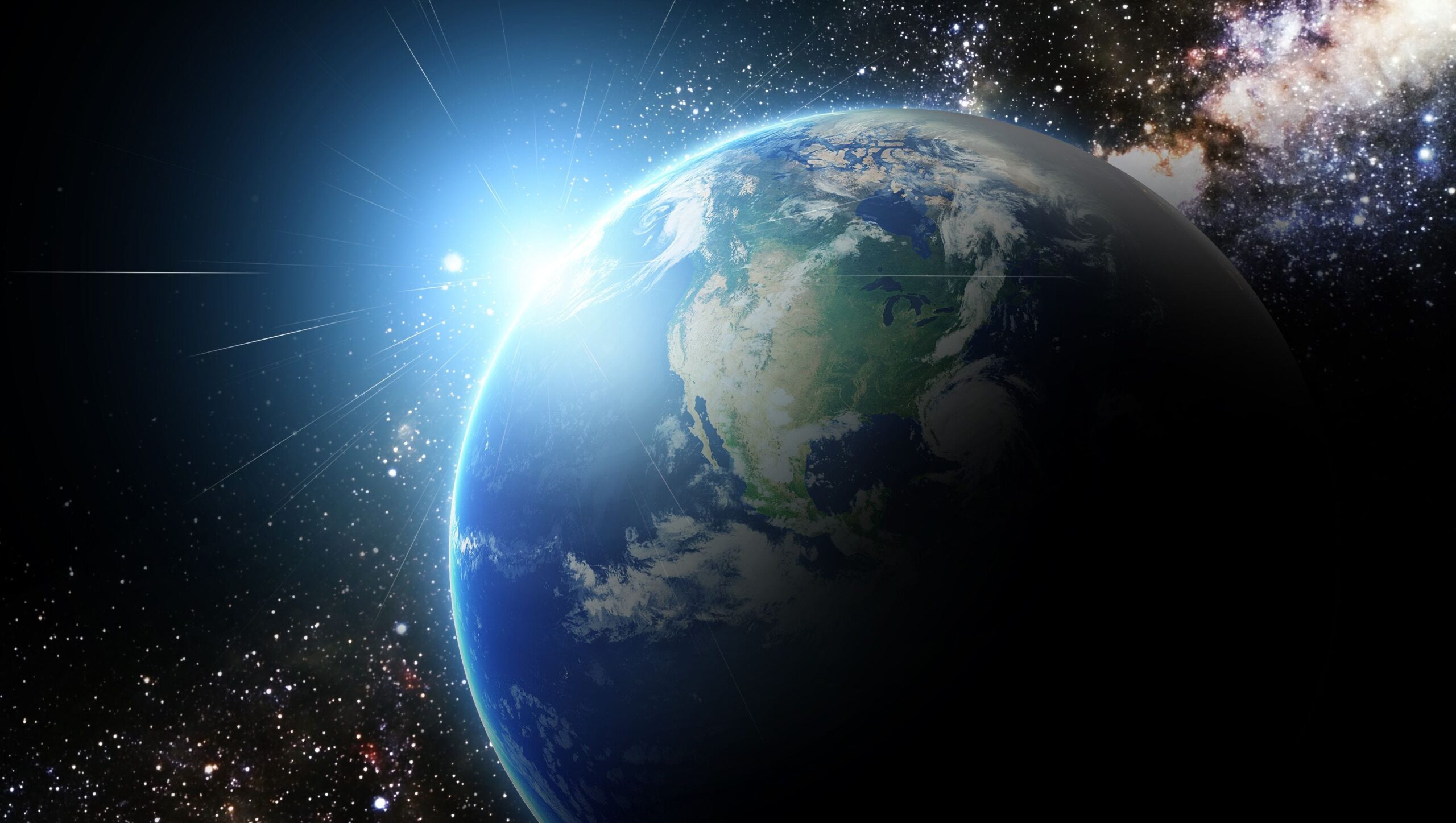
Earth is the only known planet in the universe that supports life. It is home to towering mountains, vast oceans, dense forests, scorching deserts, frozen polar ice, and an atmosphere that protects every living thing beneath it. Yet despite living on this remarkable planet every day, many people rarely stop to wonder how it formed, why continents move, how volcanoes erupt, where earthquakes come from, or what controls the weather.
These questions lie at the heart of Earth science.
Earth science is the branch of science devoted to understanding our planet—its structure, history, processes, and place in the universe. It explores everything from the rocks beneath our feet to the clouds above our heads, from the deepest ocean trenches to the highest mountain peaks, and from ancient fossils buried underground to the changing climate of today.
More than simply studying the Earth as it exists now, Earth science tells the story of a planet that has been changing continuously for more than 4.5 billion years. It reveals how Earth’s landscapes were shaped, how life evolved, why natural disasters occur, and how humans interact with the environment.
Understanding the Meaning of Earth Science
Earth science is the scientific study of the Earth and the natural processes that shape it. It investigates the planet’s solid surface, interior, atmosphere, oceans, water systems, climate, and the interactions among these components.
Unlike many other sciences that focus on a single subject, Earth science combines knowledge from physics, chemistry, biology, mathematics, and environmental science to explain how the planet works as an interconnected system.
Every rainfall, volcanic eruption, earthquake, glacier, river, hurricane, and ocean current is part of Earth’s dynamic system. Earth scientists study these natural processes to understand why they happen, how they influence one another, and how they affect life on Earth.
Earth Is a Dynamic Planet
At first glance, Earth may seem stable and unchanging. Mountains appear permanent, continents seem fixed, and oceans look timeless.
In reality, Earth is constantly changing.
The continents slowly drift across the planet’s surface.
Mountains rise while others gradually erode.
New ocean floors form as old ones disappear.
Volcanoes build new land.
Earthquakes reshape landscapes within seconds.
Rivers carve valleys over millions of years.
Glaciers slowly sculpt mountains.
Even the atmosphere is continually changing as weather systems move around the globe.
Some of these changes happen so slowly that humans cannot notice them during a lifetime. Others, such as earthquakes or volcanic eruptions, can transform entire regions in just moments.
Understanding these changes is one of the primary goals of Earth science.
The Four Major Systems of Earth
Earth functions as an integrated system made up of several interconnected parts. Changes in one part often influence the others.
The geosphere includes the solid Earth—rocks, minerals, mountains, continents, and Earth’s interior.
The hydrosphere includes all water found on Earth, including oceans, rivers, lakes, groundwater, glaciers, and water vapor.
The atmosphere is the layer of gases surrounding Earth. It provides oxygen for most living organisms, protects the planet from harmful solar radiation, and helps regulate temperature.
The biosphere includes every living organism, from microscopic bacteria to giant whales and towering trees.
These systems constantly exchange matter and energy.
Rain falls from the atmosphere into rivers.
Rivers carry minerals from the geosphere to the oceans.
Plants in the biosphere absorb water from the hydrosphere and carbon dioxide from the atmosphere.
Volcanic eruptions release gases from Earth’s interior into the atmosphere.
Because these systems are connected, Earth science studies them together rather than separately.
How Earth Formed
According to current scientific evidence, Earth formed approximately 4.54 billion years ago from a rotating cloud of gas and dust surrounding the young Sun.
As tiny particles collided, they gradually stuck together through gravity, forming larger bodies known as planetesimals. Continued collisions eventually produced the early Earth.
During its earliest history, Earth was an extremely hot, molten world.
Over millions of years, heavier elements such as iron and nickel sank toward the center, forming Earth’s core, while lighter materials rose toward the surface to create the mantle and crust.
As the planet cooled, water vapor condensed into liquid water, forming the first oceans. The atmosphere gradually evolved, and eventually conditions became suitable for life.
Earth science continues to investigate the details of this remarkable transformation from a lifeless ball of molten rock into the vibrant planet we know today.
The Structure of Earth
Although Earth appears solid from the surface, its interior consists of several distinct layers.
The outermost layer is the crust, a relatively thin shell made of solid rock. Continents and ocean floors are part of the crust.
Beneath the crust lies the mantle, an enormous layer of hot rock that slowly flows over geological timescales. Although mostly solid, the mantle behaves like an extremely slow-moving fluid under high temperatures and pressures.
At Earth’s center lies the core, composed primarily of iron and nickel.
The outer core is liquid, while the inner core remains solid because of immense pressure despite temperatures comparable to the surface of the Sun.
Movement within the liquid outer core generates Earth’s magnetic field, which protects the planet from harmful charged particles emitted by the Sun.
Rocks and Minerals
The ground beneath our feet tells a story stretching back billions of years.
Minerals are naturally occurring inorganic substances with specific chemical compositions and crystal structures.
Rocks are made from one or more minerals.
Earth scientists classify rocks into three major groups based on how they form.
Igneous rocks form when molten rock cools and solidifies.
Sedimentary rocks develop from layers of sediment compressed over time.
Metamorphic rocks form when existing rocks are altered by heat, pressure, or chemically active fluids without completely melting.
These rock types continuously transform through the rock cycle, a process driven by Earth’s internal heat, weathering, erosion, and plate tectonics.
The rock cycle demonstrates that Earth’s surface is never truly static.
Plate Tectonics: The Engine of Earth’s Surface
One of the greatest discoveries in Earth science is the theory of plate tectonics.
Earth’s outer shell is divided into several enormous plates that slowly move across the mantle.
Although these plates typically move only a few centimeters each year, their movement shapes nearly every major geological feature on Earth.
Where plates collide, mountains rise.
Where they separate, new ocean crust forms.
Where they slide past one another, earthquakes occur.
Volcanoes frequently develop along plate boundaries as molten rock rises from Earth’s interior.
The Himalayas continue to grow because the Indian Plate is still colliding with the Eurasian Plate.
The Atlantic Ocean gradually widens because the American plates are moving away from Europe and Africa.
Plate tectonics provides a unified explanation for earthquakes, volcanoes, mountain building, and the distribution of continents and oceans.
Earthquakes and Volcanoes
Earthquakes are sudden releases of energy caused by movement along faults within Earth’s crust.
This energy travels as seismic waves, causing the ground to shake.
Most earthquakes occur near plate boundaries, although they can also happen within plates.
Scientists monitor seismic activity to better understand Earth’s interior and improve hazard preparedness.
Volcanoes form when molten rock, known as magma beneath the surface and lava after it erupts, reaches Earth’s exterior.
Volcanic eruptions create new land, release gases into the atmosphere, and enrich soils with valuable minerals.
Although volcanic eruptions can be destructive, they have also played a vital role in shaping Earth’s surface throughout geological history.
Weather and Climate
Earth science examines both weather and climate, but these terms describe different concepts.
Weather refers to short-term atmospheric conditions such as temperature, rainfall, humidity, wind, and storms.
Climate describes long-term average weather patterns over decades or longer.
Weather changes from day to day.
Climate changes much more slowly.
The atmosphere is driven primarily by energy from the Sun. Solar heating creates differences in temperature that produce winds, clouds, precipitation, and large-scale weather systems.
Earth scientists study these processes to improve weather forecasting and understand long-term climate change.
The Water Cycle
Water continuously moves through Earth’s systems in an endless cycle.
Solar energy causes water to evaporate from oceans, lakes, rivers, and soil.
Plants release water vapor through transpiration.
As moist air cools, water condenses into clouds.
Eventually, precipitation returns water to Earth’s surface as rain, snow, sleet, or hail.
Some water flows into rivers and oceans.
Some infiltrates the ground to become groundwater.
Some becomes trapped in glaciers and polar ice.
This continuous circulation supports ecosystems, agriculture, freshwater supplies, and nearly every form of life.
Oceans: Earth’s Largest Environment
Oceans cover approximately 71 percent of Earth’s surface, making them the planet’s largest ecosystem.
They regulate global climate by storing and transporting enormous amounts of heat.
Ocean currents redistribute thermal energy around the world, influencing regional weather patterns.
The oceans also absorb significant amounts of carbon dioxide from the atmosphere and produce much of Earth’s oxygen through microscopic marine organisms known as phytoplankton.
Despite their importance, much of the deep ocean remains unexplored.
Earth scientists continue discovering new species, underwater volcanoes, hydrothermal vents, and geological processes beneath the sea.
Fossils and Earth’s History
Earth’s rocks preserve an extraordinary record of the past.
Fossils are the preserved remains, impressions, or traces of ancient organisms.
By studying fossils, scientists reconstruct the history of life on Earth.
They learn how species evolved, how ancient environments changed, and how past extinction events transformed ecosystems.
The fossil record reveals that life has existed on Earth for more than 3.5 billion years and has undergone dramatic changes through time.
Dinosaurs, giant marine reptiles, early mammals, ancient forests, and microscopic organisms all contribute pieces to Earth’s long history.
Earth’s Climate Through Time
Earth’s climate has changed repeatedly throughout its history.
There have been periods when much of the planet was covered by ice and other times when tropical forests extended into regions that are now cold.
These natural climate changes have been driven by factors such as volcanic activity, changes in Earth’s orbit, variations in solar energy, and shifts in atmospheric composition.
Today, scientific evidence shows that human activities—especially the burning of fossil fuels, deforestation, and certain industrial processes—are increasing greenhouse gas concentrations in the atmosphere. This has led to a measurable rise in global average temperatures and is affecting weather patterns, sea levels, glaciers, and ecosystems around the world.
Earth science plays a crucial role in monitoring these changes and improving our understanding of their causes and impacts.
Natural Resources
Earth provides the resources that make modern civilization possible.
Minerals supply the raw materials used to build homes, vehicles, computers, and electronics.
Freshwater supports drinking, agriculture, and industry.
Fossil fuels have powered economic development for centuries.
Renewable resources such as wind, solar energy, geothermal energy, and hydropower are becoming increasingly important as societies seek more sustainable energy systems.
Earth scientists study how these resources form, where they are located, and how they can be used responsibly while minimizing environmental impacts.
Earth Science and Natural Hazards
Natural hazards are an unavoidable part of living on a dynamic planet.
Earthquakes, volcanic eruptions, hurricanes, floods, droughts, landslides, tsunamis, and wildfires can all threaten human communities.
Earth science helps reduce these risks through careful observation, monitoring, and forecasting.
Seismic networks detect earthquake activity.
Weather satellites monitor storms.
Volcano observatories measure changes that may signal future eruptions.
Flood forecasting models predict rising rivers.
Although many natural hazards cannot be prevented, scientific understanding allows societies to prepare more effectively and save lives.
Earth Science and Space
Earth science does not end at Earth’s surface.
Scientists compare Earth with other planets and moons to better understand how planets evolve.
Studying Mars helps researchers investigate ancient water systems and planetary climate.
Observations of Venus provide insight into extreme greenhouse conditions.
The Moon preserves evidence of the early Solar System that has largely disappeared from Earth’s active surface.
Satellite technology has transformed Earth science by allowing researchers to observe weather systems, glaciers, forests, oceans, sea levels, and land use from space.
These observations improve weather forecasting, disaster response, agriculture, environmental protection, and climate research.
How Earth Scientists Study the Planet
Earth scientists use many different tools to investigate our planet.
Fieldwork allows researchers to collect rocks, fossils, soil, and water samples directly from natural environments.
Laboratory analyses reveal the chemical composition and age of rocks and minerals.
Seismographs record earthquake waves to study Earth’s interior.
Weather balloons measure atmospheric conditions.
Oceanographic instruments explore the deep sea.
Satellites observe Earth from orbit, providing continuous global measurements.
Powerful computer models help scientists simulate climate systems, volcanic eruptions, groundwater movement, and many other natural processes.
By combining observations, experiments, and mathematical modeling, Earth scientists develop increasingly accurate explanations of how the planet works.
Why Earth Science Matters
Earth science affects every person, whether they realize it or not.
It helps farmers understand rainfall patterns and soil conditions.
It guides engineers when constructing buildings, bridges, and dams.
It assists governments in preparing for natural disasters.
It supports the discovery of groundwater and mineral resources.
It improves weather forecasts that protect lives and property.
It helps scientists monitor climate change, conserve ecosystems, and manage natural resources responsibly.
As the global population grows and environmental challenges become more complex, Earth science will become even more important in helping humanity build a sustainable future.
The Future of Earth Science
New technologies are transforming the way scientists study Earth.
Artificial intelligence is helping researchers analyze enormous datasets.
High-resolution satellites provide unprecedented views of the planet.
Autonomous underwater vehicles explore the deepest oceans.
Advanced climate models improve predictions of future environmental change.
Scientists continue searching for answers to major questions about Earth’s interior, the evolution of continents, the behavior of ice sheets, the cycling of carbon, and the complex interactions among Earth’s systems.
Each discovery deepens our understanding of the planet we call home.
Conclusion
Earth science is the study of our planet in all its complexity and beauty. It seeks to understand the rocks beneath our feet, the water that sustains life, the atmosphere that protects us, the oceans that regulate climate, and the countless natural processes that have shaped Earth over billions of years.
By bringing together knowledge from geology, meteorology, oceanography, environmental science, and other disciplines, Earth science reveals that our planet is not a static world but a dynamic, interconnected system that is constantly changing. It explains the origins of mountains and oceans, the causes of earthquakes and volcanoes, the patterns of weather and climate, and the history of life preserved in ancient rocks.
Most importantly, Earth science reminds us that understanding our planet is essential for protecting it. The more we learn about Earth’s natural systems, the better prepared we are to manage its resources wisely, respond to environmental challenges, and ensure that this extraordinary world continues to support life for generations to come.