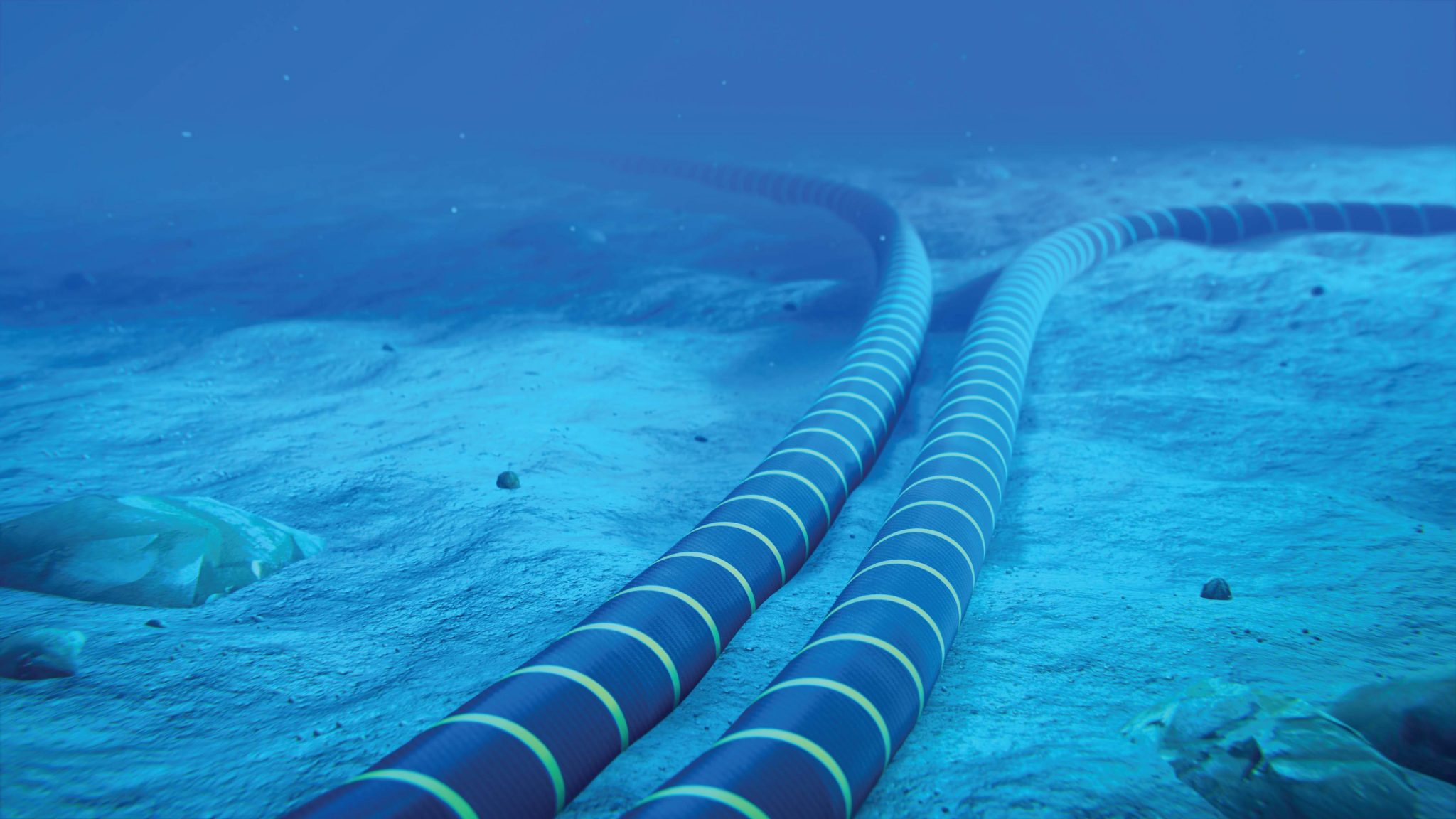
Every time you send a message to someone on another continent, watch a movie on a streaming service, join an international video call, play an online game, or browse a website hosted thousands of miles away, your data embarks on an extraordinary journey beneath the ocean. Many people imagine that the internet relies primarily on satellites floating high above Earth, but the reality is far more surprising. Nearly all international internet traffic—more than 95 percent—travels through an enormous network of submarine fiber-optic cables laid across the seafloor.
These underwater cables are among the greatest engineering achievements in human history. Stretching for thousands of kilometers across the Atlantic, Pacific, Indian, Arctic, and Southern Oceans, they quietly carry vast amounts of information every second. Although hidden beneath the waves, they form the backbone of the modern internet, making global communication almost instantaneous.
Understanding how submarine internet cables work reveals not only the incredible technology behind our connected world but also the remarkable effort required to keep billions of people online every day.
The Invisible Backbone of the Internet
The internet is often described as a “cloud,” giving the impression that information somehow floats through the air. In reality, the internet is an enormous physical infrastructure consisting of computers, servers, routers, switches, data centers, wireless networks, and millions of kilometers of cables.
Submarine internet cables are one of the most important parts of this infrastructure. They physically connect continents by carrying digital information through pulses of light traveling inside extremely thin glass fibers.
Whenever someone in New York opens a website hosted in London, or a student in India watches a lecture stored on servers in the United States, much of that information travels through underwater cables lying quietly on the ocean floor.
Without these cables, today’s global internet would simply not exist.
Why Doesn’t the Internet Use Satellites Instead?
Many people assume satellites handle most international communication because they orbit high above Earth and cover large areas. Satellites do play an important role, especially for remote regions, ships, aircraft, disaster recovery, and certain specialized communication services.
However, satellites have important limitations.
Signals traveling through satellites must journey tens of thousands of kilometers into space before returning to Earth. This creates noticeable delays known as latency.
Submarine fiber-optic cables provide much shorter communication paths, allowing data to travel far more quickly. They also carry vastly greater amounts of information than satellites.
Modern fiber-optic cables can transmit hundreds of terabits of data every second, making them the preferred choice for global internet traffic.
As a result, satellites complement the global internet rather than replace submarine cables.
What Is a Submarine Internet Cable?
A submarine internet cable is a specially designed fiber-optic communication cable installed on the seabed to connect countries and continents.
Despite stretching thousands of kilometers across oceans, the actual glass fibers carrying internet traffic are surprisingly thin. Each fiber is only slightly thicker than a human hair.
Because the deep ocean is an extremely harsh environment, these delicate fibers are protected by multiple layers of specialized materials.
A typical submarine cable contains optical fibers surrounded by waterproof gel, protective steel tubes, copper conductors for electrical power, strong steel wires for mechanical protection, waterproof insulation, and an outer polyethylene jacket.
Near coastlines, where anchors, fishing equipment, and human activities create greater risks, additional layers of steel armor make the cable much stronger.
In deeper ocean waters, where human activity is minimal, lighter cable designs are usually sufficient.
The Amazing Science of Fiber Optics
The secret behind submarine internet cables lies in fiber optics.
Instead of transmitting electricity like traditional copper telephone cables, fiber-optic cables transmit light.
Tiny lasers rapidly generate pulses of light representing digital information.
Every email, video, photo, voice call, financial transaction, and webpage becomes a sequence of binary digits—zeros and ones.
These binary digits are encoded into extremely fast flashes of laser light.
The light travels through glass fibers by repeatedly reflecting from the inner walls of the fiber.
This process, called total internal reflection, keeps the light trapped inside the fiber even as the cable bends gently along the ocean floor.
Because light travels incredibly fast, information can cross entire oceans in fractions of a second.
How Data Travels Across the Ocean
Imagine opening a website hosted on another continent.
Your computer first sends a request to your home router.
The router forwards the request to your internet service provider.
From there, the information passes through regional networks before reaching an international landing station connected to a submarine cable.
Powerful lasers convert the digital information into optical signals.
These signals race through optical fibers beneath the ocean at roughly two-thirds the speed of light in a vacuum, which is about 200,000 kilometers per second inside the glass.
Along the journey, specialized equipment strengthens the signals until they eventually arrive at another cable landing station on a different continent.
The information then travels through terrestrial fiber-optic networks until reaching the destination server.
The server sends the requested webpage back through a similar route.
This entire process often takes only a few milliseconds.
Why Light Needs Help During Long Journeys
Although optical fibers are incredibly efficient, light gradually loses strength as it travels.
This weakening is called signal attenuation.
Over thousands of kilometers, the signal would eventually become too weak to detect accurately.
To solve this problem, engineers install optical repeaters along the cable.
These repeaters are usually placed every 50 to 100 kilometers.
Unlike older electronic repeaters that converted light into electrical signals and back again, modern submarine systems commonly use optical amplifiers.
These devices directly strengthen the light signal without fully converting it into electricity.
This approach increases efficiency while supporting enormous data capacities.
Powering Equipment Deep Beneath the Ocean
The optical amplifiers scattered across the seabed require electricity.
Supplying power thousands of kilometers underwater presents a significant engineering challenge.
Each submarine cable contains copper conductors running alongside the optical fibers.
These conductors carry high-voltage direct current from cable landing stations located on shore.
The electricity continuously powers every amplifier along the cable, allowing signals to remain strong throughout their journey.
The power systems are carefully monitored around the clock because uninterrupted operation is essential for global communications.
How Submarine Cables Are Installed
Installing an underwater cable is a carefully planned operation requiring months or even years of preparation.
Scientists first survey the proposed route using advanced sonar systems, underwater robots, satellite mapping, and geological studies.
Engineers avoid underwater volcanoes, earthquake zones where practical, unstable slopes, coral reefs, environmentally sensitive habitats, and areas with heavy fishing activity whenever possible.
Once the route is finalized, specialized cable-laying ships begin deployment.
The cable is stored inside enormous circular tanks aboard the vessel.
As the ship slowly moves along the planned route, the cable is gently lowered into the ocean.
In deep water, the cable simply settles onto the seabed under its own weight.
Near coastlines, special underwater plows often bury the cable beneath the seafloor to protect it from anchors, fishing gear, and other human activities.
Every kilometer is carefully monitored to ensure proper placement.
Landing Stations: Where Oceans Meet the Internet
Submarine cables connect to land through facilities called cable landing stations.
These buildings act as gateways between underwater cables and terrestrial communication networks.
Inside the landing station, engineers monitor cable performance, manage power systems, amplify optical signals, and connect international traffic to national internet networks.
Landing stations are among the most important pieces of communication infrastructure in the world.
Many countries have multiple landing stations to improve reliability and network resilience.
How Fast Are Modern Submarine Cables?
Modern submarine cables are astonishingly powerful.
Rather than carrying a single stream of information, each cable contains multiple pairs of optical fibers.
Each fiber can simultaneously transmit many different wavelengths of laser light using a technique known as wavelength-division multiplexing.
Each wavelength carries an independent stream of digital information.
By combining dozens or even hundreds of wavelengths within a single fiber, engineers dramatically increase the cable’s total capacity.
Today’s most advanced submarine cable systems can carry hundreds of terabits of information every second.
That is enough bandwidth to support millions of simultaneous high-definition video streams, cloud computing operations, online gaming sessions, scientific research, and financial transactions.
Why Multiple Cables Connect the Same Regions
One cable alone cannot support the world’s communication needs.
For this reason, continents are connected by many independent submarine cable systems.
Having multiple routes provides redundancy.
If one cable experiences damage, internet traffic can automatically reroute through other available cables.
This design greatly improves the reliability of the global internet.
Major internet companies, telecommunications providers, and international consortia often work together to build new cable systems that expand capacity and create additional network paths.
What Can Damage Underwater Cables?
Although submarine cables are extremely durable, they are not indestructible.
Interestingly, deep ocean environments are generally quite safe.
Most cable damage actually occurs in relatively shallow coastal waters.
Fishing trawlers dragging heavy equipment across the seabed can accidentally snag cables.
Ship anchors may strike buried or exposed sections.
Occasionally, underwater landslides triggered by earthquakes or sediment movement can sever multiple cables simultaneously.
Strong ocean currents may also expose buried cables over time.
Contrary to popular myths, shark bites are not a major cause of cable failures. While sharks have occasionally bitten cables—likely attracted by electromagnetic fields in older systems—modern cables are heavily protected, and such incidents are extremely rare.
How Engineers Repair Broken Cables
When a cable fails, sophisticated monitoring systems quickly identify the approximate location of the problem.
Repair ships are then dispatched to the affected area.
Using remotely operated vehicles or specialized grappling equipment, engineers retrieve the damaged section from the seabed.
The broken portion is removed, and a new section of cable is carefully spliced into place.
The repaired cable undergoes extensive testing before being lowered back onto the ocean floor.
Repair operations can take days or even weeks, depending on weather conditions, ocean depth, and the distance from the nearest port.
Meanwhile, internet traffic is usually redirected through other cable systems to minimize service disruptions.
How Long Do Submarine Cables Last?
Submarine internet cables are designed for long-term operation.
Most systems have an expected lifespan of around 25 years, although some remain functional for longer with proper maintenance.
As internet demand grows and technology improves, older cables are eventually replaced with newer systems capable of carrying much larger amounts of data.
This continuous cycle of upgrading helps meet the ever-increasing demand for global connectivity.
The Companies Behind Global Cable Networks
Building submarine cables requires enormous investments, often costing hundreds of millions of dollars for a single project.
Historically, telecommunications companies funded these systems.
Today, many of the world’s largest technology companies—including cloud service providers and internet platforms—also invest heavily in submarine cable infrastructure.
These companies require vast international bandwidth to support cloud computing, streaming services, artificial intelligence, online collaboration, and billions of users worldwide.
International partnerships are common because sharing costs makes these ambitious projects more economically feasible.
Environmental Considerations
Installing submarine cables requires careful environmental planning.
Marine scientists study ecosystems before construction begins to minimize impacts on sensitive habitats.
In many deep-sea areas, cables rest quietly on the seabed with relatively little environmental disturbance after installation.
During construction, engineers carefully select routes that avoid vulnerable coral reefs, marine protected areas, and ecologically important habitats whenever possible.
Modern projects are subject to environmental assessments and regulatory oversight to balance technological needs with marine conservation.
Why Submarine Cables Matter to Everyday Life
Although few people ever see a submarine cable, billions rely on them every day.
International phone calls, streaming movies, cloud storage, online banking, scientific collaboration, social media, remote work, online education, weather forecasting, financial markets, and emergency communications all depend on these underwater networks.
A single cable may carry the digital conversations of millions of people simultaneously.
Even artificial intelligence systems, international medical research, and space mission operations rely on fast, reliable global communication made possible by submarine cables.
Without them, the modern digital economy would slow dramatically.
The Future of Underwater Internet Infrastructure
Global internet traffic continues to grow every year as more people, devices, and services come online.
To meet this demand, engineers are developing new generations of submarine cables with higher capacities, more optical fibers, and improved transmission technologies.
Advances in optical amplification, signal processing, and fiber design continue to increase the amount of information each cable can carry.
Future systems will support expanding cloud computing, artificial intelligence, scientific research, immersive virtual experiences, autonomous technologies, and the growing Internet of Things.
Although wireless technologies continue to advance, the world’s digital future will remain firmly anchored to the oceans.
The Hidden Lifeline Beneath the Waves
Submarine internet cables rarely appear in headlines, yet they are among the most important pieces of infrastructure ever built. Quietly resting on the ocean floor, they connect continents with threads of glass no thicker than a human hair, carrying the world’s conversations, discoveries, businesses, entertainment, and ideas at nearly the speed of light.
Every international message sent, every overseas video call made, every global financial transaction completed, and every webpage loaded from another continent depends on this remarkable underwater network. It is a powerful reminder that the internet is not an invisible cloud but a vast, carefully engineered system built through science, innovation, and international cooperation.
Hidden beneath the waves, these cables form the unseen lifeline of our connected world, ensuring that people separated by oceans can communicate almost instantly. As technology continues to evolve, submarine internet cables will remain one of humanity’s greatest engineering achievements, silently supporting the digital civilization of the twenty-first century and beyond.