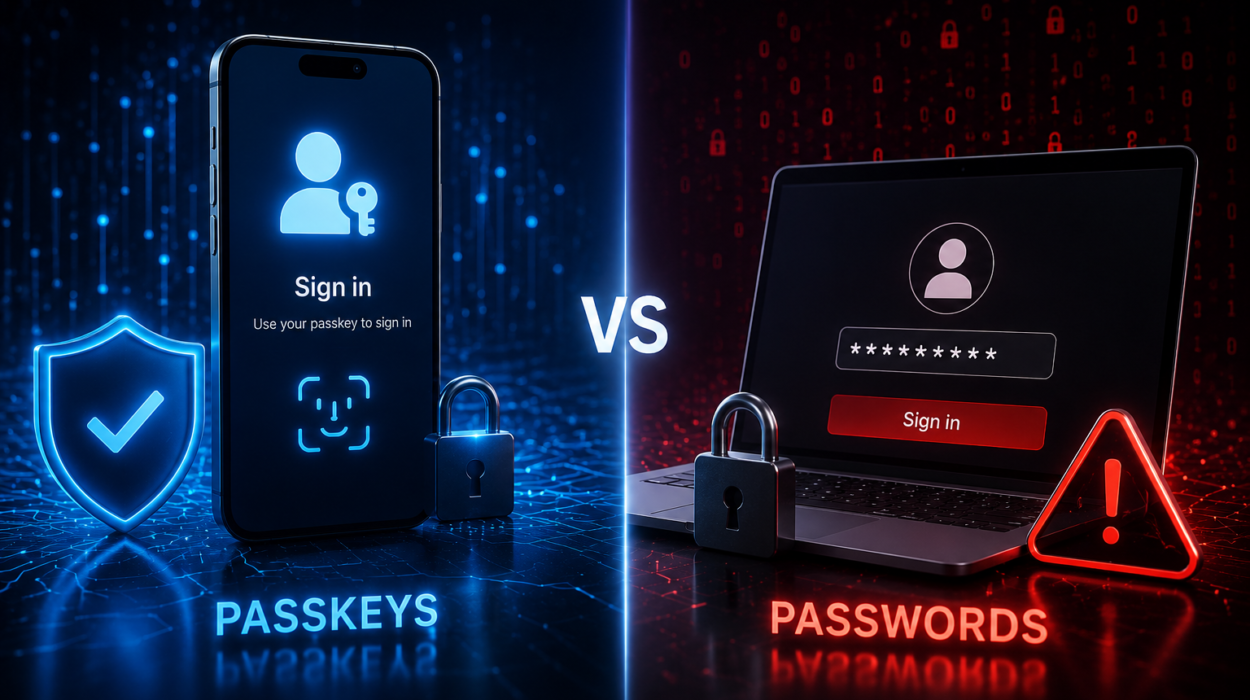
For decades, passwords have served as the digital keys to our online lives. They protect our email accounts, banking apps, social media profiles, shopping websites, cloud storage, and countless other services. Yet despite their importance, passwords have always had one major weakness: they can be stolen.
Every day, cybercriminals create fake websites, deceptive emails, and convincing text messages designed to trick people into revealing their login credentials. This type of cyberattack, known as phishing, has become one of the most common and successful forms of online fraud. Even people who are careful can occasionally be fooled by a website that looks almost identical to the real one.
Fortunately, a new authentication technology is changing how we log in online. Instead of relying on passwords that can be typed into fake websites, passkeys offer a safer and simpler way to prove your identity. Built on modern cryptography, passkeys are designed to resist phishing attacks while making the login experience faster and easier.
Passkeys are quickly becoming one of the most important advances in online security. Understanding how they work can help explain why many experts believe they represent the future of authentication.
What Is a Passkey?
A passkey is a digital credential that allows you to sign in to an online account without entering a traditional password.
Instead of creating and remembering a password, your device stores a unique cryptographic key pair. When you log in, your device securely proves that you own the correct passkey without revealing any secret information to the website.
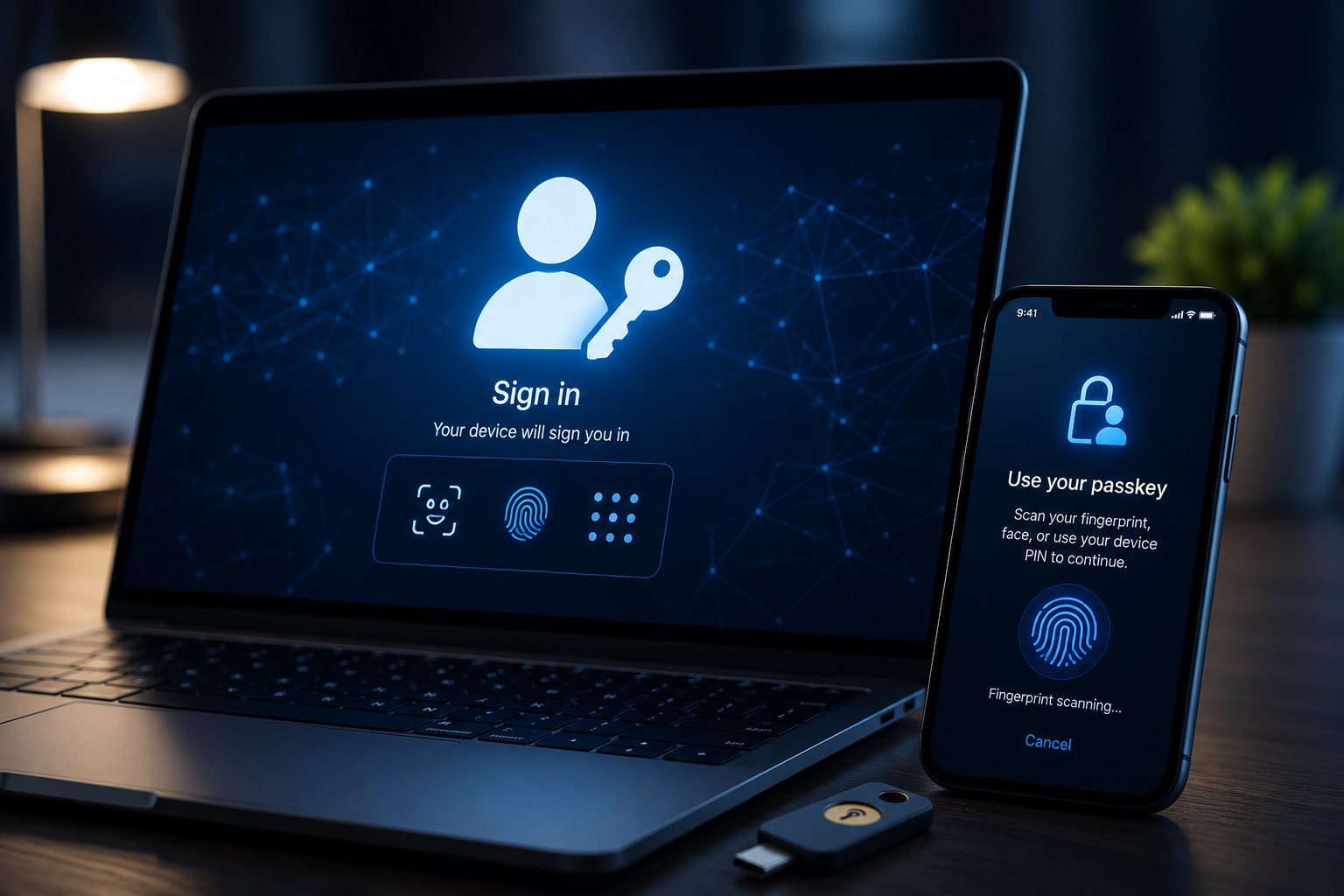
From the user’s perspective, the process is remarkably simple. You may unlock your phone or computer using your fingerprint, face recognition, or device PIN. Behind the scenes, complex cryptographic operations authenticate your identity without exposing sensitive login credentials.
Unlike passwords, passkeys are not pieces of text that can be copied, guessed, or stolen through deception.
Understanding Phishing
To understand why passkeys are so effective, it helps to first understand how phishing works.
A phishing attack usually begins with a message that appears trustworthy. It might look like an email from your bank, a notification from your favorite shopping website, or a warning that your account has been locked.
The message encourages you to click a link.
That link leads to a fake website designed to closely resemble the legitimate one. Logos, colors, buttons, and layouts are carefully copied so that the page looks authentic.
The attacker hopes you will enter your username and password.
Once you do, those credentials are sent directly to the criminal instead of the real website.
The attacker can then use the stolen password to log into your actual account.
This attack succeeds because passwords are shared secrets. If someone else learns your password, they can often pretend to be you.
Why Passwords Are Vulnerable
Passwords have several weaknesses that make phishing possible.
First, people often reuse the same password across multiple websites. If one account is compromised, others may also become vulnerable.
Second, many passwords are easy to guess because people naturally choose memorable words, birthdays, or simple number combinations.
Third, even strong passwords can be stolen if users unknowingly type them into fraudulent websites.
The problem is not always that passwords are weak. The real issue is that passwords can be transferred from one person to another.
A password entered into the wrong website immediately becomes known to an attacker.
Passkeys solve this problem in a fundamentally different way.
The Science Behind Passkeys
Passkeys rely on a branch of mathematics called public-key cryptography.
Instead of creating one secret password, your device generates two mathematically related cryptographic keys.
One is called the public key.
The other is called the private key.
The public key is shared with the website when you create your account.
The private key never leaves your device.
These keys work together mathematically, but knowing the public key does not reveal the private key.
This design is one of the most important principles in modern cybersecurity.
How Passkeys Work During Login
When you attempt to log into a website using a passkey, the website sends your device a unique cryptographic challenge.
Your device uses its private key to digitally sign that challenge.
The signed response is then sent back to the website.
The website verifies the response using the stored public key.
If the mathematical signature is correct, the website knows that the genuine private key was used.
Because only your device possesses the private key, the website can confidently verify your identity.
Throughout this process, your private key never travels across the internet.
No password is transmitted.
No secret information is exposed.
Why Phishing Stops Working
The biggest reason passkeys defeat phishing is that they are tied to the genuine website.
Suppose a criminal creates a fake login page that looks identical to your bank’s website.
With a password, you could accidentally type your credentials into that fake page.
With a passkey, something very different happens.
Your device checks the identity of the website requesting authentication.
If the website’s domain name does not exactly match the one associated with your stored passkey, your device simply refuses to use the passkey.
Instead of silently authenticating you, your device recognizes that the website is not the legitimate service.
The authentication process stops before any sensitive information can be shared.
Even if the fake page looks perfect, the underlying website identity is different.
That difference prevents the attack from succeeding.
Domain Verification Makes a Huge Difference
Every website has a unique domain name.
For example, a legitimate website might use a domain such as “example.com.”
A phishing website may instead use something deceptively similar, such as “examp1e.com” or “example-login.com.”
These small differences can easily fool human eyes.
Computers, however, do not rely on visual appearance.
Passkeys are linked to the exact domain where they were created.
If the domain changes even slightly, the passkey cannot be used.
This automatic verification removes much of the burden from users.
Instead of asking people to carefully inspect every website, passkeys allow devices to perform that verification automatically.
Your Private Key Never Leaves Your Device
Traditional passwords are shared with the website every time you log in.
Passkeys work differently.
The private key remains securely stored inside your device.
Only a cryptographic proof is sent during authentication.
Because the private key never travels across the internet, attackers cannot intercept it.
Even if someone monitors network traffic, they cannot recover the private key from the information exchanged during login.
This dramatically reduces the opportunities for credential theft.
Fake Websites Cannot Steal What They Never Receive
A phishing website succeeds only if it convinces users to hand over valuable information.
Passkeys remove that opportunity.
The fake website never receives your private key.
It never learns your authentication secret.
It cannot replay previous login attempts.
It cannot trick your device into revealing confidential cryptographic material.
Without access to the private key, the attacker cannot successfully authenticate as you.
Protection Against Credential Theft
Large-scale data breaches have become increasingly common.
When a company stores passwords, those passwords must be protected.
Even when passwords are encrypted using secure methods, attackers may still attempt to crack stolen password databases.
Passkeys significantly reduce this risk.
Websites store only public keys.
Public keys are designed to be shared openly.
Even if attackers obtain them, they cannot use them to log into your account.
The critical private key remains safely stored on your personal device.
Resistant to Password Guessing
Attackers frequently use automated software to guess passwords.
These attacks may try millions of possible combinations.
Weak passwords often fall quickly.
Passkeys eliminate this problem.
There is no password to guess.
The private key is generated using cryptographically secure random numbers and is vastly more complex than anything a human could realistically create or memorize.
The enormous number of possible keys makes brute-force guessing computationally impractical with current technology.
Easier for People to Use
Security often becomes stronger when systems are easier to use.
Many people struggle to remember dozens or even hundreds of passwords.
As a result, they may reuse passwords or choose simple ones.
Passkeys remove this burden.
You no longer need to memorize long character strings.
Instead, authentication often requires only a fingerprint, facial recognition, or your device PIN.
This improves both convenience and security at the same time.
Biometrics and Passkeys
Many people associate passkeys with fingerprints or facial recognition.
These biometric methods are not the passkeys themselves.
Instead, biometrics simply unlock the private key stored on your device.
Your fingerprint usually remains on your device rather than being sent to websites.
The website does not receive your fingerprint.
It receives only the cryptographic proof that your device successfully authenticated you.
This separation helps protect personal biometric information while maintaining secure authentication.
What Happens If You Get a New Device?
Many modern operating systems allow passkeys to synchronize securely across your trusted devices using encrypted cloud services.
This means you can often continue accessing your accounts after replacing your phone or computer.
Some services also allow passkeys to be transferred or recovered through secure account recovery procedures.
These systems are designed to maintain strong security while reducing the risk of permanent account loss.
Passkeys and Two-Factor Authentication
Traditional accounts often require two-factor authentication in addition to passwords.
This adds another layer of security by requesting a second proof of identity.
Passkeys already combine several security principles.
The private cryptographic key provides one essential element.
Unlocking the device with biometrics or a PIN provides another.
As a result, passkeys can offer protection comparable to strong multi-factor authentication in many situations while making the login process simpler for users.
Industries Are Rapidly Adopting Passkeys
Technology companies, financial institutions, software developers, and online services are increasingly supporting passkeys.
This growing adoption reflects years of collaboration among cybersecurity researchers, browser developers, hardware manufacturers, and standards organizations.
The goal is to replace passwords with a system that is both more secure and easier to use.
As more websites adopt passkeys, users can expect a more consistent and phishing-resistant login experience across different devices and platforms.
Are Passkeys Perfect?
No security technology is perfect.
Devices still need protection.
Keeping your operating system updated, enabling device encryption, and protecting your phone or computer from theft remain important parts of digital security.
Social engineering attacks can also target people in ways unrelated to passwords.
For example, criminals may attempt to trick victims into approving fraudulent financial transactions or revealing personal information.
Passkeys greatly reduce phishing attacks aimed at stealing login credentials, but they cannot eliminate every form of cybercrime.
Good cybersecurity always combines strong technology with informed human decisions.
The Future of Online Authentication
For many years, experts recognized that passwords had serious limitations.
Despite increasingly complex password rules, frequent password changes, and additional authentication methods, phishing continued to succeed because passwords could still be stolen.
Passkeys represent a different approach.
Instead of trying to make passwords stronger, they remove passwords from the authentication process altogether.
By relying on modern cryptography, device-based authentication, and automatic website verification, passkeys provide security that is both stronger and easier to use.
As adoption continues to grow, they are likely to become a standard method of signing in across the internet.
Conclusion
Phishing has remained one of the most persistent cybersecurity threats because it exploits a simple weakness: people can be tricked into giving away passwords. Passkeys change this relationship entirely. They replace shared secrets with cryptographic proof, keep private keys securely on your device, and automatically verify that you are communicating with the genuine website before authentication takes place.
This combination of public-key cryptography, secure device authentication, and domain verification makes passkeys exceptionally resistant to phishing attacks. Fake websites cannot steal credentials that are never shared, and attackers cannot impersonate users without access to the private key stored on their devices.
By making secure authentication both simpler and more reliable, passkeys are helping reshape the future of online security. They reduce one of the internet’s oldest vulnerabilities while giving people a safer, faster, and more trustworthy way to access the digital services they use every day.