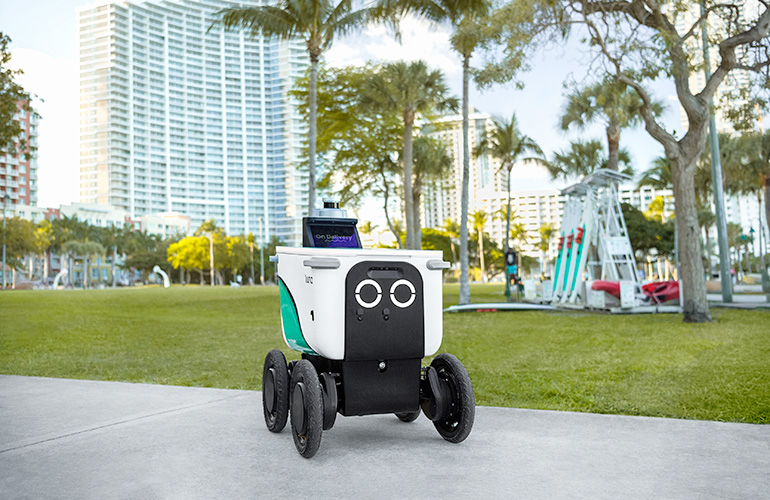
Imagine ordering your favorite meal, a package, or medicine online. Instead of waiting for a human driver, you receive a notification saying, “Your delivery robot has arrived.” You walk outside, enter a security code on a small robotic vehicle, and your order is waiting safely inside. What once sounded like science fiction is quickly becoming a reality in many parts of the world.
Autonomous delivery robots are quietly transforming the way goods move through cities, neighborhoods, university campuses, and business districts. These small robotic vehicles can travel on sidewalks or designated paths without a human driver, delivering food, groceries, parcels, and even medical supplies. Behind their friendly appearance lies an impressive combination of artificial intelligence, robotics, computer vision, navigation systems, and advanced sensors working together every second.
But how do these robots know where to go? How do they avoid people and obstacles? How can they travel safely without someone controlling them? The answers lie in some of the most exciting technologies of modern science and engineering.
What Is an Autonomous Delivery Robot?
An autonomous delivery robot is a self-driving robotic vehicle designed to transport goods from one location to another without requiring a human operator to control it during normal operation.
These robots are typically small, slow-moving, and electric-powered. Most are designed to carry lightweight items such as restaurant meals, groceries, small packages, office supplies, or prescription medications.
Unlike industrial robots that remain inside factories, delivery robots operate in real-world environments filled with pedestrians, bicycles, pets, changing weather, and unexpected obstacles. They must constantly observe their surroundings and make safe decisions while traveling.
The word “autonomous” means the robot can perform many tasks independently. It plans routes, avoids obstacles, adjusts its speed, and reaches its destination using onboard computers and sensors.
Why Are Delivery Robots Being Developed?
The demand for fast delivery has increased dramatically in recent years. People expect groceries, meals, and online purchases to arrive quickly and reliably.
Traditional delivery methods rely heavily on human drivers, which can become expensive and time-consuming, especially for short-distance deliveries.
Autonomous robots offer a possible solution for what is often called the “last mile” of delivery—the final stage between a local distribution center and the customer’s doorstep.
Because they are electric, many delivery robots also produce no direct exhaust emissions while operating. They may help reduce traffic in some situations by handling short-distance deliveries that might otherwise require cars or motorcycles.
Scientists and engineers also see these robots as valuable tools for delivering medicines, laboratory samples, or supplies to hospitals, university campuses, retirement communities, and business parks.
The Brain Inside the Robot
Although delivery robots may appear simple from the outside, they contain powerful onboard computers.
These computers act as the robot’s brain.
Every second, they receive enormous amounts of information from cameras, sensors, navigation systems, and electronic components.
The computer processes this information almost instantly to answer critical questions.
Where am I?
Where should I go?
Is someone walking in front of me?
Is there a bicycle approaching?
Should I slow down?
Should I stop?
Should I choose another path?
The robot continuously makes these decisions while moving, allowing it to navigate safely through complex environments.
Understanding the World with Sensors
Humans rely on eyes, ears, and touch to understand the world.
Delivery robots use sensors that perform similar functions.
Instead of biological senses, they collect electronic measurements about the environment.
These sensors allow the robot to detect nearby objects, measure distances, estimate speed, monitor movement, and understand its surroundings.
By combining information from multiple sensors, the robot builds an accurate picture of the world around it.
This process is known as sensor fusion.
Cameras Help the Robot See
Many autonomous delivery robots are equipped with multiple cameras positioned around the vehicle.
These cameras capture continuous images of the surrounding environment.
Computer vision software analyzes the images to recognize sidewalks, roads, crosswalks, curbs, buildings, signs, pedestrians, bicycles, parked vehicles, and other objects.
Unlike a simple security camera that merely records video, these intelligent systems interpret what they see.
For example, the robot can distinguish between a person standing still and someone walking across its path.
It can recognize whether a sidewalk is clear or blocked.
This ability is essential for safe navigation.
LiDAR Creates a Three-Dimensional Map
Many advanced delivery robots use a technology called LiDAR, which stands for Light Detection and Ranging.
LiDAR works by sending out thousands—or even millions—of tiny laser pulses every second.
These laser pulses bounce off nearby objects and return to the sensor.
By measuring how long each pulse takes to return, the robot calculates extremely accurate distances.
The result is a detailed three-dimensional map of the surrounding environment.
LiDAR allows the robot to detect trees, walls, benches, bicycles, people, and many other obstacles, even when lighting conditions are less than ideal.
Radar Adds Another Layer of Awareness
Some robots also use radar.
Radar sends out radio waves instead of laser light.
It measures how those waves bounce back after striking nearby objects.
Radar performs especially well in certain challenging weather conditions, such as rain or fog, where cameras may have reduced visibility.
By combining radar with cameras and LiDAR, robots gain a more reliable understanding of their surroundings.
Ultrasonic Sensors Detect Nearby Objects
For very short distances, delivery robots often use ultrasonic sensors.
These sensors emit sound waves that are too high-pitched for humans to hear.
When the sound waves bounce back from nearby objects, the robot calculates how close those objects are.
Ultrasonic sensors are especially useful when maneuvering around curbs, docking at delivery locations, or avoiding low obstacles.
GPS Helps the Robot Know Its Location
To travel from one place to another, the robot needs to know where it is.
Many delivery robots use the Global Positioning System (GPS) or other global navigation satellite systems.
Satellites orbiting Earth transmit timing signals.
By receiving signals from multiple satellites, the robot estimates its position.
However, satellite navigation alone is usually not accurate enough for precise sidewalk travel.
Tall buildings, trees, and other structures can interfere with satellite signals.
For this reason, robots combine satellite navigation with cameras, wheel sensors, LiDAR, and digital maps to determine their exact location.
Digital Maps Guide Every Journey
Before a robot begins a delivery, it accesses highly detailed digital maps.
These maps contain far more information than ordinary navigation apps.
They may include sidewalk locations, pedestrian crossings, ramps, building entrances, traffic signals, and areas where robots should not travel.
Using these maps, the robot calculates the safest and most efficient route.
If conditions change, such as encountering construction work or a blocked pathway, the robot can choose an alternative route.
Artificial Intelligence Makes Decisions
Artificial intelligence plays a central role in autonomous delivery.
AI allows the robot to interpret sensor data and make decisions without constant human control.
Machine learning algorithms help recognize objects such as pedestrians, bicycles, animals, vehicles, and traffic signs.
The robot evaluates countless possibilities every second.
If someone suddenly steps into its path, the robot slows or stops.
If another pedestrian changes direction unexpectedly, the robot adjusts its own movement.
These decisions happen continuously throughout the journey.
Computer Vision Understands Images
Computer vision is one of the robot’s most important abilities.
Instead of simply recording pictures, computer vision allows the robot to understand what appears in each image.
Advanced algorithms identify important features in the environment.
The system recognizes sidewalks, building entrances, road markings, crosswalks, traffic lights, and obstacles.
This understanding enables the robot to move safely through crowded public spaces.
Planning the Best Route
Navigation involves much more than traveling in a straight line.
The robot must determine the safest, shortest, and most efficient path.
It considers many factors.
The width of sidewalks.
Pedestrian traffic.
Road crossings.
Construction zones.
Temporary obstacles.
Weather conditions.
Battery level.
The route is continuously updated as conditions change.
Avoiding Obstacles
Obstacle avoidance is one of the most impressive abilities of autonomous robots.
As the robot moves, it constantly monitors the area around it.
If someone walks toward the robot, it predicts the person’s movement and adjusts its own path.
If a bicycle approaches, the robot may pause until it is safe.
If a garbage bin blocks the sidewalk, the robot carefully navigates around it if sufficient space exists.
These adjustments happen smoothly and automatically.
How the Robot Crosses Streets
Crossing roads requires careful judgment.
Depending on the design and operating environment, delivery robots may cross only at designated crosswalks.
Their cameras and sensors monitor traffic signals, approaching vehicles, and pedestrian movement.
Some robots operate only in low-speed environments where crossings are relatively simple.
Others may receive additional assistance from remote human operators when facing unusually complex traffic situations.
Safety remains the highest priority.
Electric Power Keeps the Robot Moving
Nearly all delivery robots are powered by rechargeable batteries.
Electric motors drive the wheels quietly and efficiently.
Battery technology determines how far the robot can travel before recharging.
Engineers carefully balance battery size, vehicle weight, and energy consumption.
Efficient route planning also helps conserve battery power.
After completing several deliveries, the robot typically returns to a charging station.
Keeping Deliveries Secure
Customers trust delivery robots with valuable items.
To protect deliveries, robots usually have locked storage compartments.
Only the intended customer can unlock the compartment using a smartphone app, digital code, or another secure authentication method.
Many robots also include cameras that record activity during deliveries.
These security measures help protect both the robot and its cargo.
Communication with Remote Systems
Although autonomous robots make many decisions independently, they often remain connected to remote computer systems through wireless networks.
This connection allows operators to monitor robot status, battery level, location, and delivery progress.
If the robot encounters an unusual situation that it cannot safely resolve on its own, a trained remote operator may review the situation and provide limited assistance, depending on the system’s design.
This combination of autonomy and human oversight improves reliability.
How Robots Handle Different Weather
Weather presents important challenges.
Rain can make sidewalks slippery.
Snow may cover markings.
Bright sunlight creates shadows.
Fog reduces visibility.
Engineers design delivery robots to operate safely under many weather conditions, but performance limits vary depending on the model.
Some robots temporarily suspend operation during severe weather when safety cannot be guaranteed.
Safety Around People
Because delivery robots share sidewalks with pedestrians, safety is essential.
Most robots travel at relatively low speeds, often comparable to a brisk walking pace.
They continuously monitor nearby people and leave enough space whenever possible.
If uncertain about a situation, the robot usually stops rather than taking unnecessary risks.
This cautious behavior helps reduce the likelihood of collisions.
Learning Through Data
Every delivery provides valuable information.
Engineers analyze data collected during robot operations to improve navigation software, object recognition, route planning, and safety systems.
Machine learning algorithms become better at recognizing real-world situations as they are trained using carefully selected and validated data.
This ongoing improvement helps robots perform more reliably over time.
Challenges That Engineers Still Face
Despite impressive progress, autonomous delivery robots still face important challenges.
Busy sidewalks can become crowded with pedestrians.
Construction projects may block planned routes.
Heavy rain, snow, or ice can reduce mobility.
Battery limitations restrict delivery distance.
Navigation becomes more difficult in unfamiliar environments.
Robots must also comply with local laws and regulations governing their operation.
Engineers continue working to solve these challenges through improved software, better sensors, stronger batteries, and more advanced artificial intelligence.
Where Delivery Robots Are Used Today
Autonomous delivery robots are already operating in selected locations around the world.
Many serve university campuses, where predictable pathways and moderate traffic make testing easier.
Others deliver restaurant meals, groceries, and parcels in residential neighborhoods or business districts.
Hospitals are also exploring robotic delivery systems to transport medicines, laboratory samples, and medical supplies within large healthcare facilities.
As technology improves, the number of applications is expected to grow.
The Future of Autonomous Delivery
The future of delivery robots looks promising.
Advances in artificial intelligence will improve decision-making.
Better batteries will increase travel distance.
More accurate sensors will enhance safety.
Faster wireless communication networks will allow robots to share information more efficiently.
Future robots may cooperate with drones, self-driving delivery vans, and automated warehouses to create highly integrated delivery systems.
Instead of replacing every human worker, these technologies are more likely to assist people by handling routine deliveries while humans focus on tasks requiring creativity, judgment, customer service, and complex problem-solving.
Conclusion
Autonomous delivery robots represent a remarkable blend of robotics, artificial intelligence, computer vision, navigation technology, and electrical engineering. Using cameras, LiDAR, radar, ultrasonic sensors, digital maps, satellite navigation, and powerful onboard computers, these machines can understand their surroundings, plan safe routes, avoid obstacles, and deliver goods with little or no direct human control.
Although challenges such as weather, battery capacity, and complex urban environments remain, the technology continues to improve rapidly. As scientists and engineers refine these intelligent machines, autonomous delivery robots are becoming more than a futuristic idea—they are gradually changing how goods move through our communities. Every successful delivery demonstrates how advances in science can transform everyday life, bringing greater convenience, efficiency, and innovation to the simple act of sending something from one place to another.