Imagine getting into your car, telling it where you want to go, and then simply relaxing while the vehicle safely drives itself through busy streets, stops at traffic lights, avoids obstacles, and reaches your destination without you touching the steering wheel. For many years, this idea belonged only to science fiction. Today, however, it is becoming a reality thanks to remarkable advances in science, engineering, artificial intelligence, and computing.
Self-driving cars are among the most exciting technologies of the twenty-first century. Around the world, researchers and technology companies are developing vehicles that can understand their surroundings, make driving decisions, and navigate roads with little or no human assistance. Although fully autonomous cars are still under development and are not yet common on public roads, rapid progress continues every year.
But what exactly is a self-driving car? How can a machine make driving decisions? How does it “see” the road? Is it really safe? And what challenges remain before these vehicles become part of everyday life?
Understanding self-driving cars means exploring one of the most fascinating combinations of modern science and technology.
What Is a Self-Driving Car?
A self-driving car, also called an autonomous vehicle, is a vehicle designed to travel without requiring continuous human control. Instead of relying entirely on a driver, the car uses computers, sensors, cameras, software, and artificial intelligence to observe its surroundings, make decisions, and control steering, acceleration, and braking.
Unlike conventional vehicles, where every driving action depends on a human, a self-driving car continuously analyzes the environment and responds in real time.
Some autonomous vehicles still require a driver to remain ready to take control if necessary, while future designs aim to operate without any human intervention under specific conditions or, eventually, in a wider range of environments.
Why Were Self-Driving Cars Created?
Driving is one of the most common daily activities, but it also requires constant attention. Human drivers can become tired, distracted, stressed, or make mistakes. Many road accidents around the world are linked to human error.
Scientists and engineers began exploring autonomous driving to improve road safety, reduce traffic congestion, increase transportation efficiency, and make travel easier for people who cannot drive because of age or certain disabilities.
Self-driving technology also has the potential to improve fuel efficiency, reduce unnecessary braking and acceleration, and make transportation systems more organized.
Rather than replacing human intelligence completely, the goal is to assist or automate driving tasks while maintaining a high standard of safety.
How Does a Self-Driving Car Work?
A self-driving car works by continuously performing three essential tasks.
First, it observes the environment.
Second, it understands what it observes.
Third, it decides what action to take.
These steps happen repeatedly, many times every second.
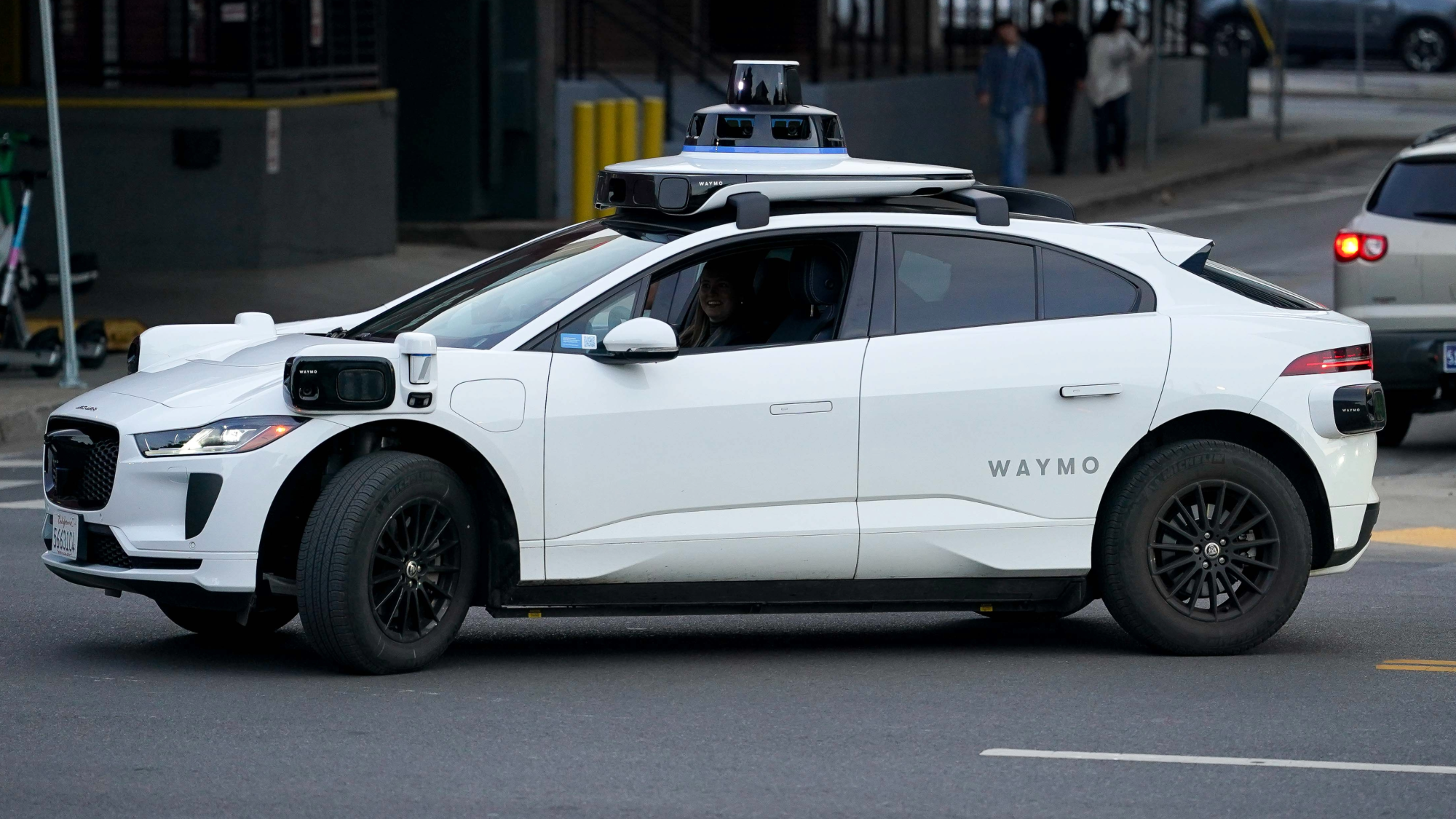
The vehicle gathers enormous amounts of information through cameras, radar, laser sensors, ultrasonic sensors, satellite navigation, and other instruments. Powerful onboard computers process this information almost instantly.
The software identifies roads, traffic signs, pedestrians, cyclists, vehicles, lane markings, and obstacles. It predicts how surrounding objects may move and calculates the safest path forward.
Finally, the computer controls the steering wheel, brakes, accelerator, and sometimes the transmission to drive safely.
This entire process occurs continuously while the vehicle is moving.
How Does the Car “See” the Road?
Although a self-driving car has no eyes like a human, it uses several types of sensors that allow it to perceive its surroundings.
High-resolution cameras capture images similar to human vision. They recognize traffic lights, road signs, lane markings, pedestrians, and other vehicles.
Radar sends out radio waves that bounce off nearby objects. By measuring the reflected signals, radar determines the distance, speed, and direction of surrounding vehicles, even in conditions where visibility is limited.
Some autonomous vehicles also use LiDAR, which stands for Light Detection and Ranging. LiDAR sends out laser pulses and measures how long they take to return after striking nearby objects. This allows the vehicle to create a detailed three-dimensional map of its surroundings.
Ultrasonic sensors detect nearby objects at very short distances. These are especially useful when parking or maneuvering slowly.
Together, these sensors provide a detailed picture of the world around the vehicle.
Artificial Intelligence Is the Car’s Brain
Collecting information is only the beginning.
The real challenge is understanding what the information means.
This is where artificial intelligence, often called AI, becomes essential.
AI enables the vehicle to recognize patterns and interpret complex situations.
For example, it can distinguish between a pedestrian crossing the street and a tree beside the road. It can recognize whether a traffic light is red, yellow, or green. It can identify cyclists, motorcycles, construction zones, and temporary road signs.
The AI system constantly analyzes what is happening and predicts what may happen next.
If a child begins running toward the road, the system estimates the possible movement and prepares to slow down or stop.
These decisions must often be made within fractions of a second.
Computer Vision Helps the Car Understand Images
One of the most important technologies inside a self-driving car is computer vision.
Computer vision allows computers to analyze digital images and identify meaningful objects.
Using advanced algorithms, the vehicle can recognize lane boundaries, traffic signals, speed limit signs, intersections, crosswalks, parked cars, and road hazards.
Unlike simple image recognition, computer vision must work in constantly changing environments.
The system must function during daylight, at night, in rain, fog, snow, and bright sunlight.
Scientists continue improving computer vision so autonomous vehicles can handle an even wider range of driving conditions.
Mapping the World
Self-driving cars often rely on highly detailed digital maps.
These maps contain much more information than ordinary navigation maps.
They include lane positions, road curvature, intersections, traffic signals, speed limits, and many permanent road features.
While driving, the vehicle compares information from its sensors with these maps to determine its exact position.
This process improves navigation accuracy and helps the vehicle make better driving decisions.
However, because roads can change due to construction or accidents, the vehicle must also rely heavily on real-time sensor information.
GPS Helps with Navigation
Global Positioning System, commonly known as GPS, helps determine the vehicle’s general location.
GPS works by receiving signals from satellites orbiting Earth.
Although GPS provides useful navigation information, it is usually not accurate enough by itself for autonomous driving.
Therefore, self-driving cars combine GPS with cameras, radar, LiDAR, and onboard sensors to determine their position much more precisely.
This combination allows the vehicle to remain within its lane and navigate safely.
Understanding Traffic Rules
A human driver learns traffic laws before receiving a driving license.
Similarly, a self-driving car is programmed to understand traffic regulations.
The software recognizes stop signs, yield signs, speed limits, traffic lights, lane markings, pedestrian crossings, and other important road rules.
The vehicle must also respond appropriately when emergency vehicles approach or when temporary road conditions require different driving behavior.
Following traffic laws consistently is one of the central goals of autonomous driving systems.
Making Driving Decisions
Driving involves constant decision-making.
Should the car change lanes?
Should it slow down?
Is another vehicle about to turn?
Can it safely pass an obstacle?
Self-driving cars continuously evaluate these situations.
The onboard computer predicts how nearby vehicles, pedestrians, cyclists, and other road users may behave over the next few seconds.
Using these predictions, the vehicle selects the safest possible action while following traffic laws and maintaining passenger comfort.
This planning process repeats many times each second.
Controlling the Vehicle
After deciding what to do, the computer sends commands to the vehicle’s control systems.
Electric motors adjust the steering.
Electronic braking systems slow or stop the vehicle.
The accelerator controls vehicle speed.
Modern vehicles already use electronic systems for many driving functions, making it possible for computers to control them with high precision.
The transition from sensing to decision-making and physical control happens almost instantly.
Different Levels of Driving Automation
Not all self-driving cars have the same capabilities.
Some vehicles simply assist drivers by maintaining speed or staying within a lane.
Others can drive themselves under certain conditions while still requiring human supervision.
The highest level of automation aims to allow vehicles to perform all driving tasks without human intervention within their intended operating environments.
As technology advances, higher levels of automation are gradually becoming possible, though widespread deployment requires extensive testing and regulatory approval.
Can Self-Driving Cars Drive Everywhere?
At present, the answer is no.
Most autonomous vehicles operate best in areas where they have been carefully tested and mapped.
Complex environments with heavy traffic, unusual road layouts, severe weather, or temporary construction remain challenging.
Scientists continue improving autonomous systems so they can safely handle a wider variety of situations.
The ultimate goal is to create vehicles capable of driving reliably under many different real-world conditions.
How Safe Are Self-Driving Cars?
Safety is the most important consideration in autonomous driving.
Engineers design these vehicles with multiple backup systems to reduce the risk of failure.
Critical components often include redundant sensors, computers, communication systems, and power supplies.
The software undergoes extensive testing using computer simulations, closed testing facilities, and carefully monitored public-road trials before broader deployment.
Although autonomous technology has shown impressive capabilities, no system is perfect.
Unexpected situations, sensor limitations, severe weather, or unusual road conditions can still present challenges.
For this reason, safety testing continues to be one of the largest areas of research.
Weather Can Be Difficult
Driving becomes more challenging during heavy rain, snow, dense fog, or dust storms.
These conditions can reduce visibility and affect the performance of cameras, LiDAR, and other sensors.
Engineers develop advanced software that combines information from multiple sensors so the vehicle can continue operating as safely as possible.
Even so, extremely severe weather may require the vehicle to reduce speed or request human assistance, depending on its design.
Cybersecurity Matters
Because self-driving cars rely heavily on computers and communication systems, cybersecurity is extremely important.
Manufacturers design security systems to protect vehicles from unauthorized access.
Software updates improve safety, fix vulnerabilities, and enhance performance over time.
Protecting autonomous vehicles against cyber threats remains an active area of scientific and engineering research.
Self-Driving Cars and the Environment
Autonomous driving may contribute to environmental improvements in several ways.
Smooth acceleration and braking can reduce unnecessary energy consumption.
Efficient route planning may decrease traffic congestion.
Many autonomous vehicles are also being developed as electric vehicles, which produce no direct exhaust emissions during operation.
However, the overall environmental impact depends on factors such as electricity generation, battery manufacturing, and how transportation systems evolve.
Benefits for Society
Self-driving cars have the potential to change transportation in remarkable ways.
Older adults and people with certain disabilities could gain greater mobility and independence.
Delivery services may become more efficient.
Emergency vehicles could benefit from improved traffic coordination.
Road congestion may decrease if autonomous vehicles communicate with one another and optimize traffic flow.
Travel could become less stressful, allowing passengers to work, read, or relax during journeys.
These possibilities continue to inspire research around the world.
Challenges That Still Need to Be Solved
Despite impressive progress, important challenges remain.
Autonomous vehicles must safely handle countless unusual situations that rarely occur but still happen in real life.
Construction zones, unexpected pedestrian behavior, damaged road markings, fallen trees, flooded roads, and changing weather all require intelligent responses.
Governments must also establish regulations covering vehicle certification, liability, insurance, and public safety.
Building public trust is equally important.
People need confidence that autonomous systems can operate safely before widespread adoption becomes possible.
The Future of Self-Driving Cars
The future of autonomous transportation looks promising.
Artificial intelligence continues to improve rapidly.
Sensors are becoming more accurate and affordable.
Computer processors are becoming faster and more energy-efficient.
Communication technologies are enabling vehicles to exchange information with traffic infrastructure and, in some systems, with other vehicles.
Future cities may include transportation networks where autonomous cars, buses, delivery vehicles, and emergency services work together to improve safety and efficiency.
Although widespread fully autonomous driving will require continued scientific research, engineering innovation, careful regulation, and public acceptance, progress continues steadily.
Conclusion
A self-driving car is far more than a vehicle with advanced technology. It represents the combination of artificial intelligence, computer vision, robotics, electronics, physics, navigation, and engineering working together to solve one of humanity’s most complex everyday tasks. By using cameras, radar, LiDAR, sensors, detailed maps, and powerful computers, these vehicles can observe the road, understand their surroundings, make driving decisions, and control the vehicle with remarkable precision.
While fully autonomous cars are still evolving, they have already transformed the future of transportation. Continued advances in science and technology are bringing us closer to a world where travel may become safer, more efficient, and more accessible than ever before. Self-driving cars are not simply changing how vehicles move—they are reshaping how humans imagine mobility itself, opening the door to a new era in transportation driven by intelligence, innovation, and scientific discovery.