Have you ever walked from your living room to your bedroom only to watch your Wi-Fi signal suddenly disappear? Maybe your favorite movie starts buffering upstairs, your video call freezes in the kitchen, or your smart home devices lose their connection in certain corners of your house. These frustrating experiences are surprisingly common, especially in larger homes or buildings with thick walls.
For many years, people tried to solve these problems by buying more powerful routers or installing Wi-Fi extenders. While these solutions often helped, they usually came with their own limitations, such as slower speeds, complicated setup, or separate network names.
Mesh networking was created to solve these challenges in a smarter way. Instead of relying on a single router to cover an entire home, a mesh network uses multiple connected devices that work together as one intelligent Wi-Fi system. The result is stronger coverage, smoother connections, and a better internet experience throughout your home.
Today, mesh networking has become one of the most popular solutions for home internet, smart homes, offices, schools, hotels, and even large public spaces. Understanding how it works can help you decide whether it is the right networking solution for your needs.
What Is Mesh Networking?
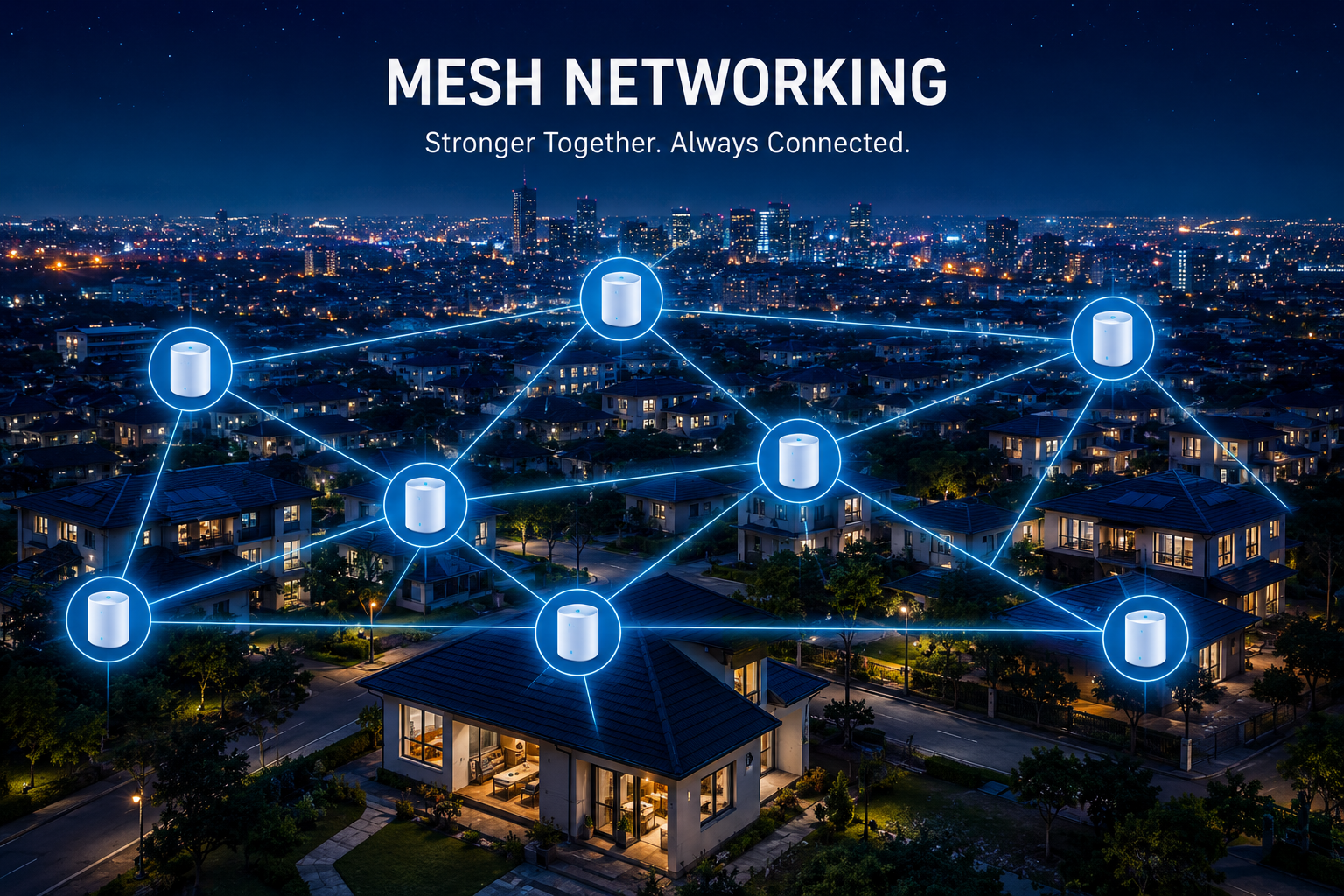
Mesh networking is a networking technology in which multiple devices, called nodes, work together to create a single wireless network. Instead of depending on one central router to provide Wi-Fi everywhere, each node communicates with the others to extend wireless coverage across a larger area.
Every node in the mesh system helps carry network traffic. If one path becomes weak or unavailable, the data can automatically travel through another node. This creates a network that is both flexible and reliable.
To the user, the entire mesh system appears as one Wi-Fi network with a single network name (SSID). Your smartphone, laptop, tablet, smart TV, or gaming console can move around the house without needing to reconnect manually.
Unlike traditional Wi-Fi extenders, which often create separate wireless networks, mesh systems behave as one unified network that intelligently manages your connection.
How Mesh Networking Works
A mesh Wi-Fi system usually begins with a main router connected directly to your modem or fiber internet connection. Additional mesh nodes are placed around your home or building.
Each node communicates with nearby nodes using wireless signals or, in some installations, wired Ethernet connections. Together, these nodes form a network that shares information continuously.
When you connect your phone to Wi-Fi, your device automatically communicates with whichever node offers the strongest and fastest signal. As you move around the building, your device quietly switches between nodes without interrupting your internet connection.
This process is known as seamless roaming. It allows activities like video streaming, online gaming, and video conferencing to continue smoothly while you walk through your home.
Behind the scenes, the mesh system constantly measures signal quality, network traffic, and device locations to determine the best communication path.
Understanding Mesh Nodes
A mesh node is a networking device that acts as both a Wi-Fi access point and a communication hub.
Each node extends wireless coverage while also exchanging data with neighboring nodes.
Unlike traditional network extenders that simply repeat an existing signal, mesh nodes cooperate with one another. They continuously optimize routes for data transmission, ensuring devices receive the strongest available connection.
Some mesh systems include only two or three nodes for average-sized homes, while larger buildings may require many more.
Why Mesh Networking Is Different from Traditional Routers
A traditional Wi-Fi network usually relies on one central router.
Every wireless device must communicate directly with that router. As you move farther away, the signal becomes weaker. Walls, floors, furniture, and appliances can further reduce signal strength.
Eventually, the connection becomes slow or disappears completely.
Mesh networking takes a different approach.
Instead of asking every device to reach a single router, nearby mesh nodes help carry the signal across the building.
Because devices connect to the closest node, they usually receive a stronger and more stable connection.
The network behaves as a team rather than depending on one device to do all the work.
The Self-Healing Nature of Mesh Networks
One of the most impressive features of mesh networking is its ability to recover automatically from problems.
Suppose one mesh node temporarily loses power.
Instead of disconnecting every device connected through that node, the network automatically searches for another available communication path.
Data simply flows through neighboring nodes.
This capability is often called self-healing because the network adapts without requiring manual intervention.
Although coverage may be slightly reduced until the disconnected node returns, most users continue enjoying internet access without noticing major interruptions.
Intelligent Routing
Mesh networks constantly evaluate multiple possible routes for sending data.
Imagine several roads connecting different cities.
If one road becomes crowded or blocked, a navigation system finds another route.
Mesh networking works in a similar way.
Instead of always following one fixed path, the system dynamically selects the fastest and most reliable route available.
This intelligent routing improves overall network performance and reliability.
Seamless Roaming
One of the biggest advantages of mesh networking is seamless roaming.
Suppose you begin watching a video in your living room.
As you walk upstairs, your smartphone quietly disconnects from one mesh node and connects to another without interrupting the video.
You do not need to manually switch Wi-Fi networks.
Everything happens automatically.
Modern mesh systems are designed to make these transitions nearly invisible to users.
Stronger Wi-Fi Coverage
Large homes often contain Wi-Fi dead zones where internet signals struggle to reach.
These weak spots may occur behind thick concrete walls, inside basements, upstairs bedrooms, garages, or outdoor patios.
Mesh networking significantly reduces these dead zones.
Because multiple nodes distribute wireless coverage throughout the building, more areas receive stronger signals.
Instead of relying on one distant router, devices communicate with nearby nodes.
This usually results in faster speeds and fewer dropped connections.
Better Performance for Smart Homes
Modern homes increasingly rely on connected devices.
Smart speakers.
Security cameras.
Video doorbells.
Smart thermostats.
Smart lighting.
Robot vacuum cleaners.
Connected appliances.
Voice assistants.
These devices constantly exchange information across the home network.
A mesh network helps ensure they maintain reliable communication, even if they are located far from the primary router.
As smart homes continue growing, mesh networking provides the broader coverage these devices often require.
How Mesh Systems Manage Many Devices
Today’s households often have dozens of internet-connected devices operating simultaneously.
Parents may attend video meetings.
Children may stream educational videos.
Someone may play online games.
Smart TVs stream movies.
Security cameras upload video.
Smartphones synchronize photos.
Traditional routers can become overloaded when many devices compete for bandwidth.
Modern mesh systems are designed to distribute wireless traffic efficiently among multiple nodes, reducing congestion and improving performance for busy households.
Wireless Backhaul
Communication between mesh nodes is called backhaul.
In many mesh systems, nodes communicate wirelessly.
This wireless backhaul allows flexible placement without running Ethernet cables.
Some advanced systems use a dedicated wireless frequency exclusively for communication between nodes.
Keeping this traffic separate from user devices can improve network efficiency and maintain higher speeds.
Wired Backhaul
Some homes allow mesh nodes to be connected using Ethernet cables.
This arrangement is known as wired backhaul.
Instead of using wireless signals to communicate with each other, nodes exchange data through high-speed wired connections.
Because wired connections are generally faster and less affected by interference, wired backhaul often provides better performance, especially in larger homes or office environments.
Mesh Networking and Internet Speed
Many people assume installing a mesh system automatically makes their internet connection faster.
In reality, a mesh network does not increase the speed provided by your internet service provider.
Instead, it helps distribute that available speed more effectively throughout your home.
For example, if your internet service delivers 500 megabits per second, a mesh system cannot create 1 gigabit per second.
However, it can help more rooms receive speeds closer to the maximum your internet connection already provides.
Mesh Networking and Wi-Fi Standards
Mesh networking works alongside modern Wi-Fi technologies.
Many current mesh systems support Wi-Fi 6, Wi-Fi 6E, or Wi-Fi 7.
These newer Wi-Fi standards offer higher speeds, lower latency, improved energy efficiency, and better performance when many devices are connected simultaneously.
While mesh networking and Wi-Fi standards are different technologies, they complement one another.
A Wi-Fi 7 mesh system combines advanced wireless capabilities with expanded coverage.
Security in Mesh Networks
Security remains an essential part of any wireless network.
Modern mesh systems support strong encryption methods such as WPA2 and WPA3, helping protect data transmitted between devices and network nodes.
Many systems also receive automatic firmware updates that fix security vulnerabilities and improve overall performance.
Some manufacturers include additional security features, such as parental controls, guest networks, malware detection, and device monitoring.
Keeping the system updated is important for maintaining strong network security.
Mesh Networking for Businesses
Although mesh networking is popular in homes, businesses also benefit from this technology.
Hotels.
Schools.
Hospitals.
Warehouses.
Retail stores.
Office buildings.
University campuses.
Large shopping centers.
These environments often require reliable wireless coverage across large areas.
Mesh systems allow users to move freely while maintaining continuous network access.
Employees, customers, students, and visitors experience smoother connectivity without repeatedly reconnecting to different wireless networks.
Community Mesh Networks
Mesh networking can also connect neighborhoods and communities.
In community mesh networks, many independently owned nodes cooperate to create shared internet infrastructure.
These networks may improve internet access in underserved areas or provide communication during emergencies when traditional infrastructure becomes unavailable.
Some community projects are operated by volunteers, universities, or nonprofit organizations seeking affordable local connectivity.
Mesh Networking During Emergencies
Mesh networks have attracted attention for disaster response.
Earthquakes, hurricanes, floods, or wildfires may damage communication infrastructure.
Portable mesh networking equipment can quickly establish temporary communication between rescue teams.
Because mesh nodes automatically organize themselves, emergency responders can deploy networks rapidly without relying entirely on damaged cellular towers or fixed internet infrastructure.
This flexibility makes mesh networking valuable in challenging environments.
Challenges of Mesh Networking
Although mesh networking offers many advantages, it is not perfect.
Installing several mesh nodes is generally more expensive than purchasing a single traditional router.
Very large homes may require additional nodes to achieve complete coverage.
Wireless communication between nodes can also reduce overall speed compared with direct wired Ethernet connections, especially if nodes are placed too far apart or encounter heavy interference.
Careful placement is therefore important.
Nodes should usually be positioned where they still receive a strong signal from neighboring nodes while extending coverage into new areas.
Mesh Networking Compared with Wi-Fi Extenders
Many people confuse mesh networking with Wi-Fi extenders.
While both increase wireless coverage, they operate differently.
A Wi-Fi extender simply receives an existing Wi-Fi signal and retransmits it.
This process can reduce speed because the extender uses the same wireless channel for both receiving and transmitting data.
Extenders may also create separate Wi-Fi network names, requiring devices to reconnect manually as users move around.
Mesh networking avoids many of these limitations.
All nodes cooperate as one intelligent system.
Users remain connected to a single network.
Roaming happens automatically.
Traffic is managed more efficiently across the entire network.
Who Can Benefit from Mesh Networking?
Mesh networking is particularly useful in homes where a single router cannot provide reliable coverage.
Multi-story houses often benefit because Wi-Fi signals weaken as they pass through floors and walls.
Homes with thick concrete or brick construction also experience significant improvements.
Families using numerous smart home devices often appreciate the stable coverage provided by mesh systems.
People working from home, participating in video conferences, streaming high-definition content, or playing online games can also benefit from more consistent wireless performance.
Even smaller homes may find mesh networking valuable if the building layout creates difficult Wi-Fi dead zones.
The Future of Mesh Networking
As internet usage continues growing, wireless networks must support more devices than ever before.
Artificial intelligence is beginning to improve mesh networking by helping systems predict network congestion, optimize signal paths, and automatically adjust settings for better performance.
Future mesh systems may become even more intelligent, learning household usage patterns and adapting network resources accordingly.
The expansion of Wi-Fi 7, faster fiber internet, edge computing, and the Internet of Things will likely make mesh networking an even more important part of everyday connectivity.
Homes, businesses, factories, and cities are becoming increasingly connected, and reliable wireless coverage will continue to be essential.
Conclusion
Mesh networking represents a major evolution in wireless communication. Instead of relying on a single router to serve an entire building, it creates a collaborative network of intelligent nodes that work together to deliver fast, reliable, and seamless Wi-Fi coverage.
By automatically selecting the best communication paths, supporting smooth roaming, reducing dead zones, and adapting to changing network conditions, mesh networking provides a more consistent internet experience than traditional single-router setups in many environments.
As our homes fill with connected devices and our dependence on reliable internet continues to grow, mesh networking is becoming more than just a convenient upgrade. It is an increasingly important technology that helps ensure every room, every device, and every user stays connected to the digital world with greater speed, stability, and confidence.