Every day, billions of pieces of sensitive information travel across the internet. Passwords are typed into websites, online purchases are completed in seconds, private messages are exchanged with friends and family, and financial transactions move between banks around the world. Most of us rarely stop to think about what protects this enormous flow of information from hackers and cybercriminals.
The answer often lies in encryption.
Encryption transforms readable information into a form that appears completely meaningless to anyone who does not have permission to read it. Among the many encryption methods developed over the decades, one stands above the rest in terms of trust, security, and worldwide adoption: Advanced Encryption Standard (AES).
AES encryption is the silent guardian of modern digital life. It protects smartphones, laptops, cloud storage, banking systems, Wi-Fi networks, messaging apps, government communications, healthcare records, and countless other technologies. Every time you unlock an encrypted device or securely connect to a website, there is a good chance that AES is working behind the scenes.
Despite its importance, AES is not magic. It is the result of decades of mathematical research, careful engineering, and continuous testing by security experts worldwide. Understanding how it works provides a fascinating glimpse into the science of cybersecurity and the technologies that protect our privacy every day.
Understanding Encryption
Before exploring AES specifically, it helps to understand what encryption actually is.
Encryption is the process of converting readable information, called plaintext, into an unreadable form known as ciphertext. This transformation is performed using a mathematical algorithm together with a secret value called a key.
Without the correct key, the encrypted data appears to be nothing more than random characters or meaningless binary data.
When an authorized user wants to read the information, the ciphertext is converted back into its original readable form through a process called decryption.
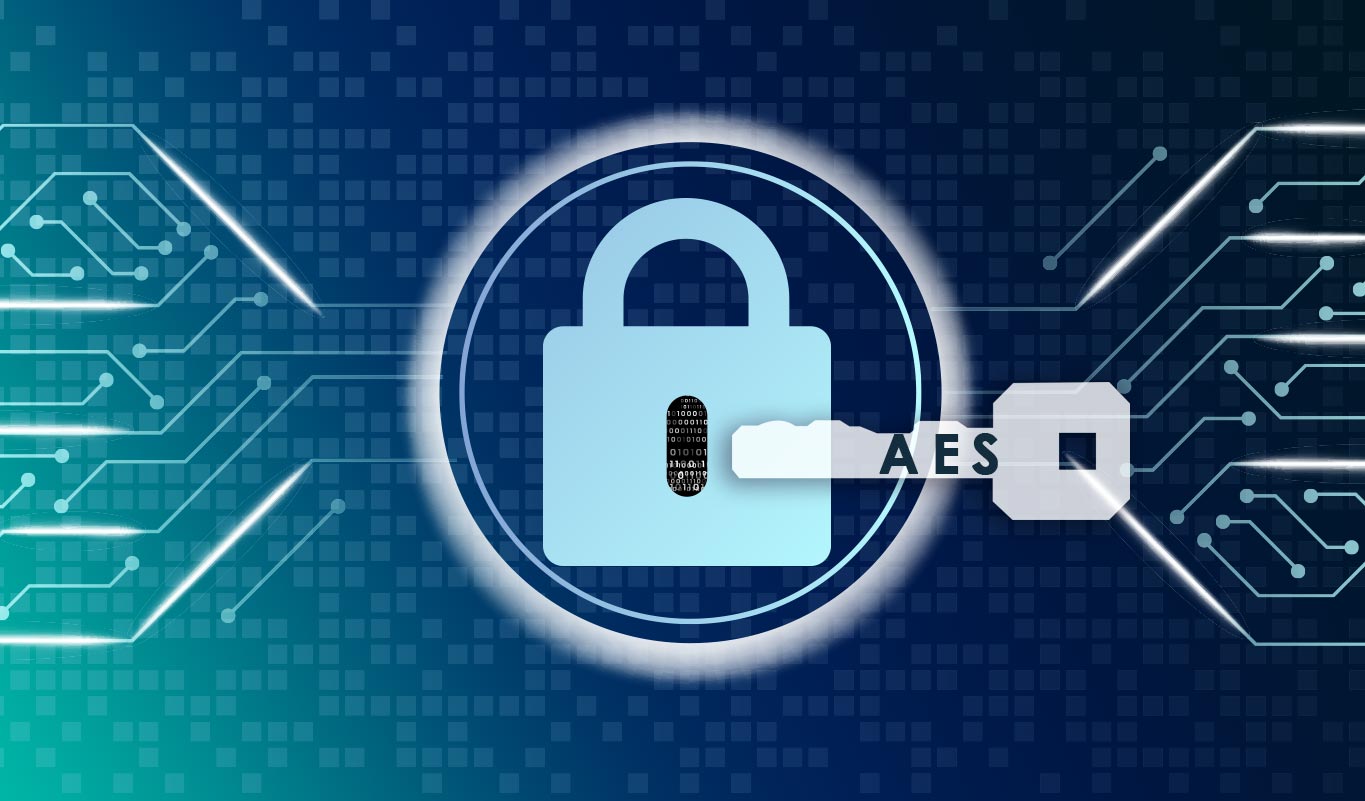
Imagine placing an important letter inside a locked safe. Anyone may see the safe, but only someone with the correct key can open it. AES works in a similar way, except instead of protecting paper documents, it protects digital information.
What Is AES Encryption?
AES, short for Advanced Encryption Standard, is a symmetric-key encryption algorithm designed to securely protect electronic data.
The term “symmetric-key” means that the same secret key is used for both encryption and decryption. If two people want to communicate securely using AES, they must both possess the same encryption key while keeping it hidden from everyone else.
AES transforms readable information into encrypted data through a series of carefully designed mathematical operations. These operations make it practically impossible for an attacker to recover the original information without the correct key.
Today, AES is considered one of the most secure encryption standards ever developed and is trusted by governments, businesses, researchers, financial institutions, and technology companies around the world.
Why AES Was Created
Before AES became the global encryption standard, another algorithm called the Data Encryption Standard (DES) was widely used.
When DES was introduced during the 1970s, it provided strong protection for its time. However, as computers became dramatically faster, attackers gained enough computing power to break DES through brute-force attacks by testing every possible key.
Security experts recognized that a stronger encryption standard would eventually be needed.
In the late 1990s, the U.S. National Institute of Standards and Technology (NIST) launched an international competition to develop a replacement for DES.
Researchers from around the world submitted encryption algorithms for evaluation. Each candidate underwent years of public analysis by cryptographers who searched for weaknesses.
After extensive testing, the algorithm called Rijndael, created by Belgian cryptographers Joan Daemen and Vincent Rijmen, was selected.
In 2001, it officially became the Advanced Encryption Standard, or AES.
Since then, it has become one of the most widely deployed encryption systems in history.
How AES Works
AES operates on fixed-size blocks of digital data.
Rather than encrypting one character at a time, AES processes information in blocks containing 128 bits, regardless of the total file size.
Each block passes through multiple rounds of mathematical transformations. These transformations rearrange the data, substitute values, mix information together, and combine everything with the secret encryption key.
Each round increases the complexity of the encryption.
By the final round, the original data has been transformed into ciphertext that bears no visible relationship to the original information.
Even changing a single bit in the original data produces an entirely different encrypted result, making it extremely difficult for attackers to identify patterns.
AES Key Sizes
One of AES’s greatest strengths is its flexible key length.
AES supports three different key sizes.
AES-128 uses a 128-bit key.
AES-192 uses a 192-bit key.
AES-256 uses a 256-bit key.
The larger the key, the greater the number of possible combinations.
A 128-bit key already provides an unimaginably large number of possibilities. A brute-force attack attempting every possible key would require far more computing power and time than currently available technology could realistically provide.
AES-256 offers an even larger security margin and is commonly used for highly sensitive information.
Although AES-256 is mathematically stronger, AES-128 is also considered highly secure when implemented correctly and remains suitable for most practical applications.
The Importance of the Secret Key
The security of AES depends almost entirely on the secrecy of the encryption key.
The encryption algorithm itself is public knowledge. Researchers, universities, and security professionals have studied it extensively for decades.
This openness is actually an advantage.
Because experts worldwide continuously examine AES, weaknesses are far more likely to be discovered and corrected than if the algorithm were kept secret.
The true protection comes from the key.
If an attacker somehow obtains the secret key, the encrypted information can be decrypted regardless of how strong the algorithm is.
For this reason, securely generating, storing, and managing encryption keys is one of the most important aspects of cybersecurity.
Why AES Is So Secure
AES remains trusted because it combines several powerful security principles.
Its mathematical design effectively removes predictable patterns from the original data.
Each encryption round spreads information throughout the entire data block, making statistical analysis extremely difficult.
The enormous number of possible keys makes brute-force attacks practically impossible with current computing technology.
Over more than two decades of intensive research, cryptographers have continuously tested AES against new attack methods.
Although researchers have developed theoretical attacks against simplified versions or unrealistic scenarios, no practical attack has broken properly implemented full-strength AES encryption.
Its security depends not only on mathematical complexity but also on decades of public scrutiny.
Where AES Is Used
AES protects an extraordinary range of technologies used every day.
When you connect to a secure website using HTTPS, AES often encrypts the communication after the secure connection has been established.
Many messaging applications use AES to protect conversations from unauthorized access.
Wi-Fi networks commonly rely on AES to secure wireless communications.
Modern smartphones frequently encrypt internal storage using AES, ensuring that lost or stolen devices cannot easily reveal personal data.
Laptop full-disk encryption systems often use AES to protect files.
Cloud storage providers encrypt stored information using AES.
Banks rely on AES to safeguard financial transactions.
Hospitals use it to protect confidential medical records.
Government agencies secure classified information using approved implementations of AES.
Military communications, scientific research, and international commerce also depend heavily on AES.
In many ways, AES has become one of the invisible foundations of the modern digital economy.
AES in Password Protection
Many people assume passwords themselves are directly encrypted using AES.
In reality, password protection often works somewhat differently.
Instead of reversible encryption, secure systems usually store passwords using cryptographic hashing, which is designed to be one-way.
However, AES still plays an important role.
Password managers often use AES to encrypt their password databases.
Encrypted storage systems protect password files using AES.
Applications may encrypt authentication tokens, backup files, or configuration data using AES.
So while AES is not always responsible for password storage itself, it remains central to protecting many password-related systems.
AES and Secure Websites
Whenever you visit a secure website, your browser establishes an encrypted connection with the server.
This secure communication typically begins with public-key cryptography to exchange secret information safely.
Once both sides agree on a shared secret key, AES is frequently used to encrypt the actual data exchanged during the session.
This combination allows websites to deliver both secure key exchange and extremely fast data encryption.
Every online purchase, login, or private message transmitted through these secure connections benefits from technologies like AES.
AES and File Encryption
AES is one of the most common choices for encrypting files.
Entire hard drives can be encrypted so that every stored document remains unreadable without authentication.
USB drives may use AES to protect portable data.
Backup archives often rely on AES before being uploaded to cloud storage.
Even if someone physically steals the storage device, properly encrypted files remain inaccessible without the correct encryption key.
AES in Smartphones
Modern smartphones contain vast amounts of personal information.
Photos, emails, messages, banking applications, health records, passwords, and payment information all reside inside a single device.
AES helps protect this information by encrypting storage.
When users unlock their phones with a PIN, fingerprint, or facial recognition, those authentication methods ultimately help unlock encryption keys that allow the phone to decrypt stored information.
Without successful authentication, the encrypted data remains protected.
AES and Wi-Fi Security
Wireless networks constantly transmit data through the air.
Without encryption, nearby attackers could potentially intercept sensitive information.
Modern Wi-Fi security standards use AES to encrypt wireless communication between devices and routers.
As a result, people can browse the internet, stream videos, and transfer files over wireless connections with much greater confidence that outsiders cannot easily read their data.
Performance Advantages of AES
Security alone is not enough for a modern encryption algorithm.
It must also operate efficiently.
AES was specifically designed to be both secure and fast.
Modern processors often include specialized hardware instructions that accelerate AES encryption dramatically.
This hardware support allows computers and smartphones to encrypt enormous amounts of data with minimal impact on performance or battery life.
Because of its efficiency, AES can protect everything from tiny embedded devices to massive cloud computing systems.
Common Misconceptions About AES
Some people believe encryption makes information impossible to steal.
Encryption actually protects data only if attackers cannot obtain the secret key.
Others assume stronger encryption automatically guarantees complete cybersecurity.
In reality, security depends on the entire system.
Weak passwords, phishing attacks, malware, software vulnerabilities, or poor key management can still compromise protected information even if AES itself remains mathematically secure.
Another common misconception is that encrypted files are impossible to delete or damage.
Encryption protects confidentiality, not availability. Files can still be deleted, corrupted, or held for ransom if attackers gain sufficient access.
Can AES Be Broken?
This question naturally arises whenever encryption is discussed.
The answer depends on what “broken” means.
No practical method is currently known for defeating properly implemented AES simply by attacking its mathematics.
The enormous number of possible keys makes exhaustive brute-force searching infeasible with today’s computing capabilities.
However, attackers rarely attempt to break AES directly.
Instead, they often target weaker parts of a system.
They may steal passwords, trick users through phishing, exploit software vulnerabilities, infect devices with malware, or compromise encryption keys.
In practice, these indirect attacks are far more successful than trying to defeat AES itself.
AES and Quantum Computing
Quantum computing has generated significant discussion about the future of encryption.
Large-scale quantum computers could eventually reduce the effective security of symmetric encryption through a quantum algorithm known as Grover’s algorithm. Rather than completely breaking AES, this algorithm would provide a theoretical speedup for searching keys.
Even under this scenario, AES-256 would still be expected to provide a very high level of security because its larger key size leaves a substantial security margin against known quantum search techniques.
Researchers continue developing quantum-resistant cryptographic methods, particularly for public-key cryptography, while AES remains an important component of modern security strategies.
The Future of AES
More than two decades after becoming the global encryption standard, AES continues to protect vast amounts of digital information.
Security researchers constantly evaluate it against new attack methods.
Hardware manufacturers continue optimizing processors for AES acceleration.
Cloud computing, artificial intelligence, connected devices, autonomous vehicles, financial technology, and next-generation communication systems all continue to rely heavily on AES for protecting sensitive information.
Although cybersecurity constantly evolves, AES remains one of the strongest and most thoroughly tested encryption standards ever created.
Why AES Encryption Matters
In an increasingly connected world, personal information has become one of our most valuable assets. Every online conversation, financial transaction, medical record, business document, and digital memory deserves protection from unauthorized access.
AES encryption provides that protection by transforming ordinary information into unreadable data that only authorized users can recover with the correct key. Its combination of strong mathematics, extensive public review, remarkable efficiency, and widespread adoption has made it a cornerstone of modern cybersecurity.
Most people never see AES working. It operates quietly in the background every time an encrypted device starts, a secure website loads, a cloud file syncs, or a protected message is sent. Yet without it, the digital world would be far less secure, and the privacy we often take for granted would be much harder to preserve.
AES is more than an encryption algorithm. It is one of the essential technologies that helps make today’s internet, digital communications, and connected society possible.