Computers have become incredibly powerful. They can solve complex equations, stream high-definition videos, power self-driving cars, and even help scientists discover new medicines. Yet despite all of these achievements, today’s computers still process information very differently from the human brain. They rely on billions of tiny electronic switches that perform calculations at astonishing speeds, but they often consume far more energy than the brain to accomplish similar tasks.
The human brain, by contrast, performs an extraordinary amount of computation while using only about 20 watts of power—roughly the same amount of electricity as a dim household light bulb. It recognizes faces instantly, understands speech in noisy environments, learns from experience, adapts to new situations, and controls the body continuously without conscious effort.
For decades, scientists have wondered whether computers could be designed to work more like the brain. This question has given rise to one of the most exciting fields in modern computing: neuromorphic engineering. At the heart of this field are neuromorphic chips—computer processors inspired by the structure and function of biological brains.
Although these chips are still an emerging technology, many researchers believe they could play a major role in the future of artificial intelligence, robotics, healthcare, autonomous vehicles, and edge computing.
What Are Neuromorphic Chips?
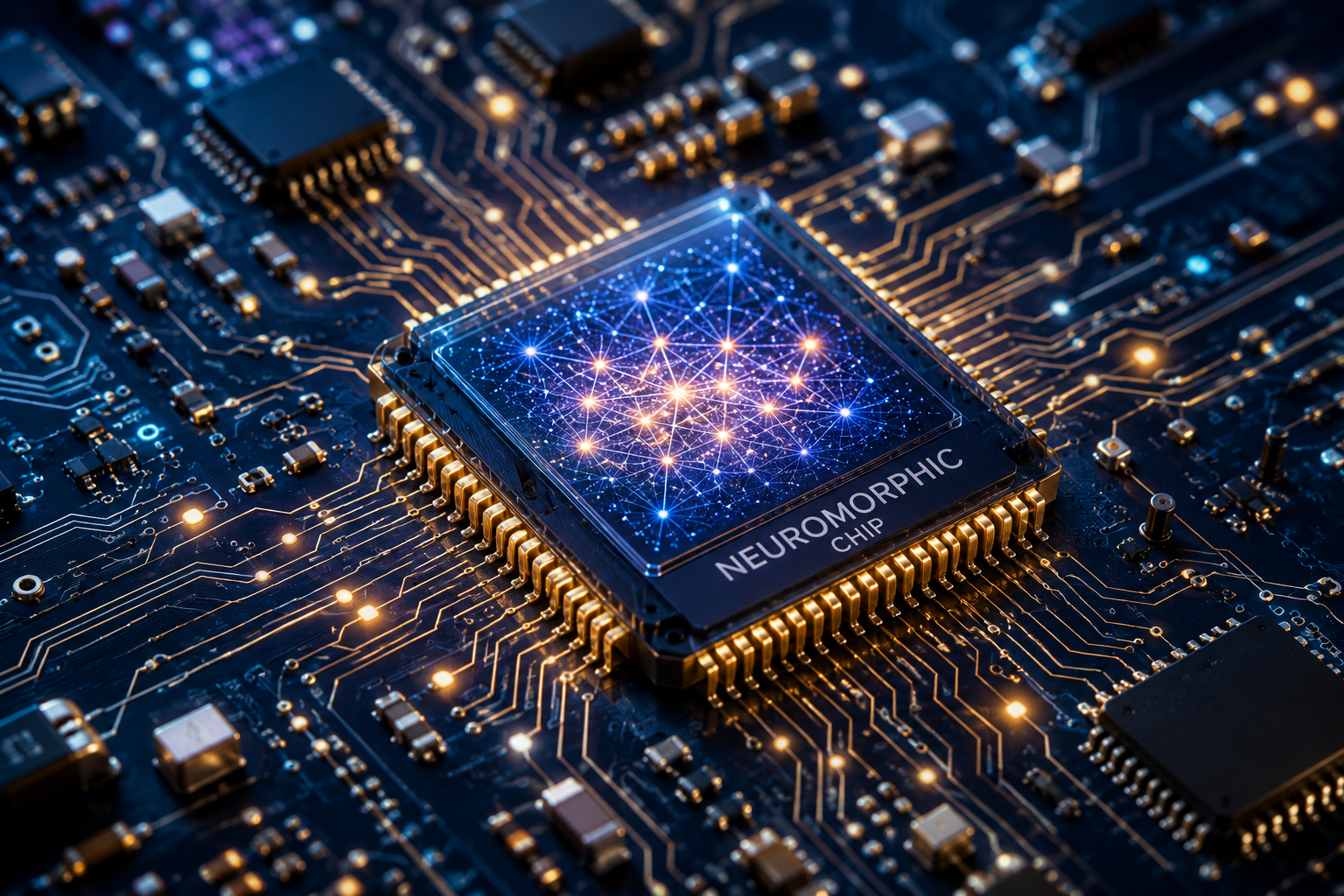
Neuromorphic chips are specialized computer processors designed to imitate the way neurons and synapses in the human brain process information.
Instead of performing calculations in the same sequential or highly synchronized manner as traditional processors, neuromorphic chips use networks of artificial neurons that communicate through electrical signals called spikes. This approach is known as spiking neural computation, and it resembles the way biological neurons exchange information.
Unlike conventional processors that constantly move data back and forth between memory and computing units, neuromorphic chips often combine memory and computation much more closely. This reduces the need for continuous data transfers, making the system significantly more energy efficient.
The word neuromorphic comes from two Greek roots: neuro, meaning nerve or neuron, and morphic, meaning form or structure. Together, the term means “having a brain-like structure.”
Why Traditional Computers Work Differently
To appreciate why neuromorphic chips are important, it helps to understand how conventional computers operate.
Most modern computers use what is known as the von Neumann architecture, named after mathematician John von Neumann. In this design, the processor performs calculations while memory stores data separately. Information constantly travels between the processor and memory.
This architecture has powered computing for decades and remains incredibly effective for many tasks, including scientific simulations, gaming, web browsing, and office applications.
However, moving enormous amounts of data between memory and the processor requires both time and energy. As artificial intelligence models become larger and more complex, this movement of data has become one of the biggest limitations in modern computing. Engineers sometimes refer to this challenge as the von Neumann bottleneck.
Neuromorphic chips attempt to overcome this limitation by organizing computation more like the brain, where memory and processing are deeply interconnected.
How the Human Brain Processes Information
The human brain contains roughly 86 billion neurons connected through hundreds of trillions of synapses.
Each neuron receives signals from thousands of neighboring neurons. When enough signals arrive, the neuron generates a tiny electrical pulse called an action potential, or spike. This spike travels to other neurons through synapses, allowing information to spread throughout the brain.
Importantly, neurons do not fire continuously. They remain mostly inactive until they need to communicate.
This event-driven style of computation is one of the brain’s greatest strengths. Because only active neurons consume significant energy at any moment, the brain performs remarkable computations while remaining highly energy efficient.
Neuromorphic chips attempt to replicate this behavior electronically.
How Neuromorphic Chips Work
Inside a neuromorphic chip are thousands, millions, or even billions of artificial neurons connected by artificial synapses.
Rather than performing calculations continuously using a central clock, many neuromorphic systems operate asynchronously. Each artificial neuron acts independently, responding only when it receives meaningful input.
When sufficient input accumulates, the neuron produces an electrical spike that travels to connected neurons.
Because communication occurs only when necessary, unnecessary computation is reduced dramatically.
Many neuromorphic systems also incorporate mechanisms that allow artificial synapses to strengthen or weaken over time, loosely resembling how learning occurs in biological brains.
Although today’s neuromorphic chips do not fully replicate brain function, they capture several key principles that make biological intelligence remarkably efficient.
Artificial Neurons and Synapses
Artificial neurons are simplified mathematical or electronic representations of biological neurons.
Each neuron receives incoming signals, processes them according to specific rules, and decides whether to generate an output spike.
Artificial synapses connect neurons together.
These synapses determine how strongly one neuron influences another.
As learning occurs, synaptic strengths may change, allowing the network to adapt to new information.
This adaptive behavior forms the basis of many learning systems inspired by neuroscience.
Event-Driven Computing
One of the defining characteristics of neuromorphic chips is event-driven computing.
Traditional processors continuously execute instructions according to an internal clock, even when little useful work is occurring.
Neuromorphic chips behave differently.
If no important event occurs, many neurons remain inactive.
When a meaningful signal arrives, only the relevant neurons become active.
This approach significantly reduces energy consumption while allowing extremely fast responses to changing inputs.
The result is a computing system that can react quickly without wasting power.
Why Neuromorphic Chips Use So Little Energy
Energy efficiency is perhaps the greatest advantage of neuromorphic computing.
The human brain performs astonishingly complex tasks using only about 20 watts of power.
Modern AI systems running on large graphics processing units (GPUs), by comparison, may consume hundreds or even thousands of watts during intensive computations.
Neuromorphic chips reduce power usage in several ways.
They activate only the neurons involved in processing current information.
They minimize data movement between memory and computation.
Many operate asynchronously, eliminating unnecessary clock-driven activity.
Some designs even integrate memory directly within computational structures.
These features make neuromorphic systems especially attractive for battery-powered devices and applications where energy is limited.
Learning Like the Brain
One fascinating goal of neuromorphic engineering is enabling machines to learn continuously from experience.
Many conventional AI systems require enormous datasets and extensive training inside powerful data centers before they can perform useful tasks.
Neuromorphic systems aim to support online learning, where learning happens while the system is operating.
Just as people gradually improve through experience, future neuromorphic devices may continuously adapt to new environments without requiring complete retraining.
Although this capability remains an active area of research, it represents one of the most exciting possibilities of brain-inspired computing.
Neuromorphic Chips and Artificial Intelligence
Artificial intelligence has advanced rapidly thanks to deep learning.
Today’s AI models excel at recognizing images, translating languages, generating text, and understanding speech.
However, these systems often require vast computational resources and large amounts of electricity.
Neuromorphic chips offer a different approach.
Rather than replacing conventional AI entirely, they may complement existing technologies by providing highly efficient processing for tasks involving real-time sensing, adaptation, and decision-making.
In situations where energy efficiency matters more than raw computational power, neuromorphic chips may offer significant advantages.
Real-Time Processing
Many intelligent systems must react almost instantly.
A self-driving vehicle cannot wait several seconds before recognizing a pedestrian.
A rescue robot navigating dangerous terrain must make decisions immediately.
Medical monitoring devices must detect abnormalities as they happen.
Neuromorphic chips are naturally suited to these situations because they process information as events occur.
Instead of waiting for large batches of data, they continuously respond to incoming signals.
This enables low-latency decision-making with minimal power consumption.
Edge Computing
Increasingly, intelligent devices perform computations directly where data is generated rather than sending everything to remote cloud servers.
This approach is known as edge computing.
Neuromorphic chips are particularly well suited for edge devices because they consume relatively little power while providing rapid responses.
Smart sensors, wearable devices, industrial monitoring systems, drones, and autonomous robots may all benefit from brain-inspired processors operating locally.
Local processing also improves privacy because sensitive information may never leave the device.
Robotics
Robots must constantly interpret their surroundings while coordinating movement, balance, vision, and touch.
Traditional processors can accomplish these tasks but often require significant computing resources.
Neuromorphic chips promise more natural sensory processing.
A robot equipped with neuromorphic vision sensors, for example, can detect changes in the environment almost immediately while using much less electricity.
This could enable robots that operate longer on batteries and respond more naturally to dynamic environments.
Vision Systems Inspired by Biology
Human vision is remarkably efficient.
Our eyes do not send complete images to the brain dozens of times each second.
Instead, much of the visual system emphasizes changes in the scene.
Inspired by this principle, researchers have developed event-based cameras that transmit information only when brightness changes occur.
Neuromorphic chips can process this type of data very efficiently.
This combination allows extremely fast object detection with far lower energy consumption than traditional video processing.
Such systems are being explored for autonomous vehicles, drones, industrial automation, and scientific research.
Speech and Sound Recognition
The human brain excels at recognizing speech, even in noisy environments.
Neuromorphic chips may improve speech recognition by processing sounds as continuous streams of events rather than fixed blocks of digital data.
Researchers are investigating how brain-inspired processors can recognize spoken commands with lower energy requirements, making them useful for portable electronic devices and hearing technologies.
Healthcare Applications
Medicine is another promising field for neuromorphic computing.
Wearable health monitors could analyze heart rhythms continuously without rapidly draining batteries.
Brain-computer interfaces may benefit from processors designed specifically to interpret neural activity.
Artificial limbs could respond more naturally to muscle signals.
Medical implants requiring extremely low power consumption may eventually incorporate neuromorphic processors to extend operational lifetimes.
Although many of these applications remain under development, the underlying technology continues to advance rapidly.
Scientific Research
Neuromorphic chips are valuable tools for studying the brain itself.
Neuroscientists use these systems to test theories about learning, memory, perception, and neural communication.
By comparing artificial neural behavior with biological observations, researchers can improve both neuroscience and computer engineering.
This collaboration between disciplines helps deepen our understanding of intelligence in both machines and living organisms.
Challenges Facing Neuromorphic Computing
Despite its tremendous promise, neuromorphic computing is still an emerging field.
Programming these chips differs significantly from programming conventional computers.
Many existing software tools were designed for traditional processors rather than spiking neural systems.
Scientists are also continuing to investigate the most effective learning algorithms for neuromorphic hardware.
Another challenge involves developing standardized platforms so researchers worldwide can build compatible applications.
In addition, the human brain remains only partially understood. Because neuroscience continues to uncover new insights, engineers must continually refine brain-inspired computing models.
Neuromorphic Chips Are Not Artificial Brains
A common misconception is that neuromorphic chips are electronic brains.
In reality, they are not.
The human brain is vastly more complex than any current computer system.
It contains enormous networks of neurons interacting through intricate biochemical processes shaped by evolution over hundreds of millions of years.
Neuromorphic chips imitate only selected computational principles observed in biological nervous systems.
They are inspired by the brain rather than replicating it.
Nevertheless, even partial imitation has already demonstrated impressive improvements in energy efficiency for certain computational tasks.
Examples of Neuromorphic Research
Research organizations and technology companies around the world are actively developing neuromorphic hardware.
Experimental chips have demonstrated millions of artificial neurons and hundreds of millions of programmable synaptic connections.
Scientists continue improving hardware architectures, memory technologies, communication methods, and learning algorithms.
Universities, government laboratories, and semiconductor companies all recognize neuromorphic computing as a promising direction for future computing systems.
Although these processors are not yet common in consumer electronics, research activity continues to expand.
Could Neuromorphic Chips Replace Traditional CPUs and GPUs?
Probably not—at least not in the foreseeable future.
Traditional processors remain exceptionally effective for many kinds of computation.
Central processing units excel at general-purpose tasks.
Graphics processing units provide enormous parallel computing power for artificial intelligence training, scientific simulations, and graphics rendering.
Neuromorphic chips are designed for different strengths.
They are particularly valuable for low-power sensing, adaptive learning, real-time decision-making, and event-driven processing.
Rather than replacing CPUs and GPUs, neuromorphic processors will likely work alongside them, each handling the tasks they perform best.
The Future of Neuromorphic Computing
As artificial intelligence becomes increasingly integrated into everyday life, demand for efficient computing will continue to grow.
Future smartphones, robots, wearable devices, autonomous vehicles, spacecraft, industrial sensors, and medical technologies may all require intelligent processing that operates with minimal energy.
Neuromorphic chips offer a promising path toward this goal.
Advances in semiconductor manufacturing, neuroscience, materials science, and machine learning are steadily improving brain-inspired hardware.
Researchers are also exploring emerging memory technologies that more closely resemble biological synapses, potentially enabling even greater efficiency.
Although significant scientific and engineering challenges remain, the field is progressing rapidly.
A New Way of Thinking About Computers
For decades, faster computing largely meant increasing clock speeds, adding more transistors, and building more powerful processors. Neuromorphic computing introduces a different philosophy. Instead of simply making traditional computers faster, it asks whether computers can become more efficient by learning from nature itself.
The human brain represents one of the most remarkable information-processing systems known. It learns continuously, adapts effortlessly, recognizes complex patterns, and performs extraordinary computations while consuming surprisingly little energy. Neuromorphic chips do not duplicate the brain, but they borrow some of its most effective strategies to create smarter, more efficient computing systems.
As scientists continue unlocking the secrets of biological intelligence, neuromorphic chips may help usher in a new era of artificial intelligence—one in which machines become not only more powerful, but also more adaptable, responsive, and energy efficient. In many ways, the future of computing may depend not just on building faster machines, but on building machines that think a little more like nature itself.