Bluetooth has quietly become one of the most important wireless technologies in our daily lives. It connects our earbuds to our phones, our smartwatches to our wrists, our keyboards to our computers, and even our cars to our music and navigation apps. Most of the time, it works so seamlessly that we hardly think about it.
But behind that convenience, Bluetooth technology continues to evolve. Every new version brings improvements that make wireless connections faster, more reliable, more energy-efficient, and more capable of handling the growing demands of modern devices.
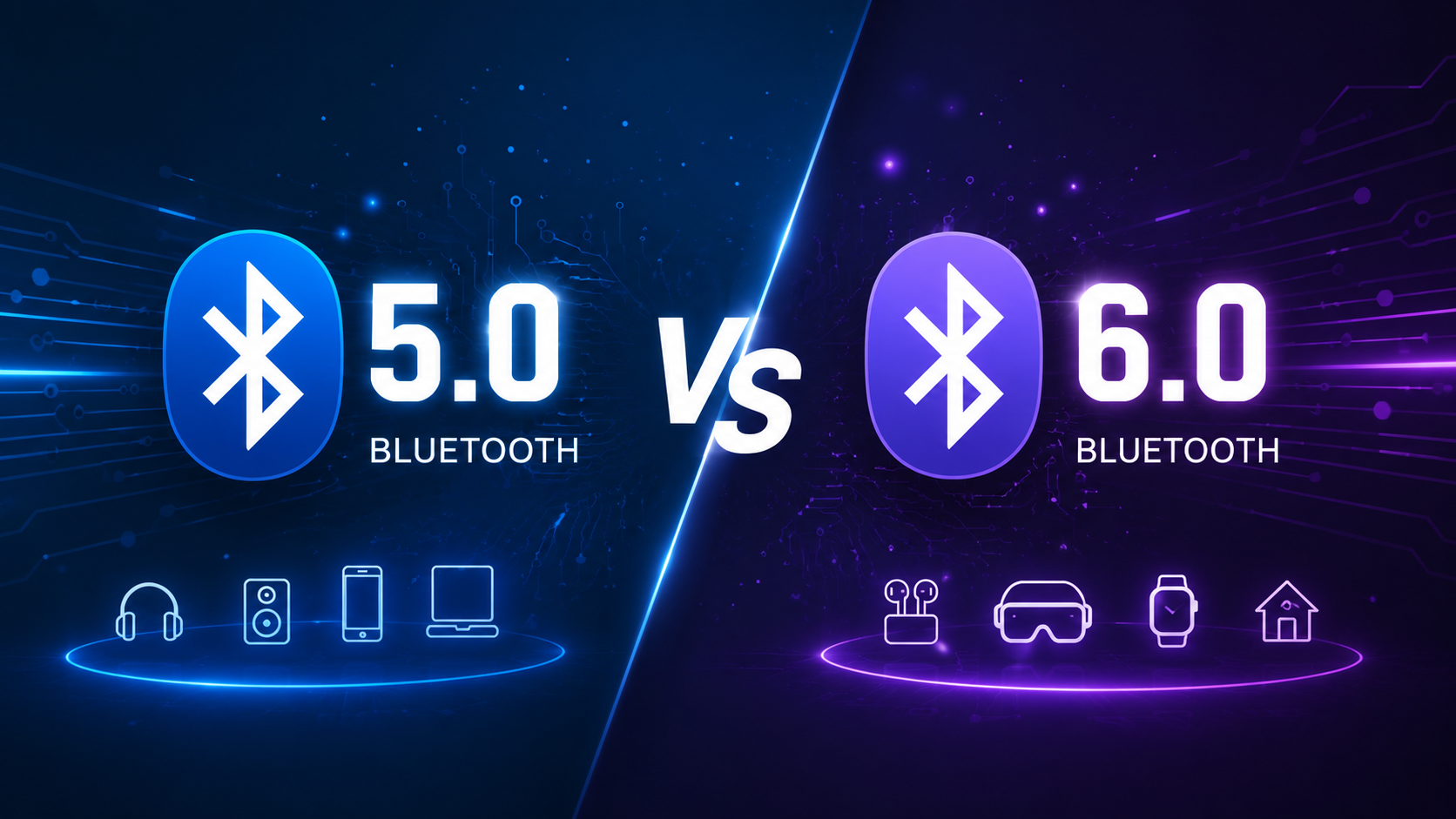
Bluetooth 5.0 was a major milestone when it was introduced, offering longer range, faster speeds, and better support for Internet of Things (IoT) devices than earlier versions. Years later, Bluetooth 6.0 arrived with a different focus. Instead of dramatically increasing speed or range, it introduced smarter communication, greater efficiency, and highly accurate distance measurement between connected devices.
At first glance, Bluetooth 5.0 and Bluetooth 6.0 may appear similar because both use the same radio technology and operate in the same frequency band. However, beneath the surface, Bluetooth 6.0 includes several important improvements that can make future wireless devices more responsive, secure, and power-efficient.
Understanding these differences can help you decide whether Bluetooth 6.0 matters for your next smartphone, laptop, earbuds, smartwatch, or smart home device.
What Is Bluetooth?
Bluetooth is a short-range wireless communication technology designed to allow electronic devices to exchange data without using cables.
It operates in the globally available 2.4 GHz Industrial, Scientific, and Medical (ISM) radio band. Instead of sending information through wires, Bluetooth uses low-power radio waves to connect compatible devices.
Depending on the version and device class, Bluetooth connections can range from just a few meters to well over 200 meters under ideal conditions.
Today, billions of Bluetooth devices are in use worldwide, including smartphones, wireless headphones, fitness trackers, gaming controllers, smart TVs, medical equipment, industrial sensors, and countless Internet of Things devices.
Understanding Bluetooth Versions
Each Bluetooth version builds upon previous generations.
New versions usually improve reliability, energy efficiency, security, compatibility, and wireless performance. Importantly, newer versions remain backward compatible. A Bluetooth 6.0 smartphone can still connect to Bluetooth 5.0 headphones, although the connection will generally operate using features supported by both devices.
Because Bluetooth is used in so many different products, not every improvement focuses on speed. Sometimes the biggest advances happen behind the scenes, making connections more stable or reducing power consumption.
Bluetooth 6.0 is an excellent example of this philosophy.
What Is Bluetooth 5.0?
Bluetooth 5.0 was officially released in December 2016 by the Bluetooth Special Interest Group (Bluetooth SIG).
It represented one of the largest upgrades since Bluetooth Low Energy (BLE) was introduced.
Compared with Bluetooth 4.2, Bluetooth 5.0 offered significantly greater communication range, higher maximum data rates for Bluetooth Low Energy, and much larger broadcasting capacity.
These improvements helped fuel the rapid growth of smart home devices, wearable technology, wireless sensors, and truly wireless earbuds.
Bluetooth 5.0 remains one of the most widely supported Bluetooth versions in consumer electronics today.
Key Features of Bluetooth 5.0
Bluetooth 5.0 introduced faster Bluetooth Low Energy communication with theoretical data rates reaching up to 2 megabits per second under supported conditions.
It also greatly increased communication range by supporting lower-speed long-range transmission modes. Depending on the environment and device implementation, Bluetooth Low Energy connections can reach significantly farther than previous versions, making it useful for smart homes and industrial IoT deployments.
Another important improvement was expanded advertising capacity. Devices could broadcast much larger packets of information before establishing a full connection, making Bluetooth beacons and location-based services more useful.
Bluetooth 5.0 also improved coexistence with other wireless technologies, helping reduce interference in crowded radio environments.
What Is Bluetooth 6.0?
Bluetooth 6.0 was officially announced by the Bluetooth Special Interest Group in September 2024.
Rather than focusing on dramatic increases in speed or range, Bluetooth 6.0 improves how devices communicate with one another.
The biggest innovation is a feature called Channel Sounding, which enables highly accurate distance measurement between compatible Bluetooth devices.
Bluetooth 6.0 also introduces several efficiency improvements that reduce unnecessary wireless activity, lower latency in certain situations, improve security, and extend battery life for many portable devices.
Instead of simply making Bluetooth “faster,” Bluetooth 6.0 makes it smarter.
Bluetooth 5.0 vs Bluetooth 6.0: Speed
Many people expect every new Bluetooth version to deliver faster transfer speeds.
Surprisingly, Bluetooth 6.0 does not significantly increase the maximum Bluetooth Low Energy data rate beyond what Bluetooth 5.0 already supports.
Bluetooth 5.0 introduced the 2 Mbps Bluetooth Low Energy mode, which remains available in Bluetooth 6.0.
This means that for activities such as listening to music, transferring small files, or connecting wireless accessories, users are unlikely to notice major speed differences solely because of the Bluetooth version.
Instead, Bluetooth 6.0 improves how efficiently devices communicate during those transfers.
Bluetooth 5.0 vs Bluetooth 6.0: Range
Bluetooth 5.0 already offers excellent wireless range when devices support its long-range modes.
Bluetooth 6.0 does not dramatically extend this maximum communication distance.
Instead, it focuses on maintaining better connection quality and improving communication efficiency within that range.
In practical use, both versions can provide stable wireless connections over similar distances, depending on hardware design, antenna quality, obstacles, and environmental interference.
Bluetooth 5.0 vs Bluetooth 6.0: Distance Accuracy
This is where Bluetooth 6.0 introduces its most exciting innovation.
Bluetooth 5.0 can estimate proximity by measuring signal strength, known as RSSI (Received Signal Strength Indicator).
Unfortunately, RSSI is only an approximation.
Walls, furniture, reflections, and interference can all affect signal strength, making precise distance estimation difficult.
Bluetooth 6.0 introduces Channel Sounding, which measures the radio signal in a much more sophisticated way.
Instead of simply guessing how close two devices are based on signal strength, Channel Sounding can estimate distance with much greater precision under appropriate conditions.
This capability opens entirely new possibilities for wireless devices.
Future smartphones may accurately determine whether your digital car key is actually beside the vehicle rather than several meters away.
Wireless trackers could more precisely guide you toward misplaced keys or luggage.
Smart home systems could detect exactly where devices are located inside a room.
These improvements make Bluetooth location services far more reliable than before.
Bluetooth 5.0 vs Bluetooth 6.0: Battery Life
Battery life is one of the most important aspects of wireless technology.
Bluetooth 5.0 already introduced major improvements in power efficiency compared with older versions.
Bluetooth 6.0 goes even further.
Several new communication optimizations reduce unnecessary transmissions between connected devices.
By allowing devices to spend more time in low-power states, Bluetooth 6.0 can help extend battery life, especially in wearables, wireless sensors, smart home devices, and Internet of Things products.
The exact improvement depends on device manufacturers and how the technology is implemented.
Bluetooth 5.0 vs Bluetooth 6.0: Latency
Latency refers to the delay between sending and receiving information.
Bluetooth 6.0 includes improvements that help reduce communication delays in certain scenarios by making device interactions more efficient and minimizing unnecessary processing.
Although users may not notice dramatic differences while listening to music, lower latency can improve the responsiveness of accessories such as wireless controllers, smart devices, and location-aware systems.
Bluetooth 5.0 vs Bluetooth 6.0: Security
Security has become increasingly important as Bluetooth is now used for digital keys, payment systems, medical devices, and personal electronics.
Bluetooth 6.0 introduces improvements that strengthen secure ranging through Channel Sounding, making certain distance-based applications more resistant to relay-style attacks. These enhancements help systems better verify that a device is genuinely nearby rather than simply forwarding signals from a distant location.
For applications like digital car keys and secure access systems, this additional protection represents an important step forward.
Bluetooth 5.0 vs Bluetooth 6.0: Audio Performance
Many people wonder whether Bluetooth 6.0 automatically improves sound quality.
The answer is more complicated than a simple yes or no.
Bluetooth audio quality depends primarily on the audio codec, available bandwidth, device hardware, and software implementation.
If the same headphones use the same codec with both Bluetooth 5.0 and Bluetooth 6.0, listeners may hear little or no direct difference in sound quality.
However, Bluetooth 6.0’s communication improvements can contribute to more reliable wireless performance and better efficiency in some situations.
Bluetooth 5.0 vs Bluetooth 6.0: Smart Home Devices
Smart homes continue to become more connected every year.
Lights, locks, thermostats, security sensors, appliances, and voice assistants increasingly communicate through Bluetooth.
Bluetooth 6.0’s improved efficiency helps these devices consume less power while maintaining dependable communication.
Accurate distance measurement could also allow future smart home systems to respond more intelligently to a person’s exact location within a building.
Imagine lights automatically following you through your home or doors recognizing precisely when you are standing nearby.
These possibilities become more practical with Bluetooth 6.0.
Bluetooth 5.0 vs Bluetooth 6.0: Wearable Devices
Fitness trackers and smartwatches rely heavily on Bluetooth.
Long battery life is essential for wearable technology.
Bluetooth 6.0’s reduced communication overhead helps conserve energy while maintaining continuous connections to smartphones.
Future wearable devices may also use precise ranging to deliver more context-aware experiences based on their exact position relative to other devices.
Bluetooth 5.0 vs Bluetooth 6.0: Internet of Things
The Internet of Things includes billions of connected devices around the world.
Factories, hospitals, warehouses, farms, offices, and homes all increasingly depend on wireless sensors.
Bluetooth 6.0 improves communication efficiency for these devices while enabling more accurate positioning capabilities.
Industries that rely on tracking equipment or monitoring assets may particularly benefit from Bluetooth 6.0’s advanced ranging features.
Bluetooth 5.0 vs Bluetooth 6.0: Backward Compatibility
One of Bluetooth’s greatest strengths is compatibility across generations.
Bluetooth 6.0 devices continue to support connections with Bluetooth 5.0 hardware.
When a newer device connects to an older one, both devices simply communicate using the highest feature set they share.
This means users do not need to replace all of their Bluetooth accessories immediately.
Real-World Differences Most People Will Notice
For many consumers, everyday experiences with Bluetooth 5.0 are already very good.
Wireless earbuds connect quickly.
Smartwatches synchronize reliably.
Keyboards and mice respond instantly.
Because of this, Bluetooth 6.0 may not feel revolutionary on the first day someone buys a compatible device.
Instead, its advantages become increasingly noticeable as manufacturers build new products that specifically take advantage of its advanced capabilities.
Digital keys become more secure.
Item trackers become more accurate.
Smart homes become more intelligent.
Wearables become more efficient.
Battery life gradually improves.
These are meaningful improvements, even if they are less obvious than simply advertising “twice the speed.”
Which Devices Support Bluetooth 6.0?
Because Bluetooth 6.0 is relatively new, support is still expanding.
Device manufacturers must include compatible Bluetooth chipsets and software to enable Bluetooth 6.0 features. As a result, many current smartphones, laptops, headphones, and smartwatches still use Bluetooth 5.x versions.
Over the next several years, Bluetooth 6.0 is expected to appear in an increasing number of flagship smartphones, premium laptops, wearable devices, automotive systems, and smart home products.
Even when a device supports Bluetooth 6.0, individual features such as Channel Sounding may require compatible hardware and support on both connected devices.
Should You Upgrade?
If your current devices use Bluetooth 5.0 and meet your needs, there is usually no urgent reason to upgrade based on Bluetooth alone. Bluetooth 5.0 remains a capable, reliable, and widely supported standard that delivers excellent performance for wireless audio, peripherals, and many everyday applications.
However, if you are purchasing a new smartphone, laptop, smartwatch, or other Bluetooth-enabled device in the coming years, choosing one that supports Bluetooth 6.0 can help future-proof your investment. As more accessories and services adopt its advanced features, you will be able to take advantage of more accurate device finding, improved efficiency, and stronger support for emerging wireless experiences.
The Future of Bluetooth
Bluetooth has evolved far beyond its original purpose of replacing cables between nearby devices. Today, it serves as a foundation for wearable technology, smart homes, connected vehicles, industrial automation, healthcare devices, and billions of Internet of Things products.
Bluetooth 5.0 marked a major leap forward by extending range, increasing Bluetooth Low Energy data rates, and improving wireless reliability. Bluetooth 6.0 builds on that strong foundation with a different vision—one centered on precision, intelligence, efficiency, and security rather than headline-grabbing speed increases.
As manufacturers continue to adopt Bluetooth 6.0, its innovations are likely to become increasingly important. Features such as precise distance measurement, lower power consumption, smarter communication, and enhanced security have the potential to reshape how wireless devices interact with one another. While Bluetooth 5.0 remains an excellent standard for today’s needs, Bluetooth 6.0 lays the groundwork for a future in which connected devices are not only faster and more reliable but also far more aware of the world around them.