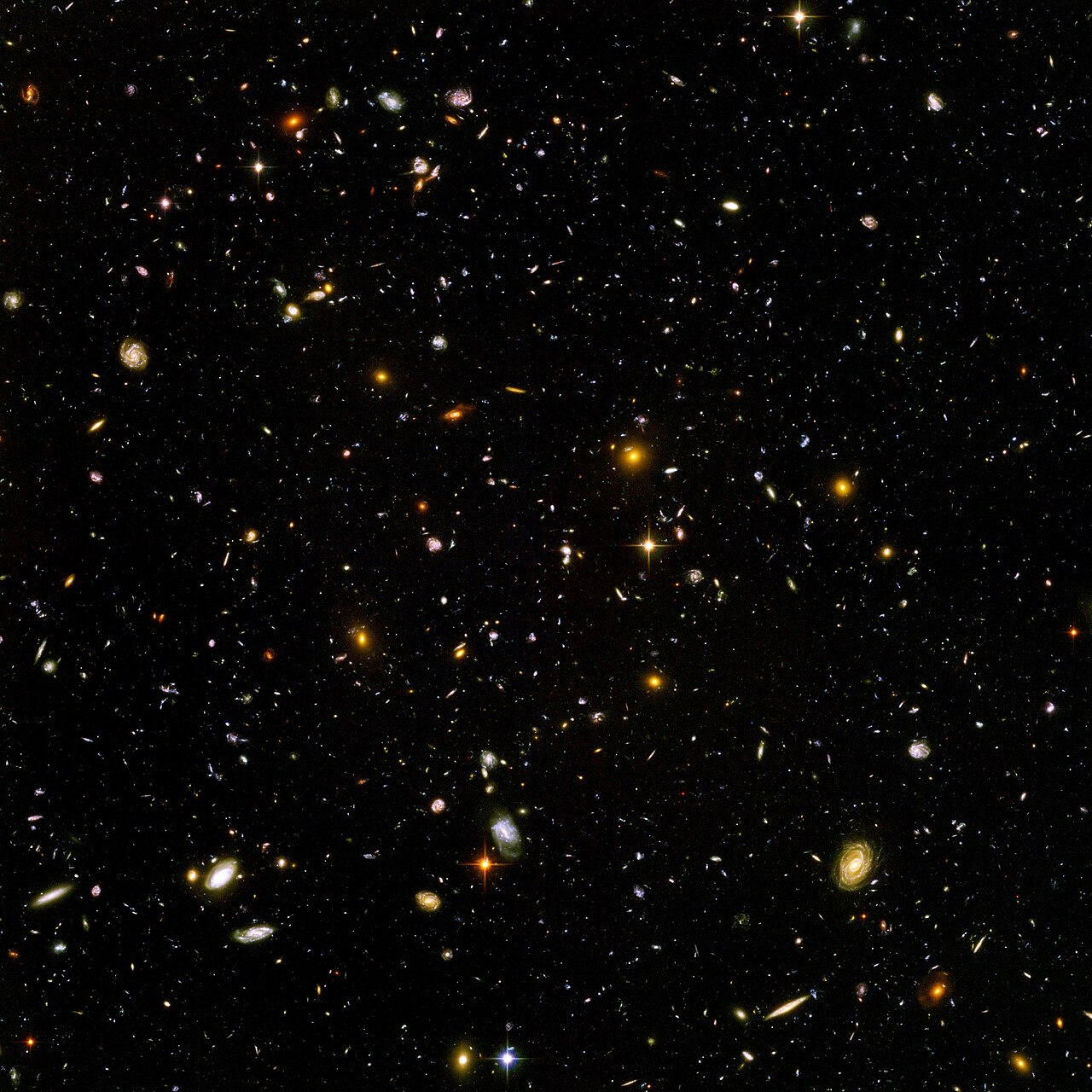
On a clear night, when you look up at the sky, the stars seem endless. Beyond the stars lie countless galaxies, and beyond those galaxies lie even more galaxies stretching into the darkness. The sheer scale of the cosmos naturally leads to one of the biggest questions humanity has ever asked: Is the universe infinite?
It is a question that has fascinated philosophers, astronomers, mathematicians, and physicists for thousands of years. Today, modern science has made extraordinary progress in understanding the universe, yet this particular mystery remains unsolved. We know far more about the cosmos than ever before, but whether the universe goes on forever or has a finite size is still one of the greatest unanswered questions in science.
The answer, surprisingly, is neither a simple “yes” nor a simple “no.” Instead, it lies at the intersection of astronomy, cosmology, mathematics, and Einstein’s theory of relativity.
What Does “Infinite” Mean?
Before asking whether the universe is infinite, it is important to understand what the word “infinite” actually means.
An infinite universe would have no edge, no boundary, and no end. No matter how far someone traveled, there would always be more universe ahead. There would never be a final destination where space simply stops.
A finite universe, on the other hand, has a limited size. However, finite does not necessarily mean that the universe has a wall surrounding it or an edge where everything suddenly ends. In modern physics, a universe can be finite without having a boundary.
This idea seems strange at first, but it becomes easier to understand with the help of geometry.
The Difference Between an Edge and a Boundary
Many people imagine a finite universe as being like a giant box with walls around it. If that were true, someone could eventually reach the edge.
Modern cosmology suggests something very different.
Imagine living on the surface of Earth. Earth’s surface is finite because it has a limited area. Yet if you walk in one direction long enough, you never encounter an edge where the ground suddenly disappears. Instead, you eventually return to where you started.
This happens because Earth’s surface is curved.
Some scientists think the universe could work in a somewhat similar way. Space itself could be curved in higher dimensions, allowing it to have a finite volume without any boundary.
This idea comes directly from Einstein’s theory of general relativity, which describes gravity as the curvature of space and time.
What Is the Observable Universe?
One of the most common misconceptions is that the observable universe is the entire universe.
It is not.
The observable universe is simply the portion of the cosmos whose light has had enough time to reach Earth since the beginning of cosmic expansion.
Because light travels at a finite speed, we cannot see objects whose light has not yet arrived.
Today, the observable universe has a diameter of about 93 billion light-years. This enormous size surprises many people because the universe itself is about 13.8 billion years old.
The reason is that space has been expanding while light has been traveling. As a result, the galaxies we observe today are much farther away than they were when they emitted the light we now detect.
Everything beyond the observable universe remains hidden from us—not because it does not exist, but because its light has not had enough time to reach Earth.
Why We Cannot See the Entire Universe
Light has a maximum speed in a vacuum: approximately 299,792 kilometers per second.
Although this speed is incredibly fast, the universe is unimaginably vast.
When we observe a galaxy one billion light-years away, we are seeing it as it appeared one billion years ago.
When astronomers observe the most distant galaxies ever detected, they are looking billions of years into the past.
Eventually, there comes a distance beyond which no light has yet reached us.
This creates a cosmic horizon.
Beyond that horizon, space may continue for an enormous distance—or even forever—but we currently have no direct way of observing it.
The Big Bang Did Not Happen at One Point
A common misunderstanding is that the Big Bang was a gigantic explosion that occurred at one location in space.
Modern cosmology tells a different story.
The Big Bang was not an explosion into empty space.
Instead, it was the rapid expansion of space itself.
Every region of today’s universe was once much closer together.
As space expanded, galaxies moved farther apart.
This means there is no central point from which the universe exploded.
Every observer, no matter where they are located, sees distant galaxies moving away due to the expansion of space.
In this sense, every location can appear to be the center of the observable universe.
How Scientists Measure the Shape of the Universe
One of the best ways to determine whether the universe might be infinite is by studying its geometry.
According to Einstein’s theory of general relativity, matter and energy determine the shape of space.
There are three main possibilities.
If space has positive curvature, it resembles the surface of a sphere in higher dimensions. Such a universe would likely be finite.
If space has zero curvature, it is geometrically flat. A perfectly flat universe could extend infinitely, although a flat universe can also be finite if space has a more complex topology.
If space has negative curvature, it resembles a saddle shape and may also be infinite.
Astronomers measure this curvature by studying the cosmic microwave background, galaxy distributions, and gravitational effects across enormous distances.
What Does the Evidence Suggest?
Measurements from modern space missions have shown that the observable universe is extremely close to geometrically flat.
This is one of the most important discoveries in modern cosmology.
However, “almost perfectly flat” does not automatically prove that the entire universe is infinite.
Imagine standing in the middle of the Pacific Ocean.
The surface appears perfectly flat because Earth is so large.
Yet Earth is actually spherical.
Similarly, even if our observable region appears flat, the entire universe could still possess a slight curvature that is too small for us to detect.
Current observations therefore cannot distinguish between an incredibly large finite universe and a truly infinite one.
Could the Universe Be Much Larger Than We Can See?
Yes.
In fact, most cosmologists think this is very likely.
The observable universe represents only the part whose light has reached us.
The complete universe could be hundreds, thousands, millions, or vastly more times larger.
Some theoretical models even suggest that the observable universe may be only a tiny fraction of the whole cosmos.
Because regions beyond our cosmic horizon cannot currently be observed, their size remains unknown.
Cosmic Inflation and an Enormous Universe
One of the leading ideas in cosmology is called cosmic inflation.
According to this theory, the universe underwent an extremely brief period of incredibly rapid expansion during the earliest fraction of a second after the Big Bang.
During this tiny instant, space expanded far faster than the speed of light—not because objects moved through space faster than light, but because space itself expanded.
Inflation explains several observed properties of the universe remarkably well.
It also suggests that the universe may be vastly larger than the observable region.
Some versions of inflation even predict that space could continue indefinitely, creating an effectively infinite universe.
Other versions allow for a finite but unimaginably enormous cosmos.
The theory itself does not settle the question.
Can an Infinite Universe Exist?
Mathematically, an infinite universe is entirely possible.
Physics does not forbid it.
If space is perfectly flat and extends forever, the universe would be infinite.
Many cosmological models naturally allow this possibility.
However, mathematics alone does not determine reality.
Scientific conclusions require observational evidence.
At present, no observation has demonstrated that the universe is truly infinite.
Likewise, no observation has shown that it is definitely finite.
The available evidence remains consistent with both possibilities.
Does an Infinite Universe Mean Infinite Copies of You?
This fascinating idea often appears in popular science discussions.
If the universe is truly infinite and matter is distributed in similar ways everywhere, some mathematical arguments suggest that arrangements of atoms could eventually repeat.
In principle, there could be regions containing planets, stars, or even people almost identical to those found here on Earth.
However, this remains speculative.
Because we cannot observe regions beyond the observable universe, there is currently no evidence that such duplicates actually exist.
It is an interesting implication of some infinite-universe models, not an established scientific fact.
What About the Multiverse?
People sometimes confuse an infinite universe with the multiverse.
These are different ideas.
An infinite universe is one continuous universe that extends without end.
A multiverse proposes that multiple separate universes may exist, each potentially having different physical properties or histories.
Some versions of cosmic inflation predict the possibility of many universes.
Other theories involving quantum mechanics or string theory also explore multiverse concepts.
However, no direct observational evidence currently confirms the existence of a multiverse.
As a result, the multiverse remains a theoretical idea rather than an accepted scientific fact.
Could We Ever Reach the Edge?
If the universe is infinite, there is no edge to reach.
If the universe is finite but has no boundary, traveling in one direction long enough might eventually bring you back to your starting point, somewhat like traveling around Earth.
In practice, however, neither journey is possible.
The universe is expanding.
Distant galaxies continue moving away as space itself stretches.
Some galaxies are already receding so rapidly because of cosmic expansion that their light will never reach us.
This means there are regions of the universe that are permanently beyond our ability to visit or observe.
Why This Question Is So Difficult to Answer
Science depends on evidence.
Unfortunately, we can only observe the observable universe.
Anything beyond our cosmic horizon is currently inaccessible.
Even future telescopes cannot overcome this limitation because no information can travel faster than light through space to reach us from beyond the observable horizon.
As a result, determining the true size of the entire universe may remain one of science’s greatest challenges.
Researchers continue improving measurements of cosmic geometry, studying the cosmic microwave background, mapping galaxies, and developing better cosmological models.
Each new observation narrows the possibilities, but the final answer remains elusive.
Why the Universe Feels Infinite
Human intuition struggles with cosmic distances.
Even within the observable universe, there are hundreds of billions to perhaps trillions of galaxies, each containing millions, billions, or even trillions of stars.
The nearest star beyond the Sun is over four light-years away.
The nearest large galaxy is about 2.5 million light-years away.
The observable universe spans roughly 93 billion light-years.
Whether or not the universe is technically infinite, its scale is so enormous that it already exceeds ordinary human imagination.
The Scientific View Today
Modern cosmology has achieved remarkable success in explaining the evolution of the universe from its earliest moments to the formation of galaxies, stars, planets, and eventually life.
Yet one of the simplest questions remains unanswered.
Is the universe finite?
Or is it infinite?
Current observations indicate that the observable universe is extremely close to flat and continues expanding.
They also suggest that the universe beyond what we can see is almost certainly much larger than the observable portion.
However, science has not yet determined whether space extends forever or eventually loops back upon itself in some higher-dimensional geometry.
Both possibilities remain scientifically plausible.
Conclusion
The question of whether the universe is infinite touches the limits of human knowledge. It challenges not only our understanding of physics but also our imagination. Modern astronomy has revealed that the observable universe is only a small window into a much larger cosmos, and evidence suggests that what lies beyond may extend far beyond anything we can currently observe.
Although no scientific observation has yet proven that the universe is infinite, neither has any observation shown that it is finite. Measurements indicate that space is extraordinarily close to flat, leaving both possibilities open. Future discoveries may bring us closer to an answer, but for now, the true size of the universe remains one of the deepest mysteries in cosmology.
Whether the universe stretches endlessly into eternity or is finite in a way that has no edge, one fact is certain: the cosmos is vastly larger, richer, and more astonishing than humanity once imagined. Every new observation reminds us that our journey of discovery has only just begun, and the universe still holds countless secrets waiting to be uncovered.