Every time you open a website, watch a video online, shop on an e-commerce store, or read the latest news, a hidden conversation takes place between your web browser and a server somewhere in the world. This conversation happens using a communication protocol called HTTP, or Hypertext Transfer Protocol. Although most internet users never notice it, HTTP is one of the most important technologies behind the modern web.
Over the years, the internet has changed dramatically. Websites have evolved from simple pages containing text and images into rich web applications filled with high-resolution photos, videos, animations, interactive features, and real-time communication. As websites became more complex, older versions of HTTP struggled to keep up with increasing demands for speed, efficiency, and reliability.
To solve these challenges, engineers introduced HTTP/2 and later HTTP/3. Both versions significantly improve website performance compared with the original HTTP/1.1, but they achieve these improvements in different ways. HTTP/3, in particular, represents one of the biggest architectural changes in the history of the web by replacing the transport protocol that HTTP had relied on for decades.
Understanding the differences between HTTP/2 and HTTP/3 helps explain why today’s websites load faster, remain more responsive, and perform better on mobile networks than ever before.
What Is HTTP?
HTTP, or Hypertext Transfer Protocol, is the set of rules that allows web browsers and web servers to communicate.
When you type a website address into your browser, the browser sends an HTTP request asking the server for a webpage. The server responds by sending back HTML files, images, CSS stylesheets, JavaScript code, videos, fonts, and other resources needed to display the page.
Without HTTP, browsers and websites would have no standardized way to exchange information.
Every webpage you visit relies on HTTP.
Why HTTP Needed Improvement
The original HTTP protocol was designed in an era when websites were much simpler than they are today.
A webpage in the 1990s often contained little more than text and a few images. Modern websites, however, may require hundreds of individual resources before the page is fully displayed.
Every image, font, stylesheet, script, icon, advertisement, and video requires communication between the browser and the server.
As websites grew larger and more interactive, older communication methods introduced unnecessary delays.
Engineers needed a protocol that could transfer data more efficiently while reducing latency and improving overall performance.
This need led to the development of HTTP/2.
Later, increasing use of smartphones, wireless networks, and real-time applications inspired the development of HTTP/3.
What Is HTTP/2?
HTTP/2 is the second major version of the Hypertext Transfer Protocol. It was standardized by the Internet Engineering Task Force (IETF) in 2015.
Unlike HTTP/1.1, HTTP/2 allows multiple requests and responses to travel simultaneously over a single network connection.
Instead of waiting for one resource to finish downloading before requesting another, the browser can receive many files at the same time.
This approach significantly reduces loading delays.
Importantly, HTTP/2 still uses TCP (Transmission Control Protocol) as its underlying transport protocol.
TCP had been the foundation of web communication for decades because it provides reliable, ordered delivery of data.
HTTP/2 modernized how HTTP communicates while continuing to rely on TCP’s dependable transport.
What Is HTTP/3?
HTTP/3 is the newest major version of HTTP.
It became an official internet standard in 2022 after years of development and testing.
Unlike every previous version of HTTP, HTTP/3 no longer uses TCP.
Instead, it uses QUIC, a modern transport protocol developed originally by Google and later standardized by the IETF.
QUIC operates on top of UDP (User Datagram Protocol), but unlike traditional UDP communication, QUIC includes sophisticated mechanisms for reliability, encryption, congestion control, and connection management.
By replacing TCP with QUIC, HTTP/3 removes several limitations that affected earlier versions of HTTP, especially on mobile and unreliable networks.
The Biggest Difference: TCP vs QUIC
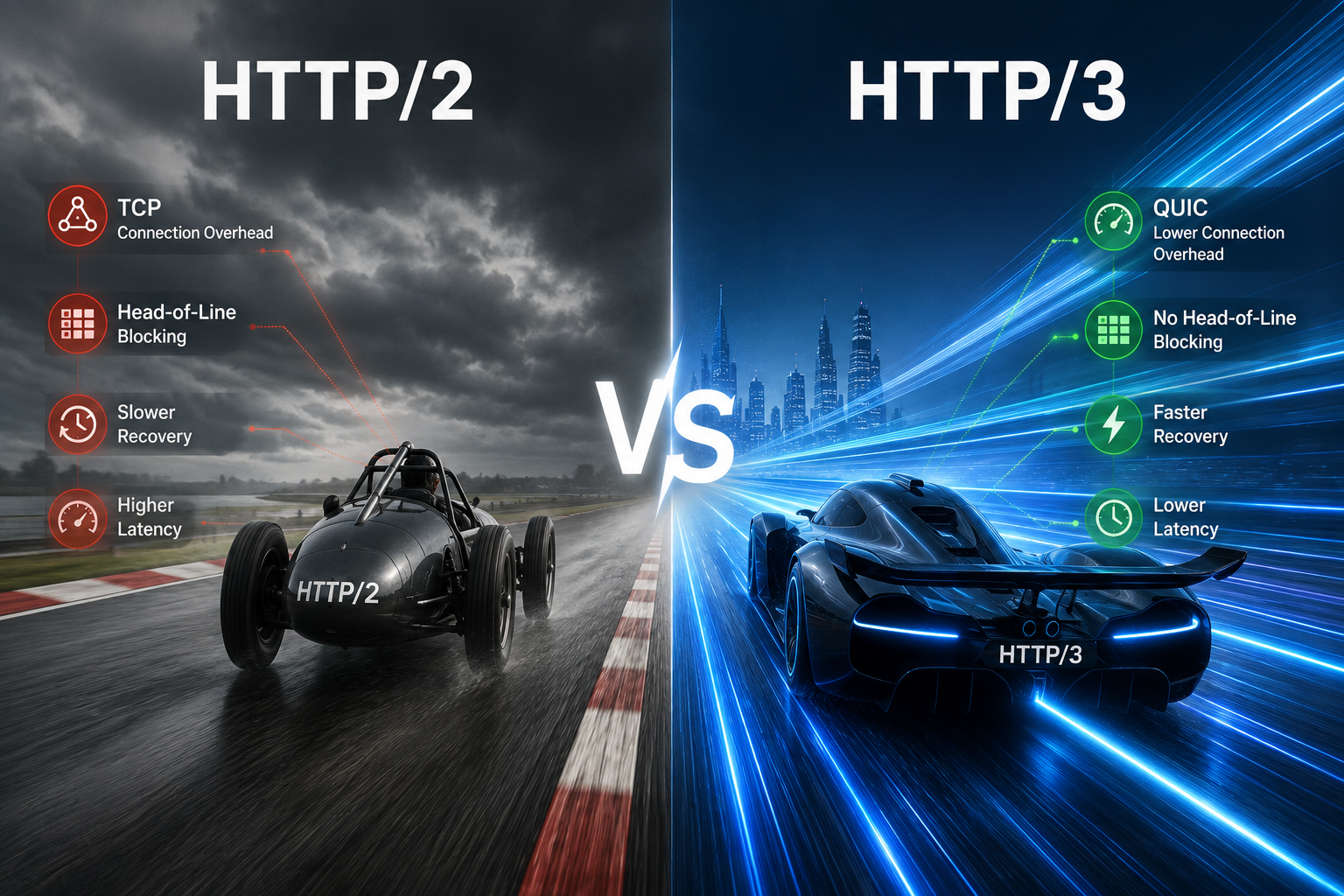
The most important distinction between HTTP/2 and HTTP/3 lies beneath the HTTP protocol itself.
HTTP/2 uses TCP.
HTTP/3 uses QUIC.
Although both protocols deliver web pages accurately, they handle network communication differently.
TCP has served the internet exceptionally well for decades. It guarantees that data arrives correctly and in the proper order.
However, TCP has certain limitations that become noticeable on congested or unstable networks.
QUIC was specifically designed to overcome many of these limitations while maintaining reliable communication.
This architectural change is what makes HTTP/3 fundamentally different from HTTP/2.
How HTTP/2 Improves Website Performance
One of HTTP/2’s greatest innovations is multiplexing.
With HTTP/1.1, browsers often needed multiple separate TCP connections to download many resources efficiently.
HTTP/2 allows numerous requests and responses to share a single connection simultaneously.
For example, a webpage may require:
HTML
CSS
JavaScript
Images
Fonts
Icons
Videos
Instead of downloading these resources one after another, HTTP/2 allows many of them to travel together over one connection.
This reduces waiting time and makes websites feel significantly faster.
Understanding Multiplexing
Imagine a highway with only one lane.
Only one vehicle can pass through at a time.
Traffic quickly becomes congested.
Now imagine expanding that highway into multiple lanes where many vehicles travel simultaneously.
Traffic flows much more efficiently.
HTTP/2 works in a similar way.
Multiple streams of information move across one connection simultaneously.
This greatly improves resource delivery for modern websites.
Header Compression
Every HTTP request includes metadata known as headers.
Headers contain information such as:
Browser type
Accepted languages
Cookies
Cache settings
Authentication details
Many of these headers remain nearly identical across multiple requests.
HTTP/2 introduces header compression using an algorithm called HPACK.
Instead of repeatedly transmitting identical header information, HTTP/2 compresses it efficiently.
This reduces bandwidth usage and improves loading speed.
Server Push
HTTP/2 introduced a feature called Server Push.
Instead of waiting for the browser to request certain files, the server could proactively send resources it expected the browser would need.
For example, after receiving a request for a webpage, the server might immediately send the associated CSS stylesheet and JavaScript files.
Although innovative, Server Push proved difficult to optimize in practice.
Many websites found limited real-world benefits, and browsers gradually reduced or removed support for this feature.
HTTP/3 does not include Server Push in the same way.
The Problem of Head-of-Line Blocking
Despite its improvements, HTTP/2 still inherits an important limitation from TCP.
TCP guarantees that packets arrive in order.
If one packet becomes delayed or lost during transmission, TCP pauses delivery until the missing packet arrives.
Even if other packets have already reached their destination, they must wait.
This phenomenon is called head-of-line blocking.
For users, it may appear as a brief delay in webpage loading, especially on congested or unreliable networks.
While this issue occurs beneath HTTP itself, it still affects HTTP/2 because TCP controls data delivery.
How HTTP/3 Solves Head-of-Line Blocking
HTTP/3’s use of QUIC fundamentally changes how data streams are managed.
Each stream operates independently.
If one stream experiences packet loss, the remaining streams continue without interruption.
For example, if one image on a webpage is delayed, other images, scripts, stylesheets, and text can continue loading normally.
The browser no longer waits unnecessarily for unrelated data.
This leads to smoother and faster page rendering, particularly on wireless networks.
Faster Connection Setup
Establishing a secure connection between a browser and a website takes time.
HTTP/2 relies on TCP, followed by a separate TLS handshake to establish encryption.
These steps require multiple exchanges between the browser and the server before useful data can begin flowing.
HTTP/3 combines transport and encryption more efficiently.
QUIC integrates TLS 1.3 directly into the connection process.
As a result, secure connections often require fewer network round trips before data transfer begins.
This reduces startup latency.
Users may notice that websites begin loading more quickly, particularly on high-latency connections.
Better Performance on Mobile Networks
Mobile internet connections constantly change.
A smartphone may move between Wi-Fi and cellular networks while remaining connected to the same website.
Traditional TCP connections often require complete reconnection when network conditions change.
QUIC was designed with mobility in mind.
HTTP/3 allows connections to survive certain network changes without restarting the entire communication process.
This provides a smoother browsing experience for mobile users.
It also reduces interruptions during streaming, online gaming, and video conferencing.
Improved Recovery From Packet Loss
Internet communication is rarely perfect.
Packets sometimes become delayed or lost due to congestion, wireless interference, or network instability.
TCP handles packet loss conservatively to maintain reliability.
QUIC uses more modern recovery techniques that allow communication to resume more efficiently.
As a result, HTTP/3 often performs noticeably better on networks with higher packet loss.
This is especially beneficial for users on cellular networks, public Wi-Fi, satellite internet, or long-distance international connections.
Built-In Modern Encryption
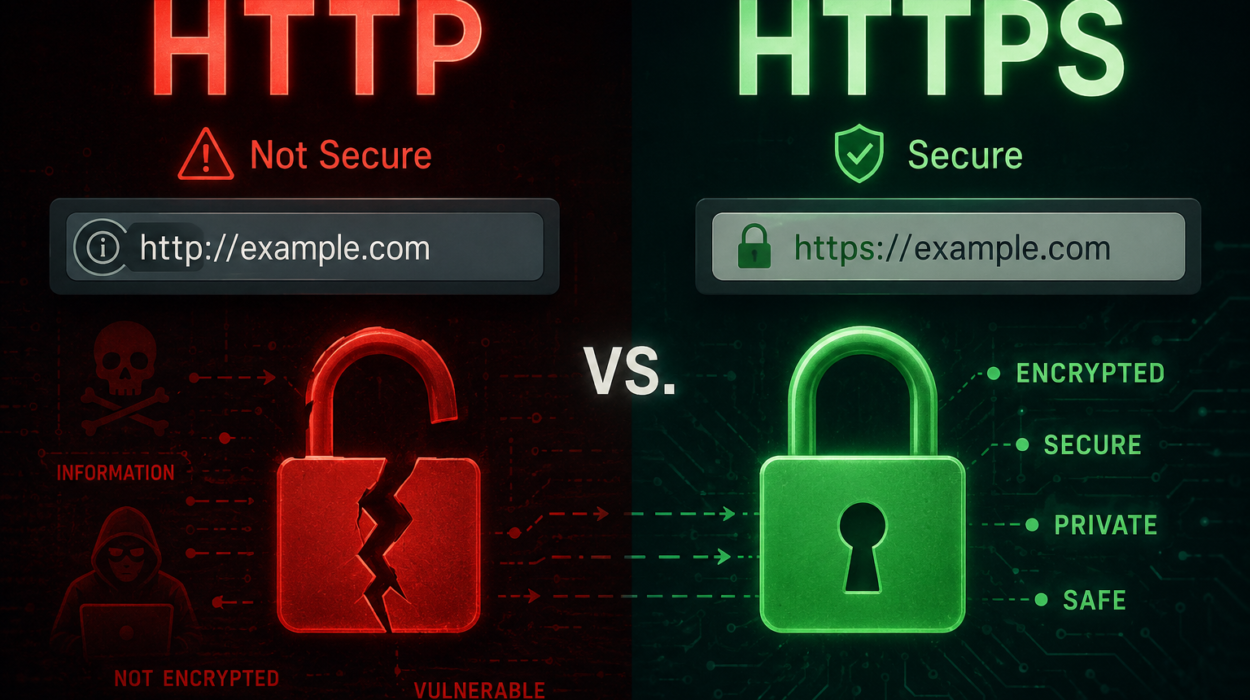
Today, virtually all websites use HTTPS rather than unencrypted HTTP.
Both HTTP/2 and HTTP/3 support secure encrypted communication.
However, HTTP/3 requires modern TLS 1.3 encryption as an integral part of QUIC.
This simplifies secure communication while improving both performance and security.
Encryption protects sensitive information such as passwords, banking details, online purchases, and personal messages from interception during transmission.
Reliability
Both HTTP/2 and HTTP/3 are highly reliable.
HTTP/2 benefits from TCP’s mature reliability mechanisms that have been refined over several decades.
HTTP/3 achieves comparable reliability through QUIC while improving efficiency under difficult network conditions.
Both protocols ensure that webpages arrive accurately.
The primary difference lies in how efficiently they recover from delays and packet loss.
Website Compatibility
Today, most major browsers support both HTTP/2 and HTTP/3.
Modern versions of Chrome, Firefox, Safari, Microsoft Edge, and Opera all support HTTP/3 when websites provide it.
Many major web hosting companies, content delivery networks (CDNs), and cloud platforms have also adopted HTTP/3.
When available, browsers automatically negotiate the newest protocol supported by both the browser and the server.
Users rarely need to configure anything manually.
Do Websites Become Faster With HTTP/3?
In many situations, yes.
The improvement depends on network conditions.
On fast, stable wired broadband connections, users may notice only modest speed differences between HTTP/2 and HTTP/3.
However, on mobile networks, congested public Wi-Fi, international connections, or networks experiencing packet loss, HTTP/3 often provides noticeably faster loading and improved responsiveness.
Its greatest advantages appear when network quality is less than ideal.
HTTP/2 vs HTTP/3 for Streaming
Streaming services deliver enormous amounts of audio and video data.
Buffering and interruptions often occur because of changing network conditions.
HTTP/3’s improved handling of packet loss and reduced connection latency make it particularly well suited for video streaming.
Many streaming platforms now support HTTP/3 because it helps provide smoother playback, especially for mobile users.
HTTP/2 vs HTTP/3 for Online Gaming
Although many online games use specialized networking protocols instead of HTTP, game launchers, updates, account management systems, cloud gaming platforms, and web-based game services benefit from HTTP/3.
Lower latency and improved packet handling contribute to faster downloads and more responsive cloud services.
HTTP/2 vs HTTP/3 for Large Websites
Large websites often contain thousands of resources spread across numerous servers.
HTTP/3’s improved connection handling reduces delays when loading complex pages.
Content delivery networks also benefit because users connect from diverse geographic regions with varying network quality.
For global websites serving millions of visitors, even small performance improvements can significantly enhance user experience.
Challenges of HTTP/3
Despite its advantages, HTTP/3 also introduces new complexity.
Because QUIC is relatively new compared with TCP, network administrators have needed to update infrastructure, monitoring tools, and security systems.
Firewalls, load balancers, and diagnostic software required modifications to fully support QUIC traffic.
Fortunately, adoption has grown steadily, and support continues expanding across the internet.
Is HTTP/2 Becoming Obsolete?
Not at all.
HTTP/2 remains an excellent protocol and continues serving a large portion of global web traffic.
Many websites still use HTTP/2 successfully.
Its performance is already vastly superior to HTTP/1.1 for most modern applications.
HTTP/3 is better viewed as an evolution rather than a replacement.
Browsers automatically fall back to HTTP/2 whenever HTTP/3 is unavailable.
This ensures compatibility across virtually all websites.
Which Protocol Is Better?
From a technical perspective, HTTP/3 represents the more advanced protocol.
Its use of QUIC provides lower latency, better packet-loss recovery, faster secure connection establishment, improved mobile performance, and elimination of TCP’s head-of-line blocking.
However, HTTP/2 remains highly capable.
For many users on reliable broadband connections, the practical difference may be relatively small.
Both protocols dramatically outperform older HTTP versions and provide fast, secure browsing experiences.
Rather than competing against each other, HTTP/2 and HTTP/3 work together during the internet’s ongoing transition toward newer networking technologies.
The Future of Web Communication
The evolution from HTTP/2 to HTTP/3 reflects a broader trend in internet engineering: designing communication systems that are faster, more resilient, and better suited for today’s mobile, global, and cloud-connected world.
As websites continue to grow more interactive and users increasingly rely on wireless networks, protocols must adapt to changing demands. HTTP/3 addresses many of the limitations that became apparent as the web expanded beyond the capabilities envisioned when TCP-based HTTP was first developed.
Although most users will never see HTTP/2 or HTTP/3 mentioned while browsing, these protocols quietly shape every online experience. They help webpages appear faster, videos stream more smoothly, online applications respond more quickly, and secure connections establish with less delay.
In the end, both HTTP/2 and HTTP/3 share the same goal: delivering the modern web as efficiently, reliably, and securely as possible. HTTP/2 laid the foundation for a faster internet, while HTTP/3 builds upon that foundation with a new generation of networking technology designed for the future of the web.