Electric vehicles have already transformed the way people think about transportation. Instead of stopping at gas stations, drivers can simply plug their cars into a charger at home, at work, or at public charging stations. But what if charging an electric vehicle required no cable at all? Imagine pulling into a parking space, stepping out of your car, and knowing that your battery is already charging without plugging in a single wire.
This is not science fiction. Wireless electric vehicle (EV) charging is a real technology that is steadily moving from research laboratories into everyday life. Engineers around the world are developing systems that can recharge electric vehicles simply by parking over a charging pad—or even while driving on specially equipped roads.
Wireless EV charging promises a future where charging becomes almost effortless. While the technology still faces challenges, it represents one of the most exciting innovations in the evolution of electric transportation.
What Is Wireless EV Charging?
Wireless EV charging is a method of transferring electrical energy from a power source to an electric vehicle without using a physical cable.
Instead of plugging a charging connector into the vehicle, electricity moves through the air using magnetic fields. The process is often called wireless power transfer or inductive charging.
Although the idea sounds futuristic, many people already use a similar technology every day. Wireless charging pads for smartphones use the same basic scientific principle, though EV charging systems operate at much higher power levels.
The goal is simple: make charging as easy as parking.
Why Wireless Charging Is Being Developed
Traditional EV charging works well, but it still requires drivers to connect and disconnect charging cables. In bad weather, this can be inconvenient. Charging cables can also become damaged, worn, or difficult for some people to handle.
Wireless charging aims to remove these barriers.
Instead of thinking about plugging in every time the vehicle is parked, the charging process becomes almost automatic.
For people with limited mobility, wireless charging can make electric vehicles much easier to use. It can also reduce wear on charging connectors and simplify charging in public spaces.
In the future, roads equipped with wireless charging technology may even recharge vehicles while they are moving, reducing the need for very large batteries.
The Science Behind Wireless EV Charging
Wireless EV charging is based on a principle called electromagnetic induction.
This phenomenon was discovered in the nineteenth century by the British scientist Michael Faraday, whose work laid the foundation for modern electrical engineering.
Electromagnetic induction occurs when a changing magnetic field creates an electric current in a nearby conductor.
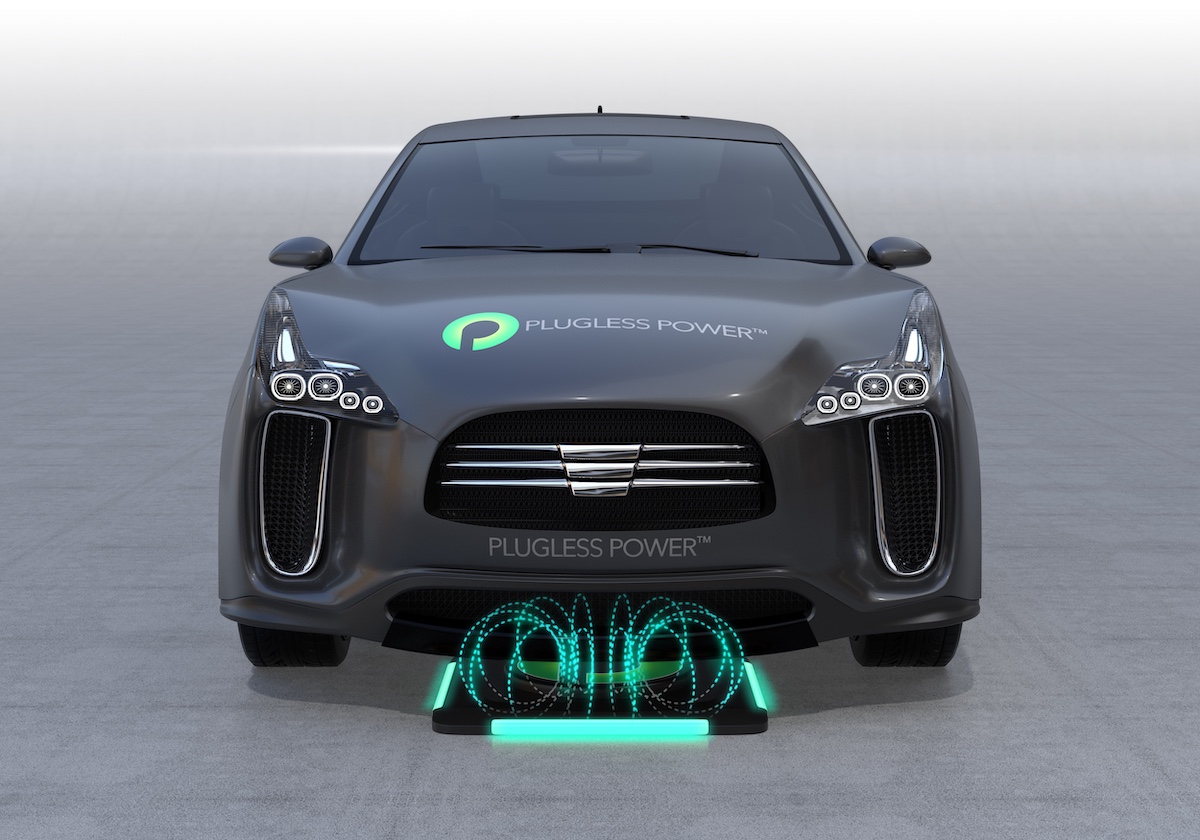
In wireless charging systems, electricity first flows into a coil of wire located inside a charging pad on or beneath the ground. This electricity creates a rapidly changing magnetic field.
A second coil, installed underneath the electric vehicle, enters this magnetic field when the vehicle is positioned over the charging pad.
The magnetic field then induces an electric current in the vehicle’s receiving coil.
That electrical energy is converted into power for charging the battery.
Although electricity never jumps directly through the air, the magnetic field acts as the invisible bridge that transfers energy between the charging pad and the vehicle.
The Main Components of a Wireless Charging System
Every wireless EV charging system contains several essential parts that work together.
The first component is the ground charging pad, sometimes called the transmitter. It connects to the electrical grid and produces the magnetic field.
The second component is the vehicle receiver, mounted underneath the electric car. This receiver captures the magnetic energy produced by the charging pad.
Power electronics carefully control the electricity flowing between the grid and the charging system. These electronic circuits convert electricity into the proper form for efficient energy transfer.
The vehicle’s battery management system continuously monitors charging conditions. It regulates voltage, current, battery temperature, and charging speed to ensure the battery charges safely.
Communication software also plays an important role. Before charging begins, the vehicle and charging station exchange information to confirm proper alignment, verify safety conditions, and determine the appropriate charging power.
Why Alternating Current Is Used
Wireless charging relies on alternating current (AC) rather than direct current (DC).
This is because only a changing electric current can create the changing magnetic field needed for electromagnetic induction.
The charging station converts incoming electrical power into a high-frequency alternating current. This rapidly changing current generates an oscillating magnetic field around the transmitting coil.
When this magnetic field reaches the receiving coil beneath the vehicle, it generates electricity that is converted into the form needed to recharge the battery.
Without alternating current, wireless power transfer would not function efficiently.
The Importance of Resonance
One of the biggest advances in wireless EV charging is the use of magnetic resonance.
Resonance occurs when two systems naturally oscillate at the same frequency.
If both the transmitting coil and receiving coil are carefully tuned to the same frequency, energy transfers much more efficiently.
This allows more electricity to reach the vehicle while reducing wasted energy.
Resonant charging also makes the system more tolerant of small positioning errors.
Drivers do not need to park with perfect precision because the magnetic field can still transfer energy effectively even if the coils are not perfectly aligned.
Parking Position Matters
Although wireless charging does not require cables, vehicle positioning still affects performance.
The transmitting and receiving coils work best when they are closely aligned.
If the vehicle parks too far away from the charging pad or at an incorrect angle, charging efficiency decreases.
Modern systems often include parking guidance technologies that help drivers position their vehicles correctly.
Some systems use cameras, sensors, or dashboard displays to guide the driver into the optimal charging position.
Future autonomous parking technologies may perform this alignment automatically.
How Efficient Is Wireless EV Charging?
One of the most common questions is whether wireless charging wastes more electricity than conventional charging.
The answer is encouraging.
Modern wireless EV charging systems can achieve efficiencies greater than 90% under ideal conditions. While this is generally slightly lower than the efficiency of high-quality wired charging, the difference has become much smaller as the technology has improved.
Engineers continue working to reduce energy losses by improving coil design, power electronics, and control software.
For many users, the convenience of automatic charging may outweigh the small reduction in efficiency.
Charging Speed
Wireless EV charging can support a variety of charging speeds.
Lower-power systems are suitable for overnight home charging.
Higher-power systems are designed for commercial parking areas, workplaces, taxi fleets, and public charging stations.
Some experimental systems are capable of delivering power levels comparable to many wired chargers.
As technology advances, charging speeds continue to improve while maintaining safe operation.
Static Wireless Charging
The simplest form of wireless charging is called static charging.
The vehicle remains parked while charging takes place.
This approach works well in homes, office parking lots, shopping centers, airports, hotels, and public parking facilities.
Whenever the vehicle is stationary over the charging pad, electricity flows automatically into the battery.
Static charging is currently the most commercially available form of wireless EV charging.
Dynamic Wireless Charging
One of the most exciting areas of research is dynamic wireless charging.
Instead of charging while parked, vehicles receive electricity while driving over specially equipped roads.
Embedded charging coils beneath the road surface generate magnetic fields that transfer power to vehicles moving above them.
If successfully deployed on a large scale, dynamic charging could dramatically reduce range anxiety because vehicles would continuously receive energy during travel.
This approach could also reduce battery size requirements, lowering vehicle weight and manufacturing costs.
However, building charging roads requires major infrastructure investments and remains in the early stages of development.
Safety of Wireless EV Charging
Because wireless charging involves magnetic fields, many people wonder whether it is safe.
Modern systems are designed with multiple layers of protection.
The magnetic fields are carefully controlled and concentrated between the transmitting and receiving coils.
Charging typically begins only after communication between the vehicle and charging station confirms proper alignment.
If a foreign object such as a metal tool or another obstacle is detected between the coils, the system can automatically stop charging.
International safety standards also limit electromagnetic exposure to ensure that wireless charging systems operate safely for drivers, passengers, and nearby pedestrians.
What Happens If It Rains?
Unlike traditional charging cables, wireless charging systems are designed to operate in outdoor environments.
The charging pads are sealed against rain, snow, dust, and dirt.
Since there are no exposed electrical connectors involved during charging, wireless systems can reduce certain weather-related concerns.
Engineers carefully design the equipment to withstand years of outdoor use under changing environmental conditions.
Advantages of Wireless EV Charging
Wireless charging offers several practical benefits.
The greatest advantage is convenience.
Drivers no longer need to handle charging cables every day.
Charging can begin automatically as soon as the vehicle is properly parked.
The absence of cables also reduces wear on mechanical connectors.
Wireless systems may improve accessibility for older adults and people with physical disabilities who find heavy charging cables difficult to manage.
For commercial fleets, automatic charging reduces human effort and simplifies daily operations.
As autonomous vehicles become more common, wireless charging may become essential because driverless cars cannot manually plug themselves into charging stations.
Challenges Facing Wireless Charging
Despite its promise, wireless EV charging still faces important challenges.
Installing underground charging pads is generally more expensive than installing conventional charging stations.
Vehicle manufacturers must integrate receiving coils into their designs, adding complexity and cost.
Charging efficiency, although high, can still be slightly lower than wired charging under some conditions.
Standardization is another challenge.
Different manufacturers must develop compatible technologies so vehicles can charge on equipment produced by different companies.
Large-scale deployment also requires significant infrastructure investment.
As production increases and technology matures, many experts expect costs to gradually decrease.
Wireless Charging at Home
Home wireless charging systems are becoming increasingly available in some markets.
A charging pad is installed in the garage or driveway.
Drivers simply park above it.
Once the vehicle is correctly positioned, charging begins automatically.
This removes the daily habit of plugging in the vehicle and creates a seamless charging experience.
Smart home systems can also schedule charging during periods of lower electricity demand, helping reduce charging costs in regions with time-based electricity pricing.
Wireless Charging in Public Places
Public wireless charging stations could become common in locations where vehicles remain parked for extended periods.
Shopping centers, office buildings, airports, hotels, hospitals, and train stations are all potential locations.
Instead of installing numerous charging posts with cables, parking spaces could include hidden charging pads beneath the pavement.
Drivers may not even notice the charging equipment as their vehicles recharge automatically during normal daily activities.
Wireless Charging for Buses and Commercial Vehicles
Public transportation is one of the most promising applications of wireless charging.
Electric buses often follow fixed routes and stop at designated stations.
Wireless charging pads installed beneath bus stops can recharge batteries during routine passenger boarding.
Even short charging sessions repeated throughout the day can significantly extend vehicle range.
Commercial delivery vehicles, warehouse equipment, autonomous robots, and airport service vehicles may also benefit from automatic charging.
Environmental Benefits
Wireless charging itself does not produce electricity.
Its environmental impact depends largely on the electricity source powering the grid.
When combined with renewable energy such as solar, wind, or hydropower, wireless charging can support cleaner transportation with lower greenhouse gas emissions.
Automatic charging may also encourage more frequent charging sessions, helping maintain healthier battery charge levels and improving battery management.
As renewable electricity generation expands worldwide, wireless charging could become part of a more sustainable transportation system.
The Future of Wireless EV Charging
Research into wireless charging continues to advance rapidly.
Engineers are developing lighter coils, more efficient electronics, improved alignment systems, and faster charging capabilities.
Artificial intelligence may help optimize charging performance by predicting vehicle positioning and adjusting power delivery in real time.
Future smart cities may integrate wireless charging directly into parking spaces, taxi stands, bus stations, and selected roadways.
As autonomous vehicles become more common, wireless charging may evolve from a convenient feature into a necessary part of transportation infrastructure.
The long-term vision is a world where electric vehicles remain charged almost continuously, with minimal effort required from drivers.
How Wireless EV Charging Could Change Transportation
Wireless electric vehicle charging represents much more than simply removing a charging cable. It changes the relationship between drivers and their vehicles by making energy transfer almost invisible. Instead of planning charging sessions around cables and connectors, charging becomes a natural part of parking—or eventually, even driving.
The science behind this technology is rooted in well-established principles of electromagnetic induction, yet decades of engineering innovation have transformed those principles into practical systems capable of safely delivering substantial amounts of electrical power. While challenges related to cost, infrastructure, and standardization remain, continued research is steadily improving performance and expanding real-world applications.
As electric vehicles become more widespread and renewable energy continues to grow, wireless charging has the potential to make clean transportation even more convenient. It offers a glimpse of a future in which vehicles quietly recharge in the background, allowing people to focus less on the act of charging and more on the journey itself.