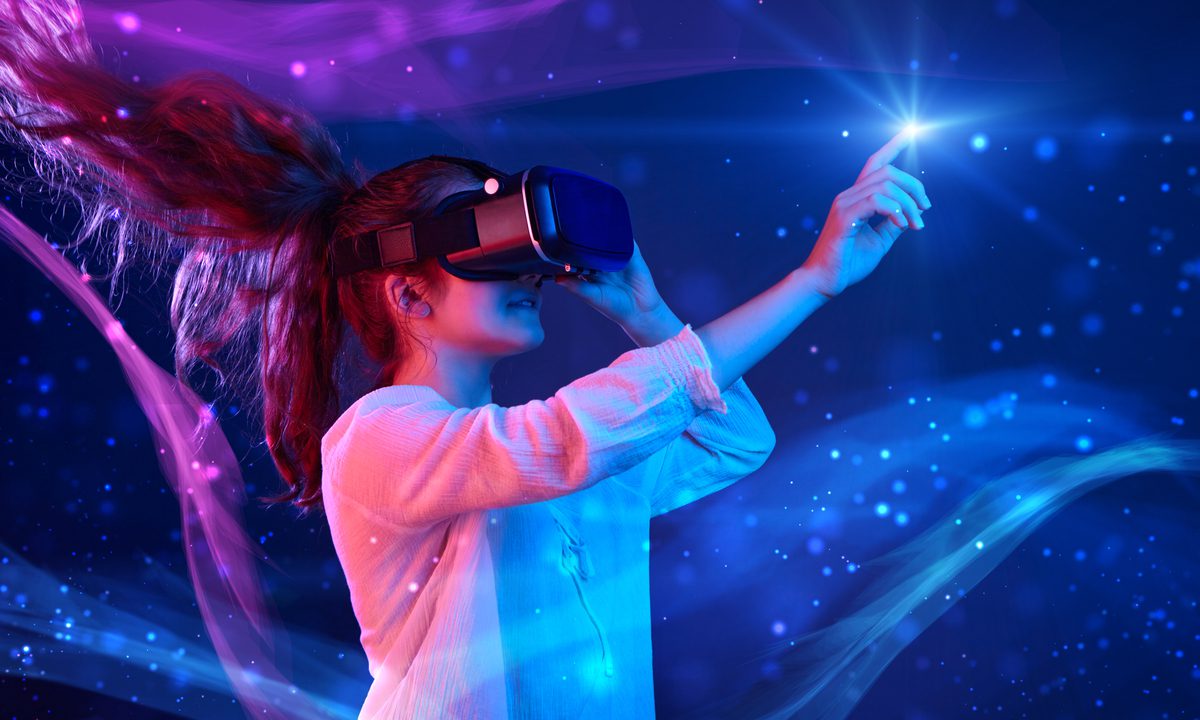
Imagine putting on a lightweight headset and seeing your living room transformed into a place where digital objects appear as real as your furniture. A virtual computer screen floats above your desk. A life-sized dinosaur walks across the floor without bumping into your sofa. A digital assistant sits beside you, responding naturally as you move around the room. As you reach out, virtual buttons react to your fingers, and digital objects stay exactly where you left them, even when you walk away and return later.
This is the promise of Mixed Reality (MR)—a technology that blends the physical and digital worlds into one shared environment. Unlike traditional digital experiences, Mixed Reality allows virtual objects to understand, interact with, and become part of the real world. It creates experiences that feel remarkably natural because the virtual world is no longer separate from reality—it exists within it.
Mixed Reality is one of the most exciting advances in modern computing. It combines innovations from computer vision, artificial intelligence, sensors, graphics, and spatial computing to create experiences that were once possible only in science fiction. Understanding how Mixed Reality works reveals not only the technology behind these experiences but also how the future of computing may change the way we work, learn, communicate, and explore.
What Is Mixed Reality?
Mixed Reality is a technology that combines the real world with computer-generated digital content, allowing both to interact in real time.
Unlike traditional screens that separate users from digital information, Mixed Reality places digital objects directly into the physical environment. These objects are not simply displayed in front of the user—they appear to exist within the real world and respond naturally to their surroundings.
For example, a virtual chair can appear to sit on your actual floor. A digital globe can rest on your table. A virtual pet can walk around your room while avoiding real furniture.
The key difference is interaction. Digital objects are aware of the physical world and behave accordingly.
Mixed Reality exists between two other immersive technologies.
Virtual Reality (VR) completely replaces the real world with a computer-generated environment. When wearing a VR headset, users cannot normally see their physical surroundings.
Augmented Reality (AR) overlays digital information onto the real world, such as showing navigation arrows on a phone screen or displaying labels above objects.
Mixed Reality goes a step further by making digital objects understand and respond to the real environment, creating a seamless blend between physical and virtual worlds.
The Core Idea Behind Mixed Reality
Mixed Reality works because computers continuously answer three important questions.
First, where is the user?
Second, what does the surrounding environment look like?
Third, how should digital objects behave inside that environment?
Every second, the system collects enormous amounts of information from cameras, sensors, and processors to answer these questions. Once it understands both the user and the environment, it creates digital content that appears stable, realistic, and interactive.
This process happens so quickly that users experience it as a natural extension of reality.
Seeing the Real World
One of the most important abilities of a Mixed Reality system is seeing the environment.
Modern MR headsets contain multiple cameras that constantly observe the surroundings from different angles. These cameras capture walls, floors, furniture, doors, windows, people, and many other objects.
Unlike ordinary cameras that simply record images, MR cameras help computers understand three-dimensional space.
Some cameras capture color images similar to human vision.
Others measure depth, allowing the system to determine how far away objects are.
Together, they provide a detailed understanding of the user’s environment.
Understanding Space
Capturing images is only the beginning.
Mixed Reality systems must also understand the shape of the environment.
This process is called spatial mapping.
The computer analyzes information from cameras and depth sensors to build a three-dimensional digital model of the room.
Walls become virtual surfaces.
Tables become recognized objects.
Floors become stable ground.
Ceilings become part of the digital map.
As users move around, the map becomes increasingly detailed.
The result is a continuously updated representation of the physical world.
Because the headset understands the room, it knows exactly where digital objects should appear.
Tracking the User
Mixed Reality also needs to know the precise position of the user at every moment.
If the headset loses track of where the user is, digital objects would appear to drift, shake, or float incorrectly.
To prevent this, MR systems use inside-out tracking.
Instead of relying on external cameras placed around a room, the headset tracks its own movement using built-in cameras and motion sensors.
These sensors include accelerometers, gyroscopes, and sometimes magnetometers.
Accelerometers measure changes in movement.
Gyroscopes measure rotation.
Together they detect even tiny head movements.
Meanwhile, cameras compare new images with previous ones, allowing the headset to calculate exactly where it is located.
This continuous process happens hundreds or even thousands of times every second.
Simultaneous Localization and Mapping
One of the most important technologies behind Mixed Reality is Simultaneous Localization and Mapping, commonly called SLAM.
SLAM allows a computer to perform two tasks at the same time.
It creates a map of the environment while simultaneously determining its own position within that map.
Imagine entering a room for the first time.
As you walk around, the headset learns the layout while also tracking your movements.
Even if you leave and return later, many systems can remember parts of the environment.
SLAM is essential because it keeps digital objects anchored in fixed positions.
Without it, virtual objects would constantly shift or disappear.
Depth Perception
Humans naturally perceive depth using both eyes.
Mixed Reality systems imitate this ability through depth sensors and stereo cameras.
Some devices use time-of-flight sensors, which measure how long light takes to travel to an object and return.
Others use structured light or stereo vision.
These technologies create detailed depth maps showing the exact distance to nearby objects.
Knowing depth allows virtual objects to interact naturally with the real environment.
For example, a digital ball can bounce off a real wall instead of passing through it.
Computer Vision
Mixed Reality relies heavily on computer vision, a field of artificial intelligence that enables computers to interpret visual information.
Computer vision allows MR devices to recognize surfaces, objects, furniture, doors, hands, faces, and even certain gestures.
Instead of simply seeing pixels, the computer understands what those pixels represent.
It can identify a table as a table.
It can recognize a person’s hands.
It can distinguish the floor from a wall.
This understanding creates far more realistic interactions between digital and physical objects.
Artificial Intelligence
Artificial intelligence makes Mixed Reality much smarter.
AI algorithms help recognize objects, predict movement, understand spoken language, identify hand gestures, and improve environmental understanding.
For example, if someone places a coffee mug on a table, AI may recognize it as a mug rather than just an unknown shape.
Voice assistants inside MR systems use natural language processing to understand spoken commands.
Machine learning continuously improves object recognition and tracking accuracy.
As AI advances, Mixed Reality becomes increasingly realistic and responsive.
Rendering Digital Objects
Once the headset understands the environment, it must create digital images.
This process is called rendering.
Powerful graphics processors generate three-dimensional models with realistic lighting, textures, shadows, reflections, and animations.
The images are updated continuously as users move their heads.
If you walk closer to a virtual object, it appears larger.
If you walk around it, you see different sides.
Just like real objects, virtual objects follow the rules of perspective.
Modern rendering engines calculate millions of graphical operations every second to maintain realistic experiences.
Display Technology
Mixed Reality headsets use advanced display systems to present digital content.
Some devices use transparent lenses that allow users to see the real world while digital images are projected onto the lenses.
Others use high-resolution cameras that capture the outside world and display it on internal screens together with computer-generated graphics. This approach is known as video passthrough.
Both methods aim to make digital objects appear naturally integrated with the physical environment.
High-resolution displays reduce visible pixels, while fast refresh rates create smoother motion and reduce motion sickness.
Eye Tracking
Many advanced Mixed Reality headsets include eye tracking.
Tiny infrared cameras observe the movement of the user’s eyes.
Eye tracking provides several advantages.
The system knows exactly where the user is looking.
It can adjust image quality accordingly.
It allows more natural interaction by selecting objects simply through gaze.
Eye tracking also improves efficiency through foveated rendering.
Since human vision sees the highest detail only at the center of focus, the headset renders that area in maximum quality while reducing detail elsewhere.
This significantly reduces computing requirements.
Hand Tracking
Instead of requiring controllers, many Mixed Reality devices recognize hand movements directly.
Cameras observe fingers, palms, and hand positions.
Artificial intelligence identifies gestures such as pointing, pinching, grabbing, or tapping.
Users can pick up virtual objects, press digital buttons, or rotate three-dimensional models using natural hand movements.
This creates interactions that feel much closer to everyday experiences.
Voice Recognition
Speaking naturally has become another important way of interacting with Mixed Reality.
Microphones capture speech while AI interprets spoken commands.
Users can open applications, move virtual objects, search for information, or control digital assistants without touching anything.
Modern speech recognition has become highly accurate, allowing conversations with virtual systems to feel increasingly natural.
Spatial Audio
Vision is only one part of immersion.
Mixed Reality also uses spatial audio.
Instead of hearing sound equally through both ears, users hear audio coming from specific locations.
If a virtual bird sits behind you, its song appears to come from behind.
If a digital person stands beside you, their voice comes from that direction.
Spatial audio helps convince the brain that virtual objects occupy real space.
Physics Simulation
Digital objects behave realistically because MR systems simulate physical laws.
Virtual balls fall due to gravity.
Objects collide with walls.
Digital water flows naturally.
Virtual cloth bends and folds.
Physics engines calculate these behaviors using mathematical models based on real-world physics.
Although simplified, these simulations create convincing interactions.
Real-Time Processing
One of the greatest challenges in Mixed Reality is speed.
Every image, sensor reading, movement, voice command, and gesture must be processed almost instantly.
If delays become noticeable, digital objects appear unstable or disconnected from reality.
This delay is called latency.
Engineers work to keep latency extremely low, often below a few milliseconds.
Fast processors, specialized graphics chips, and optimized software all contribute to maintaining smooth experiences.
Cloud Computing and Mixed Reality
Some Mixed Reality applications use cloud computing.
Instead of performing every calculation inside the headset, certain tasks are sent to powerful remote servers.
The cloud can process complex graphics, artificial intelligence models, and large datasets before returning results.
This allows smaller headsets to perform advanced tasks without requiring extremely powerful onboard hardware.
As internet speeds continue improving, cloud-assisted Mixed Reality is expected to become more common.
Networking Shared Experiences
Mixed Reality is not limited to one person.
Multiple users can enter the same digital environment while remaining in different physical locations.
Each participant sees shared virtual objects positioned consistently.
People can collaborate on engineering designs, medical procedures, educational lessons, or business meetings.
This capability creates entirely new forms of teamwork where distance becomes far less important.
Mixed Reality in Education
Education is one of the most exciting applications of Mixed Reality.
Students can examine life-sized human anatomy without needing real specimens.
They can explore the Solar System from inside a classroom.
Ancient civilizations can appear around them as interactive reconstructions.
Complex scientific concepts become easier to understand because learners can interact directly with three-dimensional models.
Research suggests that immersive learning can improve engagement and understanding, especially for subjects involving spatial relationships.
Mixed Reality in Medicine
Healthcare increasingly benefits from Mixed Reality.
Surgeons can view three-dimensional medical images during operations.
Medical students can practice procedures using realistic virtual patients.
Doctors can visualize organs beneath a patient’s skin using advanced imaging.
Rehabilitation programs can guide patients through interactive exercises.
These applications help improve training, planning, and patient care while reducing risks.
Mixed Reality in Industry
Factories, construction sites, and engineering companies use Mixed Reality to improve productivity.
Workers can view assembly instructions directly beside machinery.
Engineers can inspect digital prototypes before manufacturing begins.
Architects can walk through buildings before construction starts.
Maintenance technicians can receive step-by-step guidance while repairing complex equipment.
These capabilities reduce errors, save time, and improve efficiency.
Mixed Reality for Entertainment
Gaming has become one of the most visible uses of Mixed Reality.
Instead of playing inside a screen, players become part of the game itself.
Virtual creatures explore real rooms.
Digital puzzles appear on actual tables.
Interactive adventures blend fantasy with everyday surroundings.
Movies, concerts, museums, and theme parks are also exploring Mixed Reality to create immersive experiences that engage audiences in entirely new ways.
Challenges Facing Mixed Reality
Although Mixed Reality has advanced rapidly, several challenges remain.
Creating realistic graphics requires enormous computing power.
Headsets must become lighter, more comfortable, and more affordable.
Battery life remains limited.
Accurate tracking can become difficult in certain lighting conditions.
Privacy is another important concern because MR devices continuously observe their surroundings using cameras and sensors. Protecting this information responsibly is essential as the technology becomes more widespread.
Researchers continue working to improve hardware, software, energy efficiency, security, and user comfort.
The Future of Mixed Reality
Mixed Reality is still in its early stages, but its future appears remarkably promising.
Future headsets may become as light as ordinary eyeglasses while providing ultra-high-resolution displays, wider fields of view, faster processors, and more intelligent artificial intelligence.
Advances in computer vision, graphics, wireless communication, and wearable technology will make digital experiences increasingly seamless.
Eventually, digital information may appear naturally throughout daily life, helping people learn, work, navigate, communicate, design, and create without interrupting their connection to the physical world.
Instead of replacing reality, Mixed Reality aims to enrich it.
Why Understanding How Mixed Reality Works Matters
Mixed Reality represents much more than a new type of display. It is a new way for humans to interact with computers. Rather than looking at flat screens, people can engage with digital information as if it exists naturally within the world around them. This transformation is possible because of the remarkable combination of cameras, sensors, artificial intelligence, spatial mapping, computer vision, graphics rendering, motion tracking, and real-time processing working together in perfect coordination.
Every virtual object that appears stable on a table, every digital character that walks around a room, and every interactive hologram that responds to a simple hand gesture is the result of thousands of complex calculations happening every second. As these technologies continue to improve, the boundary between the physical and digital worlds will become increasingly difficult to notice.
Mixed Reality is not merely changing how computers display information—it is changing how humans experience information itself. As science and technology continue to advance, Mixed Reality is likely to become one of the defining computing platforms of the twenty-first century, opening new possibilities that today are only beginning to emerge.