Every time you open a website, stream a movie, send a message, or connect a smart device to Wi-Fi, something remarkable happens behind the scenes. Your device finds another device somewhere else in the world, communicates with it, exchanges data, and displays the information you requested—all within a fraction of a second.
This incredible process depends on one essential technology: the Internet Protocol, or IP. It is the addressing system that allows every device connected to the internet to identify itself and communicate with others.
For decades, the world relied on Internet Protocol version 4 (IPv4). It served the internet remarkably well during its rapid growth, but it was never designed for a world with billions of smartphones, laptops, smart TVs, connected cars, industrial sensors, and Internet of Things (IoT) devices.
To support the modern internet and prepare for the future, engineers developed Internet Protocol version 6, better known as IPv6. It is not simply an updated version of IPv4—it is a fundamental redesign of internet addressing and networking that enables virtually unlimited growth while improving efficiency, scalability, and connectivity.
Understanding how IPv6 works reveals one of the most important technologies quietly powering today’s internet and tomorrow’s digital world.
What Is IPv6?
IPv6 is the sixth version of the Internet Protocol, the communication standard responsible for identifying devices and routing data across networks.
Every device connected to the internet needs an IP address, much like every home needs a postal address. Without an address, information would have no destination.
IPv6 provides these addresses.
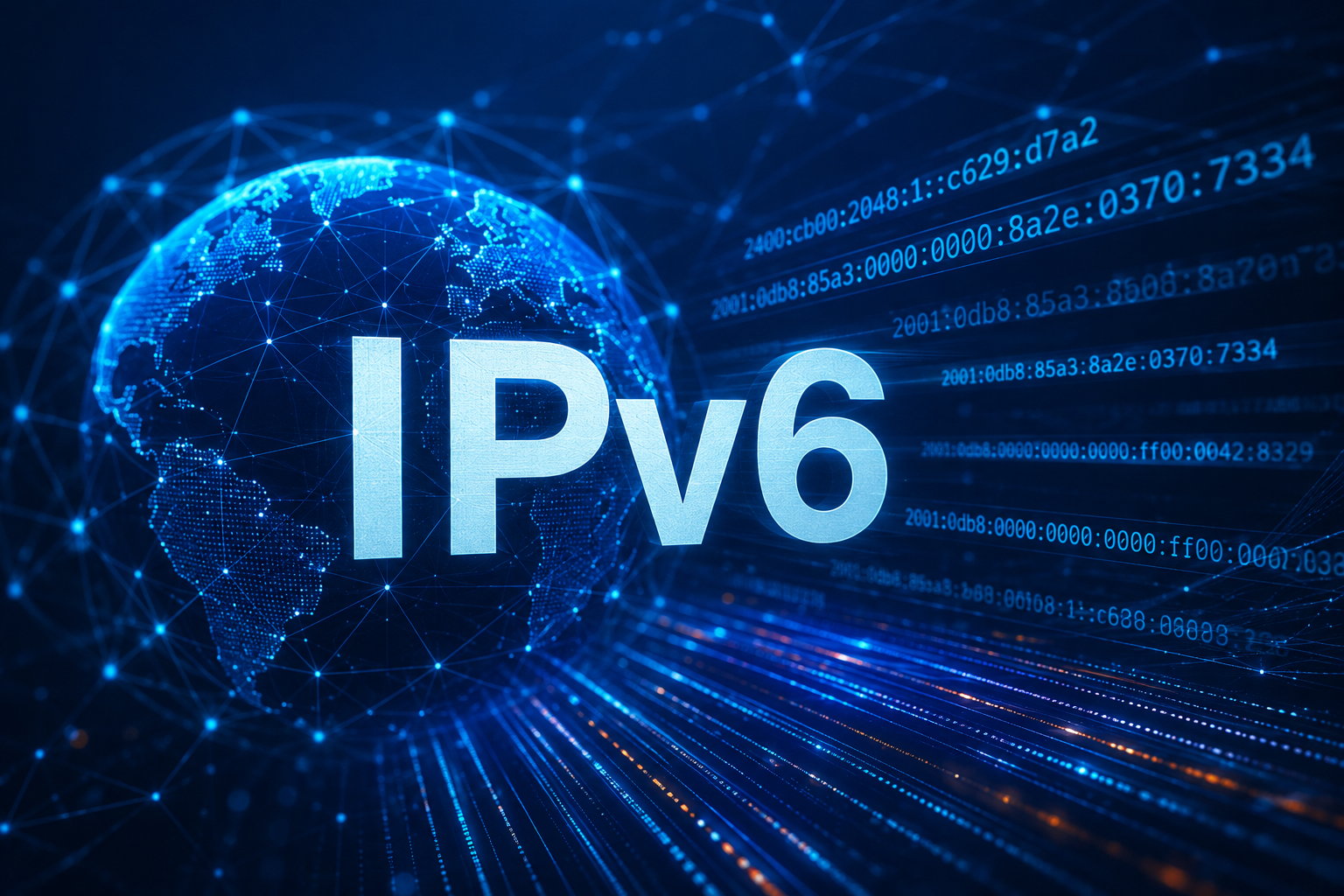
Unlike IPv4, which uses 32-bit addresses, IPv6 uses 128-bit addresses. This dramatic increase creates an unimaginably large pool of unique addresses, ensuring there are enough for every internet-connected device for the foreseeable future.
IPv6 was standardized by the Internet Engineering Task Force (IETF) in the late 1990s after experts recognized that IPv4 addresses would eventually run out.
Today, IPv6 is being deployed worldwide by internet service providers, cloud platforms, mobile carriers, governments, universities, and major technology companies.
Why the Internet Needed IPv6
When IPv4 was introduced in 1981, very few people imagined today’s internet.
At that time, computers were expensive, networks were small, and the World Wide Web did not yet exist.
IPv4 offers approximately 4.3 billion unique addresses.
Although four billion sounds enormous, the internet eventually grew far beyond those expectations.
Today, billions of people own multiple internet-connected devices. Homes often contain smartphones, laptops, tablets, televisions, gaming consoles, smart speakers, security cameras, watches, thermostats, and appliances—all requiring network connectivity.
Businesses operate millions of servers.
Factories use connected sensors.
Cities deploy intelligent traffic systems.
Scientists connect research equipment around the globe.
As the Internet of Things expanded, the available IPv4 address space became increasingly scarce.
IPv6 solved this limitation by introducing an address space so vast that address exhaustion is effectively impossible on any practical timescale.
Understanding an IPv6 Address
An IPv6 address looks very different from an IPv4 address.
An IPv4 address appears as four decimal numbers separated by periods.
For example:
192.168.1.1
An IPv6 address consists of eight groups of hexadecimal numbers separated by colons.
A typical IPv6 address might look like this:
2001:0db8:85a3:0000:0000:8a2e:0370:7334
Hexadecimal uses sixteen symbols:
0–9 and A–F.
Each hexadecimal digit represents four binary bits, allowing IPv6 addresses to store much more information than IPv4 addresses.
Although these addresses appear long, special rules allow many zeros to be shortened, making them easier to read.
For example:
2001:db8:85a3::8a2e:370:7334
Both addresses represent the same destination.
How Large Is the IPv6 Address Space?
The scale of IPv6 is difficult to imagine.
IPv6 provides approximately 340 undecillion unique addresses.
Written as a number, this is:
340,282,366,920,938,463,463,374,607,431,768,211,456
This number is so enormous that every grain of sand on Earth could theoretically have billions of billions of unique IP addresses assigned to it.
In practical terms, IPv6 ensures that humanity will not run out of internet addresses even as billions of new devices continue connecting to global networks.
How Devices Receive an IPv6 Address
When a computer, smartphone, or smart device connects to an IPv6-enabled network, it first needs an address.
IPv6 offers several methods for obtaining one.
In many home and office networks, routers automatically advertise available network information.
A newly connected device listens for these announcements and creates its own address using a process called Stateless Address Autoconfiguration (SLAAC).
Instead of asking a server for an address, the device generates one by combining information about the network with a unique identifier.
This process requires very little manual configuration.
Alternatively, organizations may use DHCPv6, a protocol that automatically assigns IPv6 addresses similarly to how DHCP works with IPv4.
Large enterprises often choose DHCPv6 because it allows centralized management of network configurations.
How IPv6 Routes Data
Once every device has an address, communication can begin.
Suppose you open your favorite website.
Your browser first determines the website’s IPv6 address using the Domain Name System (DNS).
Instead of remembering long addresses, people simply type names such as example.com.
DNS translates these names into IPv6 addresses.
Your device then creates packets containing the requested information.
Each packet includes both the source IPv6 address and the destination IPv6 address.
Routers across the internet examine the destination address and determine the best available path toward its destination.
Each router forwards the packet closer to its target.
Eventually, the packet reaches the destination server.
The server processes the request and sends response packets back to your device using your IPv6 address.
This entire exchange often takes only milliseconds.
The Structure of an IPv6 Address
An IPv6 address contains different sections that help routers efficiently direct internet traffic.
One part identifies the network.
Another identifies the specific device on that network.
This structure allows routers to quickly determine where packets should travel without maintaining unnecessarily large routing tables.
Efficient routing improves internet scalability as more networks join the global internet.
Global Unicast Addresses
Most internet-connected devices use global unicast addresses.
These are globally unique addresses that allow direct communication across the internet.
Every device receives its own unique identity.
Unlike many IPv4 networks that rely on address sharing through Network Address Translation (NAT), IPv6 was designed so devices can communicate directly using globally routable addresses.
This simplifies many networking applications.
Link-Local Addresses
Every IPv6-enabled device automatically creates a special address known as a link-local address.
These addresses are used only within the local network.
They allow neighboring devices to communicate without requiring internet connectivity.
Network discovery, router communication, and many administrative functions depend upon link-local addresses.
Even if a network has no internet access, devices can still communicate locally using these addresses.
Multicast Communication
IPv6 improves network efficiency through extensive use of multicast communication.
Instead of sending identical information separately to many devices, a sender can transmit one packet to a multicast group.
Only devices interested in that group receive the data.
For example, routers announcing network information can efficiently reach all nearby devices simultaneously.
Multicast reduces unnecessary traffic and conserves network bandwidth.
Goodbye Broadcast Traffic
IPv4 frequently uses broadcast communication.
Broadcast packets are delivered to every device on a network, regardless of whether those devices need the information.
Large broadcasts can waste bandwidth and processing power.
IPv6 eliminates broadcast traffic entirely.
Instead, it relies on multicast and other targeted communication methods.
This change reduces unnecessary network activity and improves overall efficiency.
Automatic Network Configuration
One of IPv6’s most convenient features is its ability to configure itself automatically.
A device joining a new network does not always require manual setup.
The router announces available network prefixes.
The device generates its own address.
It verifies that the address is unique.
Within moments, communication can begin.
This self-configuration greatly simplifies network administration, especially for large organizations with thousands of connected devices.
Neighbor Discovery Protocol
IPv6 replaces several older IPv4 protocols with a modern system known as Neighbor Discovery Protocol (NDP).
NDP helps devices discover neighboring systems.
It identifies routers.
It determines available network prefixes.
It checks whether addresses are already in use.
It maintains information about nearby devices.
These functions make local communication more efficient while reducing network complexity.
Built-In Support for IPsec
Security became increasingly important as the internet expanded.
IPv6 was designed with support for IPsec, a suite of protocols that provides authentication, encryption, and secure communication between devices.
Although IPsec can also be used with IPv4, IPv6 was designed from the beginning to accommodate secure networking more naturally.
IPsec helps protect sensitive information during transmission across public networks.
Why IPv6 Usually Does Not Need NAT
One major difference between IPv4 and IPv6 involves Network Address Translation, commonly called NAT.
Because IPv4 addresses became scarce, many devices in homes and businesses share a single public address.
The router translates between private internal addresses and the public internet.
While NAT conserves IPv4 addresses, it also introduces additional complexity.
IPv6 provides enough addresses for every device to have its own globally unique address.
As a result, NAT is generally unnecessary.
Direct addressing simplifies network design and can improve compatibility for certain applications, although many organizations still use firewalls to control access and enhance security.
IPv6 and Internet Speed
Many people wonder whether IPv6 makes the internet faster.
The answer is nuanced.
IPv6 itself is not inherently faster than IPv4.
The speed of an internet connection primarily depends on factors such as bandwidth, network congestion, server performance, and routing quality.
However, IPv6 includes several design improvements that can reduce processing overhead and simplify routing.
Some websites and services may perform slightly better over IPv6 because they avoid certain inefficiencies associated with IPv4.
In many situations, users notice little difference because both protocols operate efficiently.
IPv6 Header Improvements
Every internet packet contains a header with routing information.
IPv6 redesigned this header to make it simpler and more efficient.
Routers spend less time processing unnecessary information.
Optional features are separated into extension headers, allowing the main header to remain streamlined.
This simplification helps routers forward packets more efficiently across large networks.
How DNS Supports IPv6
Humans prefer memorable website names rather than long numerical addresses.
DNS performs the translation between names and IP addresses.
For IPv4, DNS uses A records.
For IPv6, DNS uses AAAA records.
When a device requests a website, DNS may return either an IPv4 address, an IPv6 address, or both.
Modern operating systems automatically choose the most appropriate protocol based on network availability.
Running IPv4 and IPv6 Together
Although IPv6 represents the future, the internet cannot switch overnight.
Millions of existing devices still rely on IPv4.
To ensure compatibility, most modern networks support both protocols simultaneously.
This approach is called dual stack.
When both IPv4 and IPv6 are available, devices automatically select the best option.
Dual-stack deployment allows the internet to transition gradually without disrupting existing services.
Challenges of IPv6 Adoption
Despite its many advantages, IPv6 deployment has taken time.
Internet infrastructure developed over several decades around IPv4.
Replacing or upgrading routers, firewalls, software, operating systems, and business applications requires significant investment and careful planning.
Some older hardware does not support IPv6.
Certain legacy software must be updated before it can communicate using the new protocol.
Network administrators also require training because IPv6 introduces new concepts and addressing methods.
For these reasons, IPv4 and IPv6 continue to coexist across much of today’s internet.
IPv6 and the Internet of Things
One of IPv6’s greatest strengths lies in supporting the Internet of Things.
Smart homes, connected factories, wearable devices, environmental sensors, agricultural monitoring systems, autonomous vehicles, and medical equipment all require unique network identities.
With virtually unlimited addresses available, IPv6 allows billions of new devices to connect without exhausting the global address supply.
As connected technologies continue expanding, IPv6 provides the foundation needed for sustainable internet growth.
IPv6 in Mobile Networks
Many mobile network operators have rapidly adopted IPv6.
Modern smartphones often communicate using IPv6 whenever available.
Because mobile carriers manage enormous numbers of customer devices, IPv6’s vast address space greatly simplifies network management.
Many cellular networks now deliver IPv6 connectivity by default while maintaining compatibility with IPv4 when necessary.
The Future of IPv6
As cloud computing, artificial intelligence, smart cities, autonomous transportation, industrial automation, and connected healthcare continue expanding, demand for IP addresses will only increase.
IPv6 was designed with this future in mind.
Its enormous address space, simplified routing, automatic configuration, efficient multicast communication, and modern architecture make it well suited for decades of internet growth.
Although IPv4 will remain in use for many years, IPv6 is steadily becoming the dominant protocol across more networks, websites, and connected devices.
Conclusion
IPv6 is much more than a larger addressing system. It is a carefully engineered foundation for the modern internet, created to overcome the limitations of IPv4 while supporting the next generation of global connectivity.
By providing an almost limitless supply of unique addresses, simplifying network configuration, improving routing efficiency, eliminating broadcast traffic, and enabling every connected device to have its own identity, IPv6 ensures that the internet can continue expanding without running out of room.
Most users never notice IPv6 working in the background. Yet every time a device automatically connects to a network, finds a website, streams a video, or communicates with another computer across the world, IPv6 quietly performs one of the internet’s most essential tasks. As billions of new devices come online and digital technologies continue transforming everyday life, IPv6 will remain one of the invisible innovations making the future of the internet possible.