Healthcare has always been about one simple goal: helping people live longer, healthier lives. Every visit to a doctor, every medical test, every life-saving surgery, and every scientific breakthrough shares that same purpose. Yet despite remarkable advances in medicine, healthcare systems around the world continue to face enormous challenges. Millions of people struggle to access quality care. Doctors often work under immense pressure. Diseases are becoming more complex, and aging populations are increasing the demand for medical services.
At the same time, medicine is producing more information than ever before. Every patient generates medical records, laboratory results, imaging scans, genetic data, and health monitoring information. Keeping up with this growing amount of data is becoming increasingly difficult, even for highly trained professionals.
This is where artificial intelligence (AI) is beginning to make a profound difference.
AI is not replacing doctors or nurses. Instead, it is becoming a powerful tool that helps healthcare professionals make better decisions, identify diseases earlier, reduce medical errors, and deliver more personalized care. While AI cannot replace human compassion, experience, or ethical judgment, it can analyze enormous amounts of information at incredible speed, allowing healthcare providers to focus more on what matters most—the patient.
The future of healthcare will likely be shaped by a partnership between human expertise and intelligent technology. Together, they have the potential to transform medicine in ways that were once considered impossible.
Understanding AI in Healthcare
Artificial intelligence refers to computer systems designed to perform tasks that normally require human intelligence. These tasks include recognizing patterns, understanding language, learning from experience, making predictions, and solving problems.
In healthcare, AI systems are trained using large amounts of medical data. These may include X-rays, MRI scans, blood test results, electronic health records, medical research papers, genetic information, and even data collected from wearable devices.
Instead of following only fixed instructions, many modern AI systems use machine learning, allowing them to improve their performance as they analyze more data. Some advanced systems also use deep learning, a branch of machine learning inspired by the structure of the human brain. Deep learning is particularly effective at recognizing patterns in medical images and complex datasets.
AI does not “think” like a human doctor. Rather, it identifies statistical patterns and relationships that may help healthcare professionals make informed decisions.
Detecting Diseases Earlier Than Ever
One of the greatest strengths of AI is its ability to identify diseases at very early stages.
Many illnesses become much easier to treat when detected early. Unfortunately, early symptoms are often subtle and difficult to recognize.
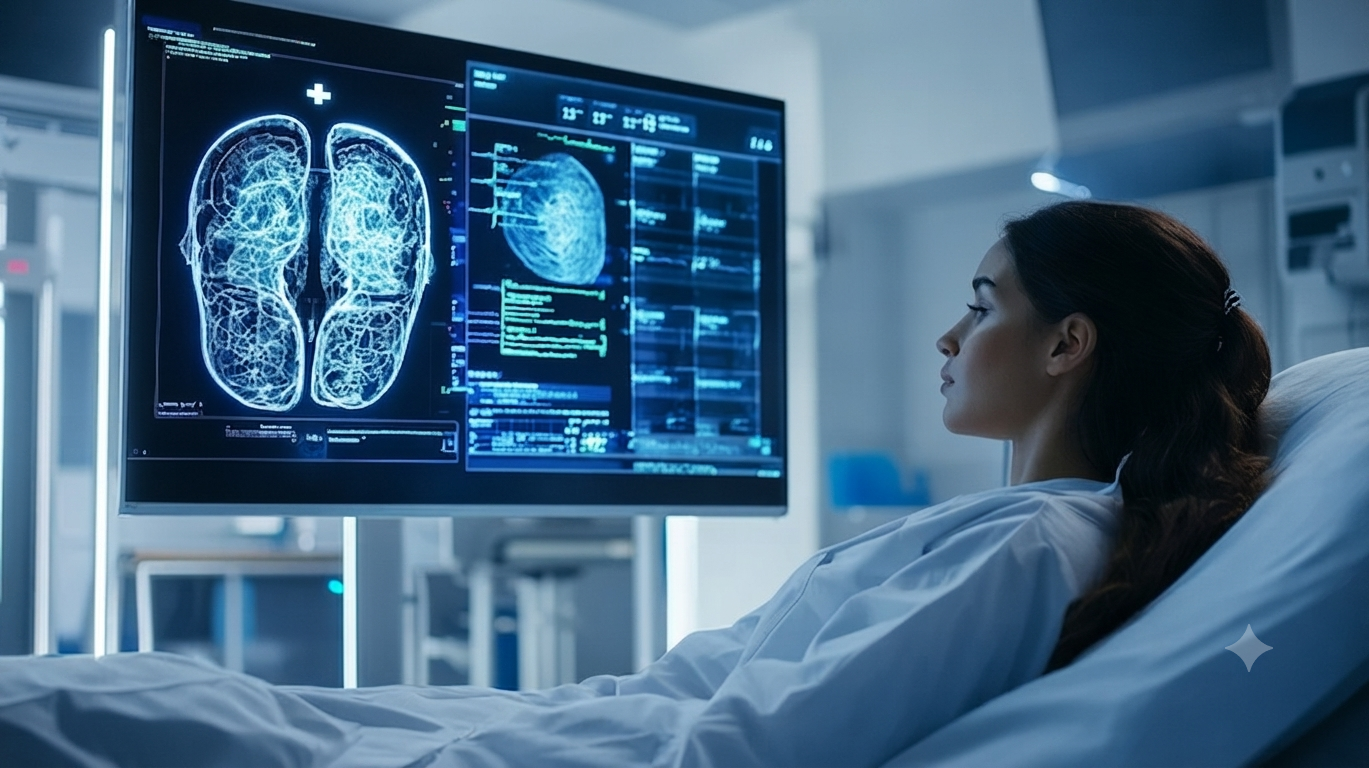
AI systems can analyze medical images such as X-rays, CT scans, mammograms, retinal photographs, and MRI scans to identify abnormalities that may indicate disease.
Researchers have shown that AI can assist radiologists in detecting certain cancers, lung diseases, fractures, and other conditions by highlighting suspicious areas that deserve closer examination.
In eye care, AI has demonstrated the ability to detect diabetic eye disease from retinal images. In dermatology, AI can help analyze photographs of skin lesions to identify features associated with skin cancer.
These systems are designed to support healthcare professionals rather than replace them. Doctors still make the final diagnosis, but AI can serve as an additional set of highly trained digital eyes.
Improving Medical Imaging
Medical imaging plays a central role in modern healthcare.
Every day, hospitals generate thousands of X-rays, ultrasounds, CT scans, and MRI images.
Reviewing each image carefully requires time and expertise.
AI can help prioritize urgent cases by identifying scans that appear to contain serious abnormalities. This allows radiologists to examine the most critical patients first.
AI can also improve image quality, reduce noise, and reconstruct clearer images from lower radiation doses in some imaging techniques. This may help improve patient safety while maintaining diagnostic accuracy.
Instead of replacing radiologists, AI is becoming a valuable assistant that increases efficiency and reduces workload.
Personalized Medicine for Every Patient
No two people are exactly alike.
Individuals respond differently to medications, treatments, diets, and diseases.
Traditional medicine often relies on treatments that work well for large groups of patients. However, AI is helping move healthcare toward personalized medicine, where treatment plans are tailored to each individual.
By analyzing medical history, genetic information, lifestyle factors, laboratory tests, and previous treatment outcomes, AI may help doctors identify therapies that are more likely to benefit a specific patient.
For example, in cancer treatment, AI can help analyze genetic changes within tumors, allowing physicians to select therapies that target the unique characteristics of a patient’s cancer.
As medical knowledge continues to grow, personalized medicine may become increasingly common.
Accelerating Drug Discovery
Developing a new medicine is an extremely long and expensive process.
Researchers often spend more than a decade studying potential drug candidates before one reaches patients.
AI is helping scientists speed up several stages of drug discovery.
Instead of manually examining millions of chemical compounds, AI can rapidly predict which molecules are most likely to interact with specific disease targets.
AI can also help researchers identify existing medicines that might be useful for treating different diseases, a process known as drug repurposing.
Although laboratory testing and clinical trials remain essential, AI can reduce the number of unsuccessful candidates, making research more efficient.
This could lead to faster development of treatments for diseases that currently have limited therapeutic options.
Helping Doctors Make Better Decisions
Modern medicine generates an overwhelming amount of scientific knowledge.
Thousands of medical studies are published every year.
Keeping up with this expanding body of research is nearly impossible for any individual physician.
AI can rapidly analyze medical literature, clinical guidelines, patient records, and laboratory results to provide evidence-based recommendations.
For example, AI systems may alert physicians about possible medication interactions, suggest additional diagnostic tests, or identify patients who may be at increased risk for certain complications.
Importantly, these systems support clinical decision-making rather than replacing it.
The physician remains responsible for evaluating AI recommendations within the broader context of each patient’s condition.
Transforming Hospital Operations
Hospitals are complex organizations where efficiency directly affects patient care.
AI is helping improve many administrative tasks that traditionally consume significant amounts of time.
Scheduling appointments, managing hospital beds, predicting patient admissions, organizing operating rooms, and optimizing staff allocation can all benefit from AI-powered systems.
Reducing administrative workload allows healthcare professionals to spend more time caring for patients.
AI can also help forecast demand for medical supplies, reducing shortages while minimizing unnecessary waste.
Although these improvements may seem less dramatic than disease diagnosis, they can significantly improve healthcare delivery.
Supporting Nurses
Nurses play one of the most important roles in healthcare.
They monitor patients, administer medications, provide emotional support, educate families, and coordinate care.
AI is beginning to assist nurses by automating repetitive documentation, monitoring patient vital signs, and identifying early warning signs of deterioration.
For example, AI systems connected to hospital monitors may recognize subtle changes in heart rate, breathing, blood pressure, or oxygen levels that suggest a patient’s condition is worsening.
Early alerts allow healthcare teams to intervene sooner.
Rather than replacing nurses, AI helps reduce routine tasks so they can devote more attention to direct patient care.
AI in Surgery
Modern surgery increasingly combines human skill with advanced technology.
AI-assisted surgical systems can help surgeons plan procedures using detailed three-dimensional medical images.
During surgery, AI may provide real-time guidance, identify anatomical structures, or help stabilize robotic surgical instruments.
Robotic surgery does not mean robots perform operations independently.
Instead, surgeons remain in complete control while robotic systems enhance precision, stability, and flexibility.
Future developments may continue improving surgical planning, navigation, and safety.
Virtual Health Assistants
Healthcare increasingly extends beyond hospitals and clinics.
AI-powered virtual assistants can answer common health questions, remind patients to take medications, schedule appointments, monitor symptoms, and encourage healthy behaviors.
Some AI chat systems help patients determine whether symptoms require urgent medical attention or routine care.
These tools can improve access to basic health information, particularly for people living far from medical centers.
However, virtual assistants cannot replace professional medical evaluation, especially during emergencies or serious illnesses.
Remote Patient Monitoring
Wearable devices have become increasingly popular.
Smartwatches, fitness trackers, and medical sensors can continuously monitor heart rate, physical activity, sleep patterns, blood oxygen levels, and, in some cases, heart rhythms.
AI analyzes this continuous stream of information to detect unusual changes that may indicate health problems.
For patients with chronic conditions such as heart disease or diabetes, remote monitoring allows healthcare providers to detect complications earlier.
Instead of waiting for scheduled appointments, doctors may receive alerts when important health indicators change.
This proactive approach has the potential to improve long-term disease management.
AI and Mental Health
Mental health is becoming an increasingly important part of healthcare.
AI tools are being developed to support mental health professionals by analyzing speech patterns, writing style, facial expressions, and other behavioral signals that may indicate changes in emotional well-being.
Some digital platforms provide guided mental health exercises, mood tracking, and cognitive behavioral therapy techniques.
Although these technologies may improve access to support, they are not substitutes for qualified mental health professionals.
Human understanding, empathy, and therapeutic relationships remain central to effective mental healthcare.
Fighting Infectious Diseases
AI has demonstrated value in monitoring infectious diseases.
By analyzing public health reports, travel patterns, environmental conditions, and healthcare data, AI can help identify emerging disease outbreaks.
Researchers also use AI to study how infectious diseases spread and to improve public health responses.
During future epidemics and pandemics, AI may help scientists analyze rapidly changing information, identify high-risk populations, and support healthcare planning.
These capabilities can strengthen preparedness for future global health challenges.
Reducing Medical Errors
Even experienced healthcare professionals can make mistakes.
Medicine is extremely complex, and human fatigue, heavy workloads, and information overload can contribute to errors.
AI can reduce certain types of medical errors by checking prescriptions for dangerous drug interactions, verifying medication dosages, identifying abnormal laboratory values, and reminding clinicians about recommended clinical guidelines.
These safety checks help create additional layers of protection for patients.
However, AI itself is not perfect and must be carefully monitored to ensure reliability.
Helping Rural and Underserved Communities
Many people live far from hospitals or medical specialists.
AI-powered diagnostic tools and telemedicine platforms may improve healthcare access in remote areas.
Healthcare workers can use AI-assisted software to evaluate medical images, interpret laboratory results, or consult specialists located hundreds of kilometers away.
This technology may reduce inequalities in healthcare by bringing advanced medical expertise to communities that previously had limited access.
Reliable internet connections, appropriate infrastructure, and trained healthcare professionals remain essential for successful implementation.
AI and Medical Research
Scientific research produces enormous amounts of data.
AI helps researchers analyze complex biological information much faster than traditional methods.
Researchers use AI to study proteins, genes, disease mechanisms, and treatment outcomes.
AI can identify patterns that might otherwise remain hidden within large datasets.
These discoveries may lead to new diagnostic tools, improved therapies, and deeper understanding of human biology.
Rather than replacing scientific investigation, AI accelerates the research process.
Ethical Challenges
Despite its enormous promise, AI also raises important ethical questions.
Patient privacy must be protected when medical data are used to train AI systems.
Healthcare organizations must ensure sensitive information remains secure.
Bias is another major concern.
If AI systems are trained using data that do not adequately represent diverse populations, their performance may be less accurate for certain groups.
Scientists and healthcare providers are actively working to reduce these biases through better data collection, careful evaluation, and ongoing monitoring.
Transparency is equally important.
Doctors should understand how AI reaches its recommendations, especially when those recommendations influence important medical decisions.
Patients also deserve clear information about how AI is being used in their care.
The Importance of Human Judgment
Although AI can process information at extraordinary speed, it lacks many qualities that define excellent healthcare.
AI does not experience compassion.
It cannot comfort a frightened patient.
It cannot fully understand personal values, cultural beliefs, family relationships, or emotional struggles.
Doctors, nurses, therapists, and other healthcare professionals provide far more than diagnoses and treatments.
They listen.
They explain difficult decisions.
They offer reassurance during uncertainty.
They support families during life’s most challenging moments.
Healthcare is ultimately a deeply human profession.
AI works best when it enhances—not replaces—human expertise.
The Future of Healthcare
The coming decades are likely to see AI integrated into nearly every area of medicine.
Hospitals may become increasingly connected through intelligent systems that analyze patient information in real time.
Doctors may receive AI-generated summaries that organize complex medical histories within seconds.
Patients may benefit from continuous health monitoring that detects disease before symptoms appear.
Medical research may progress more rapidly as AI helps scientists analyze vast amounts of biological data.
New medicines could be developed faster.
Personalized treatment plans may become more accurate.
Healthcare systems may become more efficient and accessible.
At the same time, careful regulation, rigorous scientific testing, strong data protection, and ethical oversight will remain essential to ensure AI is safe, fair, and trustworthy.
A New Partnership Between Humans and Intelligent Technology
Artificial intelligence is not simply another technological innovation. It represents one of the most significant transformations in the history of healthcare. By helping doctors detect diseases earlier, supporting medical research, improving hospital operations, accelerating drug discovery, and enabling more personalized care, AI has the potential to improve millions of lives around the world.
Yet the future of healthcare will never belong to machines alone. Medicine is built on trust, compassion, communication, and human connection—qualities that technology cannot replace. The greatest advances will come from combining the strengths of AI with the knowledge, experience, creativity, and empathy of healthcare professionals.
As researchers continue to improve AI systems and healthcare organizations adopt them responsibly, patients may experience faster diagnoses, more effective treatments, safer hospitals, and greater access to quality care. The journey is only beginning, but one thing is already clear: the future of medicine will not be defined by humans or artificial intelligence working separately. It will be shaped by their partnership, working together to create a healthier world for everyone.