Imagine asking your phone to recognize your face, watching an online store recommend products you might like, or using a navigation app that quickly finds the fastest route home. These technologies may seem incredibly intelligent, but they all have something in common. Each is designed to perform a specific task—and only that task.
This is Narrow AI.
Although headlines often suggest that artificial intelligence is becoming as smart as humans, the reality is very different. Nearly every AI system people use today belongs to a category known as Narrow AI. It can perform remarkable feats within a limited area, but it does not think, understand, or reason about the world in the broad, flexible way humans do.
Narrow AI has quietly become one of the most important technologies of the modern age. It helps doctors analyze medical images, assists scientists in processing enormous amounts of data, improves online searches, powers voice assistants, detects financial fraud, and even helps farmers monitor crops. Yet despite its growing influence, many people misunderstand what Narrow AI actually is.
Understanding Narrow AI is essential because it represents the true state of artificial intelligence today—not the science fiction version often portrayed in movies.
What Does Narrow AI Mean?
Narrow AI, sometimes called Weak AI, is an artificial intelligence system designed to perform one specific task or a small group of closely related tasks.
Unlike humans, who can learn many different skills and apply knowledge across a wide range of situations, Narrow AI focuses on a limited problem.
A facial recognition system identifies faces.
A language translation system translates text.
A spam filter detects unwanted emails.
A chess-playing program plays chess.
Each system can become extremely good at its assigned job, but it cannot automatically perform unrelated tasks.
For example, an AI that defeats world champions in chess cannot diagnose diseases, drive a car, or write a poem unless it has been specifically designed and trained for those purposes.
Its intelligence is powerful but specialized.
Why Is It Called “Narrow”?
The word “narrow” refers to the limited scope of the AI’s abilities.
Human intelligence is broad.
A person who learns mathematics can also recognize emotions, cook dinner, learn a new language, ride a bicycle, understand humor, and solve unfamiliar problems.
Narrow AI cannot do this.
Its knowledge remains confined to the area for which it was developed.
Even the most advanced AI language model cannot automatically become a medical imaging expert or a self-driving system without different training methods, different data, and often different architectures.
This limitation is one of the defining characteristics of modern artificial intelligence.
Narrow AI Is Everywhere
Many people imagine AI as futuristic robots walking among humans.
In reality, Narrow AI is already deeply woven into everyday life.
Each time you unlock your phone with your face, AI analyzes facial features.
When a music streaming service recommends songs, AI predicts your preferences.
When a search engine ranks billions of webpages in fractions of a second, AI helps determine which results appear first.
When an online store suggests products, AI analyzes shopping patterns.
When a bank detects suspicious activity on your account, AI helps identify unusual transactions.
Many people use Narrow AI dozens or even hundreds of times every day without realizing it.
How Does Narrow AI Work?
Although different systems use different techniques, most Narrow AI follows a similar process.
First, the AI receives information.
This information may include photographs, written text, spoken language, videos, medical scans, financial records, weather observations, or sensor data.
Next, mathematical algorithms analyze patterns within that information.
Rather than following simple rules written entirely by programmers, many modern AI systems learn statistical relationships from enormous datasets.
Finally, the AI produces an output.
It may recognize an object.
Translate a sentence.
Predict tomorrow’s weather.
Recommend a movie.
Answer a question.
Detect fraud.
Generate speech.
The quality of these outputs depends heavily on the quality of the training data and the design of the algorithms.
Learning from Data
Modern Narrow AI relies heavily on machine learning.
Instead of programming every possible rule manually, researchers allow AI systems to learn patterns from examples.
Imagine teaching someone to identify apples.
Rather than describing every detail, you simply show many apples.
Eventually, they recognize new apples by noticing common characteristics.
Machine learning works in a similar way.
An AI trained to recognize cats analyzes thousands or even millions of images labeled as cats and non-cats.
Over time, the system learns statistical features that distinguish one category from another.
It does not understand what a cat is in the human sense.
Instead, it identifies complex mathematical patterns associated with cat images.
Deep Learning and Narrow AI
One of the biggest breakthroughs in modern AI has been deep learning.
Deep learning uses mathematical structures called artificial neural networks, inspired loosely by the organization of neurons in biological brains.
These networks contain many interconnected layers that gradually learn increasingly complex features from data.
For example, when analyzing photographs, early layers may detect simple edges.
Later layers identify shapes.
Still later layers recognize eyes, ears, wheels, buildings, or faces.
Deep learning has dramatically improved speech recognition, language translation, image classification, and many other AI applications.
Most recent advances in AI depend heavily on deep learning techniques.
Narrow AI Does Not Understand Like Humans
One of the biggest misconceptions about AI is that it understands information the same way humans do.
It does not.
When a language model writes an article, it does not experience thoughts or emotions.
When an image recognition system identifies a dog, it does not know what it feels like to pet one.
When a navigation system finds the fastest route, it has no concept of travel or scenery.
Instead, Narrow AI analyzes patterns using mathematical computations.
Its outputs may appear intelligent because they often resemble human responses, but the underlying processes differ fundamentally from human cognition.
Narrow AI Has No Consciousness
Current Narrow AI systems are not conscious.
They do not possess self-awareness.
They do not experience happiness, sadness, fear, curiosity, or love.
They do not have personal goals or desires.
They do not know they exist.
Although AI can simulate conversations or generate creative-looking outputs, these abilities arise from mathematical pattern recognition rather than conscious experience.
Scientists continue studying consciousness, but there is no scientific evidence that today’s AI possesses subjective awareness.
Everyday Examples of Narrow AI
Narrow AI appears in far more places than most people realize.
Voice assistants recognize spoken commands and generate responses.
Email services automatically separate spam from legitimate messages.
Streaming platforms recommend films and television shows.
Online translators convert text between languages.
Smartphone cameras improve photographs using AI-powered image processing.
Navigation systems estimate traffic conditions and calculate efficient routes.
Medical imaging software helps detect abnormalities in X-rays and MRI scans.
Banks identify unusual financial transactions that may indicate fraud.
Factories use AI to inspect products for manufacturing defects.
Farmers monitor crop health using AI analysis of satellite imagery and drones.
Scientists analyze enormous research datasets with AI assistance.
Each of these systems performs a specialized function.
None possesses broad human intelligence.
Narrow AI in Healthcare
Healthcare has become one of the most promising applications of Narrow AI.
Researchers have developed AI systems capable of analyzing medical images, predicting disease risks, identifying patterns in patient records, and assisting with drug discovery.
For example, AI can help radiologists detect subtle abnormalities that might otherwise be difficult to notice.
AI also assists researchers by analyzing vast amounts of scientific literature and biological data.
However, these systems support healthcare professionals rather than replacing them.
Doctors combine AI recommendations with clinical experience, patient communication, ethical judgment, and medical expertise.
Human oversight remains essential.
Narrow AI in Education
Education is another field benefiting from specialized AI systems.
Learning platforms can adapt lessons to individual students.
Writing assistants help improve grammar and organization.
Language-learning applications personalize vocabulary practice.
Educational software identifies areas where students need additional support.
Teachers remain central to education because learning involves motivation, creativity, empathy, discussion, and social development—qualities that AI cannot fully provide.
Instead, Narrow AI serves as a valuable educational assistant.
Narrow AI in Transportation
Transportation increasingly relies on AI.
Navigation apps predict travel times using traffic data.
Airlines optimize scheduling.
Shipping companies improve delivery routes.
Researchers continue developing autonomous driving systems capable of recognizing roads, pedestrians, traffic signs, and obstacles.
These systems involve numerous Narrow AI components working together.
One AI identifies lane markings.
Another detects vehicles.
Another predicts pedestrian movement.
Another controls braking and steering.
Together, they create increasingly sophisticated driving assistance technologies.
Narrow AI in Science
Scientific research often produces more data than humans can analyze alone.
AI helps astronomers identify distant galaxies.
Biologists analyze DNA sequences.
Chemists search for promising new materials.
Climate scientists study weather and environmental patterns.
Physicists process enormous datasets from particle accelerators.
Rather than replacing scientists, Narrow AI expands researchers’ ability to explore complex questions.
Many scientific discoveries now result from collaboration between human expertise and AI-powered analysis.
Narrow AI in Business
Businesses use AI to improve efficiency and decision-making.
Customer service systems answer routine questions.
Inventory management predicts product demand.
Manufacturers optimize production schedules.
Financial institutions assess risks.
Retail companies recommend products based on customer interests.
Marketing teams analyze consumer behavior.
Although customers often notice only the final service, countless AI systems operate behind the scenes.
Why Narrow AI Is So Successful
One reason Narrow AI has advanced so rapidly is that specialized problems are easier to solve than general intelligence.
Recognizing handwritten numbers is easier than understanding every aspect of human language.
Identifying tumors in medical images is easier than practicing medicine across every specialty.
Playing chess is easier than navigating the complexities of everyday life.
By focusing on clearly defined tasks, researchers can develop highly accurate AI systems.
This specialization has produced impressive real-world applications.
The Limitations of Narrow AI
Despite its remarkable achievements, Narrow AI has important limitations.
It cannot transfer knowledge broadly between unrelated tasks.
It depends heavily on data.
It may perform poorly when encountering situations very different from those seen during training.
It can make mistakes.
It may inherit biases present in training data.
It cannot explain every decision in a way humans easily understand.
It lacks common sense in many situations.
For example, an AI may recognize thousands of dog breeds yet fail to answer a simple question requiring everyday reasoning outside its training.
These limitations remind us that AI remains a tool rather than a replacement for human intelligence.
Narrow AI and Human Intelligence
Humans possess extraordinary flexibility.
A child who learns to ride a bicycle can later learn mathematics, cooking, painting, music, and languages.
People transfer knowledge across different situations.
They understand emotions.
They imagine hypothetical futures.
They solve unfamiliar problems.
Narrow AI cannot do these things.
Its abilities remain limited to specific domains.
Even the most advanced AI systems today require careful design, training, evaluation, and human supervision.
Human intelligence remains broader, more adaptable, and deeply connected to lived experience.
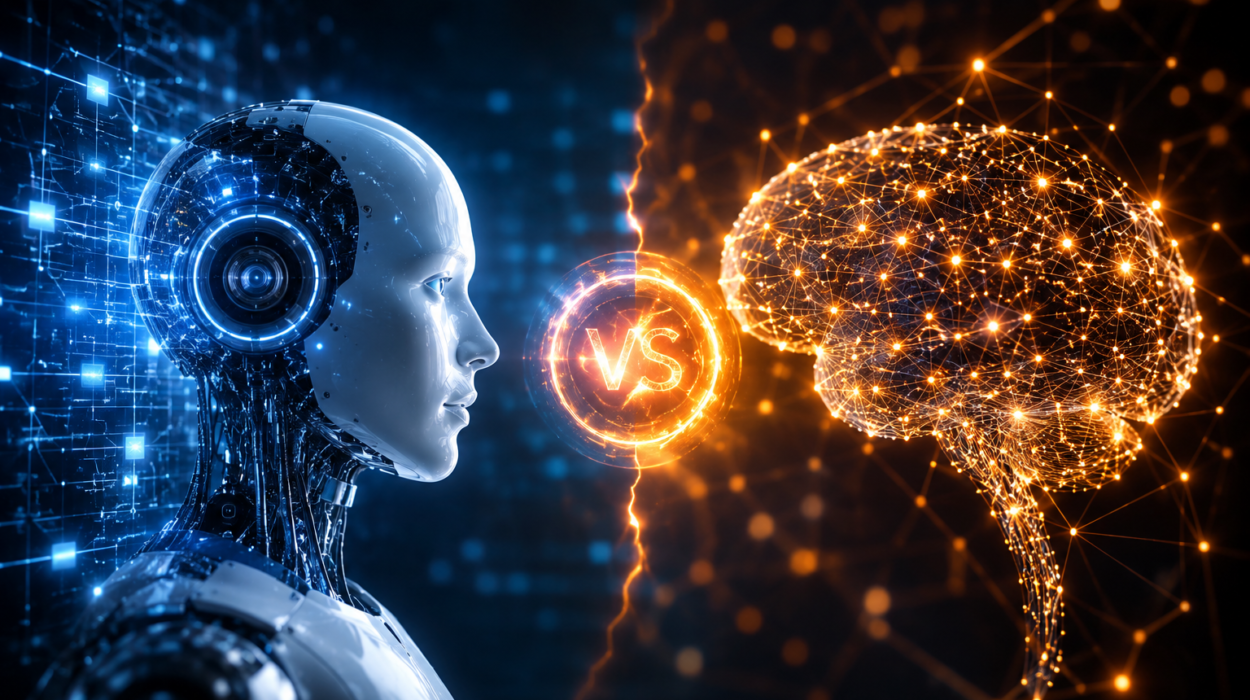
Narrow AI Versus Artificial General Intelligence
Researchers often compare Narrow AI with Artificial General Intelligence, commonly called AGI.
Narrow AI performs specialized tasks.
AGI would perform many different intellectual tasks at a level comparable to humans.
An AGI could learn new skills independently, transfer knowledge across domains, adapt to unfamiliar situations, and solve a wide variety of problems without needing entirely separate systems.
Despite decades of research, AGI has not been achieved.
Every practical AI application in widespread use today belongs to the Narrow AI category.
Understanding this distinction helps separate current scientific reality from future speculation.
Ethical Questions
As Narrow AI becomes more powerful, important ethical questions arise.
How should personal data be protected?
How can AI systems remain fair and unbiased?
Who is responsible when AI makes mistakes?
How should AI be regulated?
How can society ensure that AI benefits everyone?
Scientists, engineers, policymakers, legal experts, and ethicists continue working together to develop responsible approaches to AI development.
Addressing these questions is just as important as improving AI technology itself.
The Future of Narrow AI
Narrow AI will almost certainly become even more capable.
Future systems may improve healthcare diagnostics, accelerate scientific discoveries, reduce energy consumption, enhance environmental monitoring, personalize education, and assist with disaster response.
Researchers are developing AI that requires less data, produces more reliable results, explains its reasoning more clearly, and operates more efficiently.
Rather than disappearing, Narrow AI is expected to become an increasingly important part of daily life.
Its specialized abilities will likely continue expanding into new industries and scientific disciplines.
Why Understanding Narrow AI Matters
Narrow AI is the true face of modern artificial intelligence. It powers the technologies millions of people rely on every day, yet it remains fundamentally different from human intelligence. It excels at specialized tasks, learning patterns from data with remarkable speed and accuracy, but it does not possess consciousness, emotions, self-awareness, or the broad adaptability of the human mind.
Recognizing both its strengths and its limitations allows us to appreciate AI realistically. Narrow AI is neither a magical machine that understands the world like people do nor a threat that has already surpassed humanity. Instead, it is a powerful scientific achievement that extends human capabilities in carefully defined ways.
As research continues, Narrow AI will almost certainly become more accurate, more useful, and more deeply integrated into society. Yet its greatest value will remain the same: helping people solve problems, uncover knowledge, and accomplish tasks that would otherwise take far more time and effort. Rather than replacing human intelligence, Narrow AI works best as a tool that complements it, combining computational speed with the creativity, judgment, empathy, and curiosity that make human intelligence unique.