Artificial Intelligence is transforming the world in remarkable ways. It can recommend the next movie you might enjoy, help doctors detect diseases earlier, predict tomorrow’s weather, write stories, create artwork, compose music, and even hold conversations that feel surprisingly natural.
At first glance, all these technologies might seem to belong to the same category. After all, they are all powered by Artificial Intelligence. But beneath the surface, they often work toward very different goals.
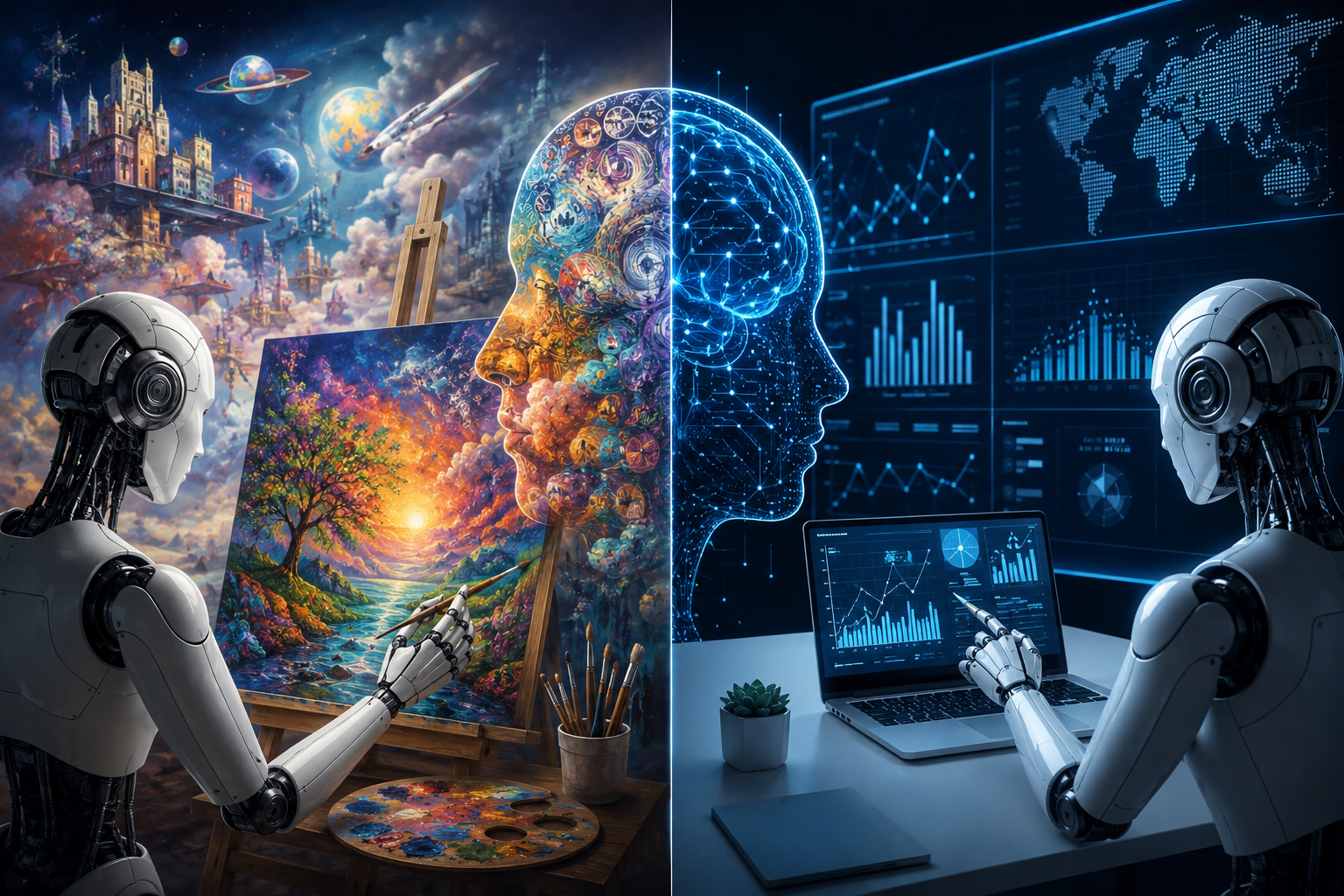
Some AI systems are designed to predict what is likely to happen. Others are designed to generate something entirely new.
These two major approaches are known as Predictive AI and Generative AI.
Although they sometimes work together, they solve different kinds of problems, learn from data in different ways, and produce different types of results. Understanding the difference is becoming increasingly important because both technologies are reshaping industries, scientific research, education, healthcare, and everyday life.
What Is Artificial Intelligence?
Before exploring the differences, it helps to understand what Artificial Intelligence actually is.
Artificial Intelligence, or AI, is a field of computer science focused on building systems that can perform tasks that normally require aspects of human intelligence. These tasks include recognizing speech, understanding language, identifying patterns, making decisions, learning from data, and solving problems.
Modern AI relies heavily on mathematical models, algorithms, and large amounts of data. Rather than being programmed with every possible rule, many AI systems learn patterns from examples.
Depending on their purpose, these systems may be designed either to predict outcomes or to create entirely new content.
That distinction forms the foundation of Predictive AI and Generative AI.
What Is Predictive AI?
Predictive AI is designed to answer one central question:
What is most likely to happen next?
Its primary purpose is to analyze existing information and estimate future outcomes or identify likely patterns.
Instead of creating new material, Predictive AI examines historical data to make informed predictions.
Imagine a weather forecasting system.
It studies years of weather observations, satellite images, atmospheric pressure, humidity, and temperature.
Using these patterns, it predicts tomorrow’s weather.
It is not creating a new weather system.
It is estimating what nature is most likely to do.
The same principle applies across many industries.
Banks use Predictive AI to estimate whether a loan applicant may repay a loan.
Hospitals use it to identify patients who might face higher health risks.
Retailers forecast future product demand.
Airlines predict maintenance needs for aircraft.
Scientists estimate the spread of diseases.
In every case, the goal is prediction rather than creation.
How Predictive AI Works
Predictive AI learns by analyzing relationships within historical data.
For example, suppose an online store wants to predict whether customers will purchase a product.
The AI studies thousands or millions of previous purchases.
It examines factors such as age, location, browsing history, shopping behavior, prices, and purchase timing.
Gradually, it identifies patterns associated with buying decisions.
When a new customer visits the website, the AI estimates the probability that the customer will make a purchase.
It does not know the future with certainty.
Instead, it calculates probabilities based on previous observations.
This statistical approach allows Predictive AI to support decision-making in many real-world situations.
What Is Generative AI?
Generative AI asks a very different question.
Instead of predicting an existing outcome, it asks:
What new content can I create?
Generative AI produces original outputs based on patterns learned during training.
These outputs may include text, images, music, videos, computer code, audio, scientific designs, or other forms of digital content.
For example, when someone asks an AI assistant to explain black holes, write a poem, summarize a report, or generate computer code, the system creates a new response rather than retrieving an identical sentence from memory.
Similarly, image-generation systems create entirely new images instead of simply copying existing photographs.
Generative AI focuses on creation rather than prediction of future events.
How Generative AI Works
Generative AI also learns from enormous collections of data.
However, instead of estimating future outcomes, it learns the complex statistical patterns underlying language, images, sounds, or other forms of information.
Consider a language model.
During training, it analyzes billions of words from books, articles, websites, and other written material.
Over time, it learns grammar, vocabulary, sentence structure, factual relationships, and many writing styles.
When given a prompt, the model generates new text by predicting the most appropriate sequence of words based on everything it has learned.
Although the internal mathematics is highly sophisticated, the result is the ability to produce entirely new content that has never existed before.
Image-generation models operate in a similar way.
Rather than storing complete pictures, they learn visual patterns that allow them to create original images matching user instructions.
The Fundamental Difference
The easiest way to understand these two technologies is to focus on their goals.
Predictive AI analyzes existing data to estimate future events, classify information, or support decisions.
Generative AI creates new content inspired by patterns learned from training data.
Predictive AI asks, “What will probably happen?”
Generative AI asks, “What can I create?”
Although both rely on machine learning, they solve different kinds of problems.
Predictive AI in Everyday Life
Many people use Predictive AI every day without realizing it.
Email services predict which messages are spam.
Navigation applications estimate travel times based on traffic.
Streaming platforms recommend movies and television shows you are likely to enjoy.
Banks detect potentially fraudulent credit card transactions.
Weather forecasts estimate future conditions.
Online stores recommend products based on previous purchases.
Healthcare systems identify patients at increased risk of certain diseases.
Factories predict equipment failures before they occur.
These applications demonstrate how Predictive AI helps people make better decisions by estimating likely outcomes.
Generative AI in Everyday Life
Generative AI has also become part of daily life.
People use it to write emails, summarize documents, create artwork, generate programming code, translate languages, produce educational materials, compose music, brainstorm ideas, and answer questions.
Businesses create marketing content.
Architects generate building concepts.
Scientists draft research summaries.
Teachers develop learning materials.
Designers explore visual ideas.
Writers overcome creative blocks.
Instead of merely predicting existing information, Generative AI actively produces new material.
The Role of Machine Learning
Both Predictive AI and Generative AI belong to the broader field of machine learning.
Machine learning allows computers to improve performance by learning patterns from data rather than relying solely on explicit programming.
However, the learning objectives differ.
Predictive AI optimizes its ability to estimate outcomes accurately.
Generative AI optimizes its ability to produce realistic, useful, and coherent new content.
The underlying mathematical techniques may overlap, but their final purposes remain distinct.
Data Requirements
Both types of AI depend heavily on data.
Predictive AI often requires carefully labeled historical data.
For example, a medical prediction system may learn from patient records that indicate whether particular diseases were diagnosed.
A financial prediction model may learn from previous loan outcomes.
Generative AI usually requires enormous datasets containing examples of language, images, music, video, or other content.
Instead of learning simple categories, it learns the rich statistical structure that enables content creation.
The quality, diversity, and reliability of training data strongly influence the performance of both systems.
Different Types of Output
One of the clearest differences lies in what each system produces.
Predictive AI typically generates probabilities, classifications, forecasts, recommendations, or risk assessments.
For example, it may estimate that there is an 85 percent chance of rain tomorrow or identify an email as likely spam.
Generative AI produces entirely new material.
It may generate an original story, create an illustration, compose music, design a logo, or write computer code.
One predicts.
The other creates.
Healthcare Applications
Healthcare illustrates the distinction particularly well.
Predictive AI can estimate which patients are at greater risk of developing certain diseases, identify those who may require additional monitoring, or forecast hospital resource needs.
Generative AI can summarize patient records, assist with medical documentation, generate educational materials for patients, and support researchers by organizing scientific literature.
In both cases, physicians remain responsible for clinical decisions.
AI serves as a tool that supports—not replaces—medical expertise.
Business and Finance
Businesses increasingly rely on both forms of AI.
Predictive AI forecasts customer demand, estimates future sales, detects fraud, predicts equipment failures, and assesses financial risk.
Generative AI creates advertising copy, customer support responses, product descriptions, reports, presentations, and software code.
Together, these technologies improve efficiency while allowing employees to focus on higher-level decision-making.
Scientific Research
Scientists also benefit from both approaches.
Predictive AI helps researchers analyze climate patterns, forecast disease outbreaks, estimate crop yields, and model complex physical systems.
Generative AI assists by drafting reports, generating molecular designs for drug discovery, producing scientific visualizations, organizing literature reviews, and supporting hypothesis generation.
Rather than replacing scientific reasoning, AI accelerates many research processes.
Education
Education offers another excellent example.
Predictive AI identifies students who may need additional academic support by analyzing learning patterns and assessment results.
Generative AI creates personalized explanations, practice questions, lesson summaries, educational illustrations, and interactive learning materials.
Teachers remain central to education because human guidance, motivation, empathy, and ethical judgment cannot be fully automated.
Creativity and Innovation
Creativity represents one of the greatest strengths of Generative AI.
Artists experiment with new visual styles.
Musicians explore melodies.
Writers develop ideas.
Game designers create fictional worlds.
Filmmakers generate concept art.
Architects visualize building designs.
However, human creativity remains essential.
People decide the goals, evaluate quality, refine outputs, and bring emotional understanding and cultural context that AI lacks.
Generative AI expands creative possibilities rather than replacing imagination.
Accuracy and Reliability
Neither Predictive AI nor Generative AI is perfect.
Predictive AI may produce incorrect forecasts if historical data are incomplete, outdated, or unrepresentative.
Unexpected events can reduce prediction accuracy because the future does not always resemble the past.
Generative AI can produce convincing but inaccurate information, misunderstand prompts, or generate unrealistic images or incorrect code.
For this reason, human review remains important, especially in medicine, science, engineering, law, education, and other high-stakes fields.
Ethical Considerations
Both technologies raise important ethical questions.
Predictive AI may unintentionally reflect biases present in historical data, potentially affecting decisions related to hiring, lending, healthcare, or criminal justice.
Generative AI introduces additional concerns related to misinformation, deepfakes, copyright, intellectual property, privacy, and content authenticity.
Researchers, governments, businesses, and educators continue developing policies and technical safeguards that encourage responsible AI use while reducing potential risks.
Responsible development requires transparency, accountability, fairness, and careful human oversight.
Can They Work Together?
Although they are different, Predictive AI and Generative AI often complement one another.
Imagine a hospital.
Predictive AI identifies patients who may require urgent attention based on medical data.
Generative AI then creates clear summaries of those patients’ medical histories for physicians.
Or consider an online business.
Predictive AI forecasts which products customers will likely purchase.
Generative AI creates personalized marketing messages for those customers.
By combining prediction with creation, organizations can build more effective AI systems.
Which One Is More Important?
Neither technology is inherently better than the other.
Their value depends entirely on the problem being solved.
If the goal is forecasting future demand, detecting fraud, predicting disease risk, or estimating weather conditions, Predictive AI is the appropriate tool.
If the goal is writing articles, generating images, creating educational content, composing music, producing software code, or designing new ideas, Generative AI is more suitable.
In many real-world applications, both technologies work side by side.
The Future of Artificial Intelligence
As Artificial Intelligence continues advancing, the distinction between Predictive AI and Generative AI may become less visible to users.
Future AI systems are likely to combine prediction, reasoning, planning, content generation, and decision support within unified platforms.
Researchers are also working to improve reliability, transparency, efficiency, and safety.
Future AI may contribute to scientific discovery, environmental protection, healthcare, education, engineering, and space exploration in ways that are only beginning to emerge.
At the same time, society will need thoughtful policies, ethical standards, and ongoing scientific research to ensure these technologies are used responsibly.
Understanding the Difference Matters
Predictive AI and Generative AI represent two of the most important branches of modern Artificial Intelligence. While they share common foundations in machine learning and data analysis, they pursue different goals and produce different kinds of results.
Predictive AI looks at existing information to estimate what is most likely to happen next. It helps people make informed decisions by forecasting outcomes, identifying risks, and recognizing patterns hidden within data.
Generative AI goes a step further by creating something new. It can generate text, images, music, software code, videos, and many other forms of original content based on patterns learned during training.
Together, these technologies are reshaping the way people work, learn, communicate, and innovate. One helps us better understand the future. The other expands our ability to imagine and create. As Artificial Intelligence continues to evolve, both Predictive AI and Generative AI will remain essential tools, each contributing in its own unique way to solving complex problems and opening new possibilities for science, technology, and society.