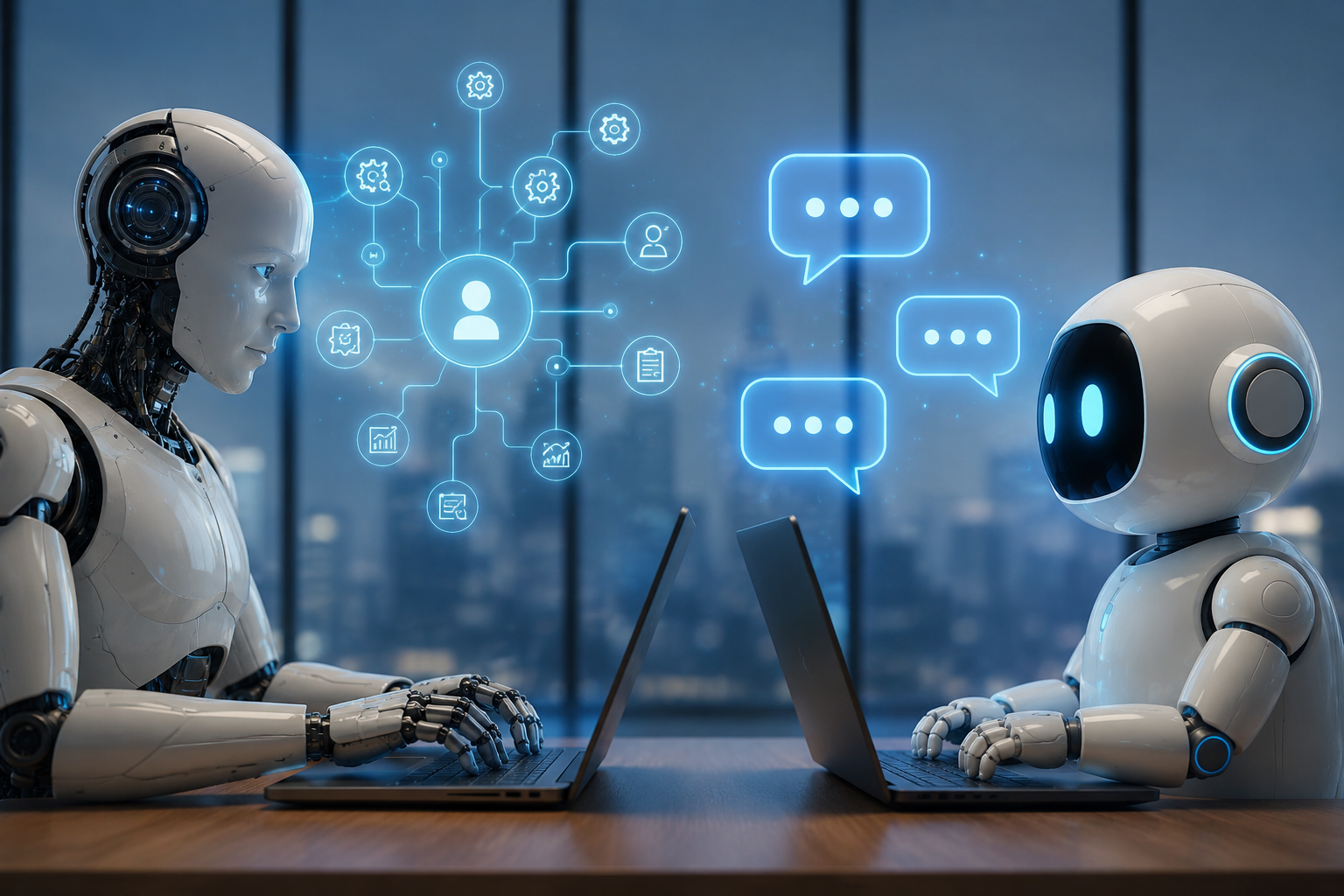
Artificial Intelligence is changing the way people interact with technology. A few years ago, chatting with a computer was a novelty. Today, millions of people ask AI to answer questions, write emails, translate languages, create images, summarize documents, or even help with coding. As AI continues to evolve, two terms appear more frequently than ever before: AI chatbot and AI agent.
At first glance, they may seem like the same thing. Both can understand human language, respond to questions, and assist users in completing tasks. Because of these similarities, many people use the terms interchangeably.
However, they are not the same.
A chatbot is designed primarily to communicate. An AI agent is designed not only to communicate but also to plan, make decisions, and perform actions to accomplish goals.
Understanding the difference between these two technologies is becoming increasingly important because they represent different stages in the evolution of artificial intelligence. While chatbots have already become part of everyday life, AI agents are beginning to reshape how work is done across businesses, research, education, healthcare, and many other fields.
What Is a Chatbot?
A chatbot is a software application designed to interact with people through conversation.
Its main purpose is to answer questions, provide information, assist with customer support, or help users complete simple tasks through text or voice.
Early chatbots followed fixed rules.
If a user typed a specific question, the chatbot searched for matching keywords and returned a prewritten response.
These rule-based systems worked well for predictable situations but struggled when users asked unexpected questions.
Modern AI chatbots are much more advanced.
Instead of relying only on fixed rules, many use large language models (LLMs) that have been trained on vast amounts of text. These models can understand context, generate natural-sounding responses, explain complex topics, write stories, translate languages, and answer questions across many subjects.
Even though modern chatbots can appear highly intelligent, their primary role remains conversation.
They respond to requests made by users.
They generally do not take independent action outside the conversation unless specifically connected to external tools or services.
What Is an AI Agent?
An AI agent goes beyond conversation.
An AI agent is a software system designed to achieve goals by observing information, making decisions, planning multiple steps, using available tools, and carrying out actions with varying degrees of autonomy.
Instead of simply answering questions, an AI agent attempts to complete tasks.
Imagine asking an AI chatbot,
“How can I plan a vacation?”
The chatbot may provide helpful advice, suggest destinations, estimate costs, and recommend activities.
Now imagine asking an AI agent,
“Plan my vacation.”
The agent could search for flights, compare hotel prices, create an itinerary, schedule activities, organize travel documents, and prepare everything for your review before you approve the final plan.
Rather than stopping after giving information, the AI agent actively works toward accomplishing the objective.
The Difference Begins with Purpose
The biggest difference between chatbots and AI agents lies in their purpose.
A chatbot exists primarily to communicate.
An AI agent exists primarily to accomplish goals.
Conversation is the chatbot’s destination.
Conversation is often only the starting point for an AI agent.
This distinction changes everything about how each system operates.
Communication Versus Action
Imagine asking two different assistants for help.
The first assistant answers every question clearly and politely but never leaves the room.
The second assistant answers questions, then gets up, gathers information, completes paperwork, checks schedules, contacts other people, and returns with the finished results.
The first behaves like a chatbot.
The second behaves like an AI agent.
Modern AI agents combine language understanding with the ability to perform actions.
These actions may include interacting with databases, software applications, websites, programming tools, robotic systems, or other AI models.
How Chatbots Work
Modern AI chatbots usually rely on language models.
When a user enters a prompt, the chatbot analyzes the words, understands the context, predicts an appropriate response, and generates natural language.
The chatbot focuses on producing useful information based on the conversation.
Some chatbots also access external knowledge sources, search engines, or specialized databases to improve accuracy.
However, their main task remains generating responses.
They typically wait for the next user instruction before continuing.
How AI Agents Work
AI agents use many of the same language technologies found in chatbots, but they add additional capabilities.
An AI agent often begins by understanding the user’s objective.
Next, it breaks the objective into smaller tasks.
It determines what information is needed.
It selects appropriate tools.
It performs actions.
It checks whether progress is being made.
If necessary, it revises its plan and continues working until the goal has been achieved or requires human input.
This ability to plan, execute, evaluate, and adapt makes AI agents fundamentally different from traditional chatbots.
Memory Makes a Difference
Many chatbots have limited conversational memory.
They remember information within an ongoing conversation but may not retain knowledge after the session ends unless specifically designed to do so.
AI agents often require more sophisticated memory systems.
They may remember previous tasks, store important project information, track long-term objectives, and use earlier experiences to improve future decisions.
For example, an AI research agent working on a scientific project may remember which papers have already been analyzed, which experiments remain unfinished, and what conclusions have already been reached.
This persistent memory allows more complex workflows.
Planning Instead of Simply Responding
One defining characteristic of AI agents is planning.
Suppose someone asks,
“Help me launch a new online business.”
A chatbot might explain business planning, marketing strategies, website design, and financial considerations.
An AI agent could divide the project into manageable stages.
It might organize research, compare website platforms, draft business documents, prepare marketing materials, monitor deadlines, and update progress as work continues.
Instead of solving one question at a time, the agent manages an entire objective.
Decision-Making
Decision-making is another important distinction.
Chatbots usually answer based on the current conversation.
AI agents continuously evaluate different options while pursuing goals.
If one approach fails, an agent may choose another.
For example, if a software tool becomes unavailable, an AI agent might automatically select an alternative solution.
This flexibility makes AI agents suitable for more complicated environments.
Using External Tools
Modern AI agents frequently interact with external systems.
They may search databases.
They can analyze spreadsheets.
They may execute computer programs.
They can schedule meetings.
They may communicate with business software.
Some agents assist software developers by writing code, testing programs, identifying errors, and suggesting improvements.
Others help researchers organize scientific literature or analyze experimental data.
The ability to use tools transforms AI from an information provider into an active digital assistant.
Autonomy
Autonomy refers to how independently a system can operate.
Most chatbots require continuous user guidance.
They answer one question after another.
AI agents often operate with greater independence.
After receiving a goal, they may continue working through multiple steps without requiring constant instructions.
However, autonomy exists on a spectrum.
Some AI agents only perform limited automated tasks.
Others can manage highly complex workflows while still requesting human approval for important decisions.
Most practical AI systems today combine automation with human oversight rather than complete independence.
Learning and Adaptation
Some AI agents can adapt their strategies based on feedback, performance measurements, or changing environments.
For example, an inventory management agent may adjust purchasing recommendations after observing changes in customer demand.
A customer service chatbot, by contrast, usually focuses on generating helpful responses rather than continuously optimizing long-term operational strategies.
It is important to note that not all AI agents learn automatically after deployment. Many require retraining or updates by developers. The exact learning capabilities depend on how the system has been designed.
Real-World Examples of Chatbots
Many people interact with chatbots every day.
Customer support assistants answer common questions about products or services.
Virtual assistants respond to voice commands.
Educational chatbots explain scientific concepts or help students study.
Language-learning applications practice conversations.
Healthcare chatbots provide general health information while encouraging users to consult medical professionals for diagnosis and treatment.
These systems excel at communication.
Real-World Examples of AI Agents
AI agents are increasingly appearing across many industries.
Businesses use agents to automate repetitive office work.
Scientists use research agents to organize large collections of academic papers.
Cybersecurity systems employ AI agents to detect unusual network activity.
Manufacturing companies use intelligent agents to monitor equipment and predict maintenance needs.
Financial institutions use AI systems to identify suspicious transactions.
Software development teams increasingly rely on coding agents that assist with programming tasks.
In robotics, AI agents help autonomous machines navigate environments, identify objects, and complete assigned objectives.
Can a Chatbot Become an AI Agent?
The boundary between chatbots and AI agents is becoming less distinct.
Many modern AI systems combine conversational abilities with action-oriented capabilities.
A chatbot connected to calendars, databases, email systems, search engines, and productivity software may begin functioning like an AI agent.
Similarly, many AI agents communicate with users through chat interfaces.
The conversation becomes the control panel through which users assign goals and monitor progress.
Therefore, some advanced systems possess characteristics of both technologies.
The difference lies less in the interface and more in what happens behind the scenes.
Which One Is Smarter?
People often ask whether AI agents are smarter than chatbots.
The answer depends on what “smart” means.
A chatbot may generate highly sophisticated explanations, creative stories, or detailed scientific discussions.
An AI agent may be better at completing complicated projects involving multiple steps and decisions.
Their intelligence serves different purposes.
A chatbot specializes in conversation.
An AI agent specializes in accomplishing objectives.
Neither is universally superior.
Each is designed for different kinds of problems.
Benefits of Chatbots
Chatbots make information easily accessible.
They provide rapid responses.
They improve customer service availability.
They assist with education, translation, writing, and everyday communication.
Because they focus primarily on conversation, chatbots are often simpler to develop and easier to deploy than complex autonomous agents.
They have become valuable tools for millions of individuals and organizations worldwide.
Benefits of AI Agents
AI agents expand what artificial intelligence can accomplish.
Instead of merely providing advice, they help execute plans.
They automate repetitive work.
They improve productivity.
They coordinate multiple digital tools.
They reduce time spent on routine tasks.
In scientific research, engineering, logistics, healthcare, finance, and business operations, AI agents have the potential to accelerate work while allowing people to focus on creativity, judgment, and strategic thinking.
Challenges and Risks
Both chatbots and AI agents face important challenges.
Neither technology is perfect.
Chatbots sometimes generate incorrect or misleading information because they predict likely responses rather than verifying every fact.
AI agents introduce additional concerns because they can perform actions.
If an agent misunderstands instructions, accesses incorrect information, or uses inappropriate tools, mistakes may occur.
Security, privacy, transparency, and human oversight remain essential.
Researchers continue developing methods to improve reliability, reduce bias, verify information, and ensure that AI systems operate safely and responsibly.
Human Oversight Remains Essential
Although AI technology continues advancing rapidly, human expertise remains indispensable.
People establish goals.
They evaluate results.
They make ethical decisions.
They verify important information.
They determine when AI recommendations should be accepted or rejected.
For critical applications such as healthcare, scientific research, legal work, engineering, and finance, AI functions best when supporting human professionals rather than replacing them.
The Future of AI Agents and Chatbots
The future will likely bring increasing collaboration between chatbots and AI agents.
Many systems will combine natural conversation with intelligent action.
Instead of simply answering questions, future assistants may help organize projects, conduct research, coordinate teams, analyze information, and automate complex workflows while remaining under human supervision.
Advances in reasoning, planning, memory, and tool integration will continue expanding the capabilities of AI systems.
At the same time, researchers are working to improve transparency, factual accuracy, safety, and accountability.
These improvements are essential for building trustworthy AI that benefits society.
Understanding the Difference Matters
Artificial intelligence is evolving from systems that simply talk to systems that can also act. This transition represents one of the most important developments in modern computing.
A chatbot is designed primarily to communicate with people. It excels at answering questions, explaining ideas, generating text, and making conversations more natural and helpful. An AI agent builds upon these conversational abilities by adding planning, decision-making, memory, and the capacity to perform actions that move toward a specific goal.
Both technologies are valuable, and neither replaces the other. Chatbots make information and communication more accessible, while AI agents help transform ideas into completed tasks. As AI continues to advance, the distinction between the two may become less visible to users, but understanding their different purposes remains essential. One helps you through conversation, while the other helps you through action. Together, they represent the next chapter in the ongoing evolution of artificial intelligence.