Artificial Intelligence is changing the world at an extraordinary pace. Every month, new AI models appear with impressive abilities to write articles, answer questions, generate images, create music, write computer code, and even assist scientists in making discoveries. Yet behind these powerful systems lies an important difference that many people never notice.
Some AI models are open source, while others are closed or proprietary.
At first glance, the distinction may seem like a technical detail relevant only to programmers. In reality, it affects millions of people, including students, researchers, businesses, governments, and everyday users. It influences how AI is developed, who can improve it, who controls it, how transparent it is, and how much people can trust its results.
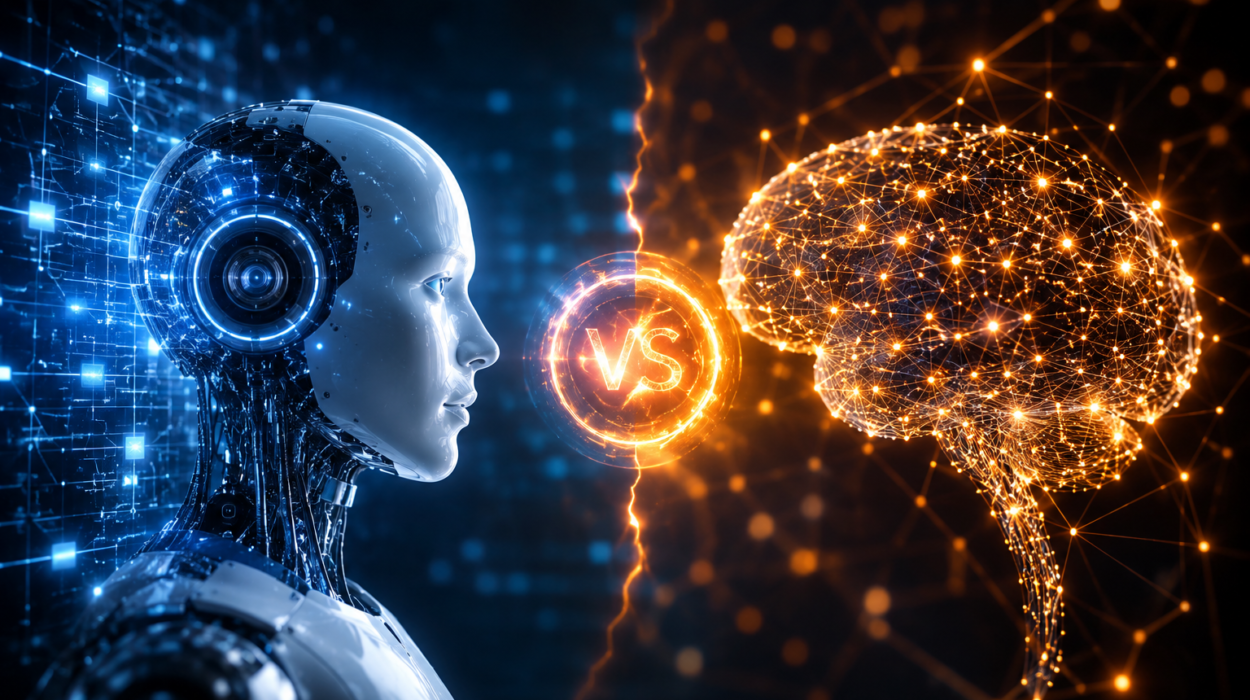
The discussion about open source AI versus closed AI is not about deciding which approach is universally better. Both have strengths, weaknesses, and important roles in the future of artificial intelligence. Understanding these two approaches helps us better understand how today’s AI systems are built and how tomorrow’s technology may evolve.
Understanding Artificial Intelligence
Before comparing open and closed AI, it helps to understand what an AI model actually is.
An AI model is a computer system trained to recognize patterns in enormous amounts of data. Modern AI models learn mathematical relationships from text, images, audio, videos, scientific data, or other information. During training, billions—or even trillions—of mathematical parameters are adjusted so the model becomes better at predicting or generating useful outputs.
Once training is complete, the model can perform tasks such as answering questions, translating languages, summarizing documents, recognizing images, or writing computer code.
Building these systems often requires massive computing resources, specialized hardware, enormous datasets, and teams of scientists and engineers.
The question then becomes: who gets access to these models?
That is where the distinction between open source AI and closed AI begins.
What Is Open Source AI?
Open source AI refers to AI systems whose developers make important parts of the technology publicly available.
Depending on the project, this may include the model’s computer code, trained model weights, documentation, research papers, or development tools.
This openness allows researchers, developers, universities, businesses, and independent enthusiasts to study how the system works, improve it, adapt it for specialized tasks, or build new applications on top of it.
Not every project labeled “open source AI” provides exactly the same level of openness. Some projects release only the software code. Others release both the code and the trained model. Some include restrictions on commercial use or redistribution. Because of these differences, experts often discuss openness as a spectrum rather than a simple yes-or-no category.
Even so, the central idea remains the same: the technology is made available for broader public access and collaboration.
What Is Closed AI?
Closed AI, often called proprietary AI, follows a different philosophy.
The companies or organizations developing these systems keep much of the underlying technology private.
The model’s internal design, training methods, datasets, and model weights are typically not released publicly.
Instead, users interact with the AI through websites, applications, or application programming interfaces (APIs). They can use the model’s capabilities without accessing its internal workings.
Many commercial AI systems follow this approach because companies invest enormous financial resources in developing advanced models. Keeping the technology private protects intellectual property, competitive advantages, and business investments.
Users receive the benefits of the AI without directly owning or modifying the underlying system.
The Philosophy Behind Open Source
Open source software has a long history extending well beyond artificial intelligence.
The philosophy centers on collaboration.
Instead of relying on one organization, thousands of developers around the world can inspect, improve, test, and expand the technology together.
Many major technologies that power the modern internet—including operating systems, programming languages, web servers, databases, and scientific software—have benefited enormously from open source development.
Supporters believe AI can advance more rapidly when knowledge is shared openly.
Researchers can verify scientific claims.
Universities can educate students more effectively.
Developers can adapt models for local languages and specialized industries.
Innovation spreads more quickly because fewer barriers prevent experimentation.
The Philosophy Behind Closed AI
Closed AI emphasizes controlled development.
Creating state-of-the-art AI models often requires billions of dollars in investment, specialized computer chips, enormous data centers, and years of research.
Companies argue that protecting these investments encourages continued innovation.
Closed development also allows organizations to carefully monitor updates, improve reliability, implement safety systems, and protect sensitive technologies from misuse.
Rather than distributing the technology freely, companies provide controlled access through carefully managed services.
This approach allows developers to improve performance while maintaining oversight over how their models are deployed.
Transparency and Understanding
One of the biggest differences between open and closed AI involves transparency.
Open source AI allows researchers to inspect much of the system directly.
Scientists can study algorithms, evaluate design choices, identify weaknesses, reproduce experiments, and independently verify research findings.
Transparency supports scientific progress because independent verification is a cornerstone of modern science.
Closed AI provides far less visibility.
Users typically see only the model’s outputs rather than its internal mechanisms.
This can make independent evaluation more difficult, although companies may publish research papers describing certain aspects of their systems.
Greater transparency often leads to increased scientific understanding, but it does not automatically guarantee better performance or safety.
Innovation Through Collaboration
Open source projects often benefit from contributions made by people around the world.
Researchers improve algorithms.
Developers fix software bugs.
Engineers optimize performance.
Educators create learning materials.
Companies build specialized tools.
This collaborative model has accelerated progress across many areas of computing.
Because thousands of people may contribute ideas, innovation often occurs rapidly.
Unexpected applications emerge as users adapt models for healthcare, education, agriculture, environmental science, language preservation, and countless other fields.
Rather than innovation flowing only from one company, it becomes distributed across an entire global community.
The Role of Competition
Closed AI also drives innovation, but through competition.
Companies invest heavily in research because successful AI products provide economic value.
Competition encourages improvements in speed, accuracy, efficiency, reliability, and user experience.
Organizations race to develop better algorithms, more capable reasoning systems, and increasingly useful applications.
This competition has contributed significantly to recent advances in generative AI, language models, computer vision, robotics, and scientific computing.
Both collaborative openness and commercial competition have played major roles in AI’s rapid development.
Safety and Security
Safety is one of the most debated aspects of open versus closed AI.
Supporters of open source argue that transparency allows many experts to identify vulnerabilities more quickly.
Independent researchers can examine models, test security measures, discover weaknesses, and propose improvements.
This process resembles scientific peer review, where many experts evaluate new findings.
Others raise concerns that openly available powerful AI systems could be modified for harmful purposes.
Certain technologies might be adapted to generate misinformation, automate cyberattacks, or assist malicious activities if appropriate safeguards are absent.
Closed AI developers argue that restricting access can reduce some risks by allowing stronger oversight and usage monitoring.
However, critics note that secrecy may also hide problems, making independent evaluation more difficult.
Neither openness nor secrecy alone guarantees safety.
Responsible development, continuous testing, security research, and thoughtful governance remain essential regardless of the development model.
Cost and Accessibility
Developing advanced AI models is extremely expensive.
Training today’s largest systems may require enormous computational resources, specialized graphics processing units, electricity, and highly skilled research teams.
Open source AI lowers barriers for many users because organizations can often build upon existing models rather than starting from scratch.
Universities, startups, nonprofit organizations, and researchers with limited budgets may gain access to powerful technologies that would otherwise remain unavailable.
Closed AI often requires subscription fees or usage-based pricing.
These costs support continued research, infrastructure maintenance, and ongoing development.
For some users, paying for professionally maintained services provides convenience and reliability.
For others, open alternatives offer greater flexibility and affordability.
Customization and Flexibility
One major advantage of open source AI is customization.
Developers can modify models for specialized purposes.
Hospitals may adapt models for medical terminology.
Scientists can train systems on research literature.
Businesses can optimize models for customer support.
Governments may develop systems for local languages.
Educational institutions can create teaching assistants tailored to specific curricula.
Because developers have direct access to the underlying technology, they can adjust many aspects of the system.
Closed AI generally offers less flexibility.
Users rely on features provided by the company.
Although many proprietary services include customization options, deeper modifications usually remain unavailable.
Privacy Considerations
Privacy is another important factor.
Organizations using open source AI may choose to run models entirely on their own computers or private servers.
Sensitive information never needs to leave their systems.
This can be especially valuable for hospitals, research laboratories, financial institutions, and government agencies handling confidential information.
Many closed AI services process requests through company-operated cloud infrastructure.
Developers often implement privacy protections and security measures, but organizations must evaluate whether these approaches satisfy their legal, ethical, and operational requirements.
Privacy depends not only on whether an AI model is open or closed but also on how it is deployed and managed.
Scientific Research
Science thrives on reproducibility.
Researchers must be able to repeat experiments and verify published findings.
Open source AI strongly supports this principle.
Scientists can inspect methods, reproduce training procedures when feasible, compare results, and build upon previous work.
Many breakthroughs in artificial intelligence have emerged because researchers openly shared ideas, algorithms, and software.
Closed AI also contributes significantly to scientific progress through published research and technological innovation.
However, some experiments may be difficult for independent researchers to reproduce if essential components remain unavailable.
Balancing scientific openness with commercial interests continues to be an active discussion within the AI community.
Business Perspectives
Businesses choose between open and closed AI based on their goals.
Some organizations value the flexibility and independence offered by open source systems.
Others prefer professionally managed commercial services that require less technical expertise.
Large companies often combine both approaches.
They may use proprietary AI for certain tasks while deploying open source models for others.
The choice depends on factors such as cost, performance, privacy, regulatory requirements, technical support, and long-term strategy.
There is no single solution suitable for every organization.
Education and Learning
Open source AI has become an important educational resource.
Students can study model architectures.
Teachers can demonstrate how algorithms function.
Researchers can perform experiments that would otherwise be impossible.
Hands-on learning deepens understanding.
Closed AI also supports education by making advanced capabilities available through user-friendly interfaces.
Students can explore language translation, programming assistance, creative writing, and problem-solving without needing specialized hardware or programming expertise.
Together, both approaches have expanded opportunities for learning around the world.
Misconceptions About Open Source AI
Many people assume that open source AI is always free.
In reality, while the software itself may be available without licensing fees, running advanced AI models often requires powerful computers and substantial electricity.
Another misconception is that open source automatically means completely unrestricted.
Many projects include licenses that define how the software may be used, modified, or distributed.
Similarly, openness does not guarantee higher quality.
Some open models outperform proprietary systems in specific tasks, while others do not.
Performance depends on engineering, training data, computational resources, and careful evaluation.
Misconceptions About Closed AI
Closed AI is sometimes viewed as secretive or inherently less trustworthy.
This oversimplifies the situation.
Many proprietary AI companies publish scientific research, collaborate with universities, participate in safety evaluations, and contribute to open scientific knowledge.
Likewise, proprietary systems often receive continuous maintenance, security updates, infrastructure improvements, and customer support that many users value.
Keeping certain components private does not necessarily imply poor scientific quality.
It often reflects business strategy, security considerations, or intellectual property protection.
Can Open and Closed AI Coexist?
Rather than competing exclusively, open and closed AI increasingly influence each other.
Open research often inspires commercial innovation.
Commercial investments accelerate scientific breakthroughs.
Companies sometimes release older models as open source while keeping their newest systems proprietary.
Researchers collaborate across universities, nonprofit organizations, startups, and large technology companies.
This exchange of ideas has fueled much of AI’s extraordinary progress over the past decade.
The future of AI will likely involve a diverse ecosystem where both open and proprietary approaches continue contributing in different ways.
The Future of Open and Closed AI
Artificial Intelligence is still evolving rapidly.
Researchers continue exploring more efficient training methods, better reasoning capabilities, stronger safety techniques, and improved transparency.
Open source communities are developing increasingly capable models that can run on smaller computers, making AI accessible to more people worldwide.
At the same time, commercial organizations continue investing heavily in building some of the most advanced AI systems ever created, pushing the boundaries of scientific and engineering achievement.
Governments, educators, scientists, businesses, and civil society are also working to develop policies that encourage innovation while addressing safety, fairness, accountability, and responsible use.
Exactly how open and closed AI will evolve remains uncertain, but both approaches are likely to remain important.
Which Approach Is Better?
The question of whether open source AI or closed AI is better has no universal answer.
Open source AI excels in transparency, collaboration, customization, scientific research, and educational access. It empowers communities around the world to study, improve, and adapt artificial intelligence to local needs, often accelerating innovation through shared knowledge.
Closed AI, on the other hand, offers carefully managed services, significant commercial investment, professional maintenance, and controlled deployment. It enables companies to invest enormous resources into developing cutting-edge systems while providing users with polished, reliable, and continuously updated products.
Ultimately, these approaches should not be viewed as enemies. They represent different strategies for advancing the same field. Open collaboration has long been a driving force behind scientific discovery, while commercial innovation has often transformed those discoveries into technologies that benefit billions of people.
As Artificial Intelligence becomes increasingly woven into everyday life, the most important question may not be whether AI is open or closed. Instead, it is whether these systems are developed responsibly, evaluated scientifically, used ethically, and designed to serve humanity. If openness, innovation, safety, and accountability continue to evolve together, both open source AI and closed AI can play essential roles in shaping a future where artificial intelligence becomes one of humanity’s most valuable tools.