Imagine being unable to move your hands after a spinal cord injury. Picture losing your ability to speak after a stroke, or watching your memories slowly disappear because of Alzheimer’s disease. For millions of people around the world, these are not imaginary situations—they are daily realities. Yet a remarkable field of science is offering new hope. Researchers are developing brain implants that can communicate directly with the human brain, opening possibilities that once belonged only to science fiction.
Brain implants are no longer just futuristic ideas. Today, scientists have already used them to reduce the symptoms of Parkinson’s disease, help some people hear through cochlear implants, restore limited communication for individuals with paralysis, and even allow people to control computers using only their thoughts. While these technologies cannot cure every neurological condition, they demonstrate something extraordinary: the brain can sometimes work together with carefully designed electronic devices to regain abilities that were once thought to be permanently lost.
The question is no longer whether brain implants can help people. The real question is how much they will be able to restore in the future.
Understanding the Human Brain
To understand brain implants, it helps to first understand the brain itself.
The human brain is one of the most complex structures known to science. It contains approximately 86 billion neurons, or nerve cells, connected by hundreds of trillions of synapses. These neurons communicate using tiny electrical and chemical signals that travel throughout the brain and nervous system.
Every thought, memory, movement, emotion, sensation, and decision depends on these signals. When you decide to pick up a cup of coffee, neurons in your brain generate electrical activity that travels through the spinal cord and nerves to your muscles. When you hear music, see a familiar face, or remember a childhood experience, different networks of neurons become active.
When disease or injury damages these networks, important abilities may be lost. A stroke can interrupt communication between brain regions. A spinal cord injury can prevent signals from reaching the muscles. Neurodegenerative diseases can gradually destroy neurons involved in memory or movement.
Brain implants aim to restore or replace some of these broken communication pathways.
What Is a Brain Implant?
A brain implant is a medical device designed to interact directly with the brain or nervous system. Depending on its purpose, the implant may record brain activity, stimulate specific brain regions with electrical pulses, or both.
Some implants are placed deep inside the brain during neurosurgery. Others rest on the brain’s surface. Researchers are also developing less invasive systems that can be inserted through blood vessels or use flexible electrodes designed to reduce damage to brain tissue.
The exact design depends on the medical condition being treated.
Unlike ordinary electronic devices, brain implants must work safely inside one of the body’s most delicate organs. They must accurately detect tiny electrical signals while minimizing risks such as infection, inflammation, or tissue damage.
How Brain Implants Communicate with the Brain
Neurons communicate through electrical impulses called action potentials. Brain implants use tiny electrodes to detect these signals or deliver carefully controlled electrical stimulation.
When recording brain activity, the electrodes capture patterns of electrical signals generated by nearby neurons. Advanced computer algorithms analyze these patterns and translate them into useful information. For example, the system may recognize that a person intends to move a hand, even if paralysis prevents the movement from occurring.
When providing stimulation, the implant sends small electrical pulses to specific brain regions. These pulses can help restore more normal patterns of brain activity in certain neurological disorders.
The interaction between biology and electronics forms the basis of what scientists call a brain-computer interface, often abbreviated as BCI.
Deep Brain Stimulation: One of the Most Successful Brain Implants
One of the best-established brain implant technologies is deep brain stimulation (DBS).
Doctors use DBS primarily to help treat movement disorders such as Parkinson’s disease, essential tremor, and some cases of dystonia.
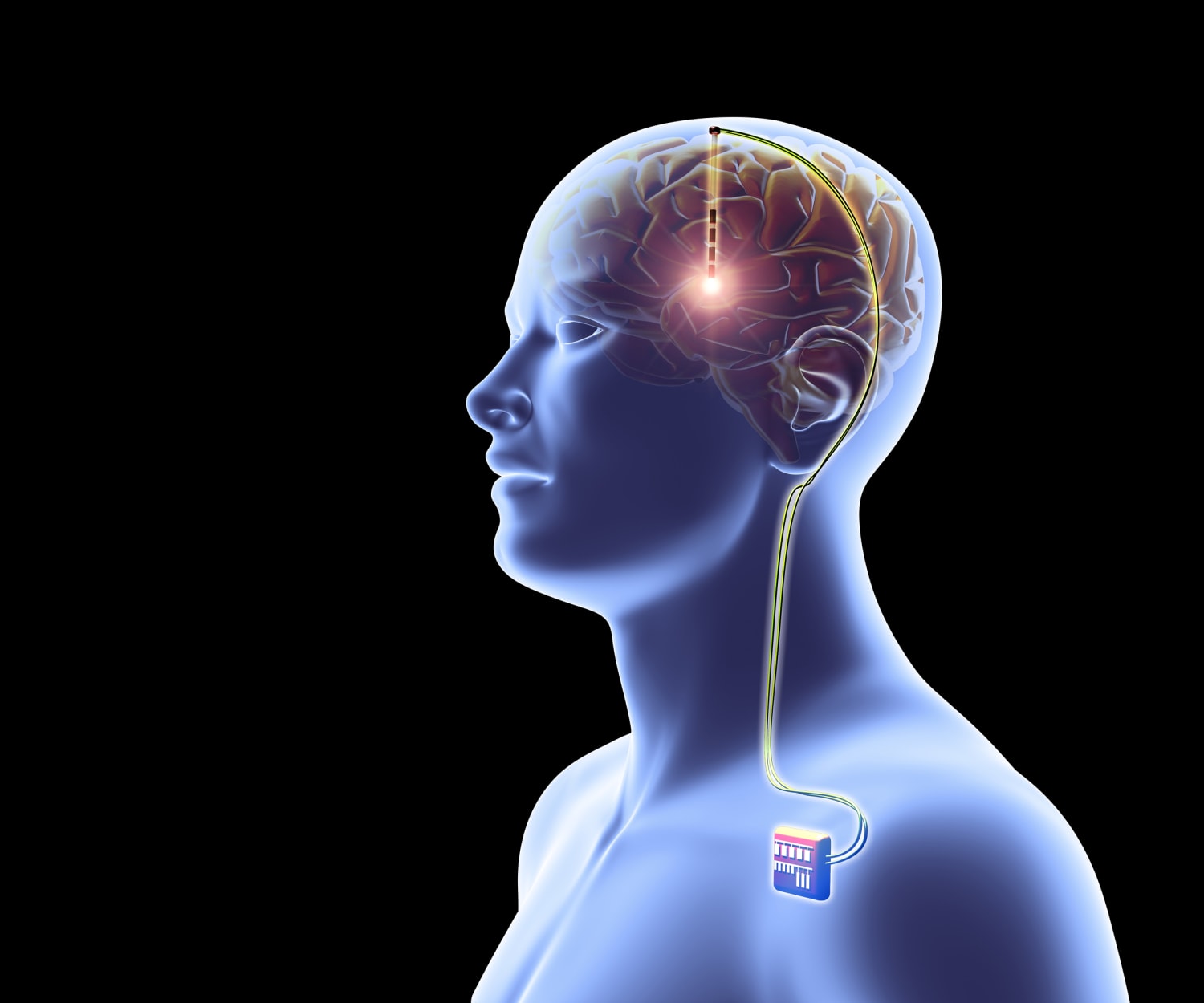
In this procedure, surgeons place thin electrodes into carefully selected brain regions. These electrodes connect to a small pulse generator implanted beneath the skin, usually near the chest. The device continuously delivers electrical stimulation that helps regulate abnormal brain activity.
For many patients with Parkinson’s disease, DBS can significantly reduce tremors, muscle stiffness, and involuntary movements. It often improves quality of life, although it does not stop the progression of the disease or cure its underlying cause.
Decades of research have established DBS as an important treatment option for carefully selected patients.
Helping People Move Again
One of the most exciting goals of brain implant research is restoring movement after paralysis.
Paralysis can occur when communication between the brain and muscles is interrupted, often because of spinal cord injury or stroke. In many cases, the brain still generates movement commands, but those signals cannot reach the body.
Researchers have developed experimental brain-computer interfaces that record signals from the motor cortex, the brain region responsible for voluntary movement. Artificial intelligence algorithms interpret these signals and translate them into commands for external devices.
In research studies, some participants with paralysis have learned to move robotic arms, operate computer cursors, write text, and even control their own muscles through implanted systems linked to electrical stimulators.
Although these technologies remain largely experimental, they demonstrate that lost movement can sometimes be partially restored by bypassing damaged neural pathways.
Restoring Communication After Paralysis
For individuals with severe paralysis, even speaking or typing may become impossible.
Brain implants are offering new ways to communicate.
Scientists have developed systems that decode patterns of brain activity associated with intended speech or handwriting. Artificial intelligence converts these signals into text displayed on a computer screen or into synthesized speech generated in real time.
Recent studies have shown that some individuals with paralysis can communicate much faster than was previously possible using traditional eye-tracking technologies.
While current systems still require further refinement, they represent a major step toward restoring one of humanity’s most essential abilities: communication.
Can Brain Implants Restore Vision?
Vision loss affects millions of people worldwide.
Researchers are exploring several approaches to restoring limited vision using brain implants.
Some devices stimulate the retina, the light-sensitive tissue at the back of the eye. Others bypass damaged eyes entirely by stimulating the visual cortex, the part of the brain responsible for processing visual information.
Current visual prostheses do not restore normal eyesight. Instead, they may allow users to detect light, recognize large objects, identify doorways, or distinguish simple shapes.
Although these systems remain limited compared with natural vision, ongoing advances in neuroscience, electronics, and artificial intelligence continue to improve their capabilities.
Restoring Hearing Through Cochlear Implants
One of the greatest success stories in neurotechnology is the cochlear implant.
Unlike many experimental brain implants, cochlear implants are already widely used around the world.
These devices bypass damaged structures in the inner ear and directly stimulate the auditory nerve using electrical signals. The brain learns to interpret these signals as sound.
Many people with severe hearing loss can understand speech, enjoy music to varying degrees, and participate more fully in daily life after receiving cochlear implants.
Although cochlear implants do not produce hearing identical to natural hearing, they have transformed the lives of hundreds of thousands of individuals.
Could Brain Implants Help Restore Memory?
Memory disorders remain among the greatest medical challenges.
Scientists are investigating whether brain implants might strengthen or restore memory in people affected by traumatic brain injury, epilepsy, or neurodegenerative diseases.
Some experimental devices record neural activity during successful memory formation and later deliver carefully timed electrical stimulation intended to reinforce similar patterns.
Early research has shown encouraging results in limited settings, but scientists emphasize that these technologies are still under investigation.
Human memory is extraordinarily complex, involving multiple brain regions and countless neural connections. Fully restoring lost memories remains far beyond current scientific capabilities.
Brain Implants and Stroke Recovery
Stroke is one of the leading causes of long-term disability worldwide.
After a stroke, damaged brain tissue may impair movement, speech, sensation, or cognitive function.
Researchers are studying whether brain implants can enhance rehabilitation by stimulating neural circuits involved in recovery. Electrical stimulation may encourage the brain’s natural ability to reorganize itself, a process known as neuroplasticity.
When combined with physical therapy, these approaches may improve recovery in some patients. However, scientists are still determining which individuals are most likely to benefit.
Helping People with Epilepsy
Epilepsy causes recurrent seizures resulting from abnormal electrical activity in the brain.
Some patients continue experiencing seizures despite medication.
Responsive neurostimulation systems offer a promising treatment option for selected individuals. These implanted devices continuously monitor brain activity. When they detect patterns associated with an approaching seizure, they automatically deliver electrical stimulation designed to interrupt the abnormal activity before a seizure fully develops.
Clinical studies have shown that responsive neurostimulation can reduce seizure frequency in many appropriately selected patients, although it does not cure epilepsy.
Brain Implants and Mental Health
Researchers are also exploring brain implants for certain psychiatric conditions.
Experimental studies have investigated deep brain stimulation for treatment-resistant depression, obsessive-compulsive disorder, and other severe mental illnesses.
Some patients have experienced meaningful improvements when other treatments failed. However, responses vary considerably, and these procedures remain appropriate only in carefully selected cases under specialized medical supervision.
Mental health disorders involve highly complex brain networks, making this area of research especially challenging.
The Role of Artificial Intelligence
Modern brain implants increasingly rely on artificial intelligence.
The brain produces enormous amounts of electrical data every second. AI algorithms help identify meaningful patterns within this activity, allowing implanted systems to respond more accurately and efficiently.
Machine learning also enables some devices to improve over time as they adapt to an individual’s unique brain activity.
Rather than replacing the human brain, artificial intelligence serves as a translator between neural signals and digital technology.
Neuroplasticity Makes Recovery Possible
One reason brain implants can sometimes restore lost abilities is the brain’s remarkable capacity for adaptation.
This ability, called neuroplasticity, allows neural networks to reorganize after injury or learning.
When combined with rehabilitation, brain implants may encourage surviving neurons to form new connections and strengthen existing pathways.
The brain is not infinitely flexible, and recovery varies greatly among individuals. Nevertheless, neuroplasticity provides an important biological foundation for many restorative therapies.
Current Limitations
Despite impressive progress, brain implants have important limitations.
Most devices restore only part of a lost function rather than fully returning normal ability.
Surgical implantation carries risks, including infection, bleeding, and complications related to anesthesia.
Some implants may gradually lose signal quality over time as scar tissue forms around electrodes.
Battery replacement or device maintenance may require additional procedures.
Researchers are actively working to develop safer, smaller, longer-lasting implants that provide more reliable performance.
Ethical Questions
As brain implant technology advances, important ethical questions arise.
Who should have access to these expensive treatments?
How should sensitive brain data be protected?
Could future technologies influence personal privacy or autonomy?
How should society regulate devices that directly interact with human thought?
Scientists, physicians, engineers, ethicists, policymakers, and patients all contribute to these ongoing discussions.
Responsible development requires balancing innovation with safety, fairness, and respect for individual rights.
What the Future May Hold
The future of brain implants is filled with both excitement and uncertainty.
Researchers are developing flexible electrodes that better match the softness of brain tissue. Wireless implants may reduce the need for bulky hardware. Improved artificial intelligence could allow faster and more accurate interpretation of brain signals.
Scientists are also exploring technologies that combine electrical stimulation with advanced materials, gene therapy, or regenerative medicine.
Although many ideas remain experimental, progress over the past few decades suggests that brain-computer technologies will continue to improve.
It is important, however, to separate realistic expectations from science fiction. Current brain implants cannot upload memories, read minds, dramatically increase intelligence, or instantly cure neurological diseases. Most existing devices address specific medical problems and require extensive rehabilitation and clinical support.
A New Era of Hope
Brain implants represent one of the most remarkable achievements in modern neuroscience and biomedical engineering. By creating direct communication between the brain and electronic devices, they are helping restore movement, hearing, communication, and other important functions for some people living with neurological disorders.
These technologies are not miracles, and they are not cures for every condition. Their effectiveness depends on the type of injury or disease, the specific technology used, and the unique biology of each patient. Even so, they demonstrate an extraordinary truth: the human brain is more adaptable than scientists once believed, and carefully designed technology can sometimes help rebuild pathways that disease or injury has disrupted.
As neuroscience, artificial intelligence, materials science, and medicine continue advancing together, brain implants may restore even more lost abilities in the future. Each breakthrough brings researchers closer to a world where neurological injuries no longer mean the permanent loss of communication, movement, or independence. While many scientific challenges remain, brain implants have already transformed lives and continue to redefine what is possible in the treatment of disorders affecting the human brain.