Imagine waking up one morning to discover that your bank account has been emptied, your personal photos have been stolen, or your company’s website has suddenly gone offline. In many cases, these incidents begin with a cyberattack that happens silently in the background, often long before anyone notices something is wrong.
Cybercriminals are becoming faster, smarter, and more organized every year. They use sophisticated software, automated hacking tools, and even artificial intelligence to target individuals, businesses, hospitals, schools, and governments. Traditional cybersecurity tools still play an essential role, but many modern attacks move too quickly for humans alone to detect and stop.
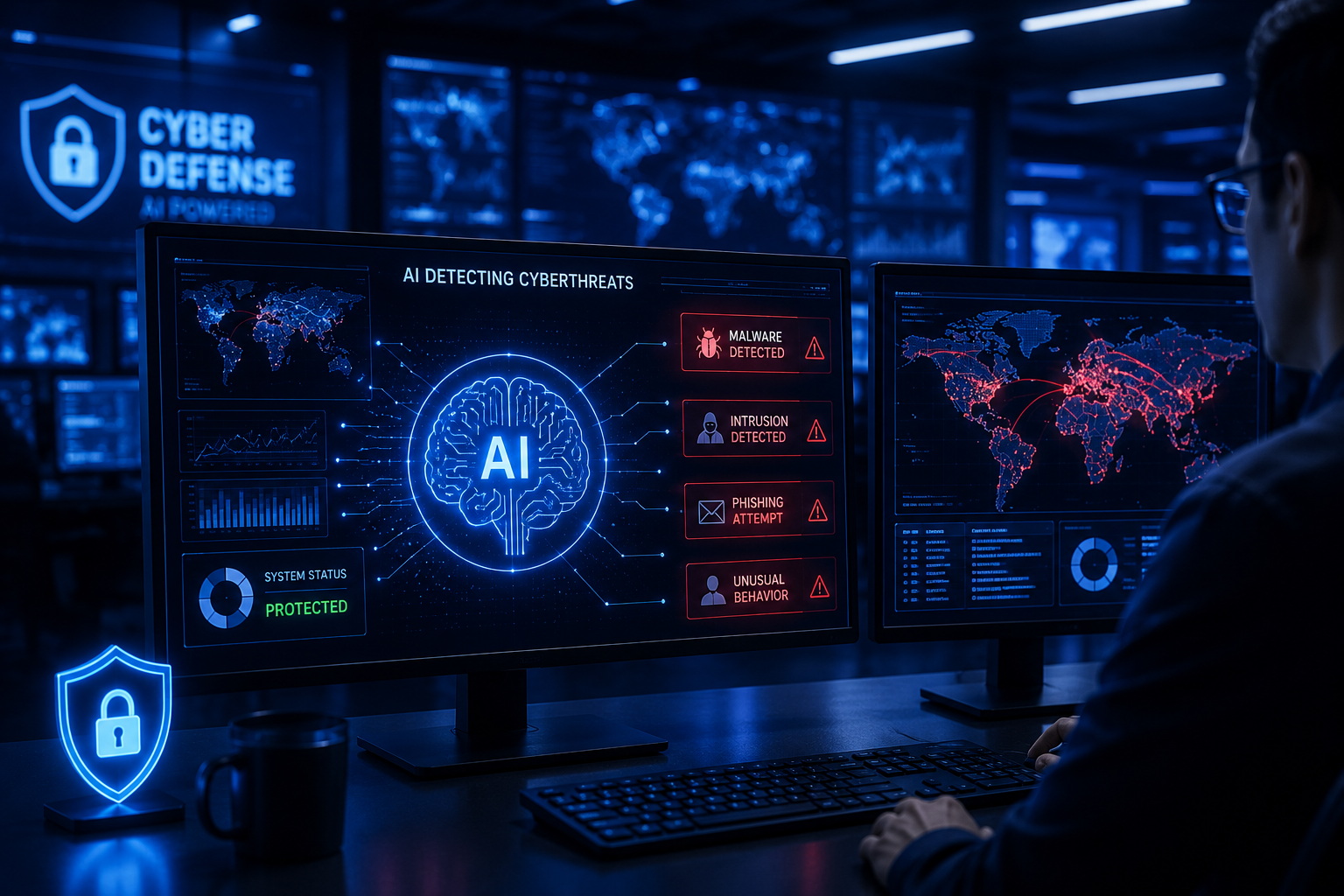
This is where artificial intelligence (AI) is transforming cybersecurity. AI can analyze enormous amounts of digital information, recognize unusual behavior, identify hidden threats, and help security teams respond before serious damage occurs.
But can AI really detect cyberattacks? The answer is yes—but with important limitations. AI is a powerful tool, not a magical solution. It works best when combined with human expertise, strong security practices, and continuously updated technology.
What Is a Cyberattack?
A cyberattack is an attempt to damage, steal, manipulate, or gain unauthorized access to computer systems, networks, or digital information.
Cyberattacks come in many forms. Some criminals try to steal passwords or financial information. Others spread ransomware that locks files until a payment is made. Some attacks secretly install malicious software that spies on victims for months without being detected. Others overwhelm websites with massive amounts of internet traffic, making them unavailable to users.
The goal is often money, but attacks can also aim to disrupt businesses, steal intellectual property, spread political influence, or damage critical infrastructure.
As more of our lives move online, the number of possible targets continues to grow.
Why Detecting Cyberattacks Is So Difficult
Modern computer networks generate enormous amounts of data every second.
Every login attempt, email, file transfer, website visit, software update, and network connection creates digital records.
A large company may produce billions of security-related events every day.
No human security team can manually examine every event.
Cybercriminals understand this challenge. They often hide their activities among normal network traffic, making malicious behavior look almost identical to legitimate activity.
Some attacks unfold slowly over weeks or months, making them especially difficult to notice.
Artificial intelligence excels at finding patterns hidden within these massive volumes of information.
What Is Artificial Intelligence in Cybersecurity?
Artificial intelligence refers to computer systems designed to perform tasks that normally require human intelligence.
In cybersecurity, AI analyzes data, identifies suspicious activity, predicts potential threats, and assists security professionals in making faster decisions.
Unlike traditional security software that relies mainly on fixed rules, AI can recognize complex relationships in data and adapt as new threats emerge.
Many cybersecurity systems combine AI with machine learning, allowing them to improve their performance over time by learning from examples.
How AI Learns to Recognize Threats
Machine learning is one of the most important technologies behind AI-powered cybersecurity.
Instead of following only pre-programmed instructions, machine learning systems analyze large collections of historical data.
They learn what normal network behavior looks like.
For example, an employee may usually log in between 8 a.m. and 5 p.m. from the same city using the same computer.
If the account suddenly logs in at 3 a.m. from another country and immediately downloads thousands of confidential files, the AI may recognize this as highly unusual behavior.
The system can then alert security teams for further investigation.
This ability to recognize abnormal patterns is called anomaly detection.
Detecting Malware
Malware is software designed to harm computers or steal information.
Traditional antivirus programs mainly rely on known malware signatures.
This works well for previously identified threats but struggles against entirely new malware.
AI offers another layer of protection.
Instead of searching only for known signatures, AI analyzes how software behaves.
If a program suddenly begins encrypting thousands of files, modifying critical system settings, or secretly communicating with suspicious internet servers, AI may identify it as malicious even if it has never seen that exact program before.
This behavioral analysis helps detect new forms of malware that traditional methods might initially miss.
Stopping Phishing Attacks
Phishing remains one of the world’s most common cyber threats.
Attackers send emails or messages pretending to come from trusted organizations.
Their goal is to trick people into revealing passwords, financial information, or other sensitive data.
AI can examine email content, writing style, sender information, web links, attachments, and many other features simultaneously.
It searches for subtle signs that indicate fraud.
Modern AI systems can identify suspicious messages much faster than manual review alone.
Some email security platforms continuously learn from newly discovered phishing campaigns, helping them detect evolving scams.
Watching Network Traffic
Every device connected to a network constantly exchanges information.
This creates a complex web of digital communication.
AI continuously monitors these communications.
It looks for unusual spikes in activity, unexpected connections between devices, suspicious file transfers, or abnormal data movement.
If a hacker gains access to a network and begins moving from one computer to another, AI may detect the unusual pattern long before a human notices.
This early warning can significantly reduce damage.
Detecting Ransomware
Ransomware has become one of the most dangerous forms of cybercrime.
It encrypts files and demands payment for their release.
AI helps identify ransomware by monitoring file activity in real time.
If thousands of files suddenly begin changing at an unusually rapid rate, AI may recognize this as ransomware behavior.
Some advanced security systems can automatically isolate infected computers before the malware spreads throughout an organization.
Speed is critical because ransomware often encrypts data within minutes.
Finding Insider Threats
Not every cyber threat comes from outside an organization.
Sometimes employees, contractors, or trusted users accidentally—or intentionally—cause security incidents.
AI can recognize unusual user behavior.
For example, if an employee suddenly accesses confidential databases unrelated to their job or downloads unusually large amounts of sensitive information, AI may detect the change.
Importantly, unusual behavior does not automatically mean malicious intent.
Instead, AI provides alerts that allow human investigators to examine the situation more carefully.
Detecting Unknown Attacks
One of AI’s greatest strengths is identifying threats that have never been seen before.
Traditional rule-based systems depend heavily on known attack patterns.
Cybercriminals constantly develop new techniques designed to bypass these defenses.
AI can identify suspicious behavior even when no exact historical example exists.
This ability makes AI particularly valuable against so-called “zero-day” attacks, where hackers exploit previously unknown software vulnerabilities.
Although AI cannot stop every zero-day attack, it can often recognize unusual activity associated with them.
AI Responds Faster Than Humans
Time is one of the most important factors during a cyberattack.
Every minute matters.
An attacker who remains undetected for hours may steal enormous amounts of data.
AI can analyze millions of events every second.
When suspicious activity appears, automated systems may immediately isolate affected devices, block malicious internet connections, disable compromised accounts, or notify security teams.
This rapid response can dramatically reduce the impact of an attack.
AI Helps Security Analysts
Modern cybersecurity professionals face overwhelming workloads.
Thousands of security alerts may appear every day.
Many turn out to be harmless.
AI helps prioritize alerts based on their likelihood of representing real threats.
Instead of investigating every minor warning, analysts can focus on the most serious incidents.
This improves efficiency while reducing fatigue and helping security teams make better decisions.
Can AI Predict Cyberattacks?
In some situations, AI can identify warning signs before an attack fully develops.
By analyzing historical attack patterns, global threat intelligence, software vulnerabilities, and network behavior, AI may recognize conditions associated with increased risk.
However, prediction is not the same as certainty.
AI estimates probabilities based on available evidence.
It cannot see the future or guarantee that an attack will occur.
Its role is to improve preparedness rather than provide perfect forecasts.
The Importance of Human Experts
Despite its impressive capabilities, AI cannot replace cybersecurity professionals.
Human experts understand business operations, legal responsibilities, ethical considerations, and the broader context surrounding security incidents.
AI may detect suspicious activity, but people decide how to investigate, interpret evidence, communicate with affected users, and recover systems.
Cybersecurity works best when AI and humans complement each other’s strengths.
AI handles speed, automation, and large-scale data analysis.
Humans provide judgment, creativity, experience, and strategic decision-making.
Can Hackers Use AI Too?
Unfortunately, yes.
Just as defenders use AI to improve security, cybercriminals also use AI to improve attacks.
AI can help generate convincing phishing emails, automate vulnerability scanning, create fake voices, produce realistic deepfake videos, and rapidly adapt malicious software.
This creates an ongoing technological competition.
As defensive AI improves, attackers continue searching for new ways to evade detection.
Cybersecurity has become a constant race between innovation and exploitation.
The Limitations of AI
Although AI is extremely powerful, it is not perfect.
AI sometimes generates false positives by identifying harmless behavior as suspicious.
This can create unnecessary investigations.
It can also produce false negatives, where genuine threats remain undetected.
Machine learning models depend heavily on the quality of their training data.
If the training data is incomplete, outdated, or biased, AI performance may suffer.
Sophisticated attackers may also deliberately attempt to deceive AI systems by carefully modifying their behavior.
For these reasons, AI should always be viewed as one part of a broader cybersecurity strategy.
AI Protects Everyday Internet Users
Many people benefit from AI-powered cybersecurity without realizing it.
Email providers use AI to block spam and phishing messages.
Banks use AI to detect fraudulent financial transactions.
Web browsers warn users about dangerous websites.
Cloud services identify suspicious account logins.
Social media platforms use AI to detect malicious accounts and coordinated attacks.
Smartphones increasingly include AI-powered security features that identify harmful apps and suspicious behavior.
These invisible protections help make the internet safer for billions of users.
AI in Critical Infrastructure
Critical infrastructure includes systems that society depends upon every day.
Power grids, hospitals, transportation networks, communication systems, financial institutions, and water treatment facilities all face growing cyber threats.
AI helps monitor these complex environments around the clock.
By detecting unusual activity early, AI may help prevent attacks that could disrupt essential public services.
Because these systems affect millions of people, rapid threat detection is especially important.
The Future of AI in Cybersecurity
Artificial intelligence will continue becoming more capable as computing power grows and machine learning models improve.
Future AI systems may detect attacks earlier, understand complex relationships between multiple threats, and automate more aspects of incident response.
Researchers are also developing explainable AI systems that make it easier for security professionals to understand why an alert was generated.
Greater transparency helps experts evaluate AI recommendations and build trust in automated systems.
At the same time, new challenges will emerge.
Quantum computing, increasingly sophisticated cybercriminal organizations, and AI-powered attacks will require equally advanced defensive technologies.
Cybersecurity will remain an evolving field where continuous learning and adaptation are essential.
Should We Trust AI to Detect Cyberattacks?
The evidence from modern cybersecurity shows that AI has become one of the most valuable tools for detecting cyber threats. It can process enormous amounts of information far faster than any human, recognize subtle patterns that would otherwise go unnoticed, and help organizations respond to attacks before they cause widespread damage.
However, AI is not an all-knowing digital guardian. It cannot replace experienced cybersecurity professionals, eliminate every threat, or guarantee complete protection. Its greatest strength lies in working alongside human expertise, advanced security technologies, and responsible cybersecurity practices.
As cyberattacks continue to grow in speed and sophistication, artificial intelligence will play an increasingly important role in protecting the digital world. While the battle between defenders and attackers is far from over, AI has already become one of the strongest allies in helping individuals, businesses, and governments stay one step ahead of evolving cyber threats.