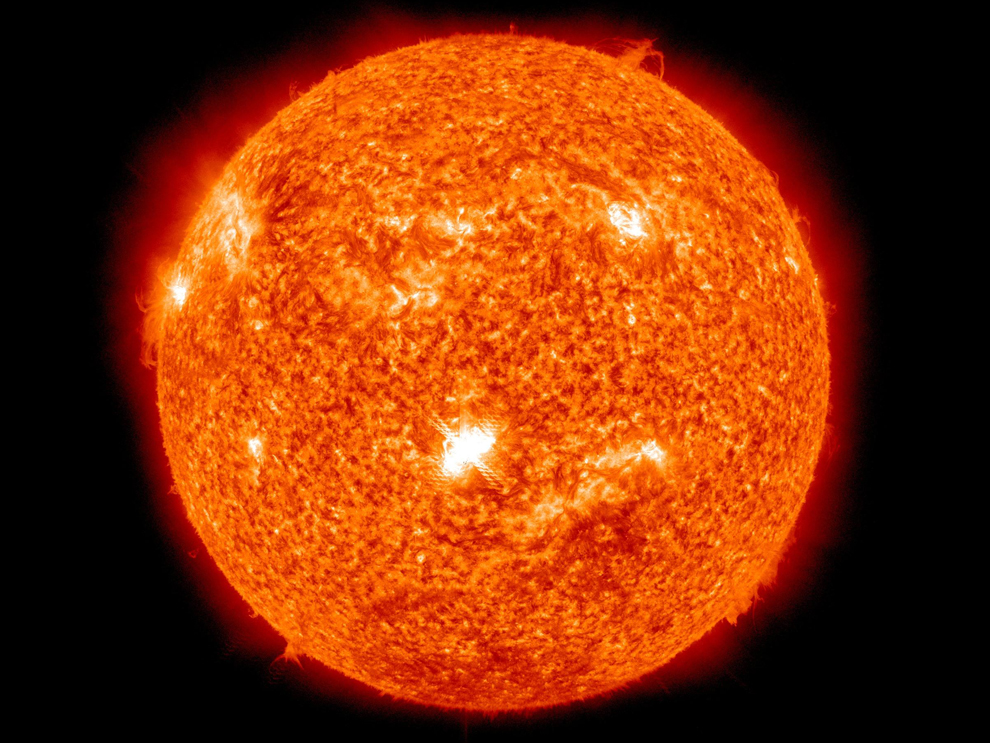
Every morning, the Sun rises above the horizon, filling the sky with light and warmth. It brightens our days, powers Earth’s climate, helps plants grow, and makes life possible. Yet despite seeing it every day, many people rarely stop to ask one simple question:
Why does the Sun shine?
For thousands of years, humans wondered whether the Sun was a giant fire in the sky, a glowing ball of molten rock, or even a divine object. Today, thanks to modern astronomy and physics, we know the answer. The Sun shines because deep inside its core, an extraordinary process called nuclear fusion transforms tiny hydrogen atoms into helium, releasing an enormous amount of energy.
This incredible process has kept the Sun shining for about 4.6 billion years, and it is expected to continue for another 5 billion years before the Sun enters the final stages of its life.
Understanding why the Sun shines is more than learning about a single star. It is a story about the fundamental forces of nature, the birth of stars, and the energy that makes life on Earth possible.
The Sun Is a Star
The Sun may seem different from the stars we see at night, but it is actually one of them.
It appears much larger and brighter simply because it is far closer to Earth than any other star. On average, the Sun is about 150 million kilometers (93 million miles) away. By comparison, the next closest star, Proxima Centauri, is more than 4.2 light-years away—over 40 trillion kilometers.
Like countless other stars scattered throughout the Milky Way, the Sun is a massive sphere of hot gas held together by gravity. It is made mostly of hydrogen, with helium making up most of the rest. Small amounts of heavier elements such as oxygen, carbon, neon, and iron are also present.
Although it looks calm from Earth, the Sun is an incredibly active and dynamic star.
The Sun Is Not Burning Like Fire
When people hear that the Sun produces heat and light, it is natural to imagine a giant fire burning in space.
But this idea is impossible.
Fire requires oxygen. On Earth, wood, paper, or gasoline burns because oxygen in the atmosphere supports combustion. Space, however, is almost completely empty. There is no surrounding oxygen to keep a fire burning.
If the Sun were simply a giant ball of fire, it would have burned out long ago.
Instead, the Sun shines through an entirely different process—one that is far more powerful than any chemical reaction.
That process is nuclear fusion.
The Incredible Pressure Inside the Sun
Gravity is the secret that makes the Sun shine.
The Sun contains about 99.8% of all the mass in the Solar System. This enormous mass creates an incredibly strong gravitational pull that squeezes the Sun inward from every direction.
At the center of the Sun, this pressure becomes almost unimaginable.
The temperature in the core reaches about 15 million degrees Celsius (27 million degrees Fahrenheit).
Under these extreme conditions, hydrogen atoms move so rapidly that they collide with tremendous force.
Normally, positively charged hydrogen nuclei repel one another because like charges push apart. But inside the Sun’s core, the pressure and temperature are so immense that the nuclei can come close enough for the strong nuclear force to take over.
When that happens, they fuse together.
Nuclear Fusion Powers the Sun
Nuclear fusion is one of the most powerful energy-producing processes in the universe.
Inside the Sun’s core, hydrogen nuclei combine through a series of reactions that ultimately produce helium.
During this process, a tiny fraction of the original mass disappears.
This missing mass is not lost.
Instead, it is converted directly into energy according to Albert Einstein’s famous equation:
E = mc²
Because the speed of light is incredibly large, even a tiny amount of mass becomes an enormous amount of energy.
Every second, the Sun converts roughly 600 million tons of hydrogen into helium. About 4 million tons of mass are transformed into pure energy every second.
That energy is what makes the Sun shine.
The Energy’s Long Journey
One might imagine that the energy produced in the Sun’s core reaches Earth almost immediately.
The reality is far more surprising.
The light we see today actually began its journey deep inside the Sun a very long time ago.
After fusion creates energy, it first appears as high-energy particles called gamma rays.
These particles cannot travel directly out of the Sun because the interior is incredibly dense. Instead, they are constantly absorbed and re-emitted by countless atoms.
This endless zigzag journey is called a random walk.
Scientists estimate that it can take tens of thousands to hundreds of thousands of years for the energy produced in the core to slowly work its way to the Sun’s visible surface.
Only after reaching the surface can the energy finally escape into space as sunlight.
From there, the journey becomes much faster.
Sunlight travels from the Sun to Earth in only about 8 minutes and 20 seconds.
Sunlight Travels Across Space
Once sunlight leaves the Sun’s surface, it moves through the vacuum of space at the speed of light—about 299,792 kilometers per second (186,282 miles per second).
Unlike sound, light does not need air or any other material to travel.
It moves through empty space as electromagnetic radiation.
By the time sunlight reaches Earth, it has crossed 150 million kilometers in just over eight minutes.
Every sunrise is therefore a glimpse of the Sun as it existed eight minutes earlier.
The Sun Produces an Astonishing Amount of Energy
The Sun’s energy output is almost impossible to imagine.
Every second, it releases about 3.8 × 10²⁶ watts of power.
In a single second, the Sun emits more energy than humanity has used throughout all of recorded history.
Fortunately, Earth receives only a tiny fraction of this energy.
Even that tiny share is enough to warm our planet, drive weather systems, fuel ocean currents, and sustain nearly every ecosystem.
Without this constant flow of solar energy, Earth would become a frozen, lifeless world.
Sunlight Makes Life Possible
Nearly every form of life on Earth depends on sunlight.
Plants capture solar energy through photosynthesis, converting sunlight, water, and carbon dioxide into sugars that fuel their growth.
During this process, plants also release oxygen into the atmosphere.
Animals—including humans—depend on plants either directly or indirectly for food.
Even fossil fuels such as coal, oil, and natural gas represent ancient solar energy stored in plants and microscopic organisms that lived millions of years ago.
The food we eat, the oxygen we breathe, and much of the energy that powers civilization all trace back to sunlight.
The Sun Keeps Earth Warm
Earth orbits at just the right distance from the Sun.
Astronomers sometimes call this region the habitable zone, where temperatures allow liquid water to exist on a planet’s surface.
The Sun constantly warms Earth’s land, oceans, and atmosphere.
This heating drives winds, creates clouds, powers storms, and shapes global climate patterns.
Without the Sun, Earth’s average surface temperature would plunge far below freezing.
Most water would become ice.
Photosynthesis would stop.
Within a relatively short time, nearly all familiar life would disappear.
The Sun is not just our nearest star—it is Earth’s primary source of energy.
The Sun Is Constantly Balancing Two Powerful Forces
The Sun exists because two enormous forces remain in balance.
Gravity constantly pulls all of the Sun’s material inward, trying to compress it further.
At the same time, nuclear fusion in the core generates tremendous heat and pressure that push outward.
These opposing forces create a stable balance known as hydrostatic equilibrium.
As long as fusion continues, the Sun remains stable.
If fusion suddenly stopped, gravity would begin crushing the Sun inward.
If fusion somehow became much stronger, the Sun would expand.
This delicate balance has kept the Sun remarkably stable for billions of years.
The Sun Does Not Shine Forever
Although the Sun seems eternal, it has a finite lifetime.
Stars shine because they have fuel.
For the Sun, that fuel is hydrogen.
Every second, some of this hydrogen is converted into helium.
Eventually, billions of years from now, much of the hydrogen in the Sun’s core will be exhausted.
When that happens, the Sun will begin a dramatic transformation.
It will expand into a red giant, becoming much larger than it is today.
Later, it will shed its outer layers into space, creating a beautiful glowing cloud known as a planetary nebula.
Its remaining core will become a white dwarf—a small, extremely dense stellar remnant that slowly cools over billions of years.
Fortunately, these events lie about 5 billion years in the future, so there is no danger to humanity.
Scientists Study the Sun Every Day
Despite being our nearest star, the Sun still holds many mysteries.
Scientists study it using powerful telescopes on Earth and in space.
Special spacecraft continuously observe the Sun’s surface, atmosphere, magnetic field, and solar activity.
These observations help researchers understand phenomena such as sunspots, solar flares, and coronal mass ejections, which can affect satellites, radio communications, GPS systems, and even electrical power grids on Earth.
By studying the Sun, scientists also learn about countless other stars throughout the universe.
The Sun serves as a natural laboratory for understanding how stars are born, evolve, and eventually die.
Every Ray of Sunshine Has an Extraordinary Story
The next time sunlight touches your face, it is worth remembering the incredible journey behind that simple moment.
The energy began as hydrogen atoms deep inside the Sun’s core, where temperatures and pressures are so immense that nuclear fusion becomes possible. It then spent thousands to hundreds of thousands of years slowly making its way toward the Sun’s surface before racing across space at the speed of light to reach Earth in just over eight minutes.
That sunlight warms the ground beneath your feet, helps forests grow, powers the weather, fuels the food chain, and supports nearly every living thing on our planet.
The Sun shines not because it is burning like a giant fire, but because gravity and nuclear fusion work together in one of nature’s most remarkable processes. For billions of years, this cosmic engine has illuminated Earth, making our world vibrant, dynamic, and alive—and it will continue to do so for billions of years to come.